Nantou Old Town (南头古城)
Walk in through the south gate and there is a board above your head with four characters cut into it. It reads Lingnan Zhongzhen — the heavy town of the south. The wall below it is Ming, built in 1394. What makes the claim interesting is how long this place had already been important, and how completely it stopped being important afterwards.
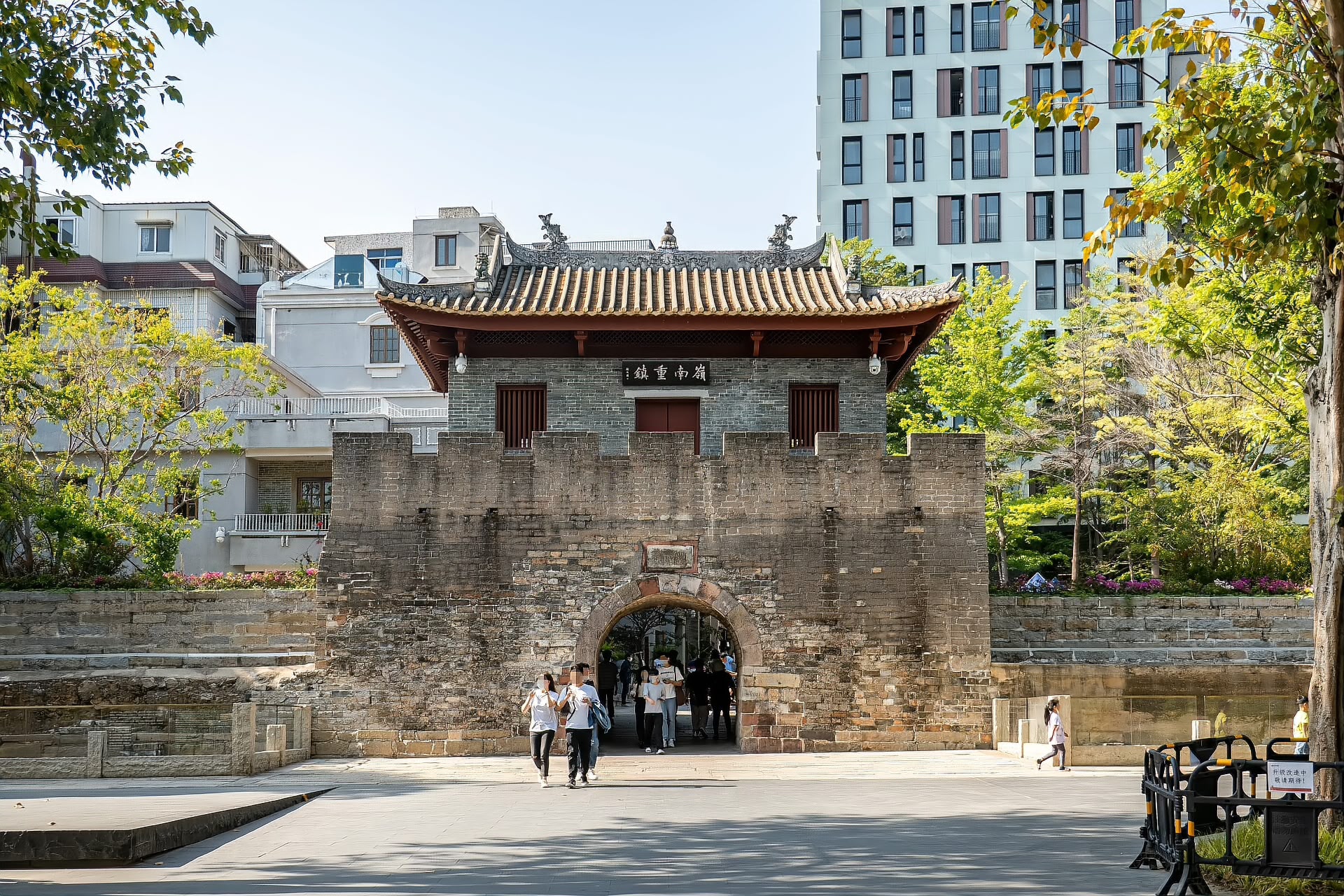
The south gate, with the board above it. Four characters: the heavy town of the south. They were written around three hundred years after the wall they sit on.
This one is easier if you know four pieces of vocabulary, because half the interest here is in names that changed and names that stayed.
南头古城 Nántóu Gǔchéng — Nantou Old Town; also signed locally as 新安故城, the old city of Xin'an
宝安 Bǎo'ān — Bao'an, the county created here in 331 and still a district name across the border
新安 Xīn'ān — Xin'an, the county that replaced Bao'an in 1573
岭南重镇 Lǐngnán Zhòngzhèn — the four characters over the south gate
东莞会馆 Dōngguǎn Huìguǎn — the Dongguan guild hall of 1868
信国公文氏祠 Xìnguó Gōng Wénshì Cí — the Wen ancestral hall to Wen Tianxiang
报德祠 Bàodé Cí — the shrine for repaying virtue
For a driver or a metro enquiry, the station is 南头古城站 (Nantou Ancient City, Line 12). Nine lanes were once named inside the wall — recorded in romanisation as Xianqian, Xianning, Yongying, Juxiu, Heyang, Yingen, Wutong, Pailou and Xinjie — and several of the names are still on the signs.
An office for salt
The story begins with something ordinary. Under the Han, this coast was one of the twenty-eight salt districts of the empire, and the officer in charge of it held the title of salt commandant of Panyu, stationed where Nantou stands today. Salt made itself out of seawater in a place with no other obvious wealth, and somebody had to tax it. In 265, during the Three Kingdoms, the post got a fortified compound known as Wucheng; the commandant held the sixth rank, roughly the standing of a county magistrate, which tells you what the salt here was worth.
The real beginning came in 331, the sixth year of the Xianhe reign of the Eastern Jin. The court split the old Nanhai commandery in two and created Dongguan commandery out of its southern and eastern parts with six counties under it — Bao'an first, then Anhuai, Xingning, Haifeng, Haian and Xinle. Both the commandery seat and the seat of its leading county were set at Nantou. Bao'an at that point covered what is now Shenzhen, the whole of Hong Kong, Dongguan, southern Panyu, Zhongshan, Zhuhai and Macau. A salt-tax office had become the capital of a province-sized district, and it stayed that way, on and off, for a thousand years.
From a county seat to a garrison
The Tang changed the job rather than the address. In 736 an army post, the Tumen garrison, was set up to guard the sea road into the Pearl River, and Nantou became a military port instead of an administrative capital. The post reported to the Annan protectorate, a long way from Guangdong, which says something about how the Tang read this water: the sea lane past Nantou was the road to the south, and whoever held the neck of land at the mouth of the river could open it, close it, or charge for it. That is what the four characters over the gate are describing. In 757 Bao'an was renamed Dongguan and the county seat moved north to the present city of Dongguan, taking the delta's centre of gravity with it.
The Ming brought the wall back into use. A coastal defence battalion — the Dongguan garrison of a thousand households — was established in 1381, and in 1394 an officer of the Guangzhou Left Guard named Cui Hao built the walled town that still gives Nantou its shape. A 1984 survey measured it as an irregular rectangle, about 680 metres east to west at its widest and 500 metres north to south, roughly seven hectares inside the rampart, with a moat. In 1573 the court divided Dongguan county again and created Xin'an, a name built out of a phrase meaning cast off the old and bring forth the new, turn danger into safety. For the next three hundred and eighty years the orders for Shenzhen and Hong Kong were written from inside Cui Hao's wall.
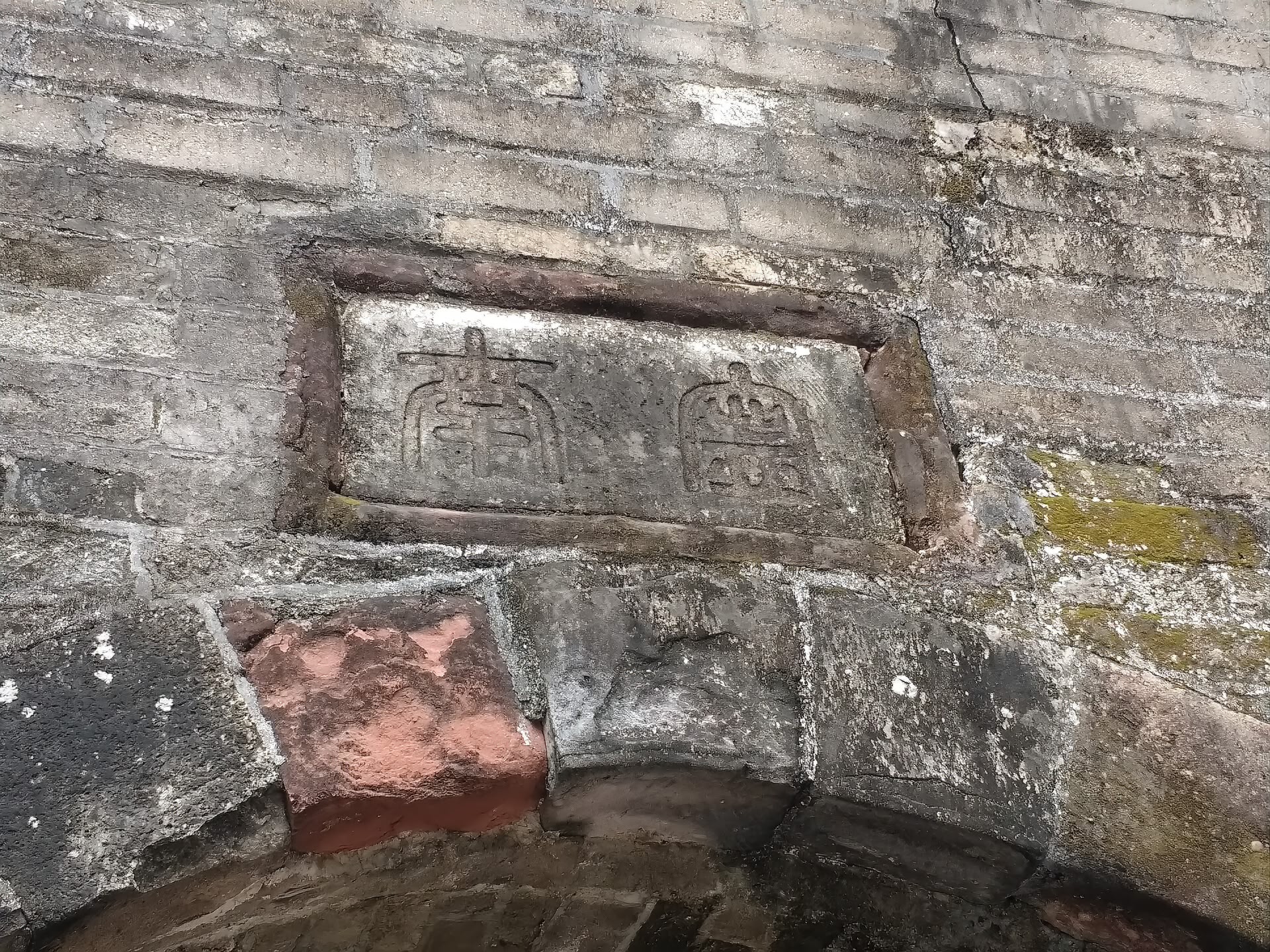
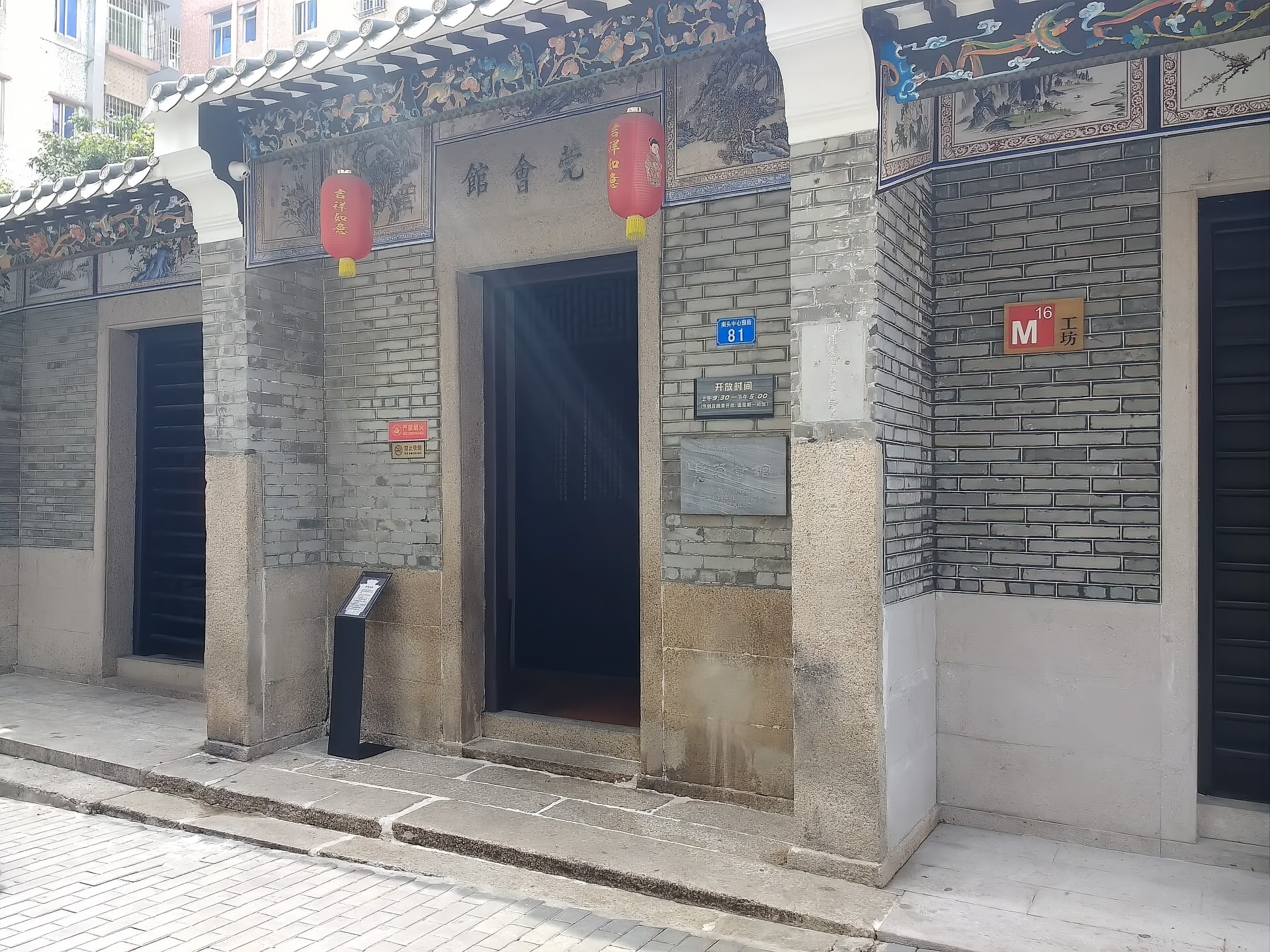
The empty coast
The worst thing that happened here was ordered from Beijing. In 1661 the Shunzhi emperor commanded that everyone living on the southeastern coast move fifty li inland, to cut the supply lines of the Ming loyalists and the pirates who traded with them. Local accounts describe families walked off their land at short notice with the houses behind them burnt, so there would be nothing to come back to. In 1666 the county was abolished outright and folded into Dongguan. For three years there was no Xin'an county to appeal to.
Two men argued against it. Wang Lairen, the governor of Guangdong, and Zhou Youde, the governor general of Guangdong and Guangxi, both petitioned the throne on behalf of people they would never meet. In the first month of 1669 the evacuation order was lifted; in the eighth month of the same year Xin'an county was restored. The town built them a shrine, put up in the Qianlong reign and first called the Governors' Shrine, later the Baode shrine — the shrine for repaying virtue. There is a street in Sheung Shui, on the other side of the border this county once administered, that carries the same name for the same reason, and still does.
The county that kept losing territory
The nineteenth century took Xin'an apart piecemeal: Hong Kong Island in 1842 after the Opium War, Kowloon in 1860, the New Territories on lease in 1898. The yamen inside the wall watched its own map shrink, and became the place from which a series of losing arguments were conducted. What survives of that period is commercial rather than official. The Dongguan guild hall on South Street, built in 1868 by merchants who used Nantou as their base on the coastal trade, stands for the town's other life as a junction where cargo and credit met, a long way from the business of running an empire.
The largest old building inside the wall is a different kind of monument. The Xinguo Wen ancestral hall was built in the Jiaqing reign for Wen Tianxiang, the Song loyalist executed in 1283 rather than serve the Mongols, remembered under the title Duke Xinguo. The Shenzhen Wen families call him their great-uncle of the first generation and trace their line to his brother Wen Bi, an official of Huizhou. The hall covers about 330 square metres — three halls across three bays, eleven metres wide and more than thirty deep — and although rebuilt in 2005 it is the biggest Ming and Qing structure left in the town. A hundred metres from the south gate, a smaller temple to Guan Yu was first built in 1612 and rebuilt in 1988.
In 1938 Japanese troops took Shenzhen and garrisoned Nantou heavily, leaving three concrete bunkers: two on the slope of Yingge Hill and one by the east gate, each about seven metres across. In 1949 the new Bao'an county government set itself up inside the old wall, which made Nantou a county capital for one more turn. In 1953 the county offices moved to Shenzhen market, the cluster of streets around Caiwuwei that became the city's core, and Nantou was left with its history and nothing to do.
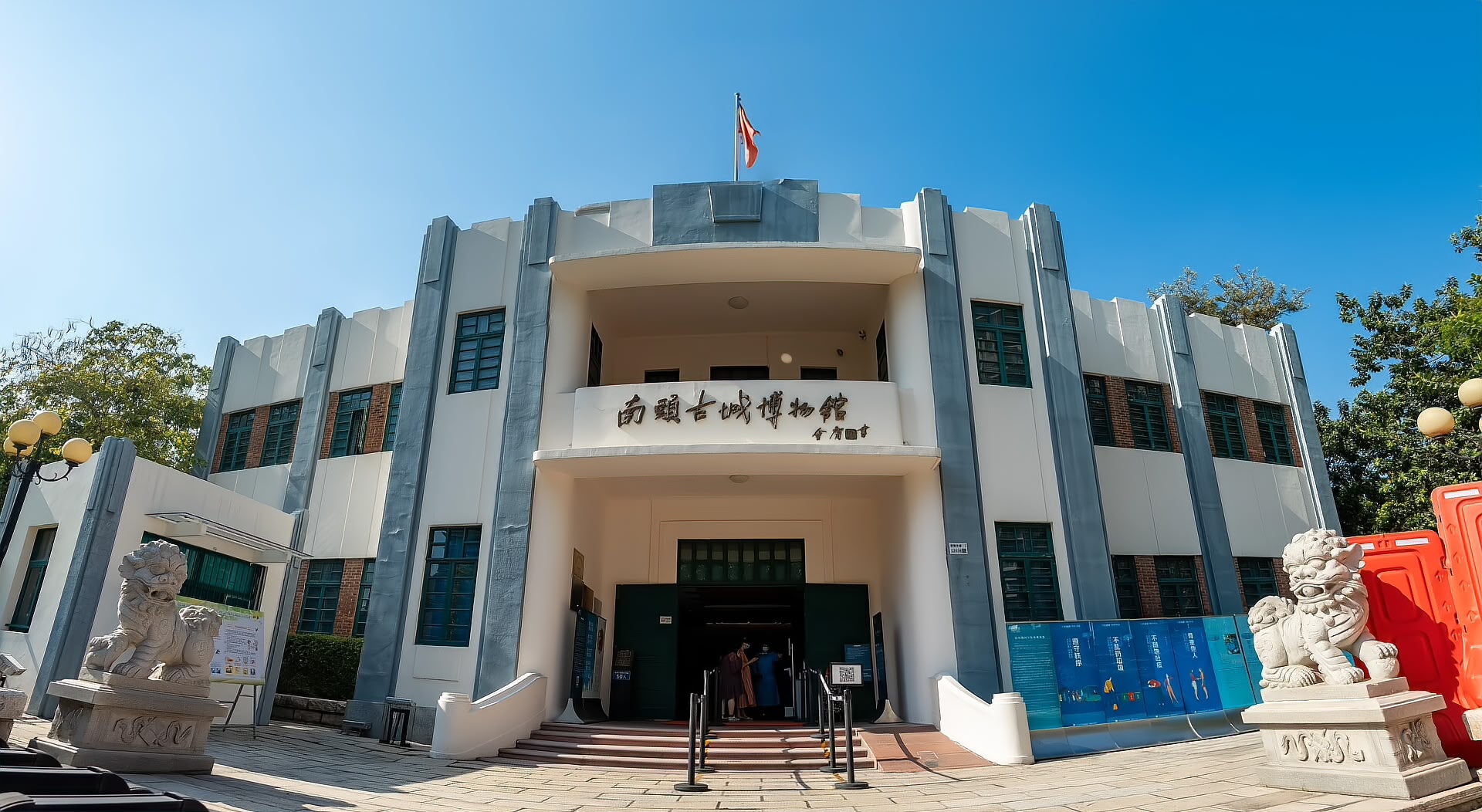
The village inside the wall
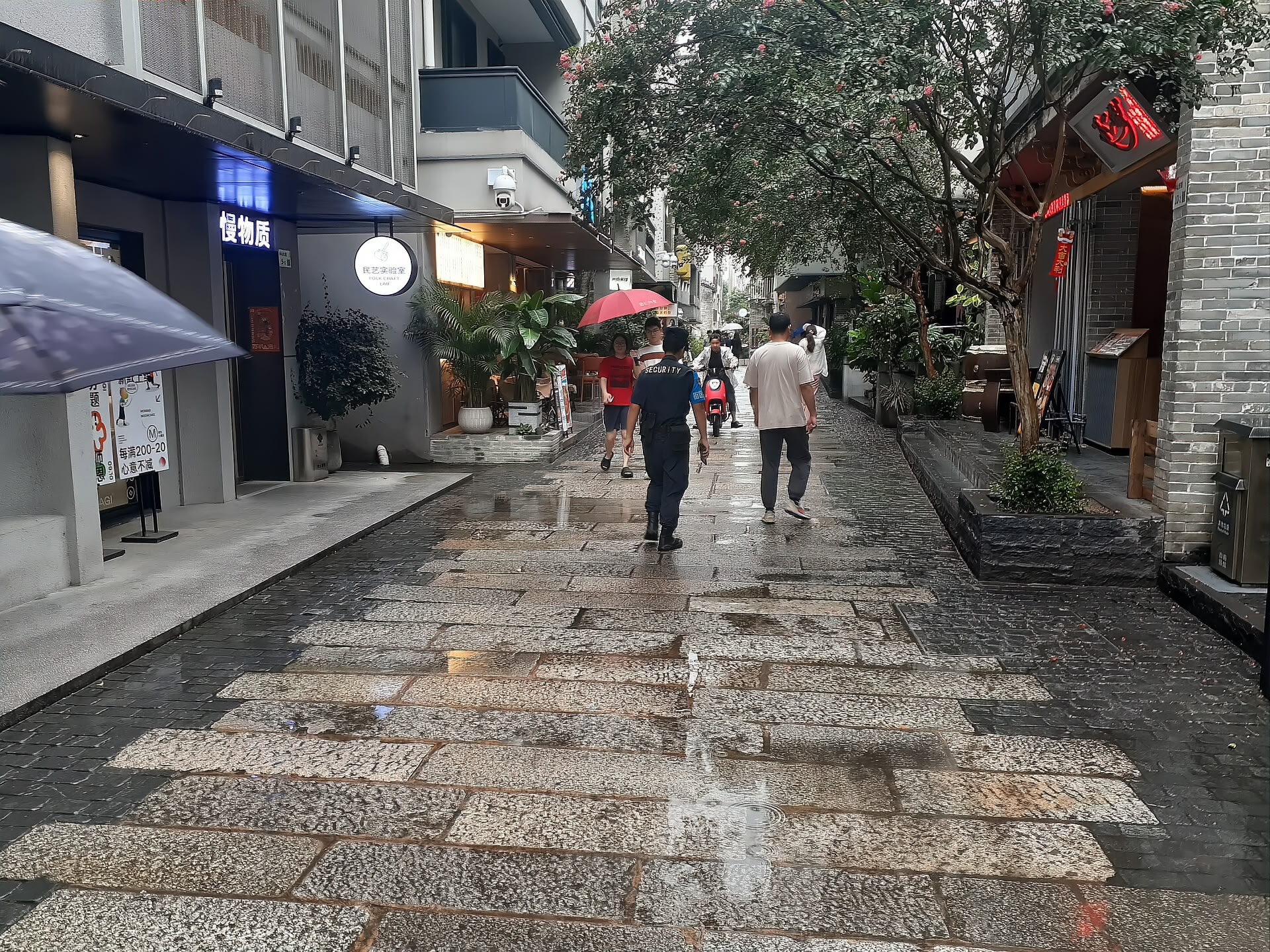
Then the city arrived from the other direction. Shenzhen grew around the wall faster than anyone planned for, and the space inside filled with handshake buildings let floor by floor to migrants. By 2015 there were 2,421 registered residents and 21,574 people living there without registration — most of them Cantonese-speaking families of the older stock plus tens of thousands of newer arrivals. Cables crossed the alleys, advertising was pasted onto the Ming rampart, and the gutters ran with whatever the day had produced. In 2001 archaeologists opened the moat and found a defence work more than seventeen hundred years old underneath the modern mess, one layer down.
The village's own record counts thirty-nine traditional houses still standing, and describes the older families as Cantonese, speaking a local Yue dialect called Nantouhua. Two thousand registered residents against more than twenty thousand who are not is the arithmetic of a Shenzhen village, and nobody bothered to explain it.
The biennale and the sugar shop
The turn came from an exhibition. The 2017 Shenzhen and Hong Kong biennale of urbanism and architecture was curated on the theme of urban coexistence, and its organisers chose Nantou as the venue: a village with a Ming street plan, a high density of cheap housing, and enough willing owners to make a project possible. For a few months artists and architects worked inside the alleys, and the city noticed the place existed.
In March 2019 the district set up a protection and reuse programme under the formula of government leads, company implements, villagers participate. Work started on 18 October 2019 under the developer Vanke, and the method was explicitly not demolition. Buildings were leased rather than bought — about 299 of them — and the leasing took a year because almost every building turned out to have two or three people with a claim on it: siblings who disagreed about ownership, divorces that never settled the title, elderly owners who would not leave the house their family had lived in for generations. More than six hundred contracts were signed. One project manager described the team as having become a family mediation service.
On 26 August 2020, the fortieth anniversary of the Shenzhen Special Economic Zone, the first 330 metres of the north–south demonstration street opened. Roughly thirty thousand square metres of illegal structures came down and more than twenty protected buildings were repaired, including the guild hall and the site of the county yamen. The street grid — six lanes north to south and one east to west — was kept as it was. A Dutch practice glazed a dead garment factory on the north-east corner and planted bamboo on its roof; a Shanghai practice wrapped a former dormitory in a screen, added a metal storey on top and turned it into a hotel. A digital hall reconstructs the market of 1820 with projected images, and a gallery on the Pearl River delta runs under the name shared origin.
One shop stayed put. Nine Streets Sugar has sold sweet soup on the main street since 1995, and it was the only original business not moved to a back alley when the frontage was re-let. Its taro balls are still rolled by hand — one worker makes about fifteen kilos a day, which is not enough for a weekend.
What the wall is now
The rampart itself is a provincial protected site, listed in the fourth batch as a Ming city wall. The count of protected things inside runs to one provincial site, five municipal ones, ten protected structures and thirty-four historic buildings, among a thousand-odd buildings in all. The moat, the south gate, the guild hall, the shrine to the two governors, the Wen ancestral hall and the site of the yamen are all still where they were.
What changed is who comes. The town is on the national list of tourism and leisure blocks, it is one of Shenzhen's ten characteristic cultural streets, and it receives more than thirteen million visits a year. Rooms that let for a thousand to fifteen hundred a month before the work now go for more than three thousand with bathrooms put in, and occupancy sits above ninety per cent. Some of the residents who once wanted the place knocked down now run shops on the lanes behind the main street.
The town calls itself the root of Shenzhen and Hong Kong history, and the claim holds up: the county that governed both was run from inside this wall for three hundred and eighty years, and before that there was a commandery here for more than four hundred. The catch is that almost everything standing above ground is younger than the claim. The rampart is Ming, the guild hall is 1868, the shrine is Qianlong, and the oldest thing excavation has turned up is the moat, which is a ditch. More than thirteen million visits a year now come through seven hectares of walled town. On a public holiday the alley between the south gate and the main street is shoulder to shoulder, and the queue at the sweet soup shop does not stop.
Going, and what to expect
Getting there. Metro Line 12 to Nantou Ancient City station (南头古城站), Exit C, then about 800 metres on foot to the south gate; Zhongshan Park station (中山公园站) on the same line, Exit D, is roughly an eight-minute walk. Several city buses stop at the old town's own stops on Shennan Road.
Tickets and hours. The streets are free and open all day, which is the way most people see it — including after dark, when the cafés are still trading. The small museums and exhibition rooms are free too, but they keep short daytime hours, given as 10:00 to 17:00 in one 2026 visitor listing and 9:30 to 17:00 in another, and they close on Mondays with public holidays excepted. The 1820 digital hall keeps longer hours — Tuesday to Friday 10:00 to 20:00 and weekends to 20:30. If you specifically want the inside of a building rather than the streets, go on a weekday afternoon.
How long, and when. Two to three hours at a walking pace; half a day if you sit down in it. Late afternoon on a weekday is the sweet spot — the light is better and the crowd thinner. Wear flat shoes: the paving is uneven stone.
Honest notes. The dates here follow the place's own reckoning. Sources count the age of the town from 331 and get about seventeen hundred years, though press accounts say sixteen hundred and some say a thousand, depending on the starting point; the fortified camp of 265 is older still. The Ming garrison is dated two ways — the battalion established in 1381, the walled town built in 1394. Xin'an county is dated to 1573 in the gazetteer and the district record, and to 1572 in one newspaper account, which appears to be a slip. The 1984 survey measured the walled rectangle at 680 by 500 metres, about seven hectares, while later accounts quote forty hectares including the village outside the wall. Accounts disagree about when the developer came in — some say it carried out the work from 2019, others 2021. And the figure of thirteen million visits a year comes from a 2025 municipal account, reported as given rather than audited.
Come in through the south gate, stand under the board, then walk the main street slowly and take the first lane that looks too narrow. Look for three things in this order: the guild hall, the shrine to the two governors, and the Wen ancestral hall. Then find the sweet soup shop, because it is the one business that was already here when the architects arrived.
Photographs and sources
Photographs from Wikimedia Commons, used under their Creative Commons licences and enhanced for this page: the south gate, the four characters above it, the Dongguan guild hall, the old town museum and the lanes inside the wall (CC BY-SA 4.0; CC0). History drawn from the Nantou Old Town editorial source file, cross-checked against 2026 visitor listings for the hours, prices and metro approaches, and against the municipal protection record usually cited for the counts of protected buildings. Where the records disagree — the town's age, the 1573 or 1572 founding of Xin'an, the area inside the wall, the year the developer began work, the museum hours — both versions are given rather than resolved.
There's more where this came from.
Read the latest insider notes →Two new posts a week — the things a non-resident can't know, written down before they cost you a morning.
Near it: Lianhuashan Park · Gankeng Old Town. Elsewhere in Guangdong: Guangzhou · Foshan · Chao Zhou · Jiang Men and the diaolou