Shenzhen (深圳)
Shenzhen is four decades old as a city and forty-five years old as an idea. It is also the place where the government of this coast sat from 331, where a Song-dynasty grave sits on the hill above the central business district, and where a Hakka village kept its own houses and rented out the shopfronts. The three are an hour apart on the metro, all free, and almost every visitor misses them.
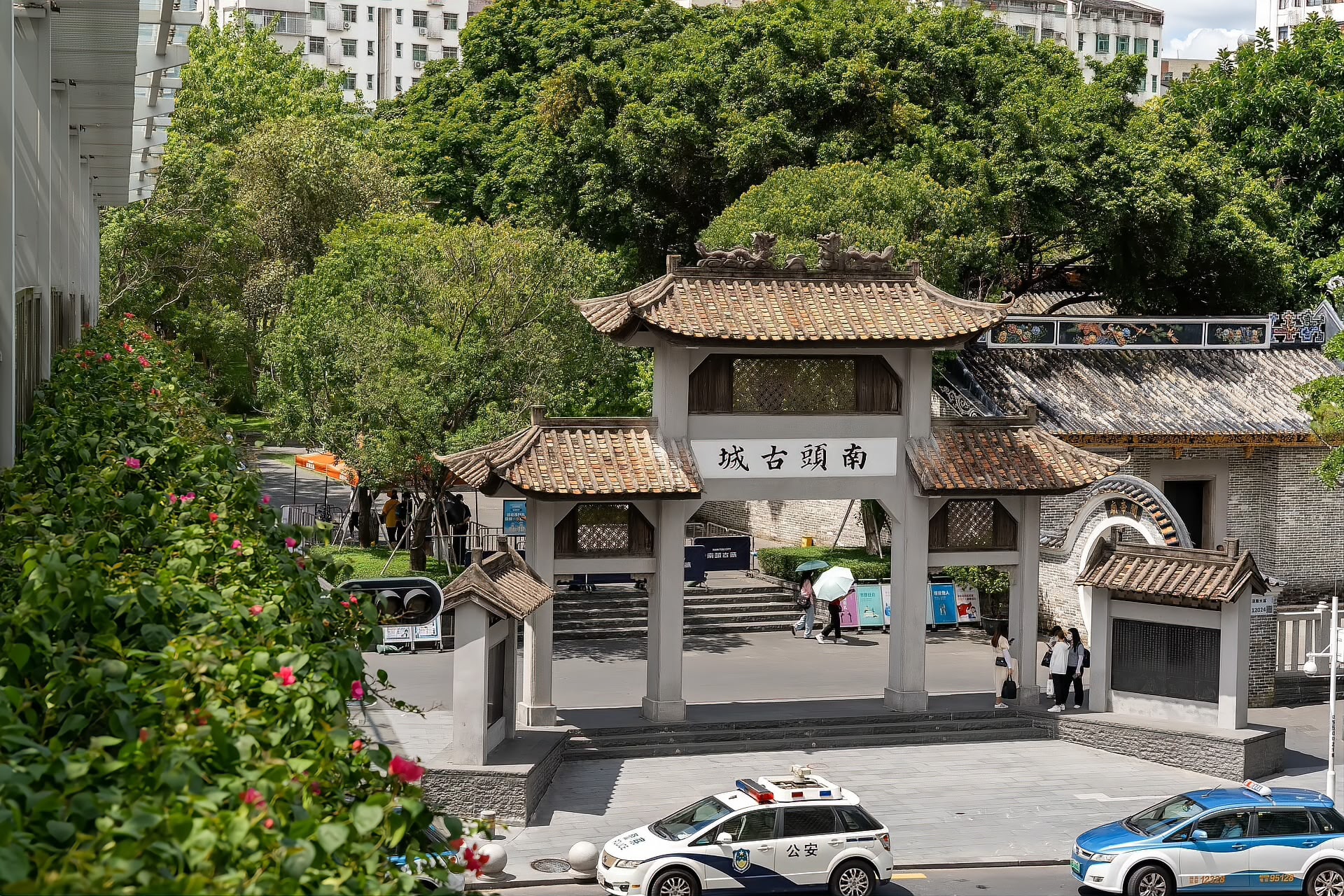
The gate, and what grew behind it. Nantou Old Town in Nanshan kept its street plan because nobody could agree on who owned the buildings. The towers went up around it.
Shenzhen works better with a handful of characters on your phone than with English, because the place you are going to is often called by a gate name or a district rather than by its tourist title. These are the ones worth saving:
深圳 Shēnzhèn — the city
南头古城 Nántóu Gǔchéng — Nantou Old Town, in Nanshan 南山区
莲花山公园 Liánhuāshān Gōngyuán — Lianhuashan Park, in Futian 福田区
甘坑古镇 Gānkēng Gǔzhèn — Gankeng Old Town, in Longgang 龙岗区
邓小平 Dèng Xiǎopíng — the name on the bronze man on the hill, and the name people say when they point at him
For the metro, ask for the station rather than the attraction: 南头古城站 (Nantou Ancient City, Line 12), 少年宫站 (Children's Palace, Lines 3 and 4, for the park's south gate), 甘坑站 (Gankeng, Line 10). Taxi drivers know all three.
A city that arrived twice
Shenzhen is described as the city that came from nothing, and the description is half right. The towers are young, the street grid is new, and a large share of what looks old in this city was built in the last thirty years. What gets missed is that this coast had been governed, garrisoned, taxed and emptied long before 1979 — and that three places inside the modern city still carry that earlier history in the ground.
The oldest of them is Nantou, in the west. A Han salt-tax office stood here; in 331 the Eastern Jin court split the old Nanhai commandery and set its southern half here, with Bao'an county around it, covering what is now Shenzhen, Hong Kong, Dongguan, part of Panyu, Zhongshan, Zhuhai and Macau. Xin'an county sat inside the Ming wall from 1573 until 1953. Treaties took Hong Kong Island in 1842, Kowloon in 1860 and the New Territories on lease in 1898, and the county yamen inside the wall watched its own map shrink.
The second is a hill. Lianhuashan Park in Futian is barely a hundred metres high, and it is the reason a central business district ends in grass rather than in a tower. It also holds the oldest dated object in Futian district — a Southern Song tomb around 1248, faced north against local habit, with a hexagonal granite stupa set into the chamber — and the most consequential bronze figure in southern China, walking south toward the border.
The third is a valley. Gankeng, in the hills of Longgang, is a Hakka settlement of roughly three hundred and fifty years that spent two centuries sending bamboo hats down the coast, then spent the factory decades catching fire, then decided to lease its own houses to itself rather than sell them. It is the clearest example in the city of what a village gets to keep when it negotiates from ownership instead of being bought out.
The three places
Getting here, and getting around
From Guangzhou. High-speed trains run from Guangzhou South to Shenzhen North, with the fastest journeys published at twenty-nine minutes. Some services continue to Futian rather than Shenzhen North, which is the stop you want for Lianhuashan Park. From the number of services on the Guangzhou–Shenzhen–Hong Kong line — the busiest high-speed corridor in the country by train frequency — tickets rarely need to be bought days ahead outside Friday evening and public holidays.
From Hong Kong. Futian to Hong Kong West Kowloon is fourteen minutes on the fastest train, and the West Kowloon terminal uses joint immigration clearance, so you clear mainland exit and Hong Kong entry in the same building. Add walking, ticketing and security at either end and a realistic door-to-door figure is closer to an hour and a half than to fourteen minutes.
Inside the city. Shenzhen's metro reaches all three places directly, and it is the fastest way to move anywhere in the city during the day. One recurring snag: at most interchange hubs you leave the railway station and queue again to be screened before entering the metro, so allow extra time when changing from intercity rail.
How long. Nantou wants three to four hours. Lianhuashan Park is ninety minutes to two hours including the climb. Gankeng is a leisurely half-day and best late in the day, when the lights come on. Nantou and Lianhuashan fit comfortably into one day; Gankeng is in the opposite corner of the city and deserves its own afternoon.
All three places are free to enter. Two of them — Nantou and Gankeng — are working neighbourhoods or commercial operations rather than museums, so "opening hours" describe businesses and small exhibition rooms rather than the site. The ages quoted here are the ones the places themselves use, and they count from different starting points: Nantou's seventeen hundred years date from 331, when the commandery was seated there, while its own salt office is earlier.
Shenzhen is a large city and these three sites sit far apart. Pairing all three in a single day means three long cross-city metro rides; two in a day works well, three does not.
Photographs and sources
Photographs from Wikimedia Commons, used under their Creative Commons licences and enhanced for this page: the paifang at Nantou Old Town (CC BY-SA 4.0). History drawn from three editorial source files — the Nantou Old Town, Lianhuashan Park and Gankeng Old Town documents — cross-checked against the Shenzhen Museum's material on the 2001 moat excavation, published screenshots of the Xin'an county gazetteer's village register, and the transport figures published for the Guangzhou–Shenzhen–Hong Kong high-speed line. Where records disagree — the area of the park, the age of the village, the date the county was created — both versions are given rather than resolved.
There's more where this came from.
Read the latest insider notes →Two new posts a week — the things a non-resident can't know, written down before they cost you a morning.
More on the region: the Guangdong region guide · the Guangzhou city guide · Foshan · Chao Zhou · Jiang Men and the diaolou · Zhaoqing