Kaiping Diaolou (开平碉楼)
In the paddies southwest of Guangzhou stand more than eighteen hundred towers that belong to no single country: a Chinese base, a Roman dome, a Gothic gable, gun ports at the corners. The men who paid for them had crossed the ocean to dig and lay track, and came home with the money in their pockets and a foreign sky still in their eyes.
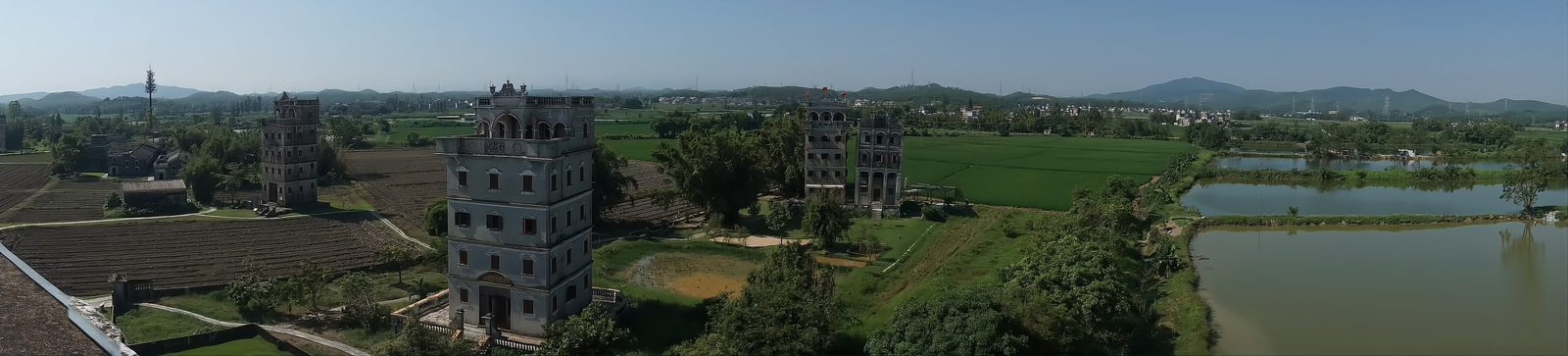
The Self-Reliance Village, from above. Towers over paddies and fish ponds, the plain running out to the hills — the view the builders had in mind.
Five storeys, nine, sometimes four; square below and fantastic above; capped with domes and spires lifted from a dozen cities the builders had never quite reached. Kaiping holds 1,833 of them, and every one is a story about leaving and coming back.
They are called diaolou — watch towers — but the name undersells them. They were banks, fortresses and family homes, and together they are the largest open-air museum of defensive architecture on earth. What makes them strange is that each one is several buildings at once. What makes them beautiful is that the several buildings come from different continents.
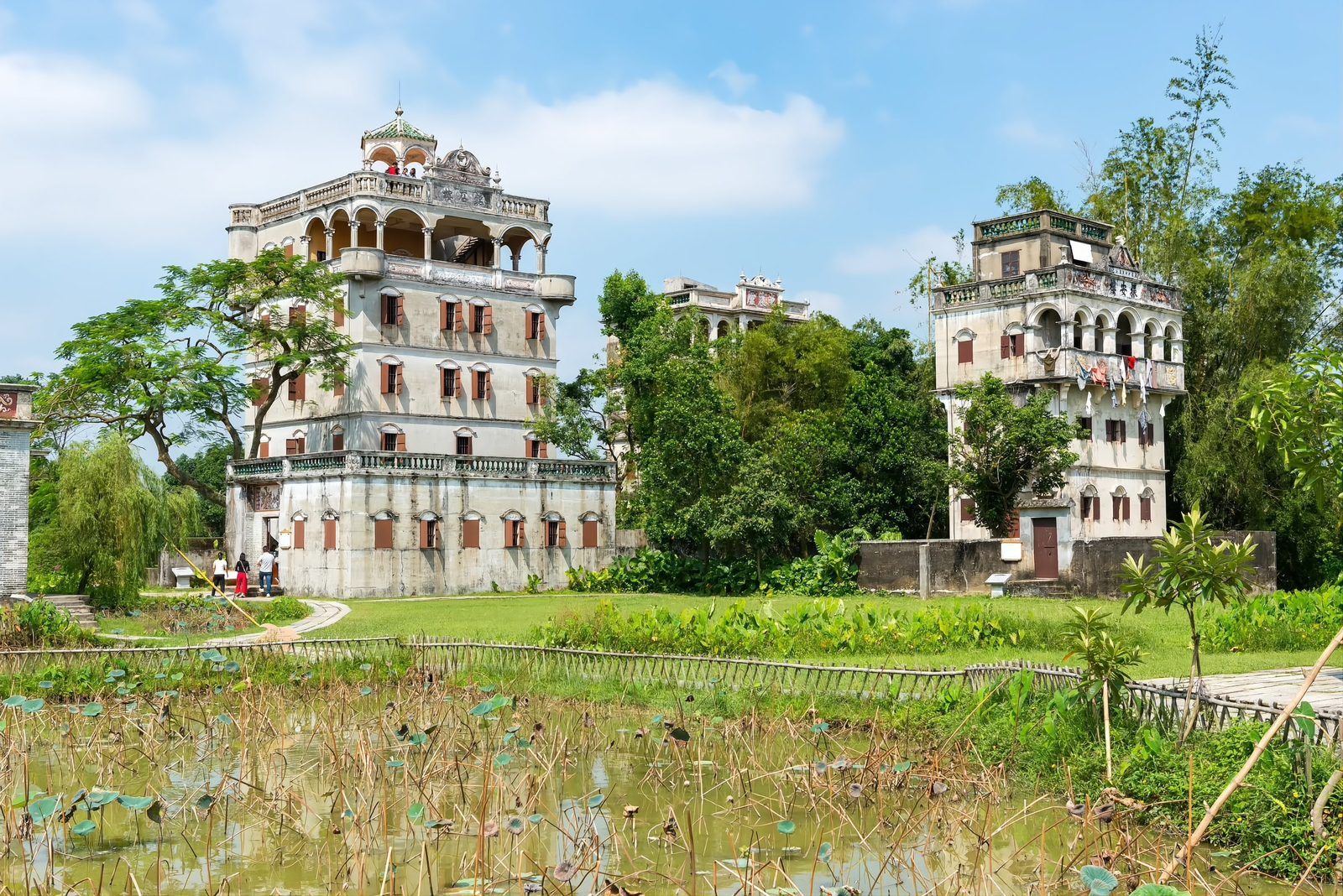
Two towers over the lotus pond. The grey-white of weathered plaster against an unbroken green — the towers were never meant to stand alone, but to watch over the fields.
A land that needed walls
Kaiping needed towers for three reasons, and none of them was vanity.
The first was water. The county sits on the alluvial plain of the Tan River, and when the typhoon rains came the fields drowned. The oldest tower still standing — the Welcoming Dragon Tower in the village of Three Gate Lane, raised in the Jiajing reign of the Ming, between 1522 and 1566 — was built first of all to give villagers a dry floor above the flood. The county records note that in the great floods of 1884 and 1908 the water rose above the rooftops, and the people who climbed the tower lived. One honest note: the Guangming Daily dates the same floods to 1883 and 1906, so both pairs are kept here.
The second reason was worse. Kaiping lay where four counties met — Xinhui, Taishan, Enping, Xinxing — and because it belonged to all of them it was guarded by none. It became a no man's land, and bandits thrived. Between 1912 and 1930 the county suffered seventy-one major raids; the county seat was taken three times, and once a magistrate was carried off. A local saying had it that one footprint draws three thieves — the men who came home with money were tracked from the moment they stepped off the boat.
The third reason was the money itself. The overseas Chinese had it, and they wanted to keep their families alive and their wealth safe. The towers answered all three needs at once: thick-walled, narrow-windowed, gun ports at every corner, and on the roof a watch platform with a searchlight, an alarm and a store of stones and gongs.
Three towers, three purposes
The towers split into three kinds, and you can read a village's history in which kind it built.
The watch tower — called the lamp tower when it carried a light — stood at the head or the tail of the village, sometimes on a low hill, and a hired watchman kept it through the night. The Fang family's Lamp Tower, built in 1920 by two villages together, rose five storeys of reinforced concrete and held a generator, a searchlight and firearms. In December 1922 it earned its keep: its light caught bandits carrying off pupils from the Kaiping First Primary School, and the alarm brought them down.
The communal tower was the democratic one. Ten or more households put in money together and built three to six storeys, with two to four rooms on every floor, so that when the bandits came or the river rose, whole families could climb in and wait. Owned by no single man.
The living tower was built by one returned emigrant for his own family, furnished with the comforts he had learned to like abroad. Between the wars the building reached its peak: more than three thousand towers stood across the county. Then the world changed, and the building stopped.
A world under one roof
At the ground you are in China. The base is the square plan and the brick and stone of a Lingnan village house, plain and serious. Lift your eyes and you leave the country. The tops wear Byzantine domes and Baroque scrolls, Greek and Roman colonnades, Gothic pointed arches and Islamic arches, all jostling on the same roofline as if a traveller had emptied his memory onto the skyline. Carved over the doors and columns you find both the dragon and phoenix of Chinese luck and the flowers and figures of the West, worked by local hands.
The materials came from everywhere too: German steel, British and Swedish cement, Italian tiles, Indonesian wood, carried in against the Chinese brick and timber the builders already had. And the defences were honest. The corners of many towers carry a swallow's nest — a little turret thrust out over the wall, with gun holes that rake the ground below. The towers were built to be closed up and held, and for decades that is exactly what they did.
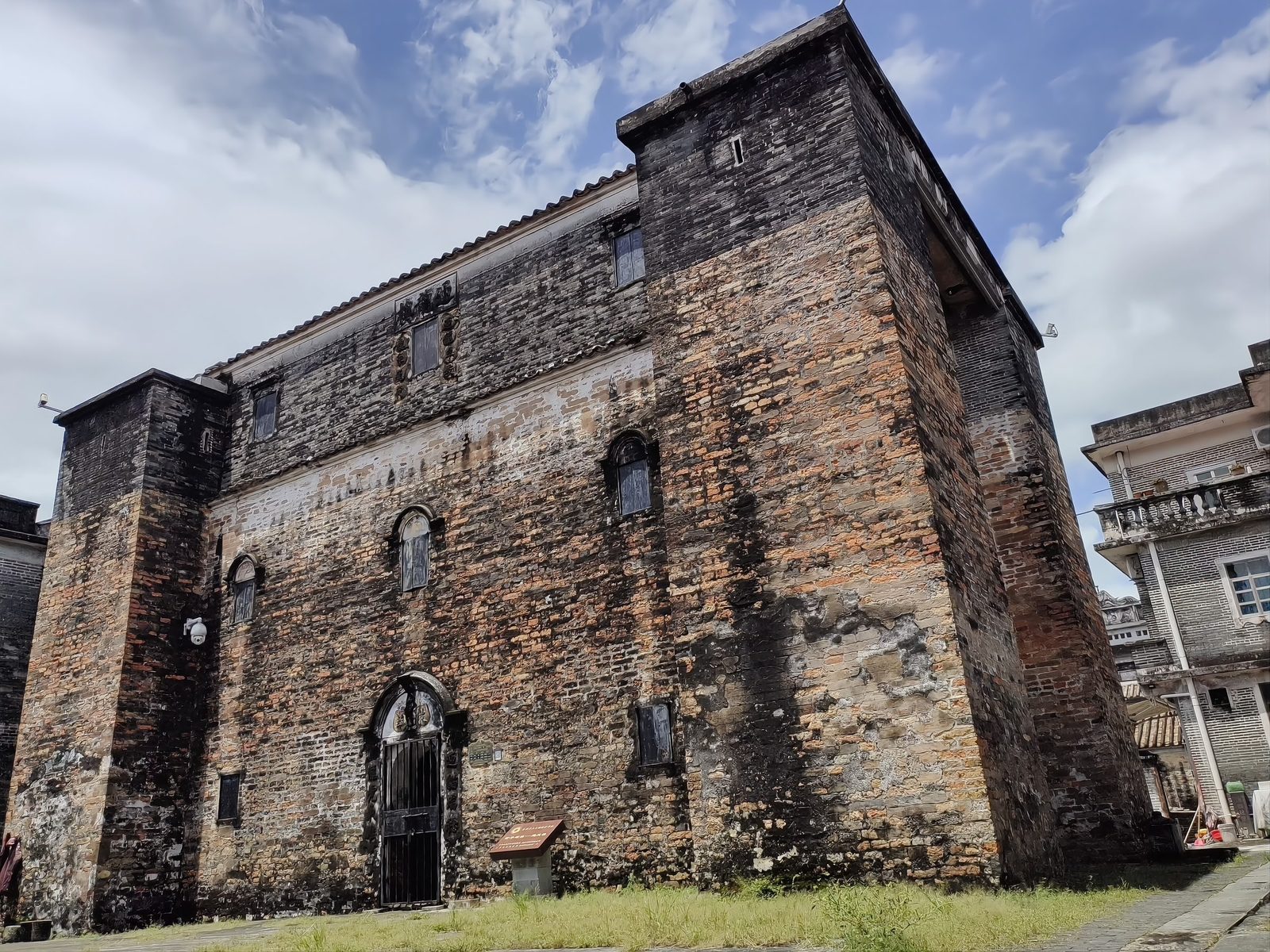
The oldest tower. The Welcoming Dragon Tower in Three Gate Lane, raised in the Ming Jiajing reign (1522–1566) — plain brick and stone, no foreign flourishes yet, built first of all to keep the flood out.
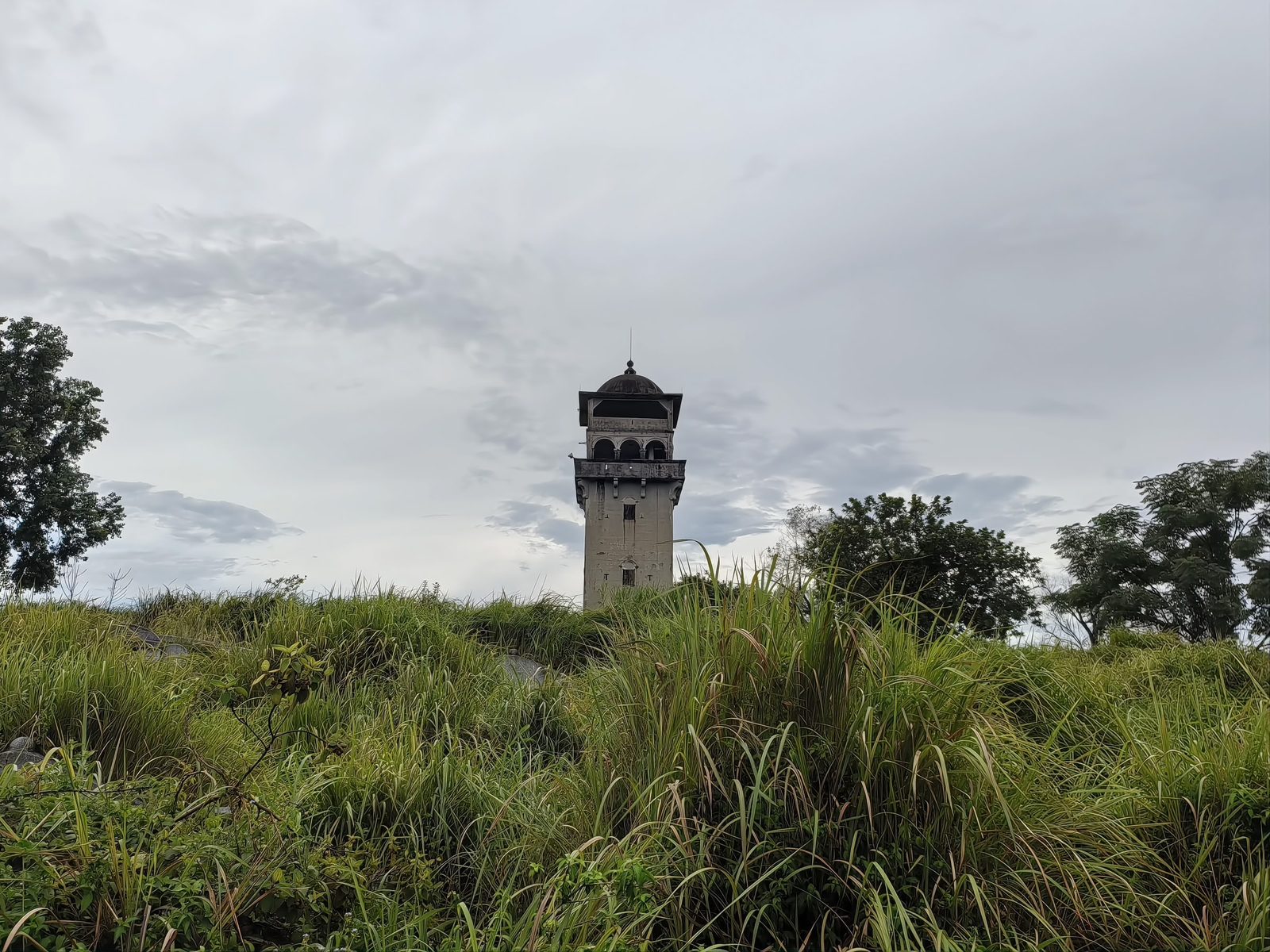
A lamp tower, unlit. The Fang family's tower, 1920: five storeys of reinforced concrete with a generator, a searchlight and firearms. Its light caught bandits carrying off school pupils in December 1922.
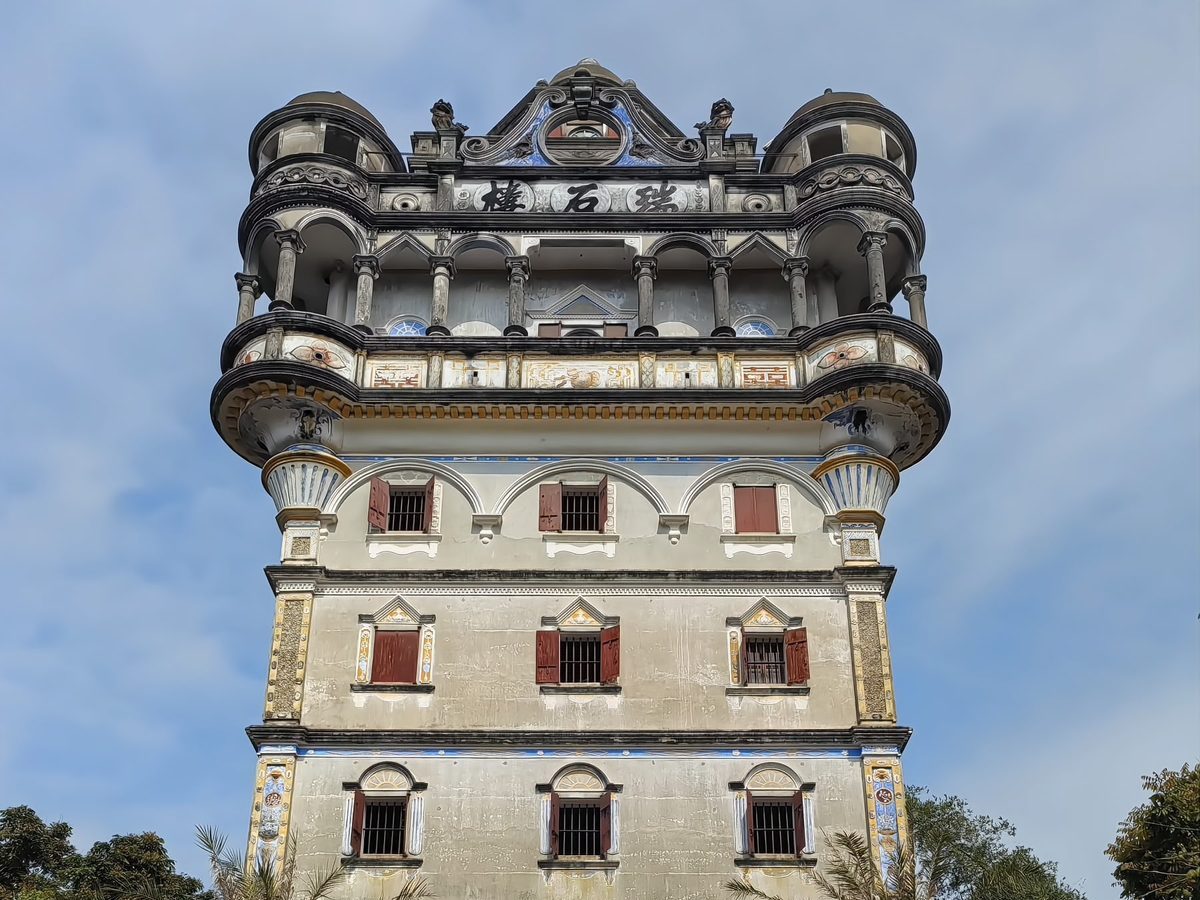
The First Tower of Kaiping. Ruishi Lou at Brocade River Lane — nine storeys, Roman arches and Ionic columns below a Baroque gable, paid for with Hong Kong dollars in 1921.
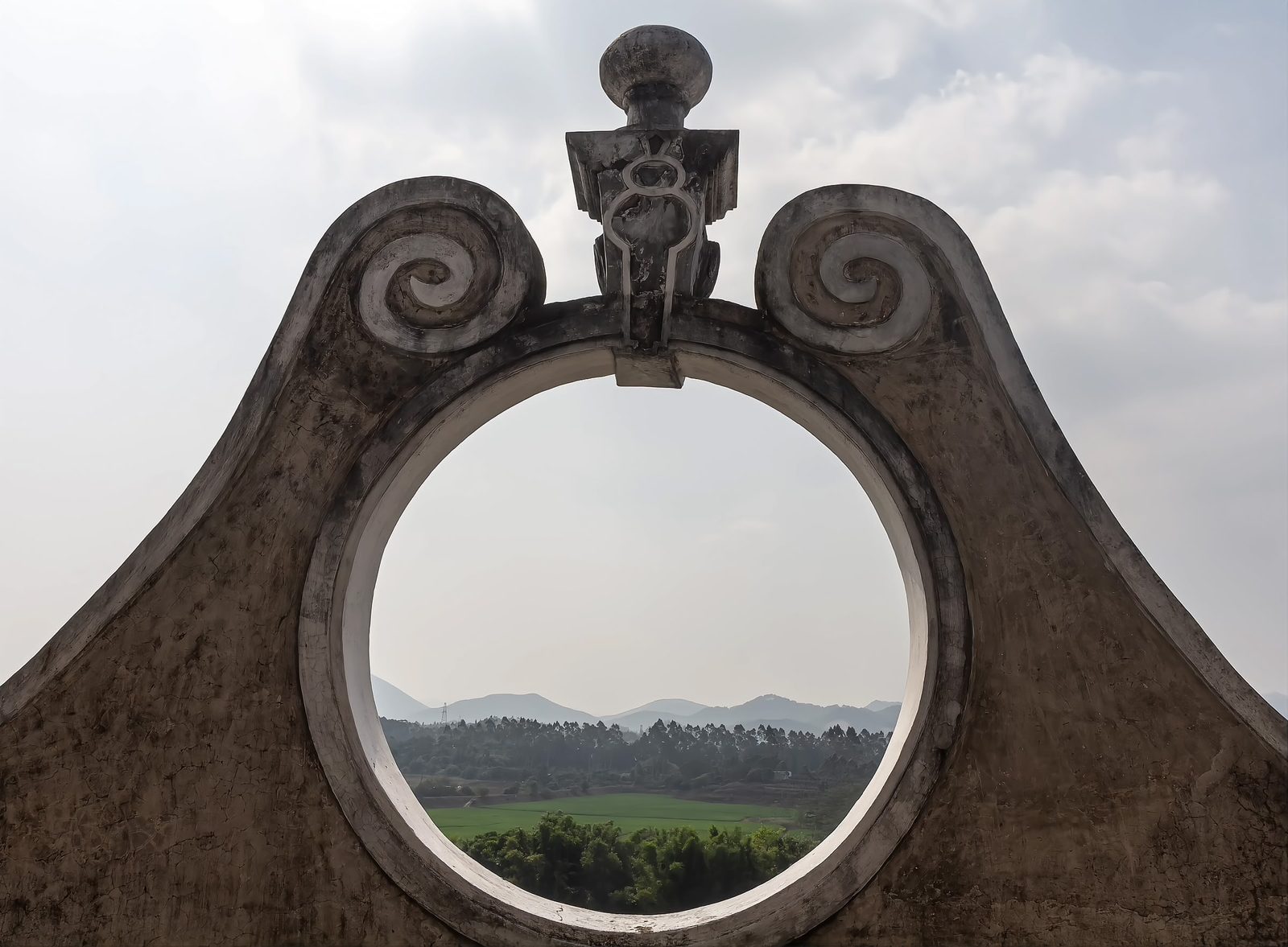
The view out. A round window at Jinjiangli, framing the plain and the hills — the argument a tower makes, held in one frame.
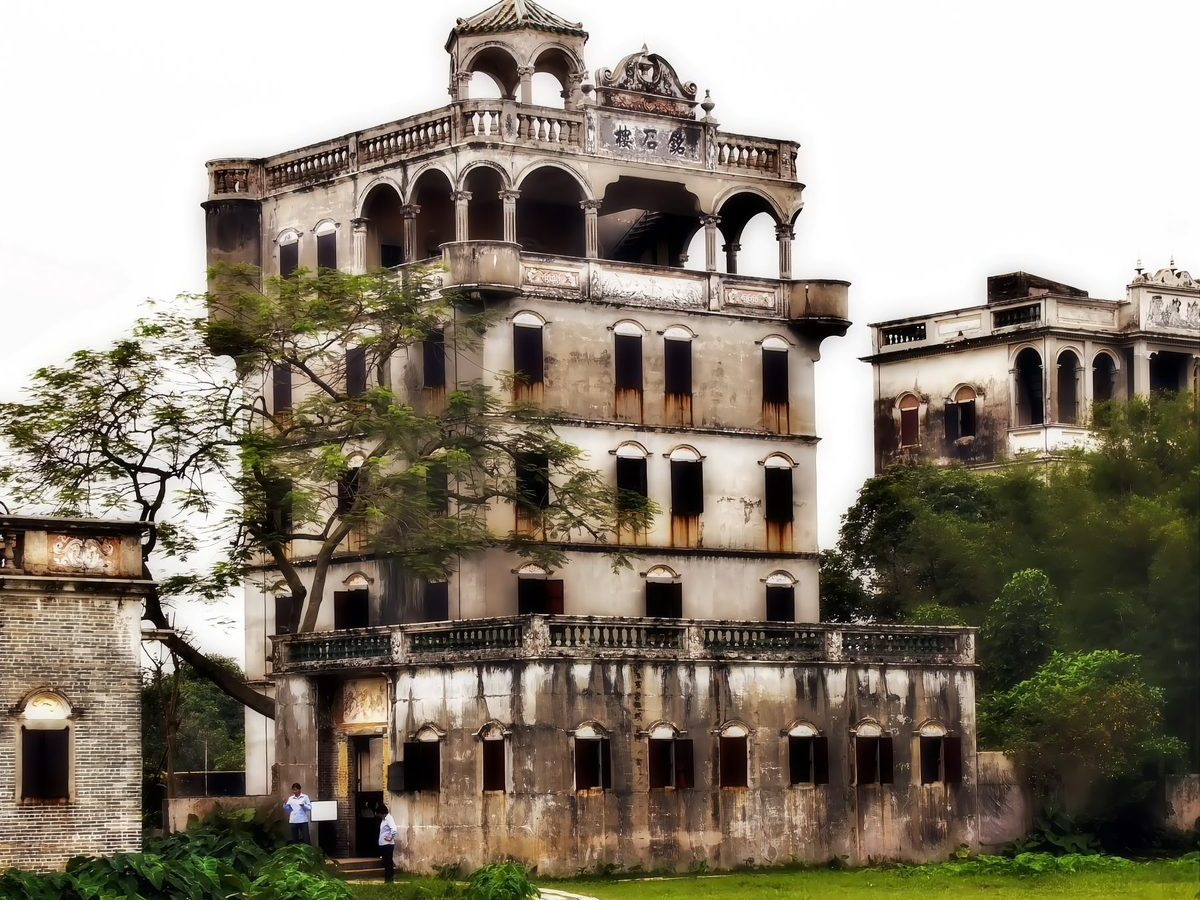
Mingshi Lou over the lotus pond. Built in 1925 by a man who had made his life in Chicago, and named for his father, who cut stone. Behind the German steel door: an Italian glass screen, a gramophone, a bathtub.
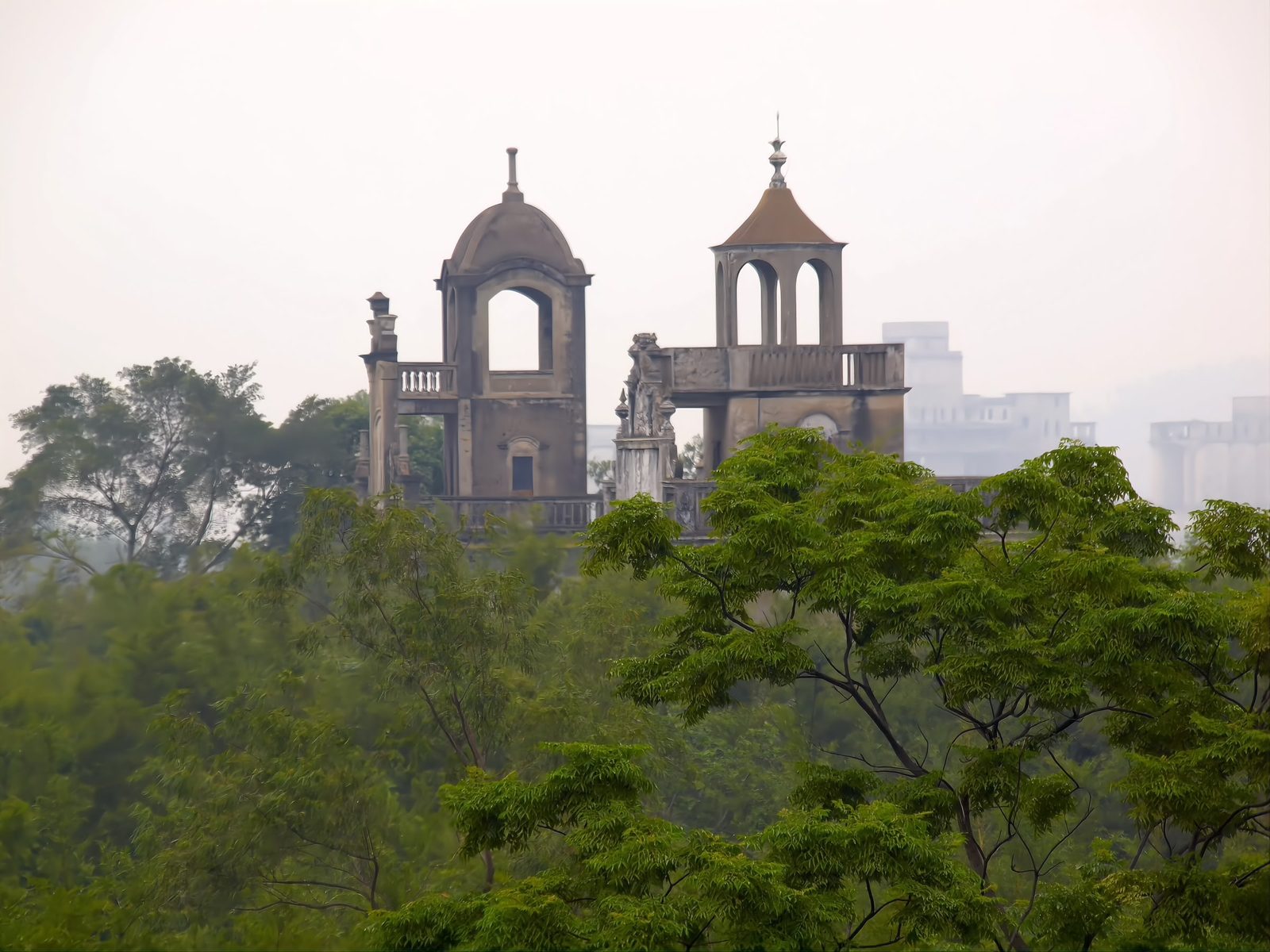
Majianglong, in the bamboo. Fifteen towers tucked into groves and stone paths across five small villages — the quietest of the four clusters, and the one that rewards walking slowly.
The tower that touched the clouds
The grandest of them all was built by a man who missed home. Huang Bixiu ran a herbal shop and a money house in Hong Kong, and in 1921 he went back to his native village of Brocade River Lane and put more than thirty thousand Hong Kong dollars into a tower. Three years of work later the result was the Jade Stone Tower — Ruishi Lou — nine storeys and about twenty-eight metres, the tallest and most decorated diaolou in Kaiping, known still as the First Tower of Kaiping. One honest note: the scenic area's own signs give the height as twenty-five metres, so both figures are kept here.
Its body carries the round arches of ancient Rome and the columns of the Ionic order, and above them a Baroque gable. But the Chinese hand is there too: the auspicious characters cut into its walls, and the name itself — Ruishi, jade stone — written in a scholar's steady hand.
A few kilometres away stands the Inscribed Stone Tower, Mingshi Lou, built in 1925 by Fang Runwen, a Kaiping man who had made his life in Chicago. He named it for his father, who had spent his own life cutting stone, and he filled it with the things he had grown used to: a glass screen from Italy, a German steel door, a hand-cranked gramophone, a bathtub, a toilet. In a corner sat the Gold Mountain trunks — the heavy cases the returned men used to carry their wealth, whose size and number were a man's standing made visible.
The villages that kept them
The towers are not scattered at random. Four village clusters hold the finest of them, and UNESCO named these four when it put Kaiping on the world map.
Three Gate Lane holds the Welcoming Dragon Tower, the oldest — the plain brick keep that began it all, still standing where the flood found it. The Self-Reliance Village holds fifteen towers among its paddy fields and banyan ponds, and its Inscribed Stone Tower is the tall one that shows the whole mixed mind of the builder. The Majianglong cluster tucks fifteen towers into bamboo groves and stone paths, a place travel writers call among the loveliest villages on earth. And Brocade River Lane holds just three, but one of them is the Jade Stone Tower itself.
Walk any of them and the layout is the same: low village houses, high towers, wide villas, set with room to breathe among rice, lotus ponds and river, the grey and white of weathered plaster against an unbroken green. The towers were never meant to stand alone. They were meant to watch over the fields, and they still do.
The silence, then the stamp
After 1949 the bandits were gone and the towers had no enemy left. Their owners' children had mostly gone abroad, and the towers were left to the damp and the termites. For half a century they stood empty, slowly softening, the watch platforms rusting, the searchlights dark.
Then the world looked again. On 28 June 2007, at the thirty-first session of the World Heritage Committee in Christchurch, New Zealand, Kaiping Diaolou and Villages was inscribed on the World Heritage List. It was China's thirty-fifth World Heritage site, the first in Guangdong, and the first anywhere to be listed for emigrant culture — the culture of people who left. The committee praised the towers as a rare and brilliant fusion of Chinese and Western building, raised by villagers who had gone out into the world and come home changed. Twenty of them, in the four groups, carry the inscription; the rest of the 1,833 stand outside it, in the fields.
The state had been protecting them longer than that: the State Council named the Kaiping diaolou a national protected site in 2001, and UNESCO's own citation notes how completely the towers survived — their life as fortified dwellings was short, and they were abandoned before anyone could modernise them out of recognition. A few years after the inscription a film called Let the Bullets Fly was shot among them — Mingshi Lou plays the gangster's mansion — and the strange, beautiful towers became known to millions who had never heard the name Kaiping.
"The towers were built to keep the danger out, and a century on they still do, now keeping the memory in."
The closing line of the editorial this page is built on — and the shortest summary of what the 2007 inscription actually protected.
What is there now
The towers of Kaiping are no longer defences. They are monuments, and they are alive.
One thousand eight hundred and thirty-three of them stand across the county: some kept as museums, some still owned by families whose forebears built them, some slowly returning to the earth they were raised from. You can walk the Self-Reliance Village at dawn when the mist is on the paddies, climb the Jade Stone Tower and look out over the village roofs, run your hand over the Italian tile and the Chinese carving in the same wall.
The men who built them are long dead, and most of their children live in other countries. But the towers keep the bargain they made: that a man who leaves can still come home, and that home can hold a little of everywhere he went. Kaiping is two places at once — one in Guangdong, one scattered across some sixty countries — and the towers are the line between them.
Walk the Self-Reliance Village: fifteen towers in one bowl of land, most of them enterable, and the Inscribed Stone Tower — the one from the film — in the middle of it. Go at opening, before the coaches.
Going, and what to expect
Getting there. High-speed trains run from Guangzhou South to Kaiping South in roughly forty-five minutes to an hour, from about ¥67; from Shenzhen North it is around eighty minutes. Kaiping South sits about ten kilometres from the town, and the tower clusters are ten to twenty minutes apart by road — the practical move is a base in Tangkou or Chikan with taxis between sites, or a car. Driving from Guangzhou is around 140 kilometres, an hour and a half to two. There is no airport in Kaiping; the nearest are Guangzhou Baiyun, about 150 kilometres away, and Zhuhai Jinwan, about 90.
Tickets and hours. The four scenic areas ticket separately: the Self-Reliance Village ¥78, Majianglong around ¥60, Brocade River Lane ¥50, Liyuan ¥100; climbing the Jade Stone Tower adds about ¥20. Nanlou is free. The five-point combination ticket (Liyuan, Self-Reliance, Majianglong, Brocade River Lane and Nanlou) runs ¥180 and lasts two days. Hours run from roughly half past eight or nine in the morning to five in the afternoon, shifting a little by site and season. Students, visitors over sixty and children pay half or less; several categories — serving military, disabled visitors, journalists, Kaiping residents over sixty — go free.
The moment to be there for. Dawn, or the last hour of light. The mist sits on the paddies early; the towers turn gold late. Midday is the worst of both — hard light and the coaches. Between March and April the canola is out, and from October the rice turns; the light those months is the reason photographers keep a Kaiping calendar.
Two honest notes. Some of the towers are private property even now — the ones with a family still attached are not yours to walk into, whatever the map says. And the scenic areas close for maintenance more often than the big parks do: the Self-Reliance Village has had short closures this year, so check the day's status before you set out. Everything above is right in shape and could be wrong in detail on the day you arrive.
Photographs and sources
Photographs from Wikimedia Commons, used under their Creative Commons licences and enhanced for this page: the Self-Reliance Village panorama (CC BY-SA 4.0, DragonSamYU), the towers over the lotus pond (CC BY 2.0, xiquinhosilva), the Welcoming Dragon Tower and the Fang lamp tower (CC BY-SA 4.0, Yumeto), the Jade Stone Tower (CC BY-SA 4.0, Yumeto), the round window at Jinjiangli (CC BY-SA 3.0, Stefan Fussan), and Mingshi Lou and Majianglong (CC BY 2.0, Kevin Poh). History drawn from the Kaiping editorial source file, cross-checked against the UNESCO World Heritage citation for Kaiping Diaolou and Villages (inscribed 28 June 2007; criteria ii, iii and iv; twenty towers in four groups) and against current Chinese ticketing and transport sources. Where the records disagree — the dates of the great floods (1884 and 1908 against 1883 and 1906), the height of the Jade Stone Tower (twenty-eight metres against twenty-five) — both figures are given rather than resolved.
There's more where this came from.
Read the latest insider notes →Two new posts a week — the things a non-resident can't know, written down before they cost you a morning.