The Ancestral Temple (祖庙)
A carpenter drove a wooden pile into the mud of a delta town in the 1080s, for a god who could hold back water. Nine centuries later the building had been a flood defence, the parliament of a city with no aristocrats, the stage Cantonese opera grew up on, and the school — in the way a street is a school — of the most filmed human being in cinema history. It is thirty minutes from Guangzhou, and it is the most important building in Foshan.
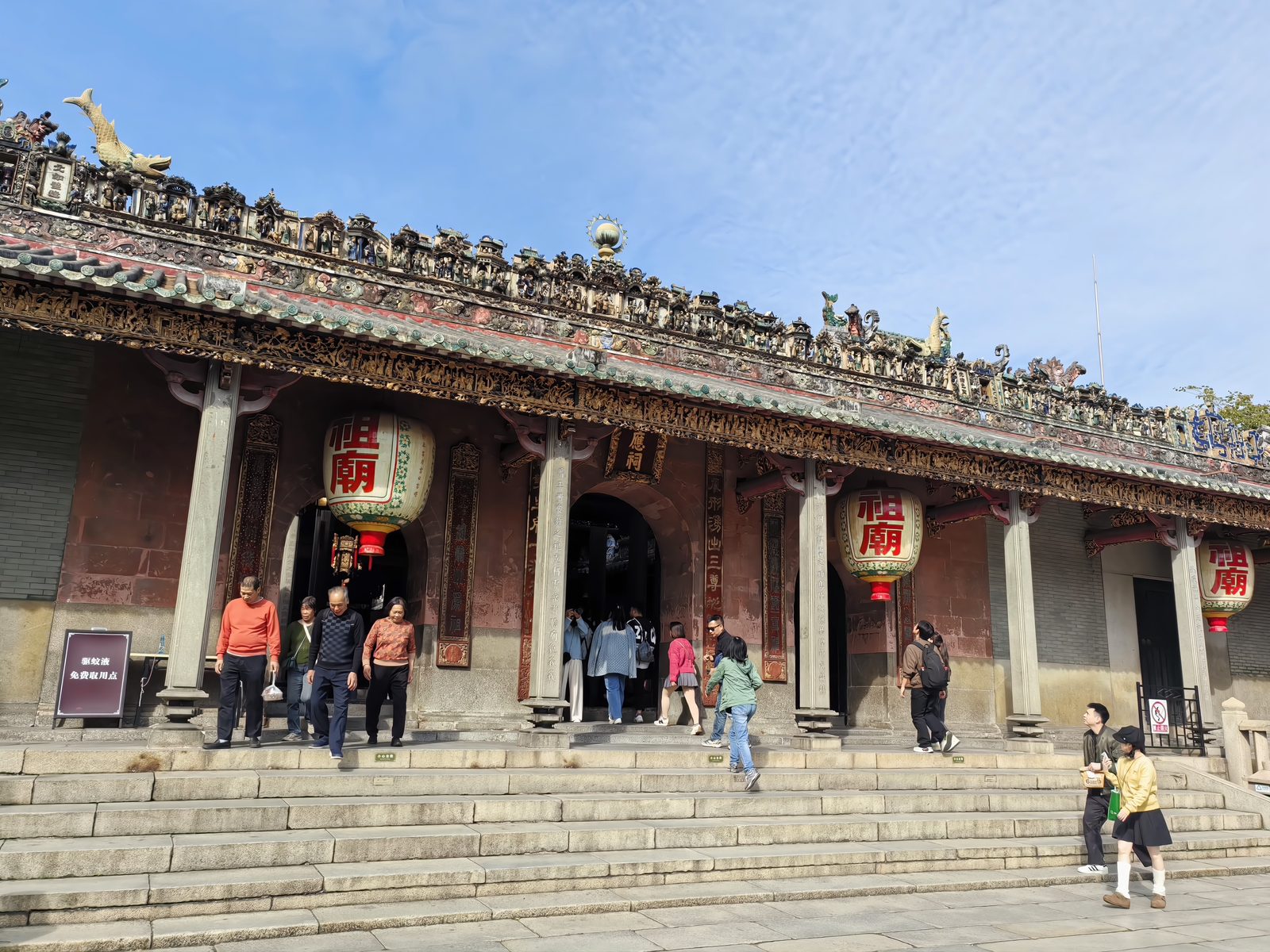
The Three Gates, with the ridge above. Three buildings' front doors joined into one facade in 1513 — and along the roof, three hundred ceramic people, standing in their rows looking out at nothing.
Before the gates open
There is a moment, before the gates open at half past eight, when the temple is only a building. The drums are in their case. The lion heads are stacked in the dark with their eyelids shut. The bronze god in the main hall has been sitting on his turtle-and-snake for five and a half centuries and is in no hurry. Then someone lights the incense, and the whole thing changes.
This is the Foshan Ancestral Temple — Zumiao — at 21 Zumiao Road in Chancheng, and it is the most important building in a city of nine million people. The records are careful about its age: the founding cannot be dated exactly, and the temple's own history gives the tradition — the Northern Song, the Yuanfeng reign, between 1078 and 1085, when a builder sank the first wooden pile into the mud of a Lingnan water town. The building was destroyed at the end of the Yuan and rebuilt in 1372, in the fifth year of Hongwu, and it has been rebuilt and expanded more than twenty times since. It became a national key cultural relic in 1996, a national first-grade museum, and one of the three great surviving architectural treasures of the Lingnan region — alongside the Chen Clan Academy in Guangzhou and the Longmu Temple at Yuecheng — which is a sentence worth slowing down for, because the other two are among the finest buildings in southern China.
A god who controls water
Understand the water first. Guangdong in the eleventh century was not a coastline; it was a delta, threaded with channels and subject to the sea. The people who moved south into it brought their gods with them, and the god they needed here was the Northern Emperor — Beidi — understood in this region for what he actually was: the god who controls water. He is usually shown sitting, hair loose, barefoot, a sword across his knees, his feet on a tortoise and a serpent. A delta city negotiates with a river, or it does not survive. A god who could hold back water was not a luxury. He was infrastructure.
The bronze of him in the main hall is the temple's treasure. It was cast in the Jingtai reign of the Ming, between 1450 and 1457, by the lost-wax method that made Foshan a foundry town. It stands 3.04 metres — nine chi and five cun, the imperial number, the height of a throne portrait — and it weighs about two and a half tonnes. It is the largest surviving Ming bronze of the Northern Emperor in China, and it is gilded and painted, which almost nothing of its age is. It has sat in this hall through six centuries in which most of the bronzes in the country were melted down for cannon.
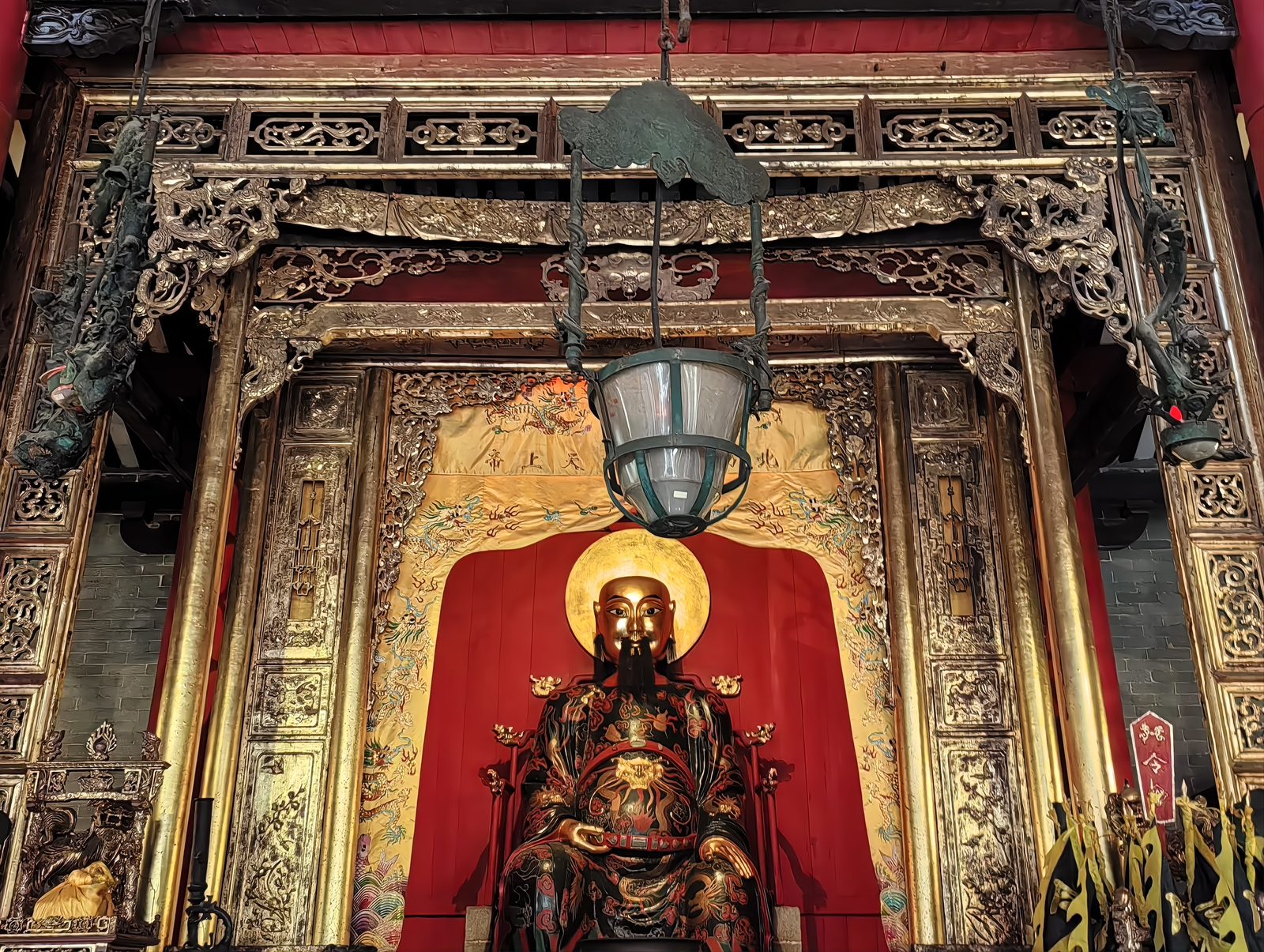
The god in his hall. Cast in the 1450s, three metres of gilt bronze, still on his throne — the largest Ming bronze of the Northern Emperor left in China.
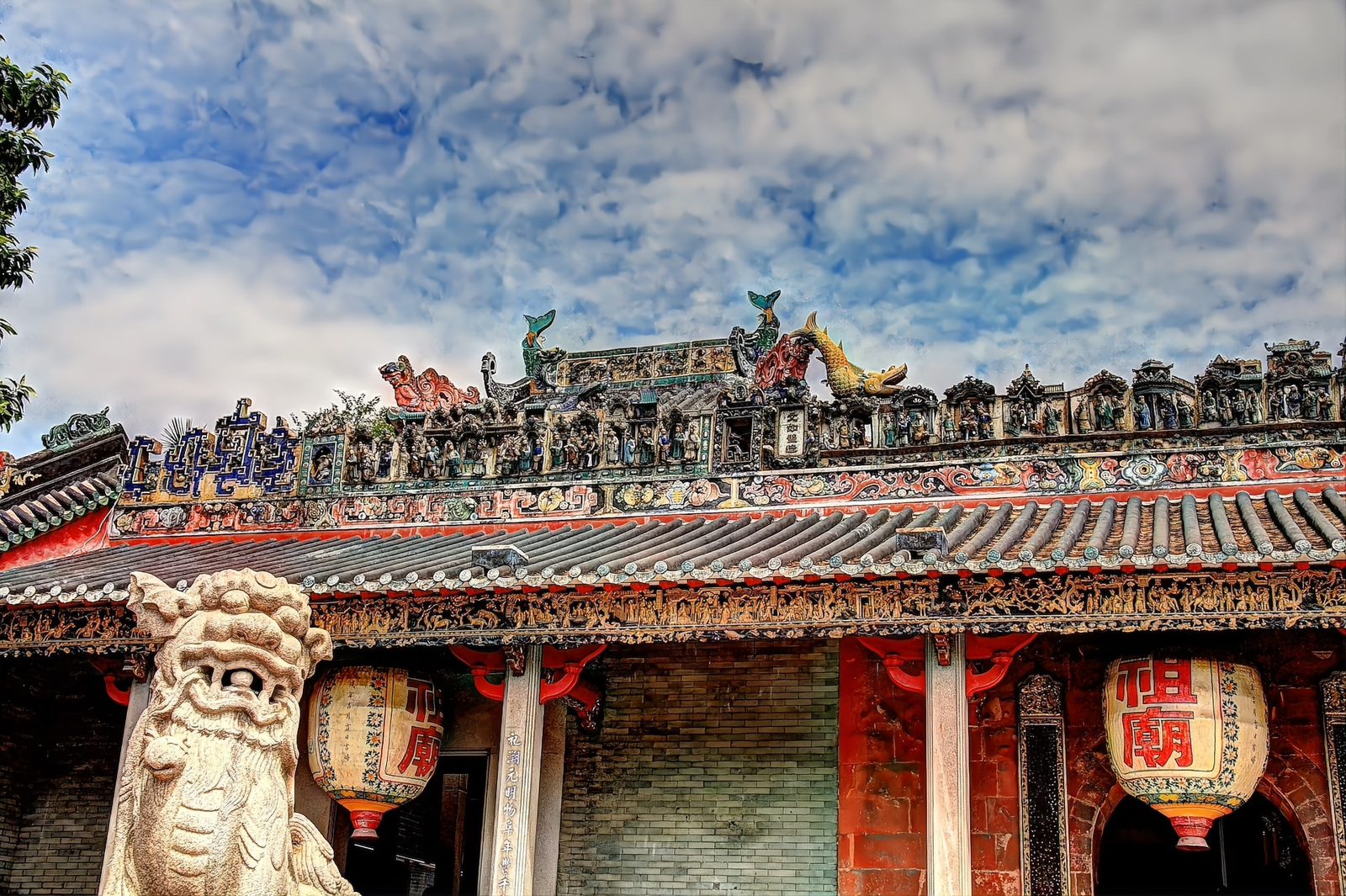
The roofline from the courtyard. Stone lion, lanterns, and the crowd of figures along the ridge — the decoration starts at the top and does not stop.
The parliament of a town with no aristocrats
What the temple became, and this is the part nobody expects from a temple, was a government. By the Ming, Foshan had grown into one of the four great towns of the empire — alongside Hankou, Jingdezhen and Zhuxian — on ironworks, kilns and dye houses, with a hundred thousand people and no aristocrats among them, and therefore no one appointed to govern them. So they governed themselves. The leading families met in this temple, in the halls, under the roof of a water god, and they settled disputes, levied money, organised flood relief, and made decisions that bound the whole town. A Qing-era gazetteer of Foshan survives in the museum's collection as a complete set of one hundred and twenty-eight carved printing blocks — the only complete woodblock set of a Qing township gazetteer known to survive — and it is the record of a town that ran its own affairs.
The scholars who study this call it an early civic institution. The word that fits better is parliament.
Twenty-two men and a hundred thousand
The story that made the temple's reputation happened in 1449. The details vary between sources, but the shape is consistent: a rebellion sweeping the delta with forces in the tens of thousands, a walled-less town of perhaps a hundred thousand, and a defence organised out of nothing. Twenty-two of the town's elders gathered in the main hall of the temple and made a decision — they would not run. They raised eleven thousand men from the ironworks and the kilns, armed them with what a foundry town could produce in a hurry, divided the town into twenty-four defended quarters behind wooden palisades and trenches, and held. The siege lasted around six months. The attackers broke; the town did not.
One detail from that siege explains half of Foshan's folk culture. With spies inside the walls judging the town's strength, the elders had the town's young men perform: lanterns strung, banners cut from silk, weapons whittled from bamboo, whole companies parading the ramparts all night with firecrackers going off like cannon. The spies reported a town bristling with soldiers. The performance became a tradition, then a festival — the Autumn Colours parade that still pours through Foshan every year — and the county's own gazetteer says plainly that it began here: the autumn scenes of Foshan started from this.
When it was over, the court did what courts do for miracles. The temple was elevated by imperial decree to the Lingying Shrine — the shrine of efficacious response — and a great archway was raised in front of it in 1451, its plaque written by the Jingtai emperor himself. The town was granted the name Loyal and Righteous — Zhongyi — and the twenty-two elders were enrolled as Officers of Loyalty and Righteousness. What the archway commemorates, under the emperor's calligraphy, is twenty-two men sitting in a hall and deciding not to run.
The roof with three hundred people on it
Look up at the Three Gates — three buildings' front doors joined into a single facade in 1513 — and the reason for the temple's other nickname, the Palace of Folk Art of the East, is on the roof. Running the length of the ridge is a ceramic frieze 31.7 metres long and nearly two metres high: three hundred–odd figures on a double-sided spine of glazed Shiwan pottery, made in 1899 by the Wen Rubi workshop. On one face, the Investiture of the Gods; on another, a meeting at Ganlu Temple; a debate before a council; a birthday party for a Tang general. It is the largest work of its kind in existence and it is called, without much argument, the King of Flower Ridges.
The figures are dressed as opera characters, because this is opera country — the ridge is a theatre with the curtain up, playing to a courtyard. Along the eaves the same logic runs in wood and brick and plaster: gilt carvings of opera scenes over the doors, lime-plaster dragons on the ridge corners, and at the base of one gutter, a ceramic goldfish the length of an arm, mouth open, swallowing the rainwater off the roof and spitting it down a bamboo-green drainpipe. Nobody needed a gutter ornament. Somebody made one anyway, and that is the whole temperament of the place.
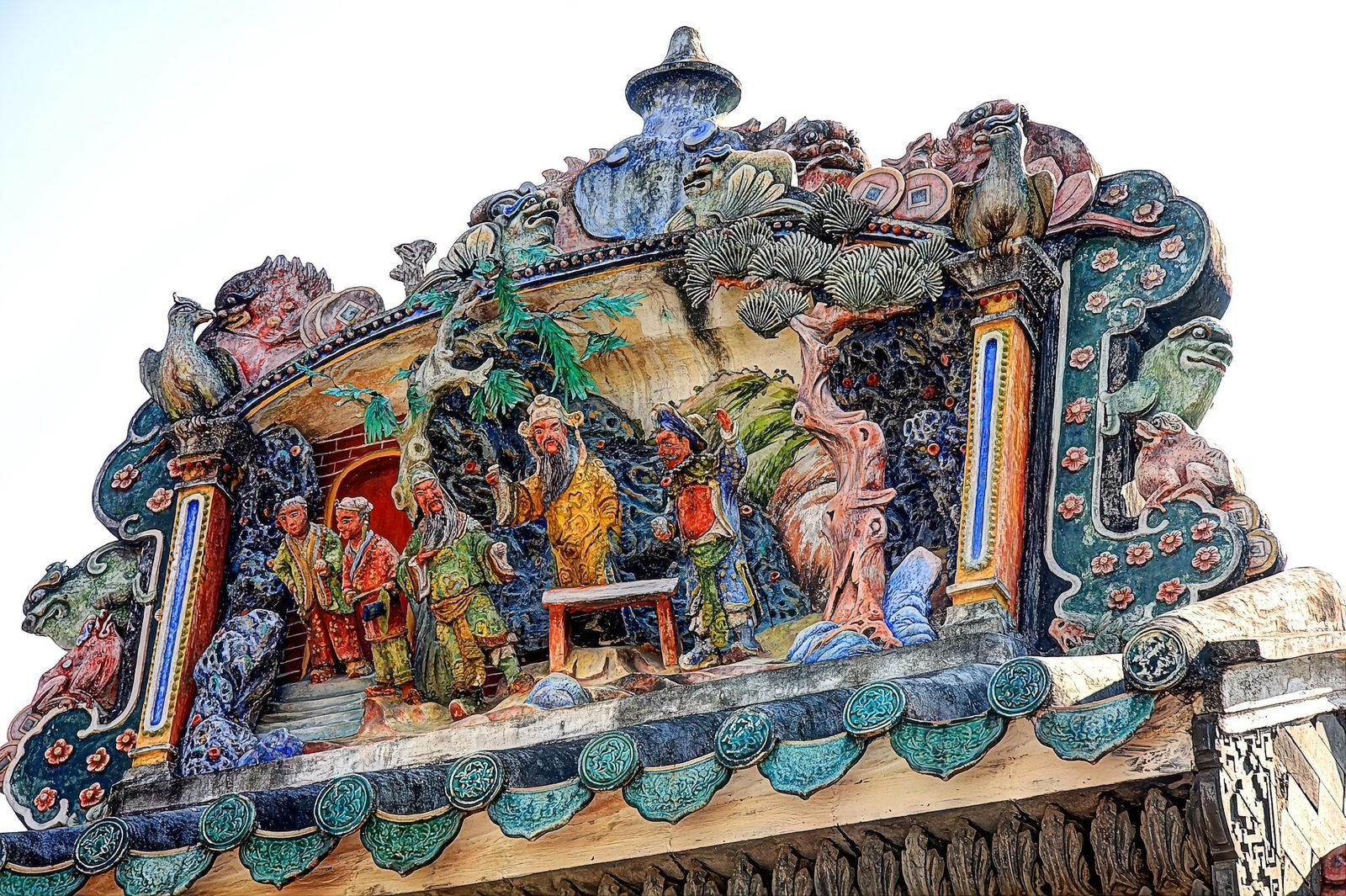
A scene on the ridge. Glazed Shiwan figures on the King of Flower Ridges — opera in pottery, playing to the courtyard below.
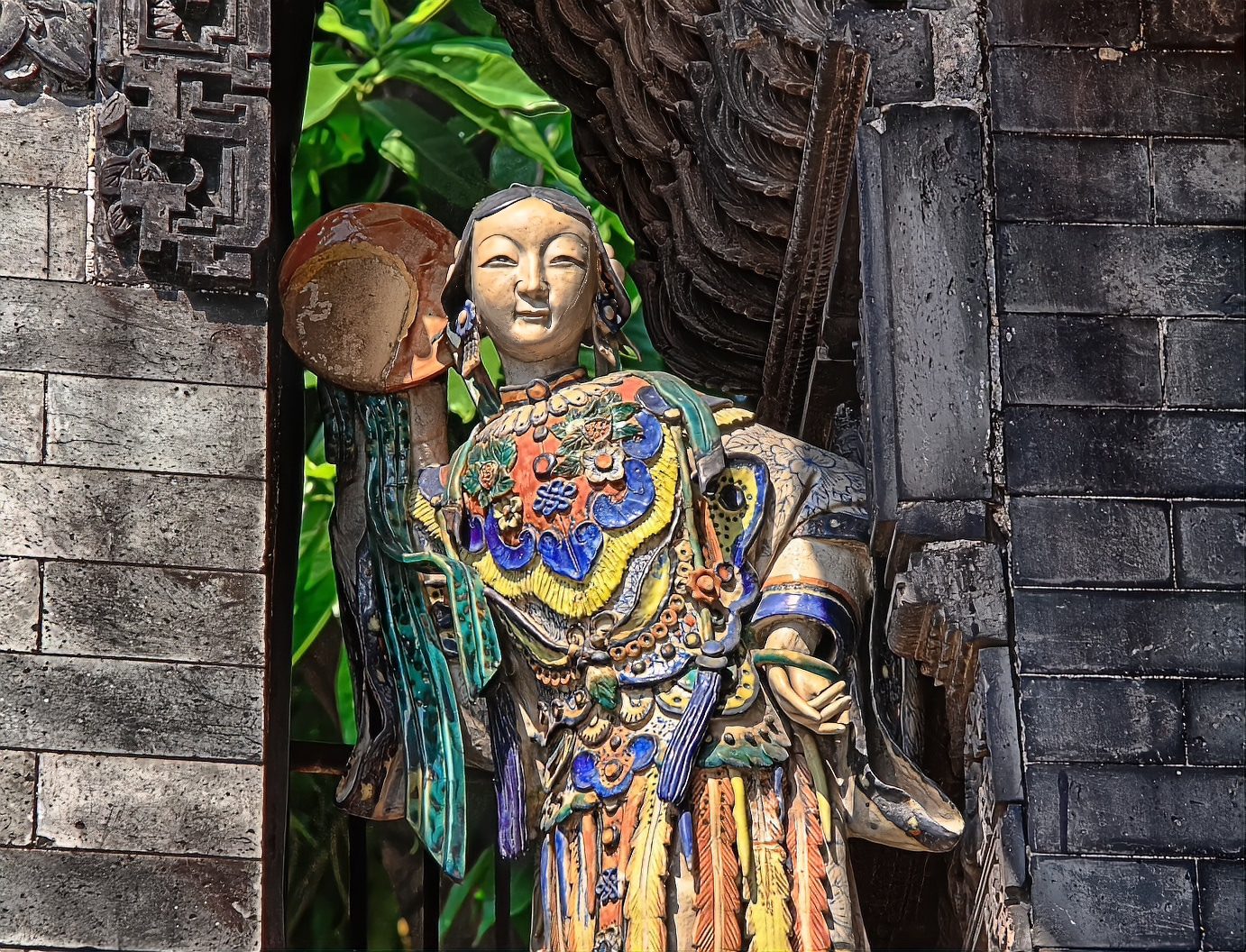
One of the three hundred. A single roof figure at human scale — the brushwork is in the drapery, the colour in the glaze.
The street
Walk out of the temple's west side, turn right, and in the nineteenth century you were on the street with more martial skill per metre than anywhere in the empire. Not in the temple — in the lanes behind it. In 1825, in a medicine shop on Chopsticks Road, a man named Leung Tsan was consolidating a fighting system that had reached him in fragments and turning it into something complete: Wing Chun. He was from a wealthy family, he treated the poor for nothing, and he taught in the back of the shop. In 1870 a thirty-nine-year-old dye-trade labourer named Chan Wah-shun began pressing his ear to that shop's door to listen. Leung Tsan knew, and did not stop him; months later he took him as his final student, and Chan became the first man to teach Wing Chun openly in Foshan, breaking a secrecy that had kept the art small for two hundred years. Further down the street, from 1851, a master named Cheung Hung-sing ran a Choy Li Fut hall that at its peak held three thousand students — the largest martial arts school in China.
And in a lane called Douchi Lane, off this street, a thirteen-year-old boy met the man who would change his life.
Three taels and six mace
The boy was Wong Fei-hung, born in Foshan in 1847 — the Foshan government's dates, used here; other accounts give 1856, and the records disagree. His birth name was Sek-cheung. The name the whole world says, Fei-hung — soaring goose — came later. His father Wong Kei-ying was one of the Ten Tigers of Canton and a martial-arts instructor to a garrison general, on a salary of three taels and six mace of silver a month, which is not a living wage; so the family performed in the streets and ran a herbal dispensary, and the boy grew up watching the arithmetic fail and hold anyway.
He had three teachers. His father gave him the foundation, ten years of it. Lam Fuk-sing — who the story says owed him a life saved in a Foshan lane — passed on the Iron Wire Fist and the flying weight, a sling technique of extraordinary precision; the detail that tells you how good he got is that Wong could fire the flying weight from inside a lion's head, at a target three or four storeys up, while dancing the lion dance. Sung Fai-tong taught him the Shadowless Kick, which became, through cinema, the single most recognisable technique in Chinese martial arts. Three teachers, everything taken from anyone willing to offer it — which in a lineage-obsessed culture bordered on heresy, and is exactly why he became great.
By 1886 he had inherited his father's practice and opened his own clinic in Guangzhou: Po Chi Lam, the Treasured Grove. He became one of the great trauma physicians of Guangdong, and the strange, verifiable part is how open he was about it — his prescriptions were published at the front of the shop for anyone to copy, which no competitor did, and the fees dropped or vanished for anyone poor. He served the Black Flag Army as a medical officer and martial instructor and followed it to Taiwan in 1895. He was called the Lion King of Guangzhou, and he was, reportedly, among the first masters in the region to take female students and organise women's lion teams — in the 1870s, the sort of thing that got you challenged.
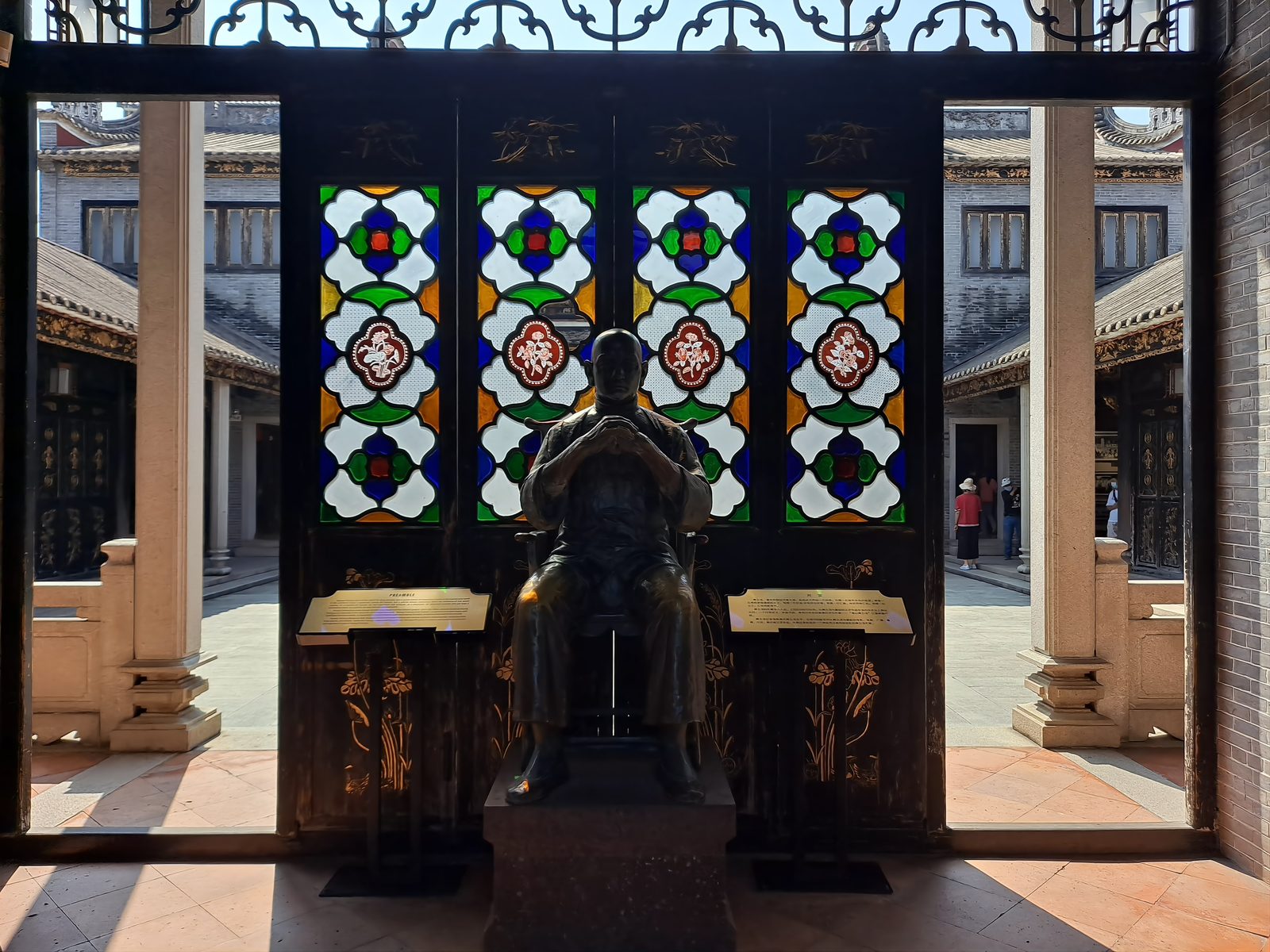
The man, in his hall. Wong Fei-hung sits in the memorial hall built for him inside the temple — bronze, backlit through coloured glass, in the salute he would have given a student.
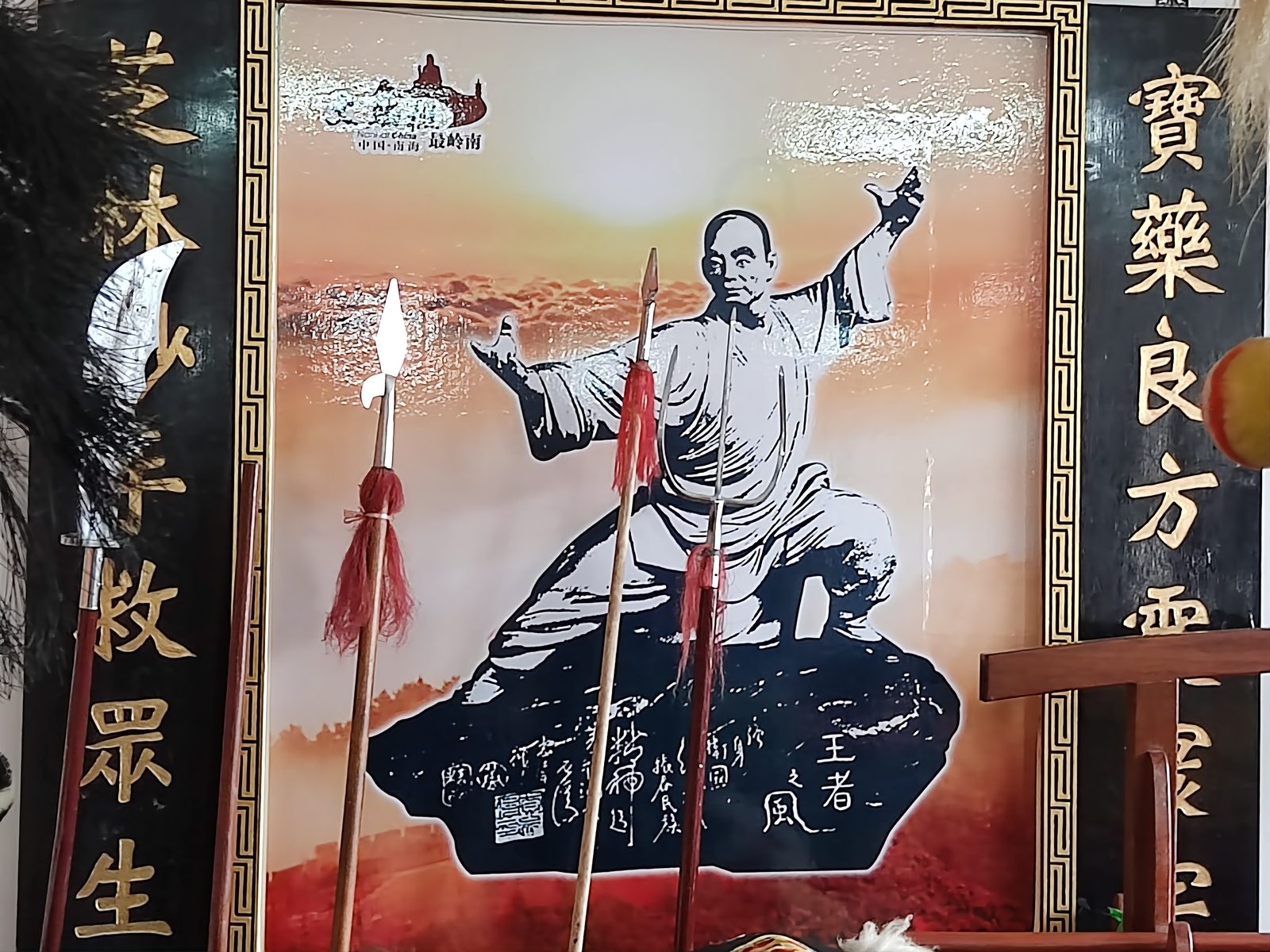
Po Chi Lam, rebuilt. His Guangzhou clinic burned in 1924. This is the pharmacist's shop as it has been rebuilt on Xiqiao Mountain, in the Nanhai district Foshan gives as his birthplace — his spear pose on the wall, weapons and a lion head in front.
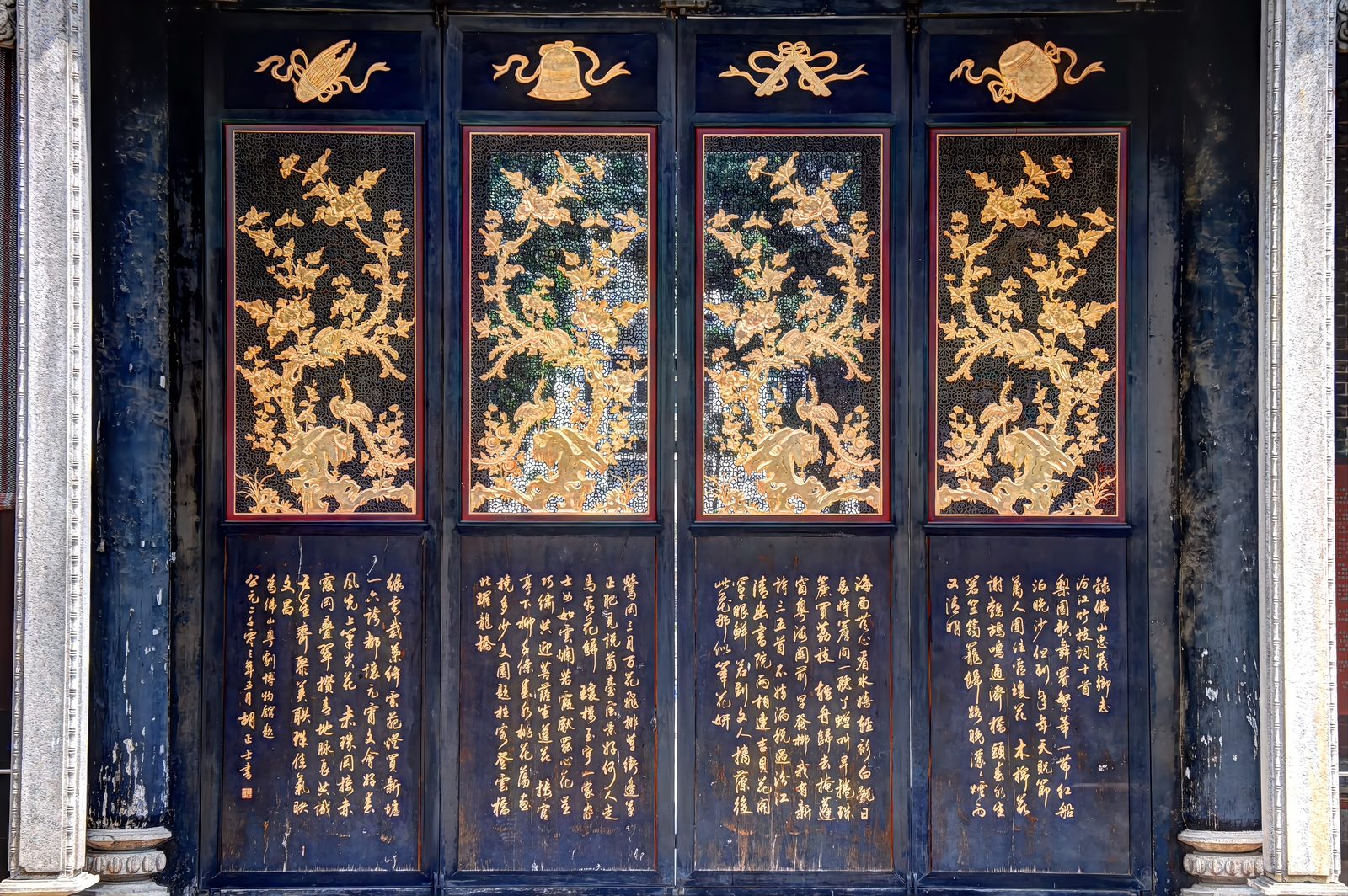
Gilt on black lacquer. Wood carving and gold leaf run through every building here — doors, screens, altars, stage.
The gutter, as an ornament. A ceramic goldfish swallows the roof's rainwater and spits it down a bamboo drainpipe — nobody needed this. Somebody made it anyway.
The pharmacy that burned
Then it went. In 1924 Guangzhou tore itself apart — a merchant militia rose against the government, the government shelled the western districts to put it down, and the fires took much of Xiguan. Po Chi Lam burned to the ground with everything Wong had built in thirty-eight years. His son had already been shot dead by a rival. He was in his late seventies, and the two things he had spent his life on were both finished. He died on 17 April 1925 in a charity hospital in the west of the city, and was buried at the foot of White Cloud Mountain. Nobody knows where the grave is now; the cemetery was cleared for development, and that is the whole of it.
What did not burn was the teaching. His widow Mok Kwai-lan took his students and surviving sons to Hong Kong and opened schools; his student Lam Sai-wing, a butcher by trade, carried Hung Ga across Southeast Asia and the Americas; and a writer named Chu Yu-chai produced a biography that turned a regional fighter into a national one. Then, in the 1950s, Hong Kong film found him. More than a hundred films have been made about Wong Fei-hung — it stands in the record books as the most films ever made about a single real person, and the number keeps climbing. Jet Li played him. Jackie Chan played his father. He has been portrayed as a Confucian sage, a revolutionary, a comic drunkard and a one-man army, sometimes in the same decade. Almost none of it is true, and all of it is him.
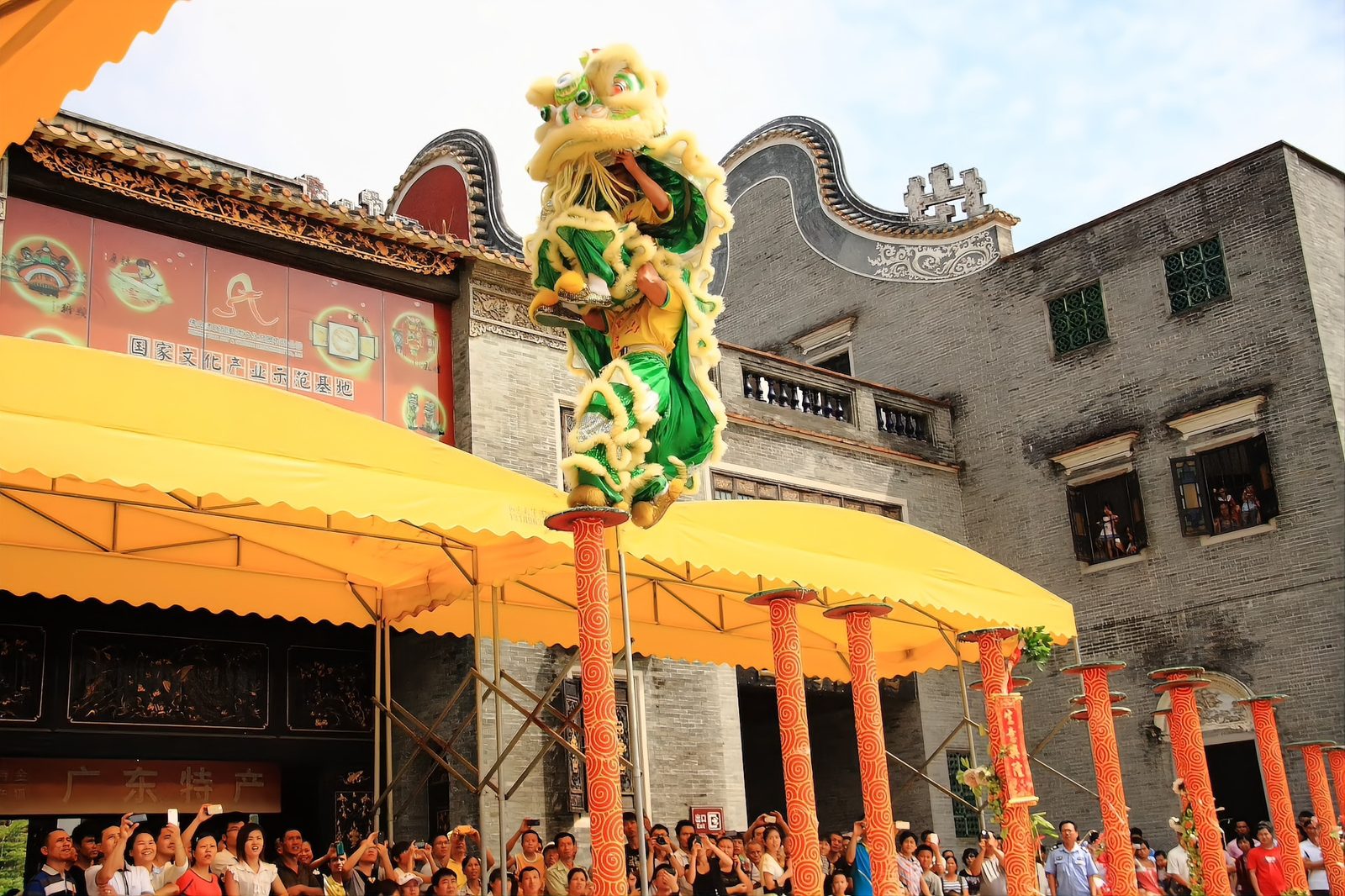
The part that did not burn. A lion on the poles in Foshan — the art he took from his father's generation and handed on, the one part of his work no fire could reach.
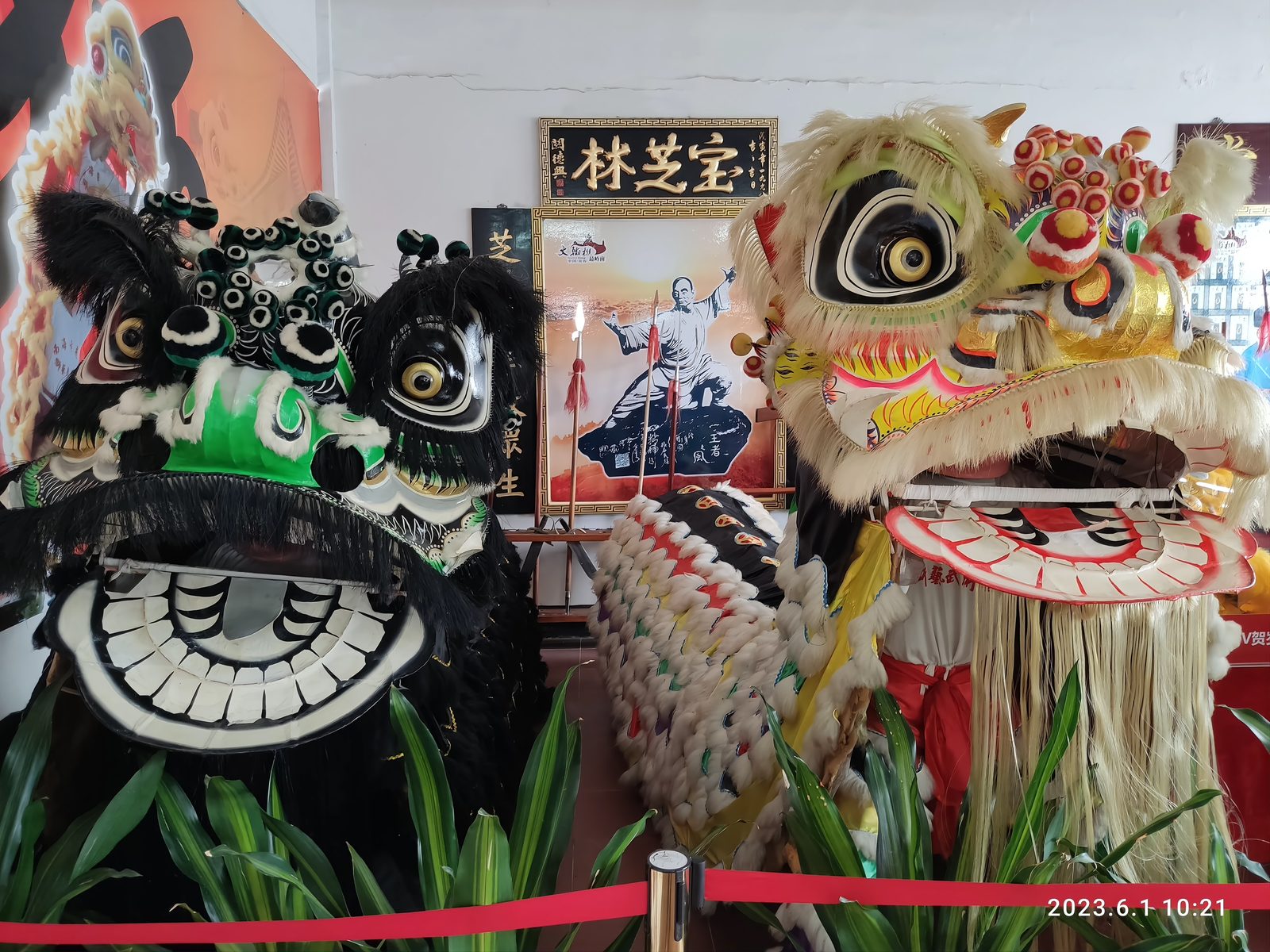
The heads in the museum. What a hundred years of Foshan lion dancing looks like when it is over — painted papier-mâché and mirror glass, kept behind glass, still taken out to perform.
Two men, one street, never met
In this temple complex there is a Wong Fei-hung Memorial Hall, and roughly a hundred metres from it an Ip Man Hall, and between the two of them sits a confusion that will not die. They were not master and student. They were not contemporaries in any meaningful sense — Wong was born in 1847, Ip Man in 1893, to a wealthy Foshan family and a Hong Kong school. Their arts were opposites: Wong's Hung Ga is hard, wide and rooted, built for open ground; Wing Chun is close, narrow and economical, built for corridors and doorways. There is no record of them ever meeting, and every serious account says so plainly.
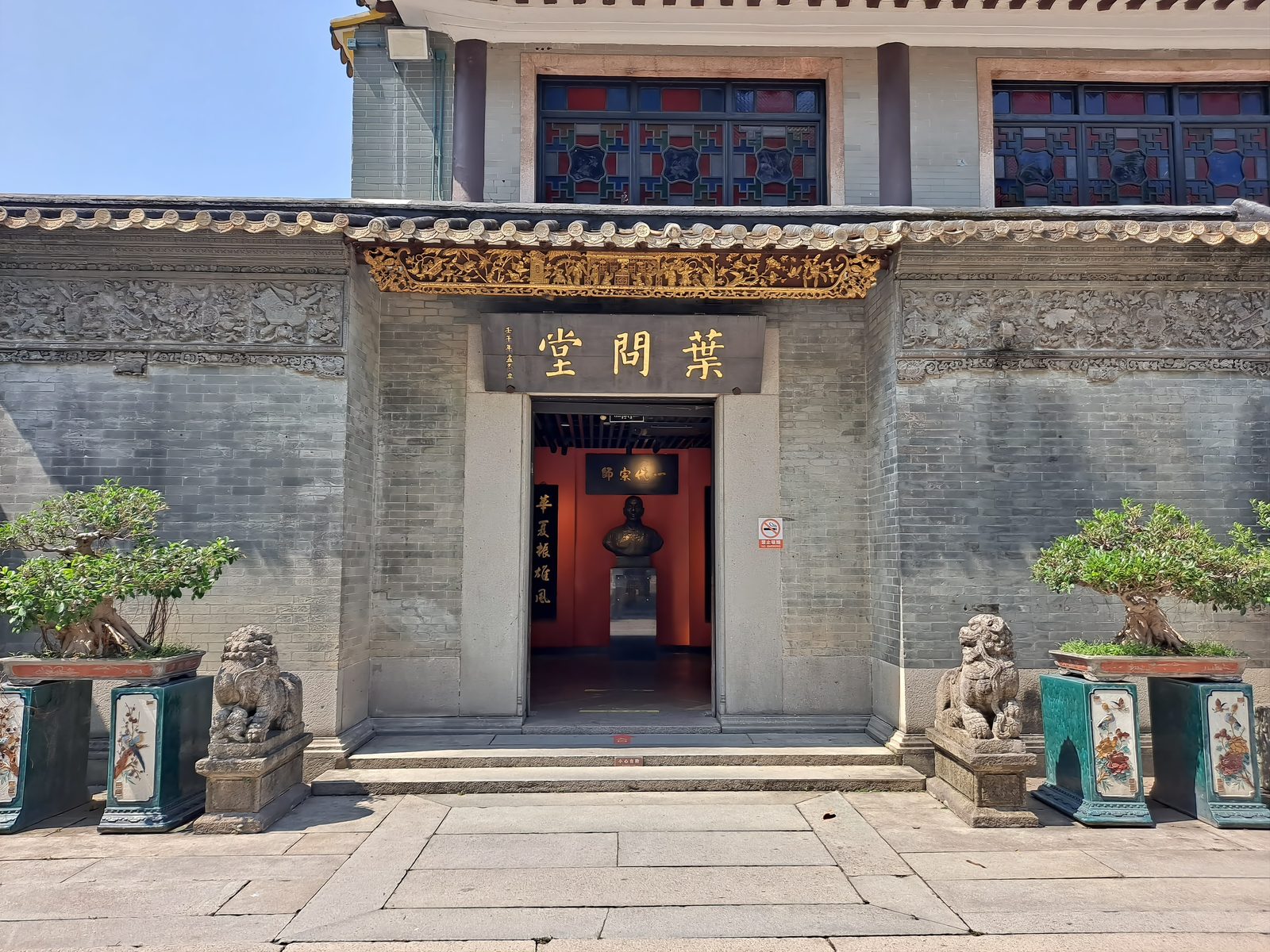
The Ip Man Hall. A hundred metres from Wong's hall, behind this gate — the hall opened in 2002, his bust inside, the couplets calling him the patriarch of a generation.
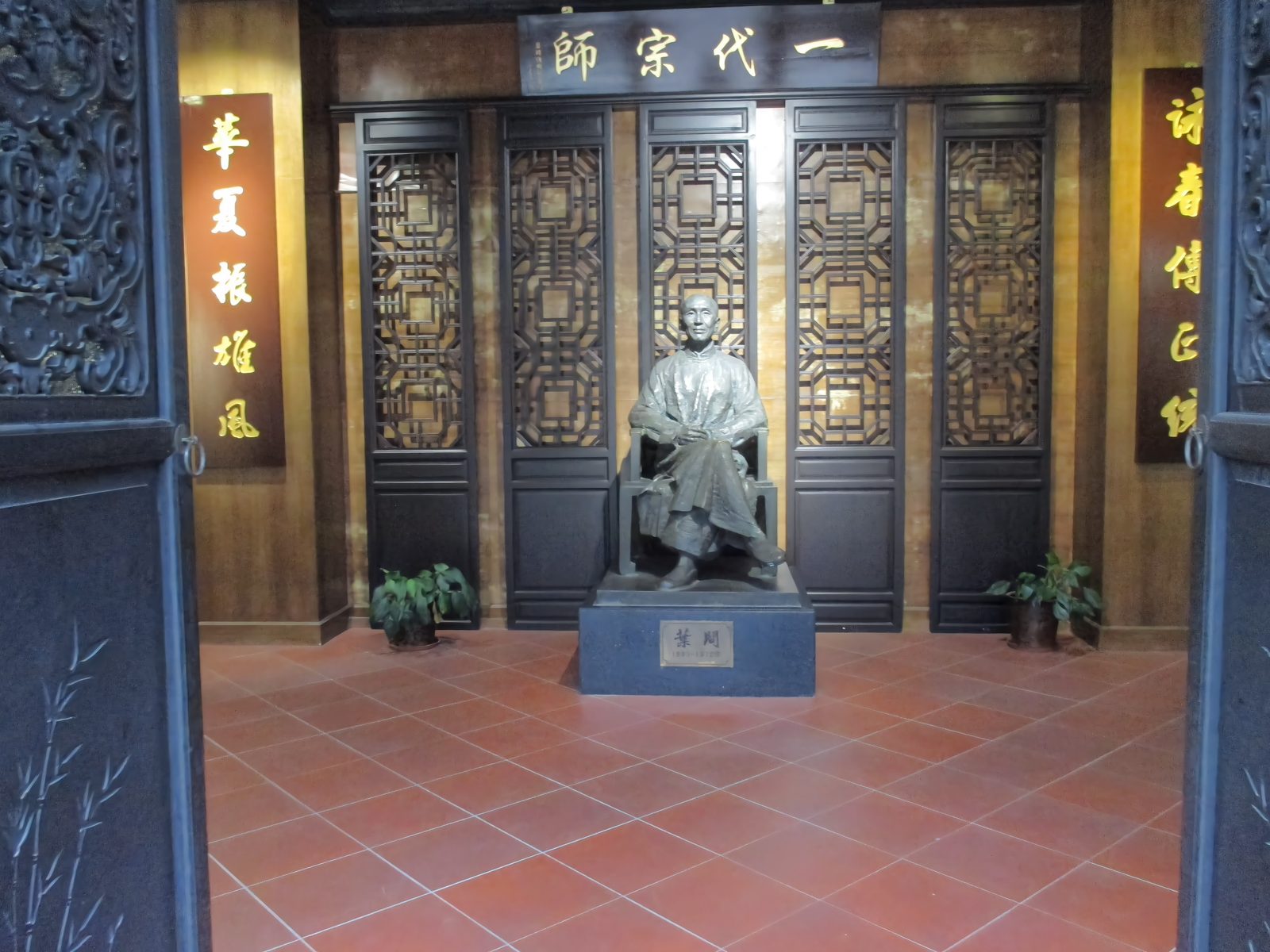
Ip Man, at home. His other memorial hall stands in Luo Village, the Nanhai township where he was born — the seated figure, and the four characters that name him.
The films get Ip Man wrong in the other direction, by shrinking him to Bruce Lee. Ip Man taught in Hong Kong for twenty-two years, from 1950 until his death in 1972, and the students who carried the art forward are a roster — Leung Sheung, Lok Yiu, Chiu Wan, and from 1953 Wong Shun-leung, the fighter who beat nearly everyone and who taught most of the Wing Chun that shows up in Bruce Lee's later work. Bruce Lee arrived around 1954, trained diligently, and left for America before finishing the syllabus. Years later, wealthy, he offered to buy Ip Man a building in exchange for filming the complete wooden-dummy form. Ip Man declined: a student who genuinely wanted to learn would be taught everything, and he would not sell it. Bruce Lee made Wing Chun famous. He did not make it global — that was done by dozens of names that never appeared in a film.
What connects them is this building and the street outside it: a city that produced more martial genius per capita than anywhere in imperial China, now remembered a hundred metres apart, in a temple built for a water god.
"Go and stand in the courtyard when the drums start at ten. The lion is not a costume and the art is not a performance. It is the one part of Wong Fei-hung that the fire did not take, and it is still going."
The closing argument of the editorial this page is built on — and the best single instruction anyone has written for visiting this temple.
What is standing there now
The complex runs about 3,600 square metres along one axis, and the order of the buildings tells the story backwards. At the front is the Wanfu Stage, built in 1658 and renamed in 1684 — the oldest surviving wooden performance stage in South China, facing the main hall so that the opera played to the god, with the acoustics of the courtyard doing the amplification. Then the Lingying Archway of 1451, the emperor's decree in stone and timber — 11.4 metres tall, the only double-eaved hip roof in the complex, and fresh out of the largest repair in its history, finished in 2024 after four years of work. Then the Jincxiang Pond with its tortoise-and-snake stone, the bell and drum towers, the Three Gates under the King of Flower Ridges, and at the back the front hall and the main hall with the bronze.
The stage still plays. Cantonese opera runs on weekend afternoons and on the first and fifteenth of the lunar month — real companies, proper repertoire, benches on flagstone — and during Spring Festival the Foshan Cantonese Opera Theatre takes the boards. The lion dance runs most days in front of the Wong Fei-hung Memorial Hall: a two-person animal with a head, a body and a tail, crossing high poles, picking the green — a lettuce and a red envelope strung above the crowd — and spitting the leaves back out, because the word for green and the word for luck sound close enough that the lion is eating fortune and giving it back to the people watching. The museum around the temple holds the Wong Fei-hung Memorial Hall with a rebuilt Po Chi Lam, the Ip Man Hall, a Confucian temple where the town's children still do the first-writing ceremony, and a history exhibit that explains, better than any guidebook, how a temple came to run a city. The two martial halls are the museum's own idea, not the temple's: the Wong Fei-hung Memorial Hall opened in 2001, the Ip Man Hall in 2002.
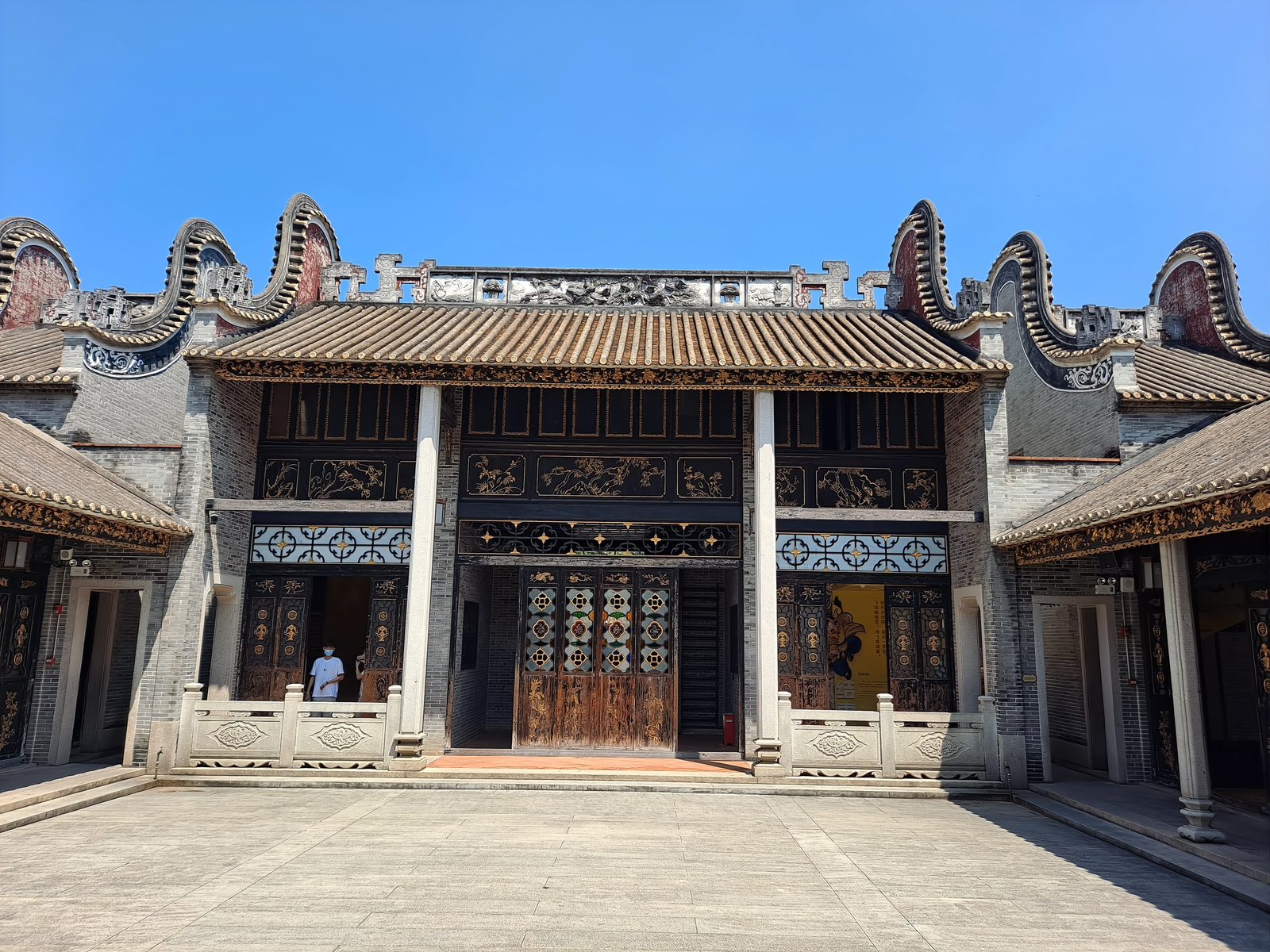
His hall, in the temple. Opened in 2001, the wok-ear roofline of a Lingnan town house — and the courtyard in front of it is where the ten o'clock lion dances.
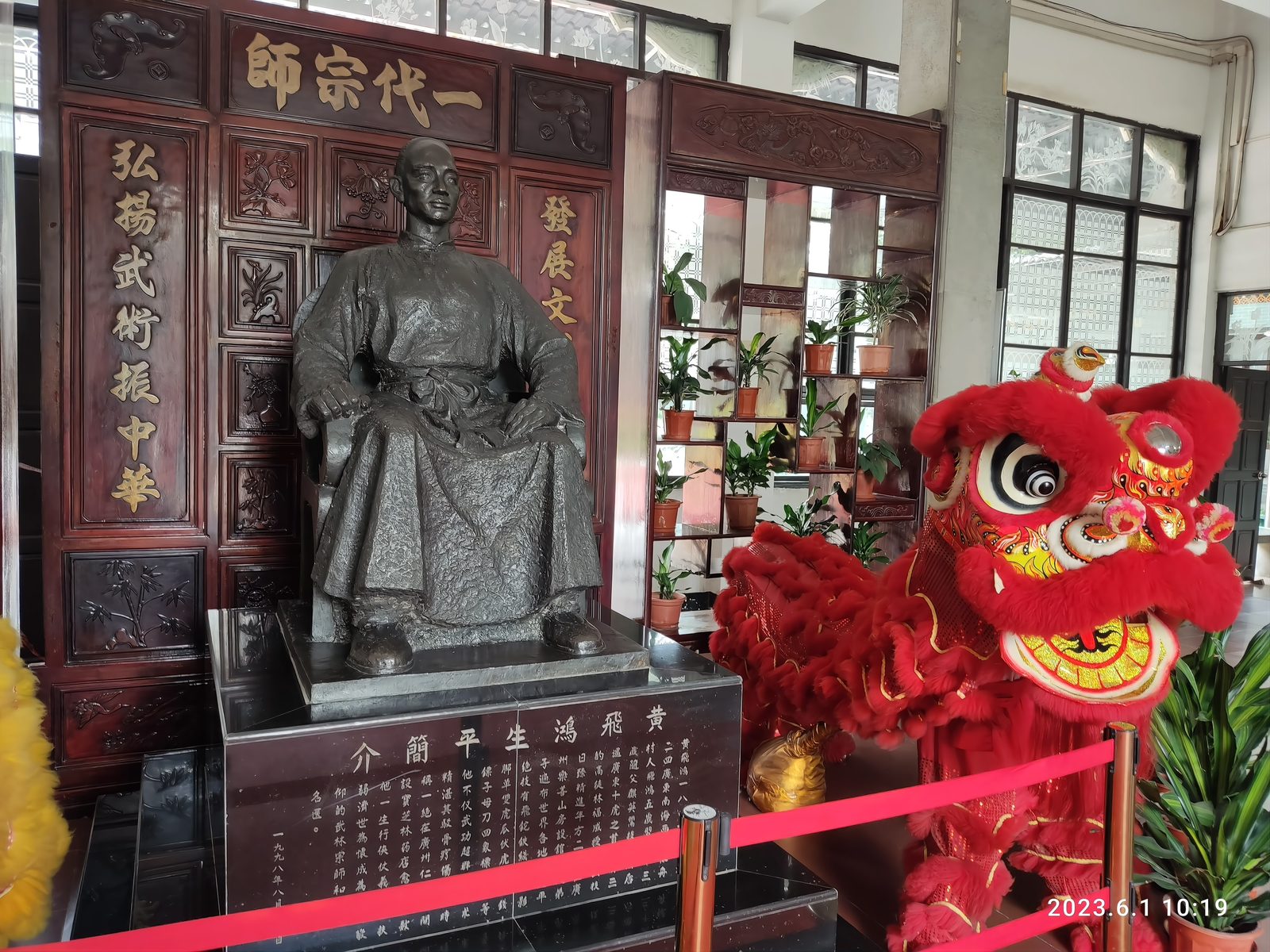
And on his home mountain. A second, bigger memorial hall stands on Xiqiao Mountain in Nanhai, the hill Foshan gives as his birthplace — the statue's base is dated 1998, and the lion sits at his feet.
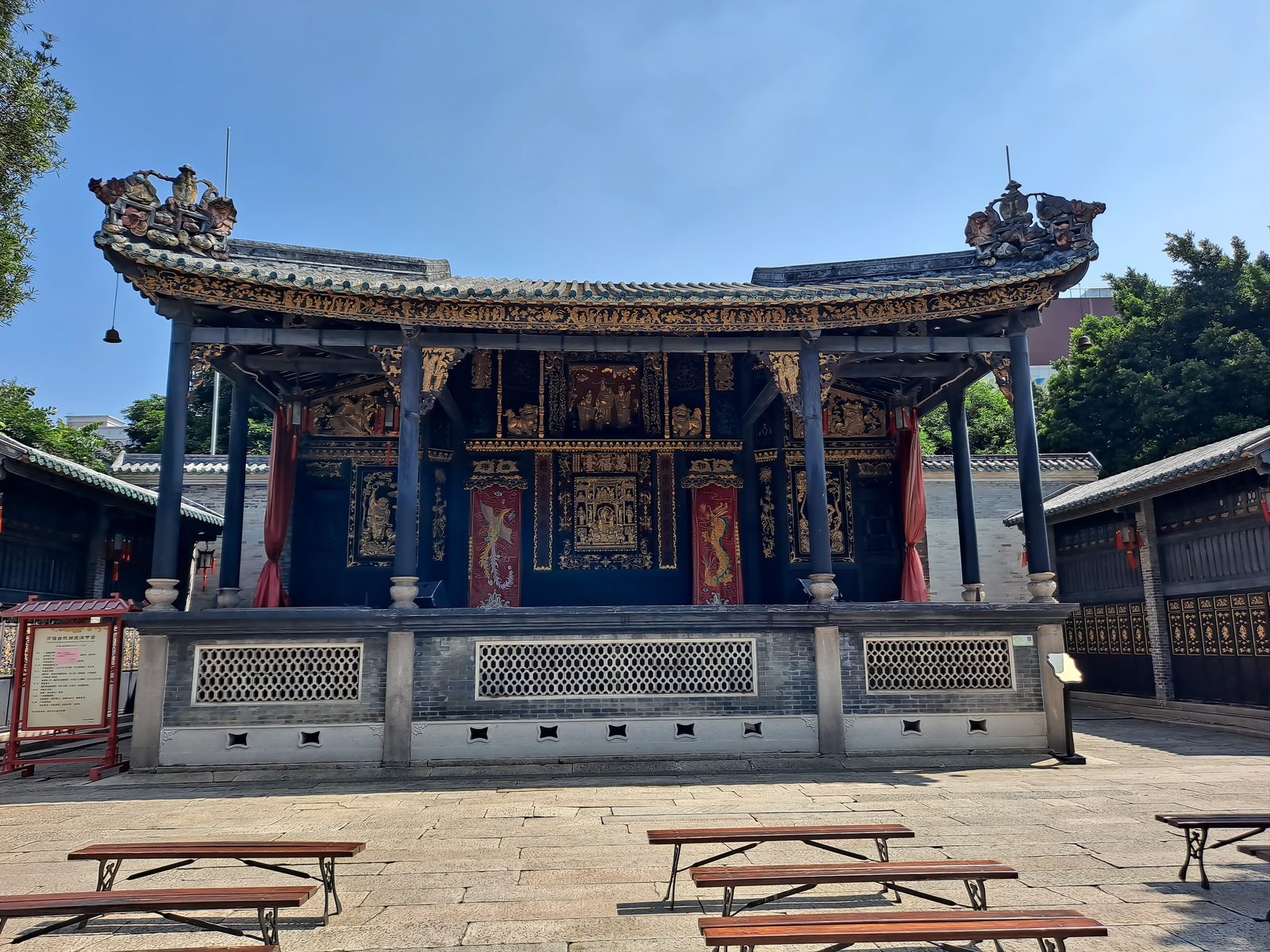
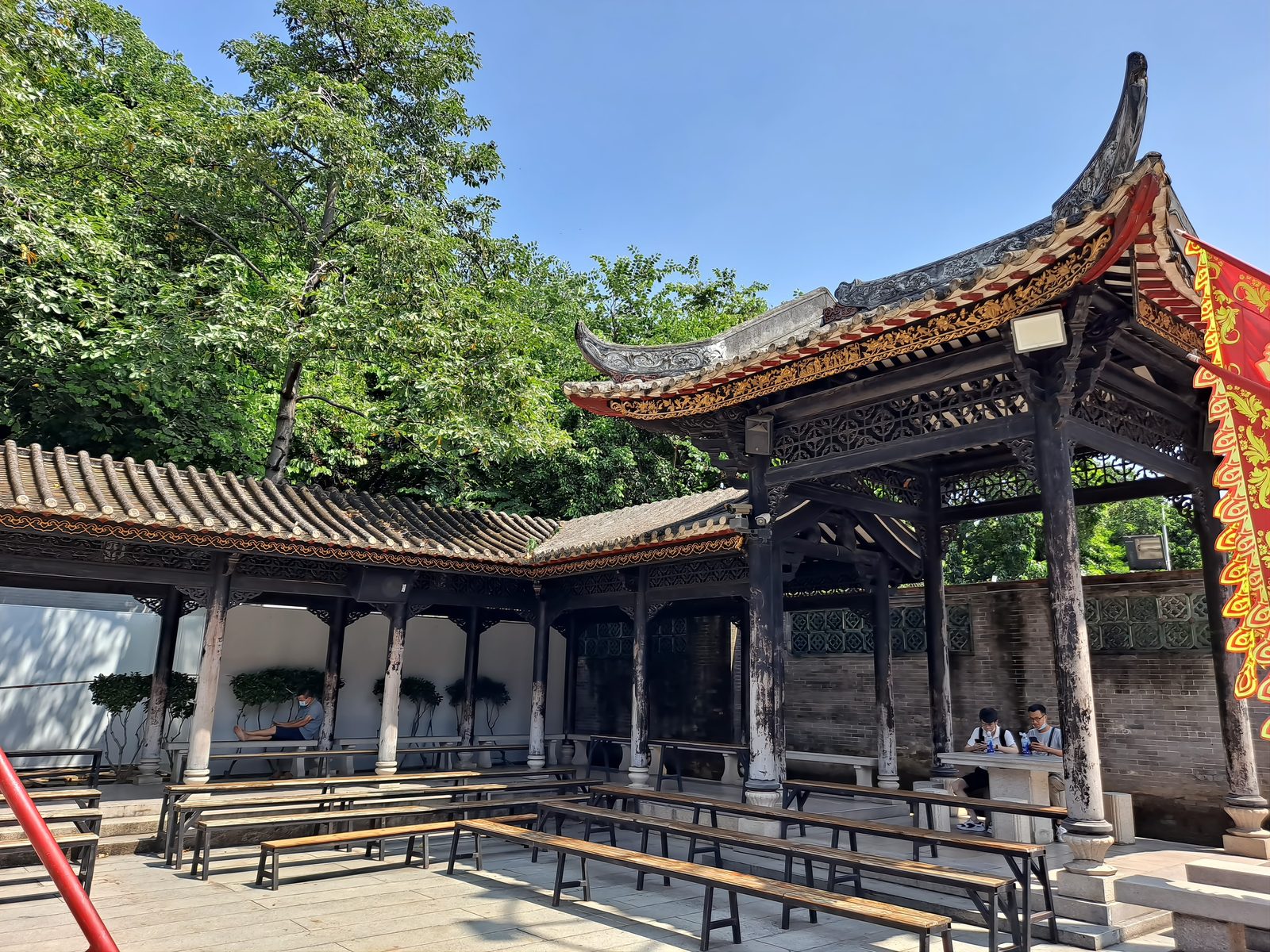
The Wanfu Stage, from the benches. Built in 1658 — the oldest wooden stage in South China, and it faces the god, not the audience.
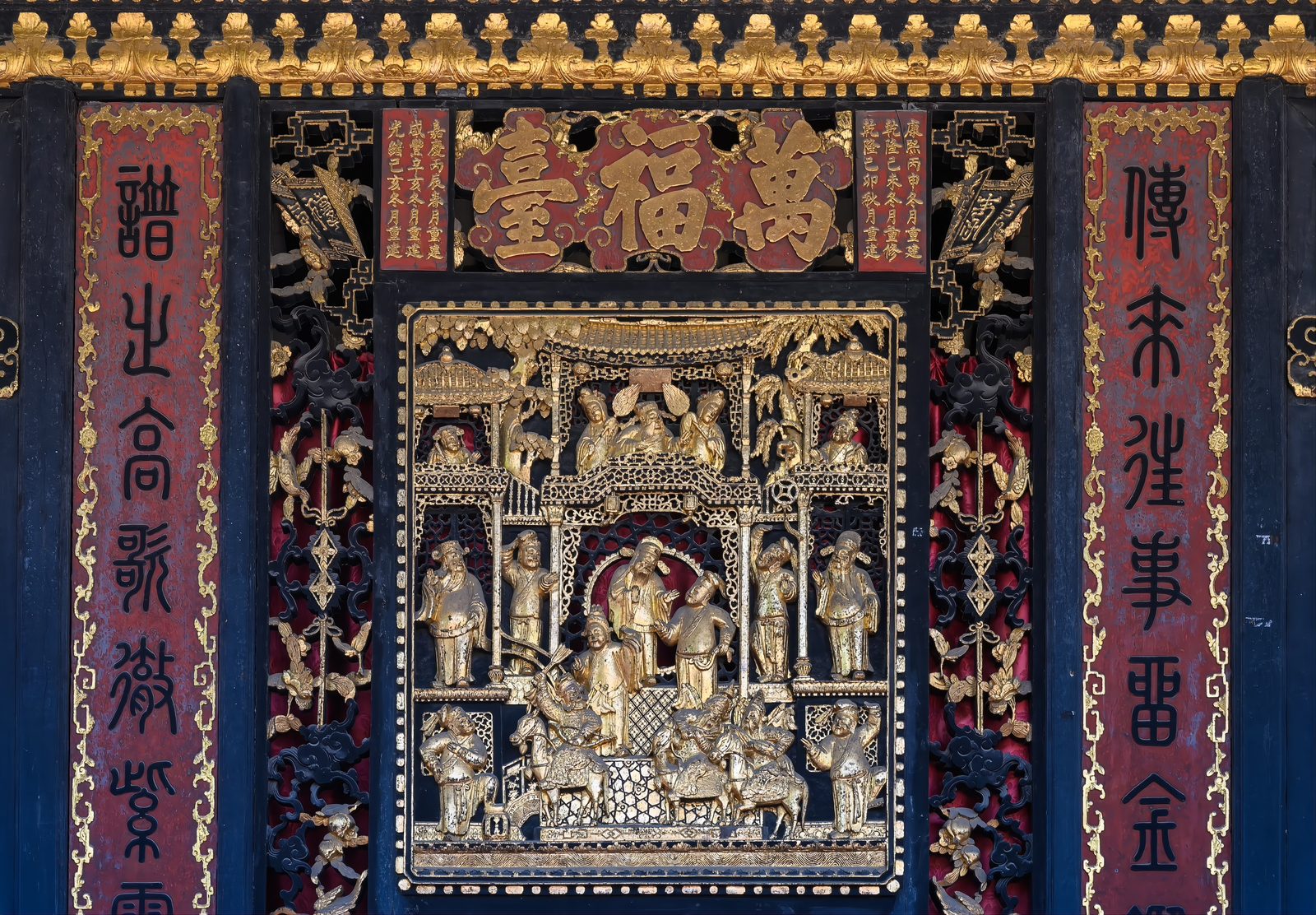
The name board, in gold. The stage's gilt carving up close — opera scenes in gold leaf, dark lacquer behind.
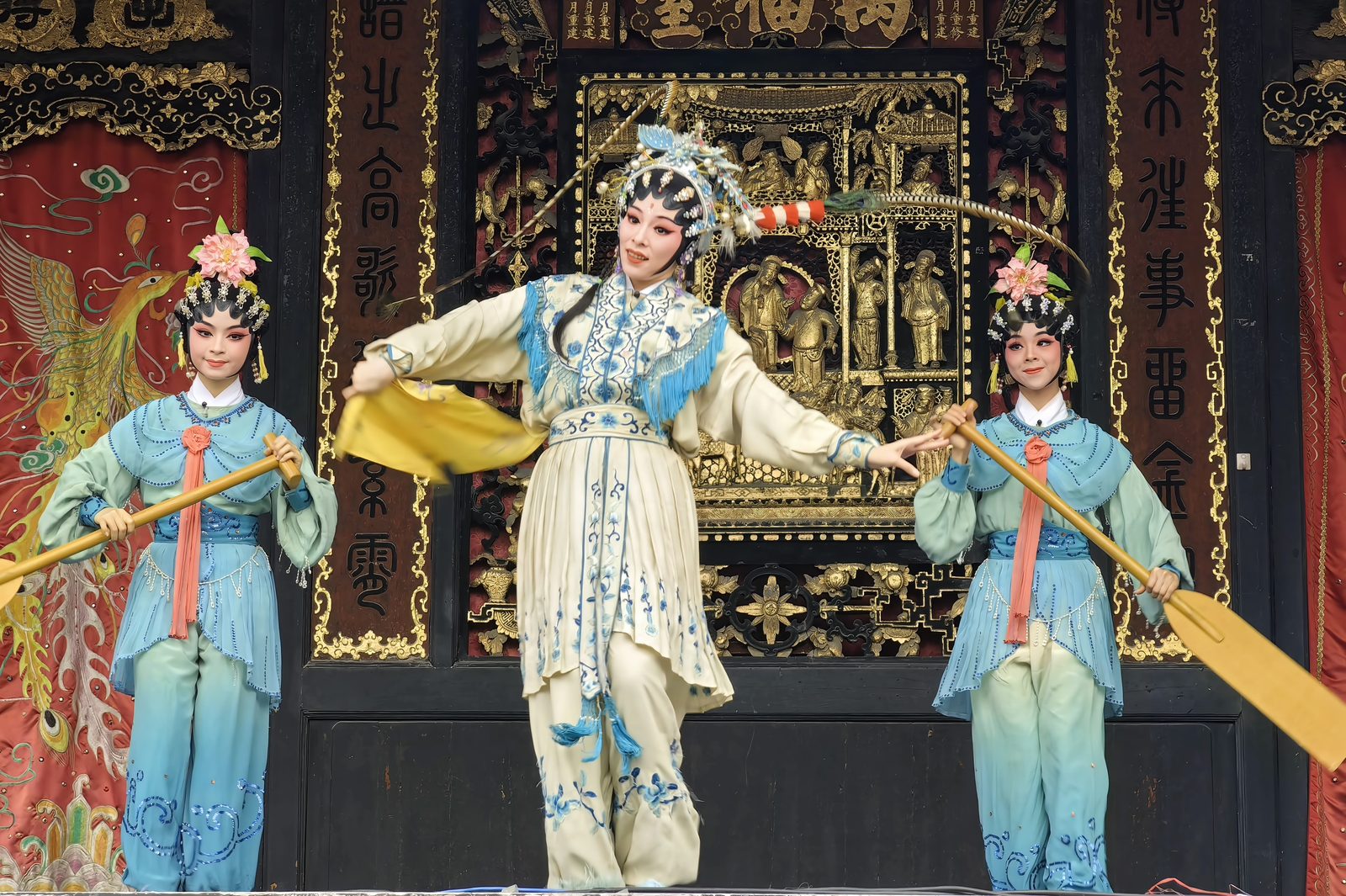
Opera on the old stage. Weekend afternoons and lunar feast days — the programme the stage was built for, still running.
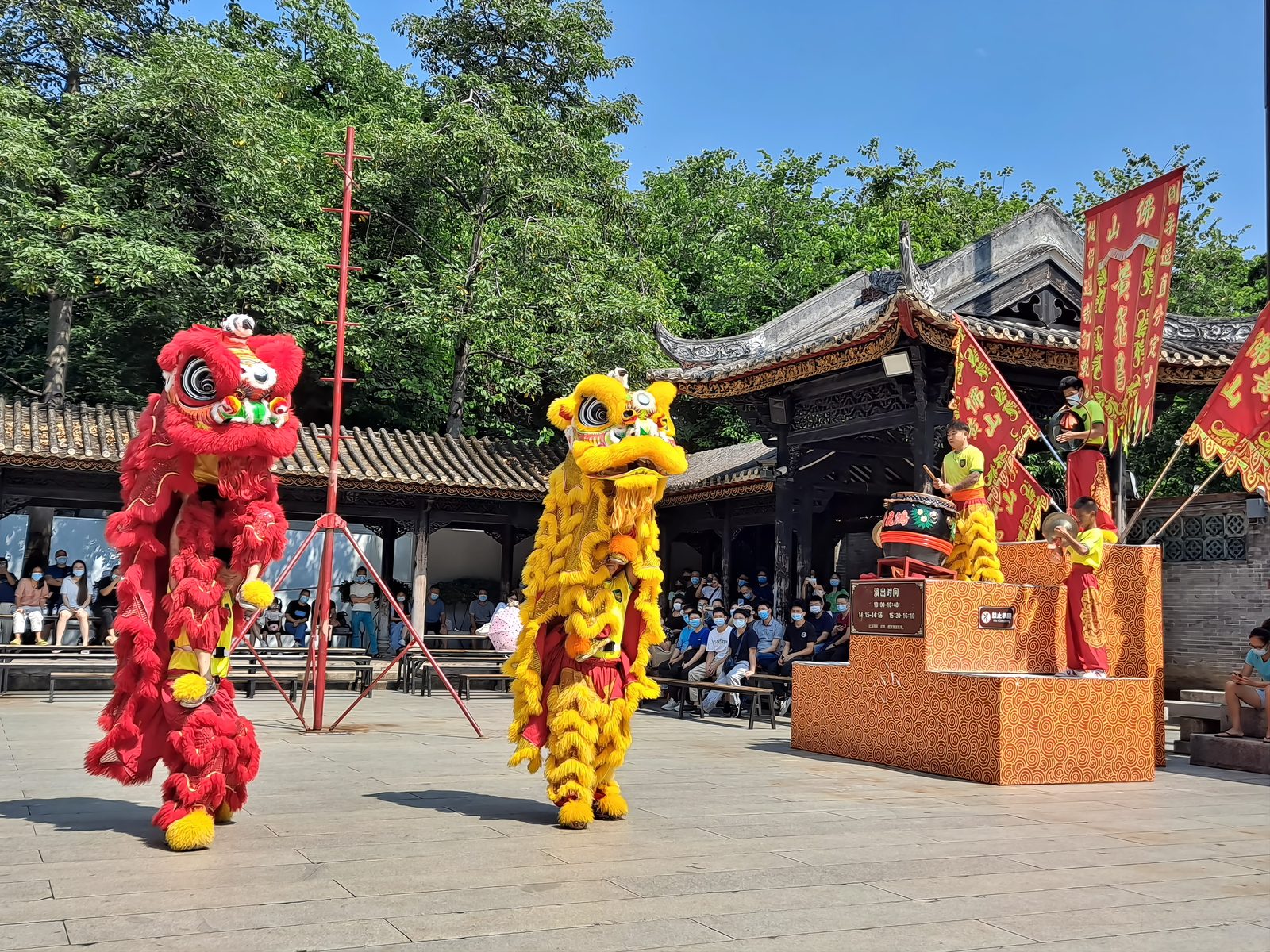
The ten o'clock lion. The daily performance in front of the Wong Fei-hung Memorial Hall — the art he mastered, still on the schedule.
Going, and what to expect
Getting there. The temple is at 21 Zumiao Road, in the middle of Chancheng, Foshan's old city. From Guangzhou, the Guangfo metro line runs straight to Zumiao station — leave by Exit D and it is a two-to-five-minute walk, about thirty minutes from central Guangzhou in total. A dozen bus routes stop at the Zumiao stops outside. Driving is the one mode to avoid: the area is the old city centre and parking is tight.
Tickets and hours. Open daily 8:30 to 18:00, with tickets and entry cut off at 17:30. A full ticket is ¥20; the ¥10 concession covers children between 1.2 and 1.5 metres, visitors aged sixty to sixty-four, and students; entry is free for the under-sixes, the over-sixty-fives and the usual national categories. Tickets are sold at the gate and through the museum's WeChat official account, which is also the only official source for the free electronic guide — it runs in Mandarin, English and Cantonese, so there is no reason to buy a guide anywhere else. Free scheduled talks run at set times: the Wong Fei-hung exhibition at 9:30, the Ip Man Hall at 9:15, and the main history exhibit at 14:00.
How long, and when. Two to three hours covers the axis, the halls and one performance with room to look up at the ridge properly — and looking up is the point, so come with the neck budget. The performances are the reason to time it: the martial-arts and lion-dance shows run at 10:00–10:40, 14:15–14:55 and 15:30–16:10 in front of the Wong Fei-hung Memorial Hall, cancelled in rain; Cantonese opera plays the Wanfu Stage on weekend afternoons and lunar feast days. Arrive by ten, watch the lion, then walk the halls while the tour groups are still at the gate. The temple sits beside the Lingnan Tiandi heritage district — lanes of wok-ear houses, now coffee shops and restaurants — and Liang Yuan, one of Guangdong's four great gardens, is a short walk further; the two make one unhurried Chancheng day.
Honest notes. The founding date is tradition, not record — the temple's own history says the founding cannot be dated and gives the Yuanfeng reign as the tradition. The bronze is 3.04 metres by the museum's own specification; popular sources sometimes round it down to 2.4. The siege of 1449 is told with varying details across sources; the shape of it — twenty-two elders, no surrender, a half-year siege — is the consistent part. The town's honorific title is dated 1451 in the archway's own repair report and 1452 in the city's account, and the leader of the twenty-two is named differently in different records; both versions are kept here. Wong Fei-hung's dates vary between 1847–1925 and 1856–1924; the Foshan government's dates are used. And one practical warning that changes plans: the Wong Fei-hung Memorial Hall itself has been closed for renovation since May 2026, with the reopening unannounced — the lion dance goes on outside it, but check the museum's WeChat account or call 0757-82286913 before you build a day around the exhibition.
Gate at 8:30, ridge first while the light is low. Lion dance at 10:00. Then down the axis in reverse — main hall and the bronze, the Three Gates and the King of Flower Ridges, the archway — and finish at the Wanfu Stage if it is a weekend, with the opera on and the benches in the sun. Out the gate into Lingnan Tiandi for lunch.
Photographs and sources
Photographs from Wikimedia Commons, used under their Creative Commons licences and enhanced for this page: the Three Gates and the bronze of the Northern Emperor (CC BY-SA 4.0, Yumeto), the roofline, the ridge scene, the roof figure, the pole lion and the gilt doors (CC BY-SA 3.0, Han Lei), the Wanfu Stage, the lion dance and the ceramic goldfish (CC BY-SA 4.0, 钉钉), the gilt name board of the stage (CC BY 2.0, xiquinhosilva), and the opera scene (CC BY-SA 4.0, Uuongkinghe); the Wong Fei-hung Memorial Hall, the bronze of Wong in its doorway, and the Ip Man Hall at the temple (CC BY-SA 4.0, 钉钉), the seated statue of Ip Man at his Luo Village memorial hall (CC BY-SA 4.0, Underwaterbuffalo), and the rebuilt Po Chi Lam, the seated Wong Fei-hung on Xiqiao Mountain and the lion heads in its case (CC BY-SA 4.0, Lukwo RuoShuma Simonz). History drawn from the Zhumiao of Foshan editorial source file, cross-checked against the Foshan Zumiao Museum's official site (hours, tickets, transport, performance times, the free guide and tour schedule), the museum's own architectural histories of the Lingying Archway and the Three Gates ridge (the 1451 decree, the 1899 Wen Rubi frieze, the 2020–2024 restoration), the Chancheng district government's intangible-heritage record of the Beidi cult (the bronze's 3.04-metre specification), the Foshan city government's cultural pages (the three treasures of Lingnan architecture, the Autumn Colours origin) People's Daily on the Shiwan roof figurines, and the museum's own visitor information on the complex (the Wong Fei-hung Memorial Hall's 2001 opening and the Ip Man Hall's 2002 opening, and the memorial hall's temporary closure for air-conditioning works from 26 May 2026). Where the records disagree — the founding date, the year of the town's honorific title, the leader of the twenty-two elders, Wong Fei-hung's birth year — both versions are given rather than resolved.
There's more where this came from.
Read the latest insider notes →Two new posts a week — the things a non-resident can't know, written down before they cost you a morning.