Shawan Old Town (沙湾古镇)
Long before it was a town it was a beach: a curve of sand on the shore of an old bay, half moon in shape. One clan arrived, reclaimed the water, farmed it and read — and built a statement about what a family should be, in stone that has now stood for seven and a half centuries. Then they added a song, a parade that floats, and a bowl of ginger milk that began as a mistake.
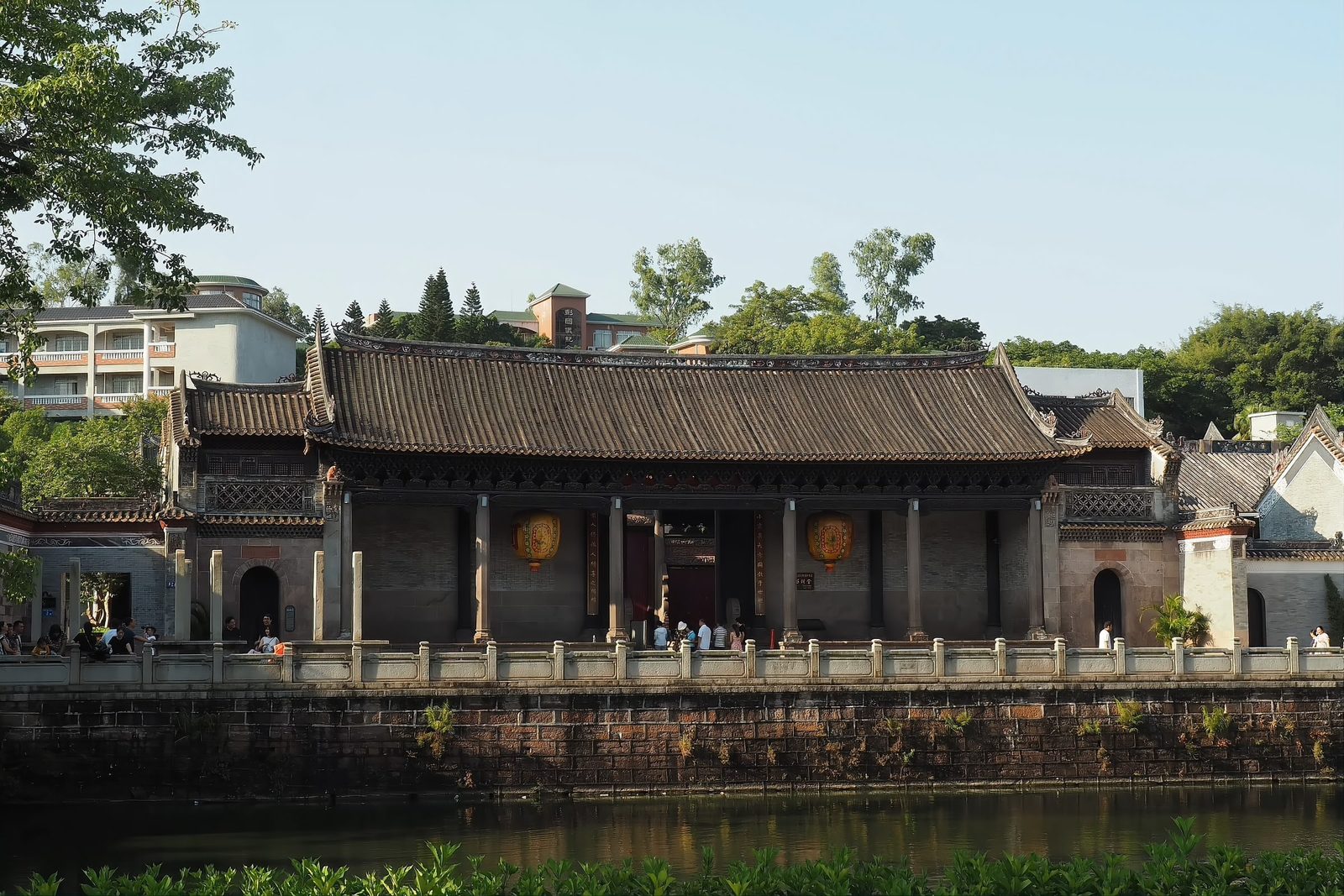
The Liugeng Hall from across the pond. Five bays wide, five courtyards deep, 112 columns — the oldest and largest surviving village ancestral hall in the Guangzhou region, first raised in 1275.
The bay that became a town
The name tells you what it was. Sha is sand, wan is bay: eight hundred years ago this was a half-moon curve of sand on the shore of an old bay on the Guangdong coast. People came, they built on the curve, and the sea went on retreating until what had been a shore became a street.
The clan that made it a town arrived in 1233, the sixth year of the Shaoding reign of the Southern Song. The He family bought the land, settled on the old shoreline, and began to reclaim fields from the water and farm them. They farmed, and they read. They built a life on the principle that the two belonged together — that you fed the body from the field and the family from the book.
That principle is still the first thing a visitor meets, because the He clan did not only build a town. They built a statement about what a family should be, and they put it in stone.
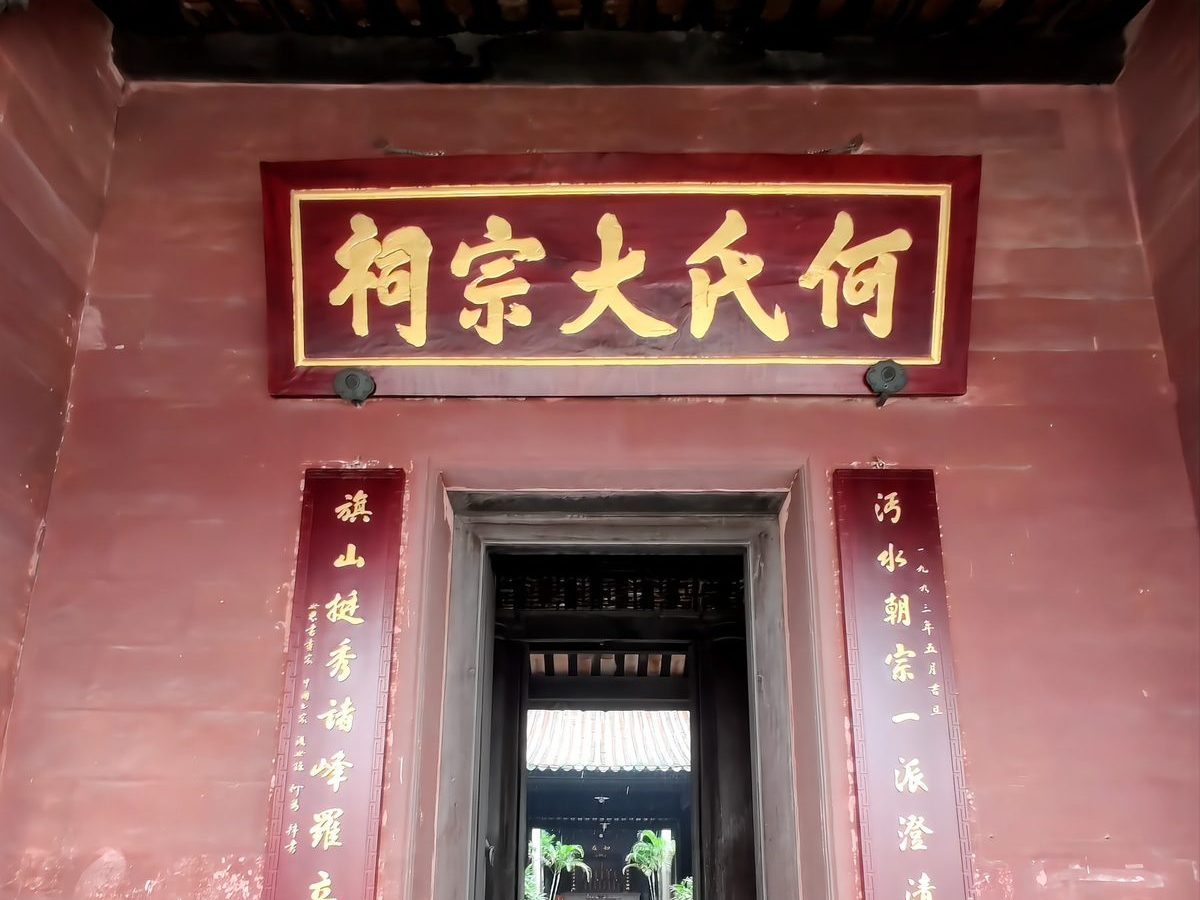
The He Clan Ancestral Hall. The plaque over the gate, and the couplet the family wrote for itself: the earlier generations build, the later generations continue, and the whole clan reads it as a job.
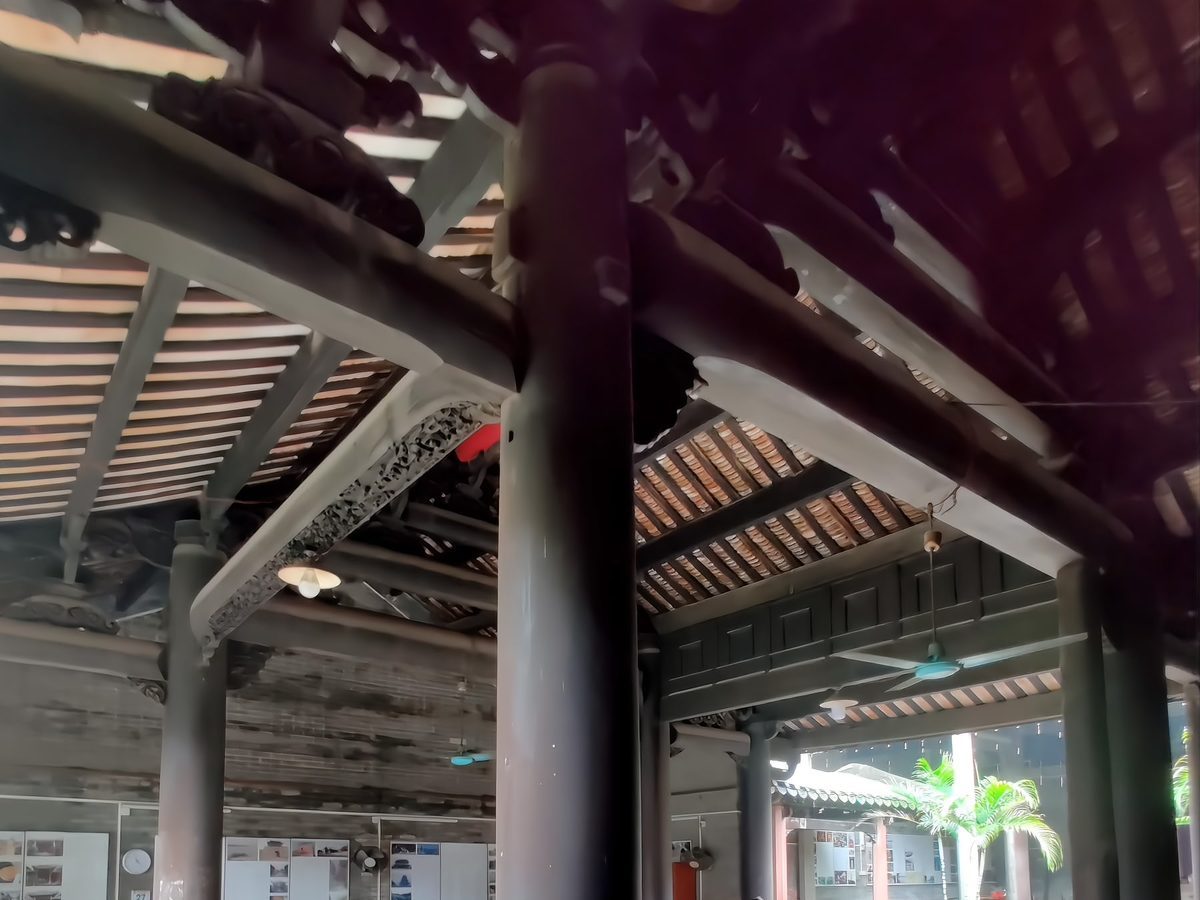
Under the columns. 112 columns hold up the hall; the central Hall of Exemplary Worthies stands on twenty-eight of them, each so thick two men cannot reach around it.
The hall that would not die
The statement is a hall. The Liugeng Hall, the great ancestral hall of the He clan, was first raised in 1275, the first year of the Deyou reign of the Southern Song, to honour the clan's founding ancestor, He Renjian — the man who bought the sand. Since then it has been destroyed three times and rebuilt three times. It was enlarged in 1440, destroyed again during the early-Qing coastal clearances, and raised once more under the Kangxi emperor: work began in 1700 and took seventeen years, laid out to the specifications of a Ming-dynasty official's family temple. The building you walk through today is that Qing rebuilding. (One honest note: the clan's own records date the completion to 1721 rather than 1700, so both are kept here.)
It is the oldest and largest surviving village ancestral hall in the Guangzhou region, and it predates the far more famous Chen Clan Academy — founded in 1888 — by more than a hundred and seventy years. Archaeologists call it a palace of Lingnan architectural art, and the state agreed in 2019, when the hall was named to the eighth batch of national protected sites.
Walk in and the scale hits you. The hall runs on a north-south axis, five bays wide and five courtyards deep, a bar of stone and timber more than eighty metres long, covering some 3,300 square metres. To hold up a span like that before reinforced concrete existed, the builders used columns — 112 of them — and the central hall alone stands on twenty-eight giant columns that two men cannot reach around.
Then the details. The east and west gable walls are built of oyster shell, laid so the pale shells catch the light — a wall material you will not see anywhere else in China. The north and south walls are grey brick. Between the wings run the blue cloud lanes, the narrow side passages that give a Lingnan courtyard its breathing room. And at the second gate stands the ceremonial gate, a three-arch stone pavilion with a ridge of grey moulded ceramic in the shape of a coiling dragon, a feature found on no other old building nearby.
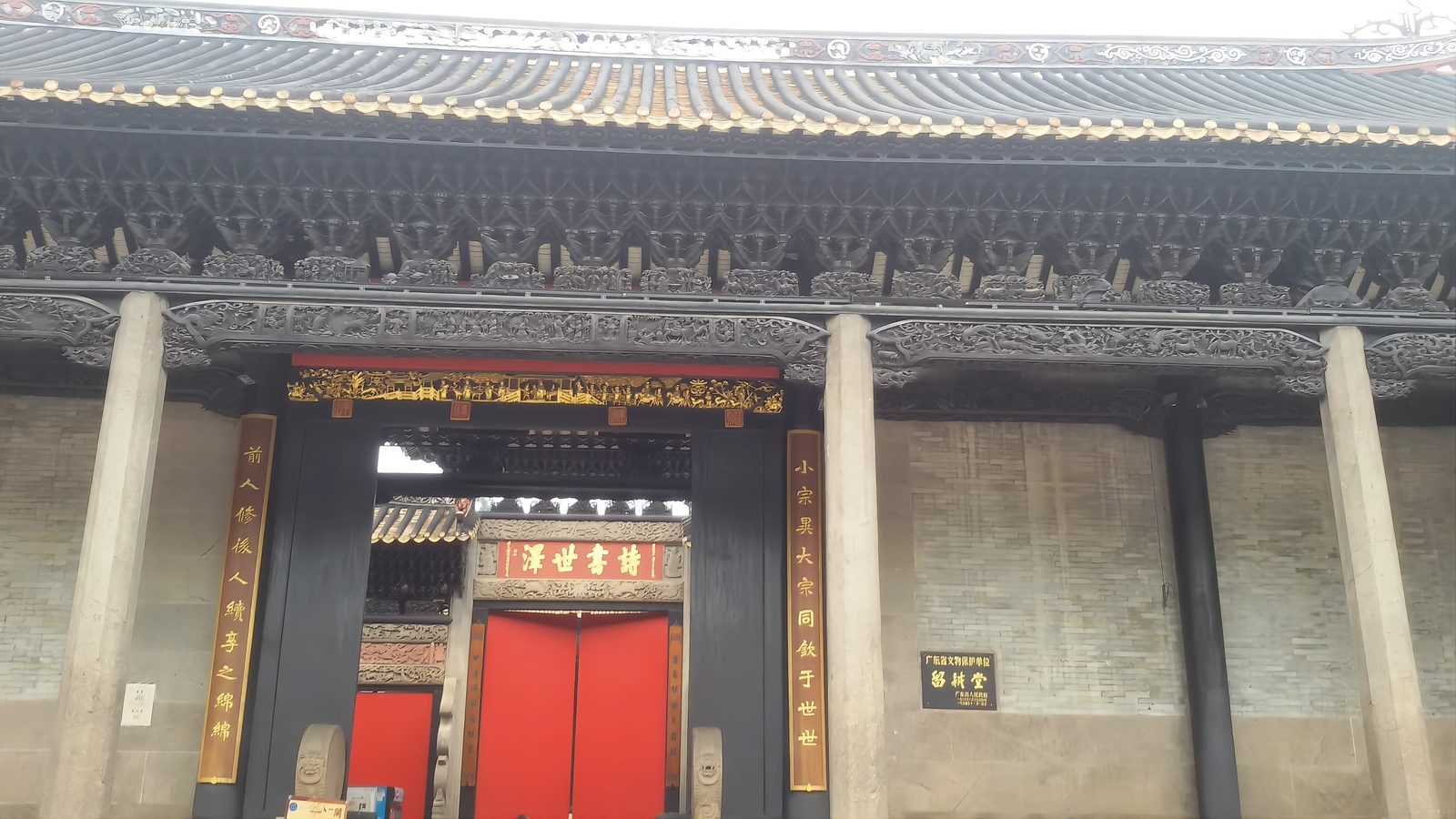
The ceremonial gate. The stone arch with its coiling-dragon ceramic ridge. The front plaque, A Scholarly Legacy, was written by the Ming scholar Chen Xianzhang; the back carries the three phoenixes.
Three phoenixes and a bookshelf
The back of that gate names the He family's proudest moment. In the Zhenghe reign of the Northern Song, around 1115, three He brothers — He Tang, He Li and He Ju — sat the palace examination together, and all three passed as advanced scholars. In an age when the examination was set by the emperor himself, one family producing three successful candidates at once was almost unheard of. He Li, the second brother, took the highest rank of all: top scholar, then the emperor's son-in-law, and finally vice grand councillor. The family carved their glory into the gate as three phoenixes in lasting fragrance.
That was not a one-off. From the He clan of Shawan came eight military and civil advanced scholars and close to fifty recommended men across the centuries, and the forecourt of the hall was once lined with flagpole stones — the markers a family planted when one of its sons passed the provincial exam. The poles stood like a forest.
The name of the hall itself comes from a couplet by Chen Xianzhang: plant far off the hidden virtue from your ancestors, and leave the heart's field to be tilled by your descendants. The He clan read that as a job. They were a family of the book, and they meant to stay one — and the grooves they cut into the local culture run deep enough that the hall still hosts the first writing ceremony for children, the breaking of innocence, where small pupils are led through the old ritual of becoming scholars. The ceremony was revived here in 2012, and the book is still open.
The sound of the water town
Writing was only half of Shawan's story. The other half was sound.
The town is one of the birthplaces of Guangdong music, the bright, swift instrumental style that became the signature sound of the Cantonese south. In the mid-nineteen-twenties a group of He clansmen known as the three masters — He Liutang, He Yunian and He Shaoxia — lifted the form to national fame, and three of the four great pieces of the Guangdong repertoire were written here: Dragon Boat Race, Rain on the Banana Leaves and A Hungry Horse Rings the Bell. He Liutang is said to have found the melody of Rain on the Banana Leaves in the courtyard of the hall below.
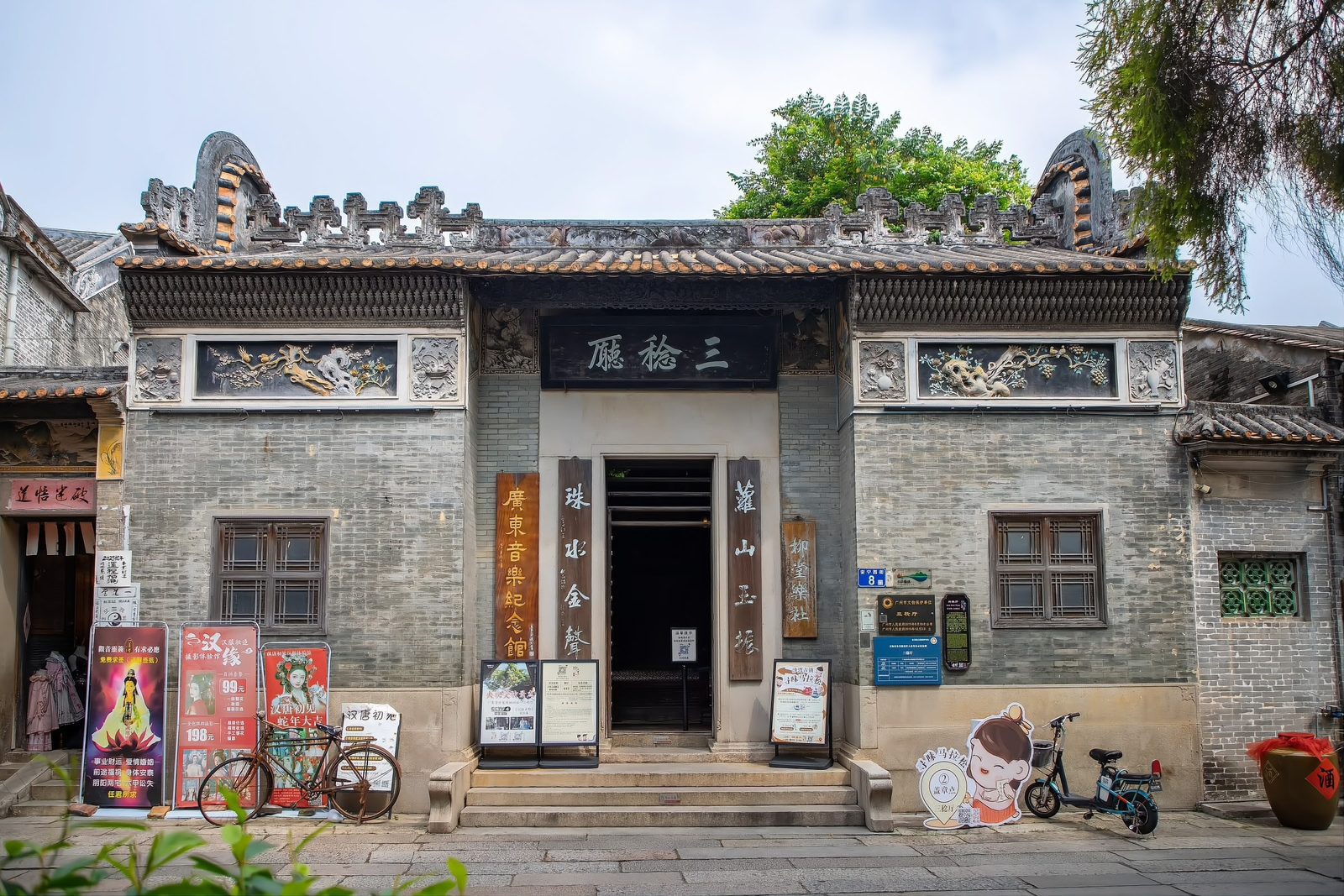
The Sanren Hall, on Peaceful West Street. Named for the fruit tree in its yard, this plain building was where the He musicians played, traded and composed — now kept as the birthplace-of-Guangdong-music memorial hall.
The room where it happened still stands. The Sanren Hall, a plain building on Peaceful West Street, was the gathering place where the He musicians played, traded and composed, and it is now treated as a holy site of the music — a couplet over its door folds two of the famous pieces into a single line. Around it grew the private troupes, the amateur clubs of devotees who met to play for the love of it, and about ten of those clubs are still active in Shawan today. You can walk past a banyan tree or a courtyard on any afternoon and hear the strings.
The form entered the provincial intangible heritage list in 2013, but the music had already outrun any list a century before, carried by players and recordings across Guangdong, Hong Kong, Macao and the communities overseas.
The frozen drama
Once a year the music stops and the town floats.
On the third day of the third lunar month — the birthday of the Northern Emperor, the water god the town has honoured since the Ming — Shawan holds its piaose, the floating colours parade. Children are dressed as figures from legend and history and mounted on a colour cabinet, a wheeled mobile stage, and the higher child, the one who seems to hang in the air with no support, is held by hidden steel rods inside the frame. The lower child, usually ten to twelve, is the screen; the upper, sometimes only three, is the float.
The effect is why piaose is called frozen drama and walking sculpture. One popular story of its origin says it all: when the Qing court banned Cantonese opera and burned the opera houses, the people who had come for the birthday fair still wanted their stories — so they dressed children as the opera figures and paraded them instead, singing nothing, showing everything.
The 2009 entry built on the dragon boat theme — the stage moved onto an electric cart, a dozen children floating above it — took the national folk art prize, the highest honour the craft can receive. The parade is a provincial intangible heritage, and it has become the event that pulls overseas kinsfolk home, the thing that ties the scattered family back to the street where the flagpoles once stood. An old Pearl River Delta saying remembers the crowds it drew: when Shawan parades its colours the rain drizzles, doors are shut and relatives are avoided — everyone has already gone to watch.
The craft is carried in the hands. Li Hanming, a third-generation maker from the east of the town, broke with bamboo in the 1980s and forged the first metal colour stem out of bicycle steel tubing, painted with bamboo-node lines to keep the look; in a 1996 typhoon his titanium stem held a seven-year-old steady in the wind. On his deathbed in the winter of 2022 he finished his last design: a take-apart digital colour stem, every part printed with a QR code that plays his installation tutorial for the apprentices. He told them he had spent his life afraid of being copied, and was now afraid of taking the skill to the grave.
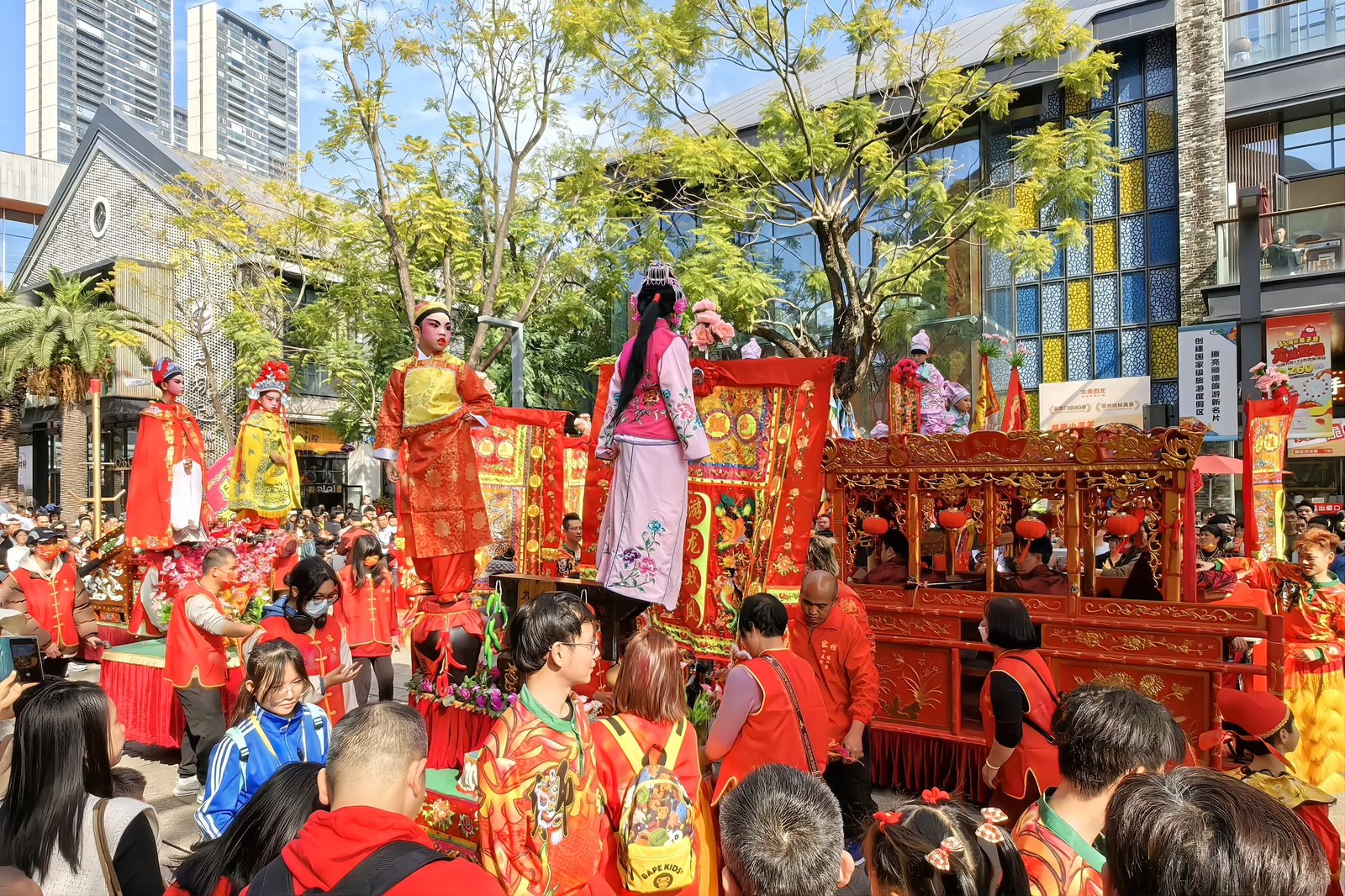
Frozen drama. A Lingnan floating-colours parade — photographed at Ronggui in neighbouring Foshan, the sister tradition to Shawan's own, because no freely licensed photograph of Shawan's parade exists yet. Same cabinets, same hidden stems, same three-year-olds in the air.
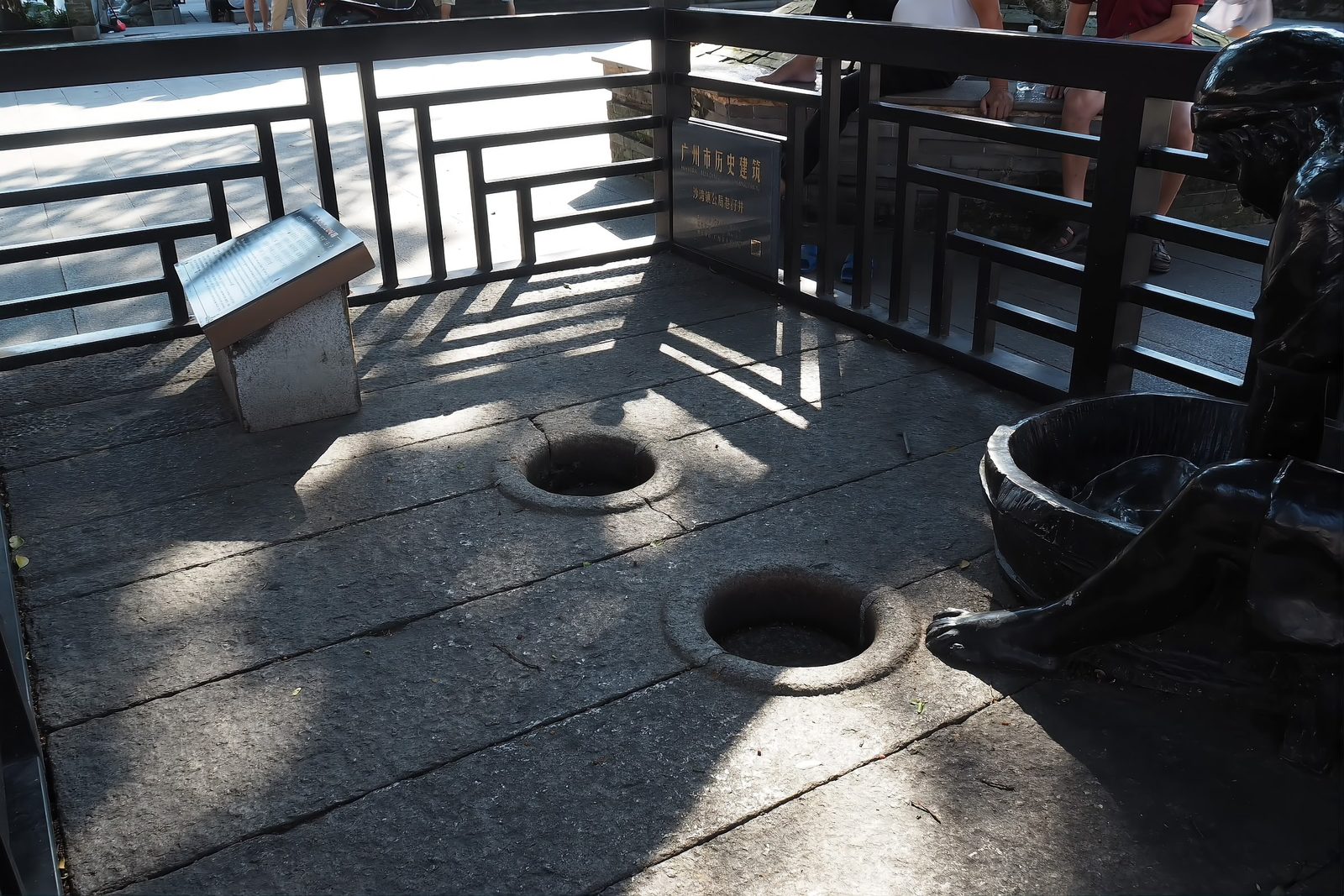
The clear water well. The town's fabric is still lived in: granite paving, old wells, doorways where the neighbours sit out the afternoon.
The bowl that was an accident
Shawan's third gift is eaten with a spoon.
The ginger milk curd — called ginger buried milk in the local speech — began as a mistake. An old woman of the town had a cough that would not clear, and someone told her ginger juice would help, but the juice was too fierce to swallow. Her daughter-in-law meant to warm milk for her and poured the hot water buffalo milk into the bowl that held the ginger by accident. The milk set. The old woman drank it, found it smooth and warming, and felt better the next day. The town has been making the accident on purpose ever since.
The trick is chemistry, not magic. Water buffalo milk from Shawan is rich and fatty, and the protease in fresh ginger makes the milk protein coagulate in about fifteen seconds when the milk is poured at the right temperature — hot, but not boiling. The locals call the setting mai, to bury or to merge, which is why the dish is ginger buried milk, a name that points at the harmony of the thing rather than the clash. A bowl is done when a spoon laid on the surface stays afloat.
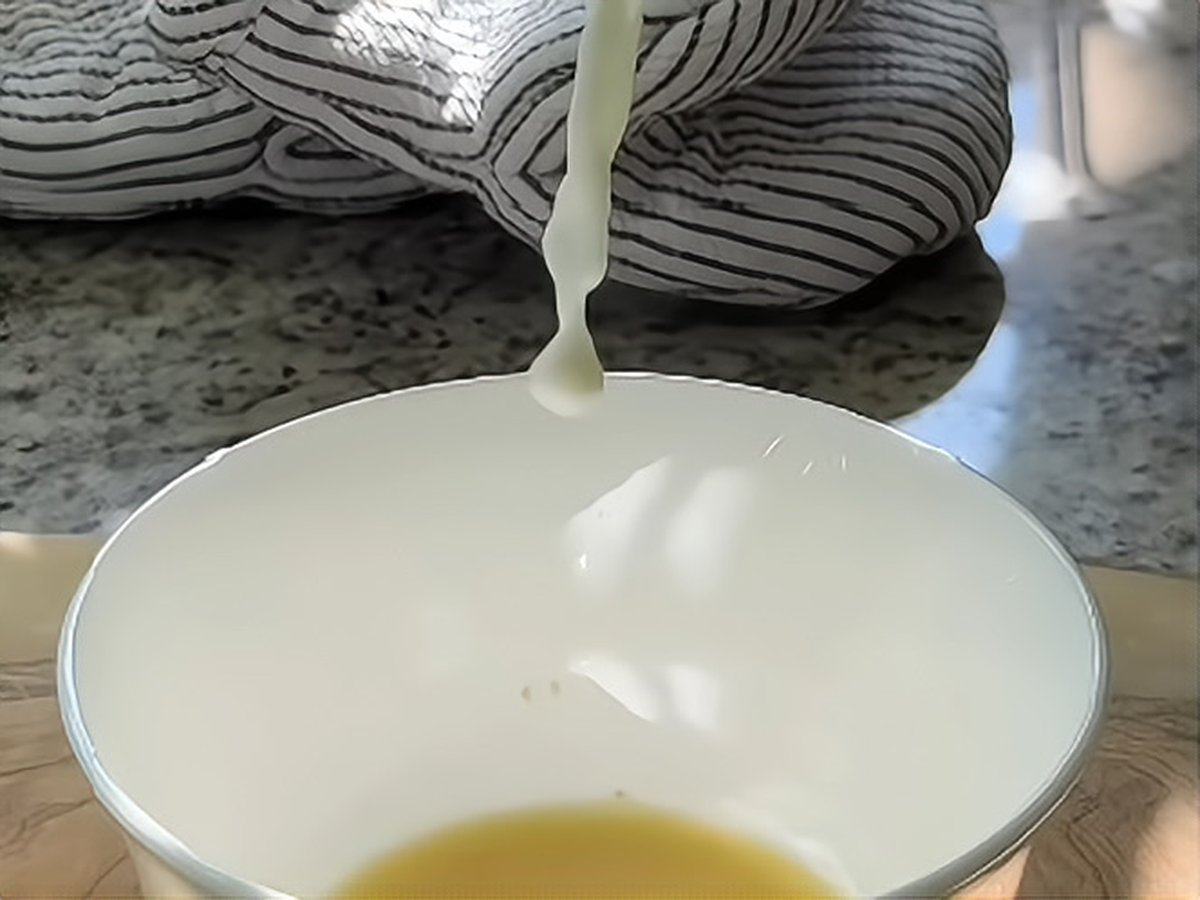
The accident. Hot milk meeting the juice — the mistake that became the town's sweet, still made by pouring at the stove.
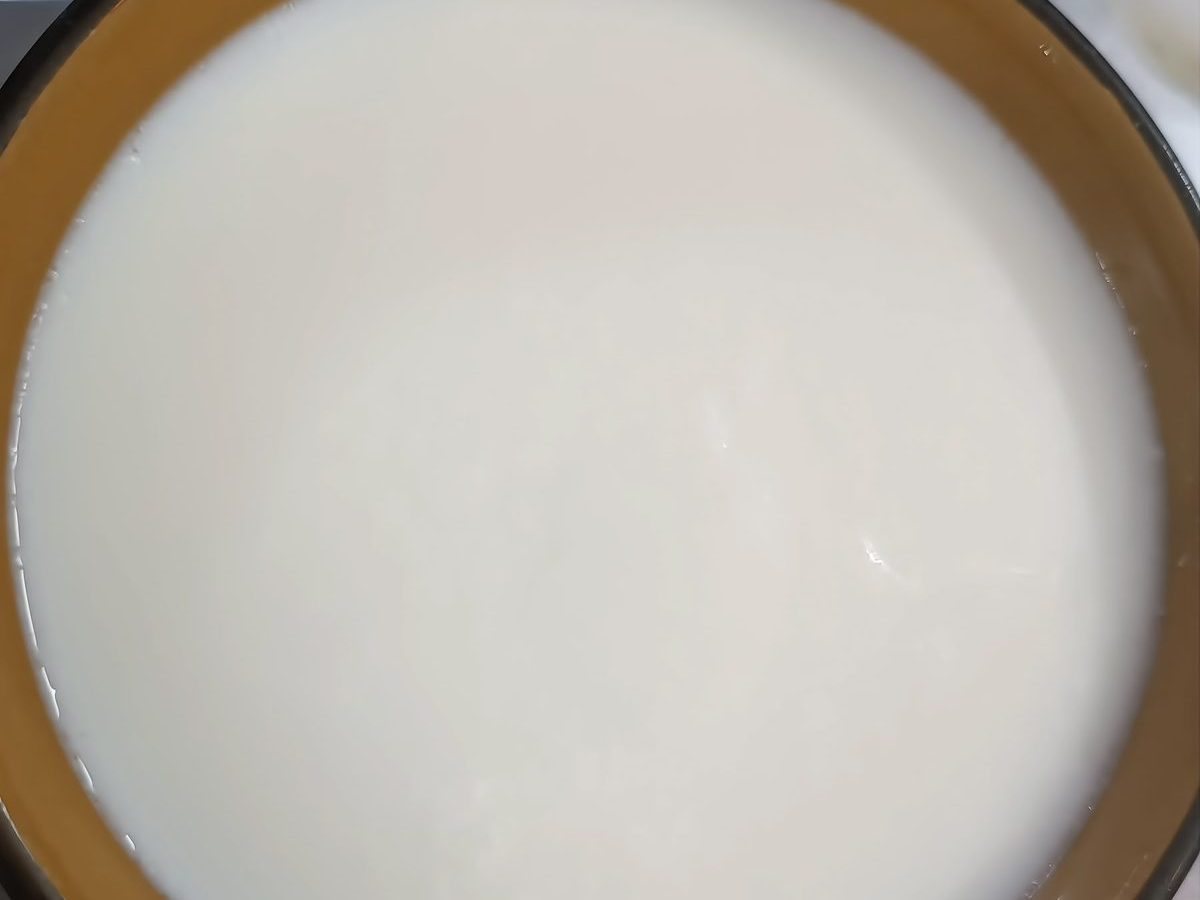
After. Hot buffalo milk poured in, and fifteen seconds of chemistry — a spoon will stay afloat on the surface. The set bowl photographed in Panyu.
Two shops carry the name now — the Milk Queen of Shawan and the Qin Fang Garden — both run by designated bearers of the intangible craft, and between them they sell several thousand bowls on a normal day and five or six thousand at a festival. It is a sweet that left Shawan and never forgot where it came from.
Walls of shell and ears of wok
Under the music and the parade the town keeps its bones. Shawan preserves the old layout of stone steps and stone lanes, some ten kilometres of granite pavement, and the houses carry the marks of the Lingnan builder. The oyster shell walls of the great hall are the most famous, but the wok ear houses are the most seen, their roof gables curved like the handle of a wok, a shape that marked a family of standing. The timber and stone entry doors, the screen and the round louvre, are still on many fronts.
The Wen Tower, the tower of letters, stands for the scholars the town kept producing, and the village core — Shawan North — holds the lanes and the ancestral halls much as they were: a living map of how a Guangdong water town arranged itself around clan and study. Nearly seventy ancestral halls survive in the town, and the Liugeng Hall is counted among the four great halls of Panyu. In 2013 the village core was named to the second batch of China's traditional villages.
"The bay is long gone. The town it became is not."
The closing line of the editorial this page is built on — and the shortest summary of what eight hundred years in this one curve of sand produced.
What is there now
Shawan is a national four-A scenic area and the only National Historical and Cultural Town in Guangzhou — named in the second batch of the national list in 2005 — and it has not been turned into a picture. People still live in the lanes, still play in the private troupes, still make the ginger milk at the stove, still take their children to the first writing ceremony in the hall their ancestors raised.
The town has kept producing people, too. The chemist He Binglin, born in Shawan in 1918, went from the Xiangxian school here to the Southwest Associated University and on to Indiana for his doctorate; blocked from home by the Korean War, he returned in 1956 and became the founding father of China's ion-exchange resins. His memorial hall stands in the town, a few lanes from the music.
You can walk the stone street, stand under the coiling dragon on the ceremonial gate, hear Rain on the Banana Leaves drift from a courtyard, and eat a bowl that was a mistake. Even the phone companies have noticed the place: a recent flagship handset was filmed against the hall's stone. The bay is long gone. The town it became is not.
Walk the Liugeng Hall in the late afternoon, when the low sun comes across the pond and the oyster-shell walls catch it. Then take Peaceful West Street to the Sanren Hall, listen for the strings, and finish with a bowl of ginger buried milk across the road from the hall's gate.
Going, and what to expect
Getting there. Shawan sits in Panyu, on the southern edge of Guangzhou, about forty minutes from the city centre by road. The public route is Metro Line 3 to Shiqiao Station (Exit B or C), then bus 番67 or 番12 to the South Gate of the ancient town — the bus ride is short and the stop is signposted. A taxi from Shiqiao runs fifteen to twenty minutes, about ¥20–30. From Guangzhou South Railway Station, bus 108 reaches the West Gate, or a taxi is about twenty minutes. Driving, navigate to the South Gate car park; the roads in are narrow and the old lanes are not for cars.
Tickets and hours. The town's streets are free and open around the clock — you can walk the lanes at any hour. The exhibition halls (the Liugeng Hall, the Sanren Hall and the other museums) keep daytime hours, roughly 9:00 to 17:30, on a combined ticket of about ¥40, usually nearer ¥30 bought online, with half price for students, children and older visitors. The combination and the day's arrangements shift with the season and with festivals, so check the current listing before you set out.
The moment to be there for. Late afternoon into dusk. The light comes low across the pond and the lanes, the fish-lantern streets on Chebei Street fill with shadow, and the halls close around you — which is the point, because the town belongs to the people who live in it after the visitors have gone. The floating colours parade runs on the third day of the third lunar month, and the town also mounts smaller processions around the spring festival and national day.
Two honest notes. The granite paving is beautiful and uneven — shoes with grip matter, especially after rain. And weekends bring the crowds from the city; weekday mornings are the quiet ones. Everything above is right in shape and could be wrong in detail on the day you arrive.
Photographs and sources
Photographs from Wikimedia Commons, used under their Creative Commons licences and enhanced for this page: the Liugeng Hall across the pond (CC BY-SA 4.0, 古海岸遗址), the hall entrance and interior columns (CC BY-SA 4.0, Augusthaiho), the ceremonial gate (CC BY-SA 4.0, 广州阿沾), the Sanren Hall (CC BY-SA 4.0, Pkkj), the clear water well (CC BY-SA 4.0, 古海岸遗址), and the two bowls of ginger juice and set curd (CC0, Lau Hau Yatyue Tiger). The floating-colours photograph is the sister parade at Ronggui, Foshan (CC BY-SA 4.0, Uuongkinghe), used because no freely licensed photograph of Shawan's own parade exists — it is captioned as such on the page. History drawn from the Shawan editorial source file, cross-checked against the People's Daily account of the Liugeng Hall (scale, the three-phoenix gate, the 2019 national listing), the State Administration of Cultural Heritage list of the second batch of National Historical and Cultural Towns (2005), the Panyu district government's intangible heritage pages (Guangdong music, floating colours), the Guangzhou Civil Affairs Bureau's place-name history, and current Chinese ticketing and transport sources. Where the records disagree — the completion of the Kangxi rebuilding (1700 against 1721) — both figures are given rather than resolved.
There's more where this came from.
Read the latest insider notes →Two new posts a week — the things a non-resident can't know, written down before they cost you a morning.