Zhenhai Lou (镇海楼)
For six hundred years this red tower on Yuexiu Hill was the first thing ships saw coming up the Pearl River, and the saying went that if you had not climbed the Five Storey Tower, you had not been to Guangzhou. It was raised in 1380 by a marquis who was flogged to death in the same year, burned and rebuilt six times, and since 1929 it has been the Guangzhou Museum — the city's whole history stacked in five floors.
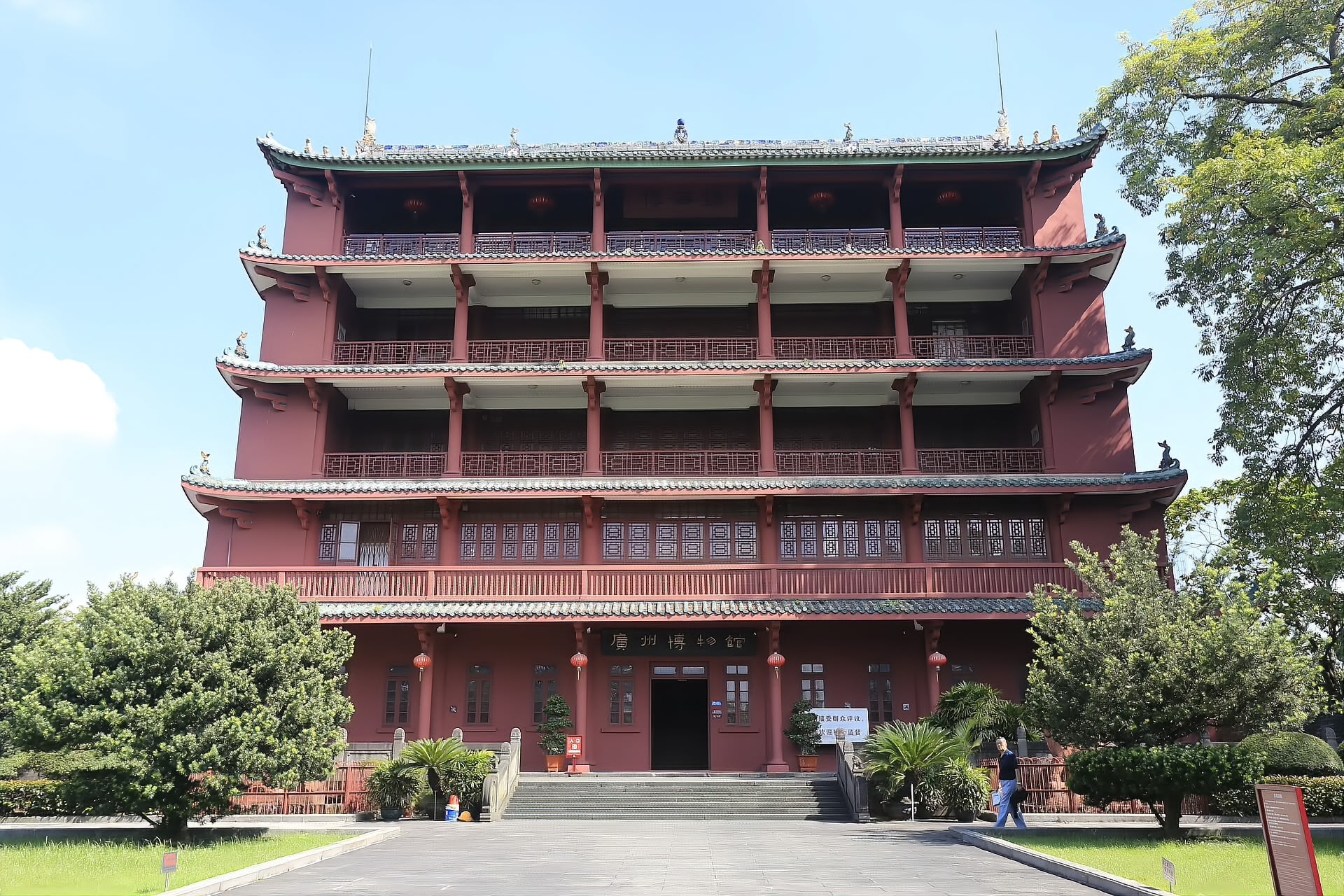
The Five Storey Tower. Red walls, green tiles, wider at the bottom than the top — a hall from the front, a pagoda from the side. The lowest two storeys are the Ming original, in the red sandstone of the hill it stands on.
The sail of the city
For most of its history Guangzhou was a low city — warehouses, temples and two- and three-storey trading houses packed close to the water — and on the northern edge, where the Ming wall ran over the shoulder of Yuexiu Hill, one building had no rival for height. Sailors coming up the Pearl River took their bearing from it. Export painters put it into albums sold to Europeans who would never make the voyage, which is why a tower on a hill in Guangzhou turns up again and again in paintings made for people on the other side of the world.
The old way of describing the city turned it into a vessel: the Flower Pagoda at the Temple of the Six Banyans and the minaret of the Huaisheng Mosque were its two masts, and the red tower on the hill was the sail. The name the Ming builders gave it says the same thing more bluntly — Zhenhai Lou, the tower that holds down the sea. Cantonese still say you have not been to Guangzhou until you have climbed it.
The marquis who moved a wall
The man who built it had fought on both sides of the war that founded the Ming dynasty. Zhu Liangzu began as a Yuan commander, was captured by Zhu Yuanzhang, went back to the Yuan, was besieged, broke out — wounding one of the hardest fighters of the age on the way — and was taken a second time. Asked what he intended, he answered: alive, I give you my strength; dead, I am dead. Zhu Yuanzhang let him live, and from then on he fought well — at Poyang Lake, at Wuchang, in the campaigns that took Zhejiang and Fujian, and in 1368 in the expedition that brought Guangdong over without a battle. In 1370 he was made Marquis of Yongjia; in 1379 he was sent to hold Guangdong.
The city he found there was three cities. The Song had walled an eastern, a western and a central quarter, and by the fourteenth century the ground between them had filled with houses that had no wall at all. In 1380 Zhu Liangzu pulled the three into one, carried the north wall more than eight hundred zhang up the slope onto Yuexiu Hill, and on the highest point of the new wall set a five-storey tower. The practical reason needs no geomancy: a tower on ground close to fifty-five metres above the river sees every approach to the city, and its base walls are nearly four metres thick. There was a story, though, about pressing down a purple cloud that hung over the hill because an emperor would rise there — one Guangdong literary history retells it and then calls it nonsense, which is probably the right verdict.
Zhu Liangzu did not live long enough to enjoy it. A Panyu magistrate named Dao Tong refused to protect the local bullies, and the bullies had the marquis's ear; Zhu Liangzu wrote to the throne, and the emperor had the magistrate executed — then found out what he had done. On the third day of the ninth month of 1380, the same year the tower went up, Zhu Yuanzhang summoned the marquis to the capital and had him and his eldest son flogged to death in his presence. He wrote the epitaph himself and buried him with the rites owed to his rank. Ten years later, in the settling of the Hu Weiyong case, the title was struck out and a second son was killed.
What the sea was
The tower was not called Zhenhai at first. It was called Wanghai — for looking at the sea — and the sea was the Pearl River, which in the fourteenth century was wide enough in front of the city to earn the word. The building burned, lay in rubble, and was rebuilt between 1545 and 1547 by the supreme commander Cai Jing and the vice minister Zhang Yue. By then the coast was troubled, and Zhang Yue renamed the tower from a phrase about mightily holding down the maritime border: from that moment the sea in its name meant the South China Sea. His account of the rebuild, cut into a stele dated the eleventh month of 1547, still stands in front of the building — the oldest surviving document of its history.
A Huizhou traveller named Ye Quan, who saw the rebuilt tower in the sixteenth century, left the fullest description anyone wrote: every inch of the five floors made of ironwood — beams, rafters, stairs, some timbers too big for one man's arms — so that walking inside was like walking through a cave. No builder in the central provinces could make this, he wrote, because no builder there had timber like this. Writing a century later, Qu Dajun put the tower at the head of the four great towers of Guangzhou and went further: even Yellow Crane Tower and Yueyang Tower, he said, cannot surpass it. It has been destroyed and raised again six times — by fire, by war, by neglect — and every time it came back with five storeys.
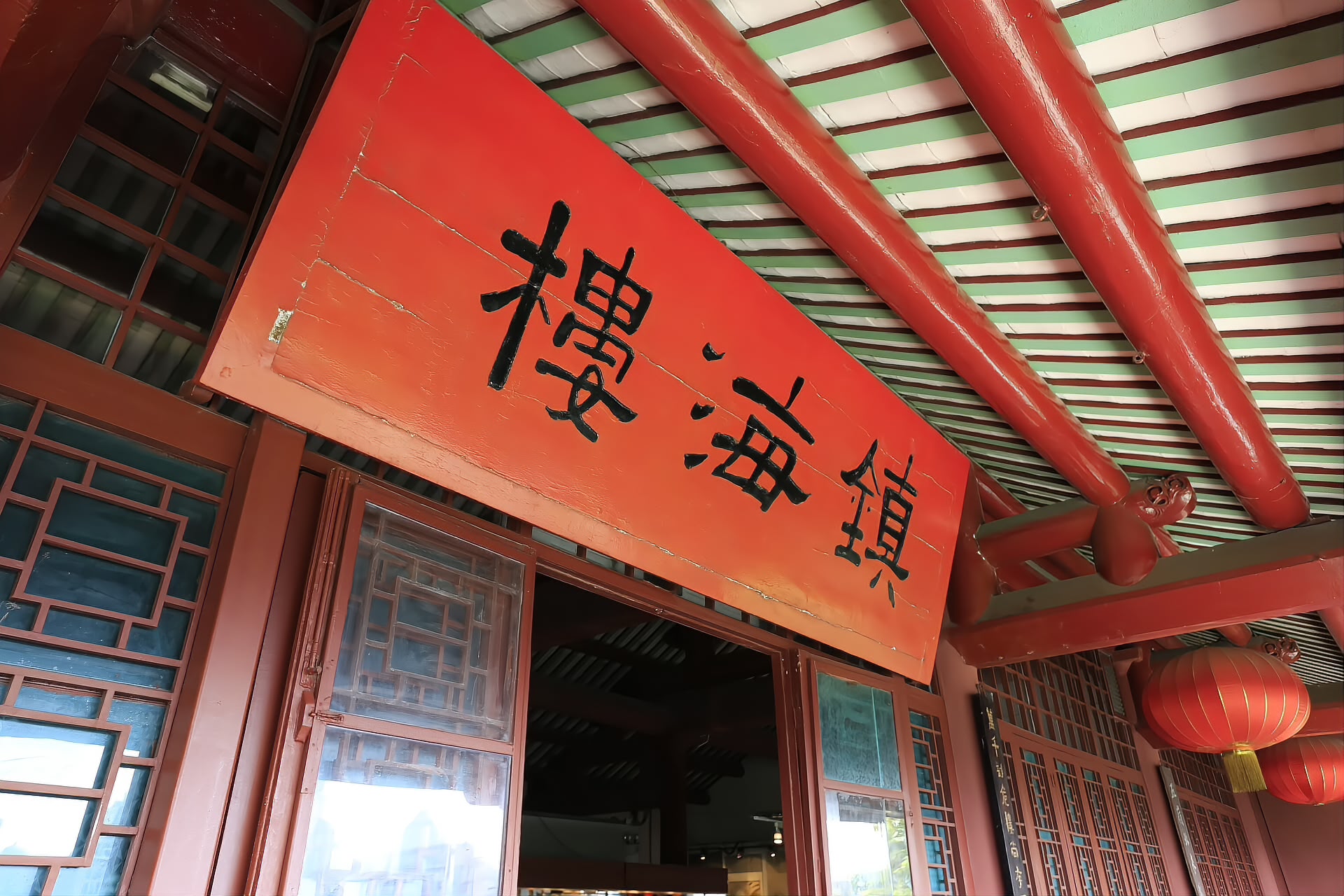
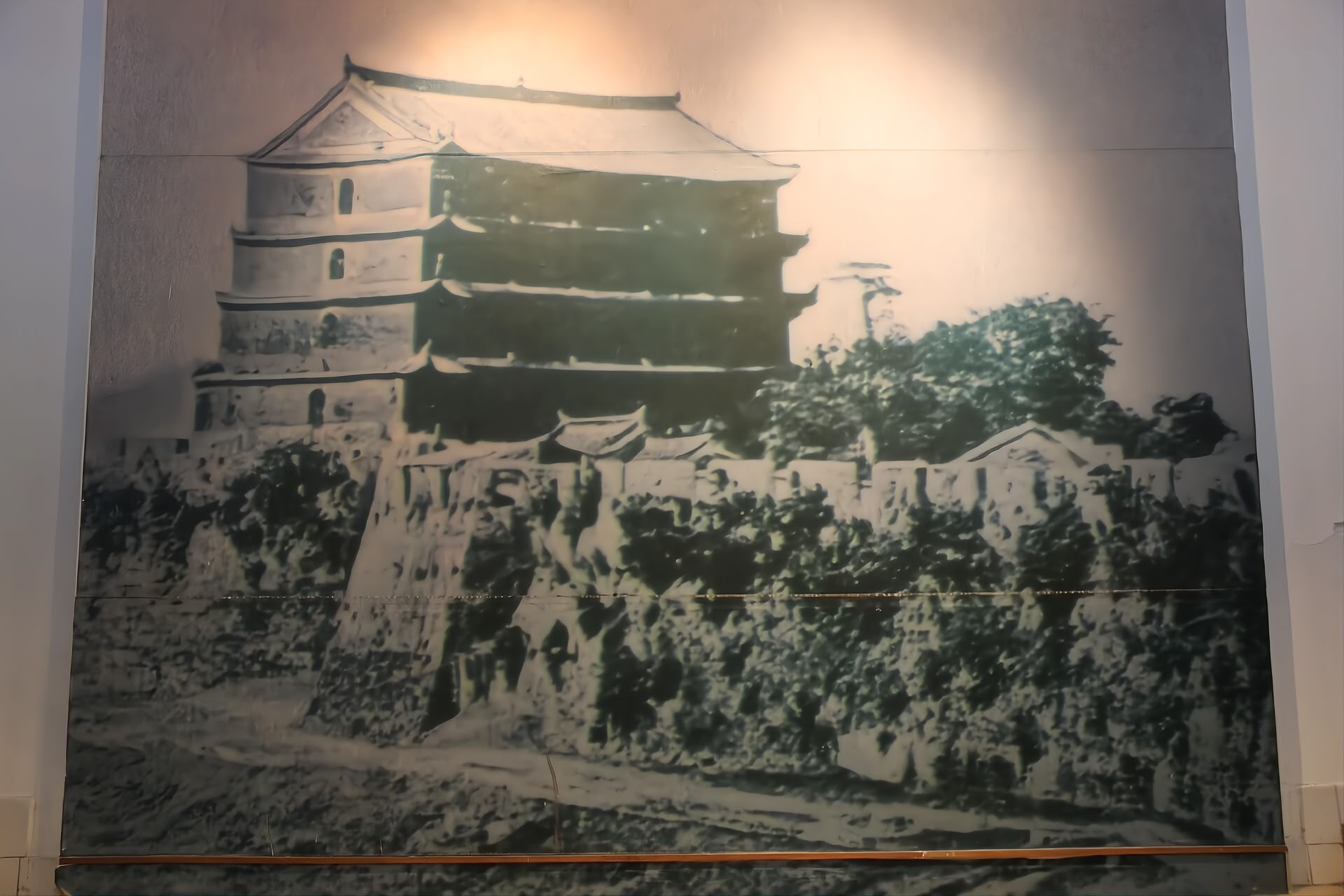
A tower with a target on it
Other famous towers stand in gardens or on river banks. This one was built into a defensive wall, between the Great North Gate and the Little North Gate, on the highest ground the wall crossed — which placed it inside every fight for the city. Rows of old cannon, cast from the Chongzhen reign of the Ming down to the middle of the Qing, still sit on the west side where visitors walk past them. In the early Qing the prince Shang Kexi kept homing pigeons on the tower and flew them to a temple up the river. In the 1850s the governor-general Ye Mingchen ran his campaign against the Red Turban rising from a command post in the building, won it, and then lost the next war: British and French forces took the city, and the hill and its tower were in enemy hands. After the revolution the warlord Long Jiguang closed the hill and put guns on it. In 1923 Sun Yat-sen went up the tower himself to direct the fighting that broke one attempt to seize the city. When the Japanese occupied Guangzhou in 1938 they used the Five Storey Tower to store gunpowder.
The poem on the top floor
Peng Yulin was Minister of War and came south in 1885 to direct the defence against France. He disagreed with the peace that followed a Chinese victory at Zhennanguan, and he wrote his disagreement as a couplet — today the most quoted thing ever written about the tower: Through ten thousand calamities, this endangered tower still stands; who now can pluck the stars and brush the sky and hold all ages cheap. Five hundred years on, where is the old marquis; he makes me lean on the rail, look at my sword and shed tears for a hero. The second line is about Zhu Liangzu, whose tower Peng Yulin was standing in and whose death he thought undeserved. Two versions of the couplet hang on the fifth floor now, one in clerical script and one in running cursive, and the wording differs slightly between them.
Poets had been coming up for a long time before him. Chen Gongyin, one of the three great Lingnan poets of the early Qing, climbed the freshly rebuilt tower in 1689 and wrote a long rhapsody on it — his own hand, the scroll he wrote himself, is held by the museum inside the building today. Kang Youwei came up at twenty-four, before he had ever left the province. Qiu Fengjia wrote about the tower at least three times, once in a set of twenty-four poems that remains the longest single group ever written about it. Gao Jianfu painted it in 1926. It was never solemn, though: old photographs show an altar to the god of literature on the top floor, and in the Republican years a restaurant traded on the premises, with cakes and tea sold so that scholars could sit all day.
Concrete, and a museum in four months
By the late Qing the tower had been reduced to four walls and a platform. In 1928 the city restored it — just over forty thousand yuan, work from May to December. The wooden floors and stairs were replaced with reinforced concrete while the Ming brick and red sandstone skin was kept, and craftsmen from the Shiwan kilns set a ceramic flower ridge on the roofline with the year cut into it: the wuchen year of the Republic, 1928. It is still there, in blue and green glaze, with the name of the kiln beside it. A stele two and a half metres tall, east of the tower, records the repair in the hand of Huang Jie, the province's commissioner of education, who wrote it out himself.
Then, while the scaffolding was still up in October 1928, a municipal meeting passed a motion that the tower should become a museum. Four months later — on 11 February 1929 — the Guangzhou Municipal Museum opened, all five floors full: geology on the first floor, then plants and animals, then minerals, then antiquities and art, and on the top floor revolutionary relics and foreign books. There were perhaps twenty-seven museums in the whole country at the time; this one opened a little over three years after the Palace Museum in Beijing. It founded the Huanghua Archaeological Institute in 1931 and published the first Chinese journal of archaeology in 1932. The collection has since grown from a few thousand objects to around a hundred thousand.
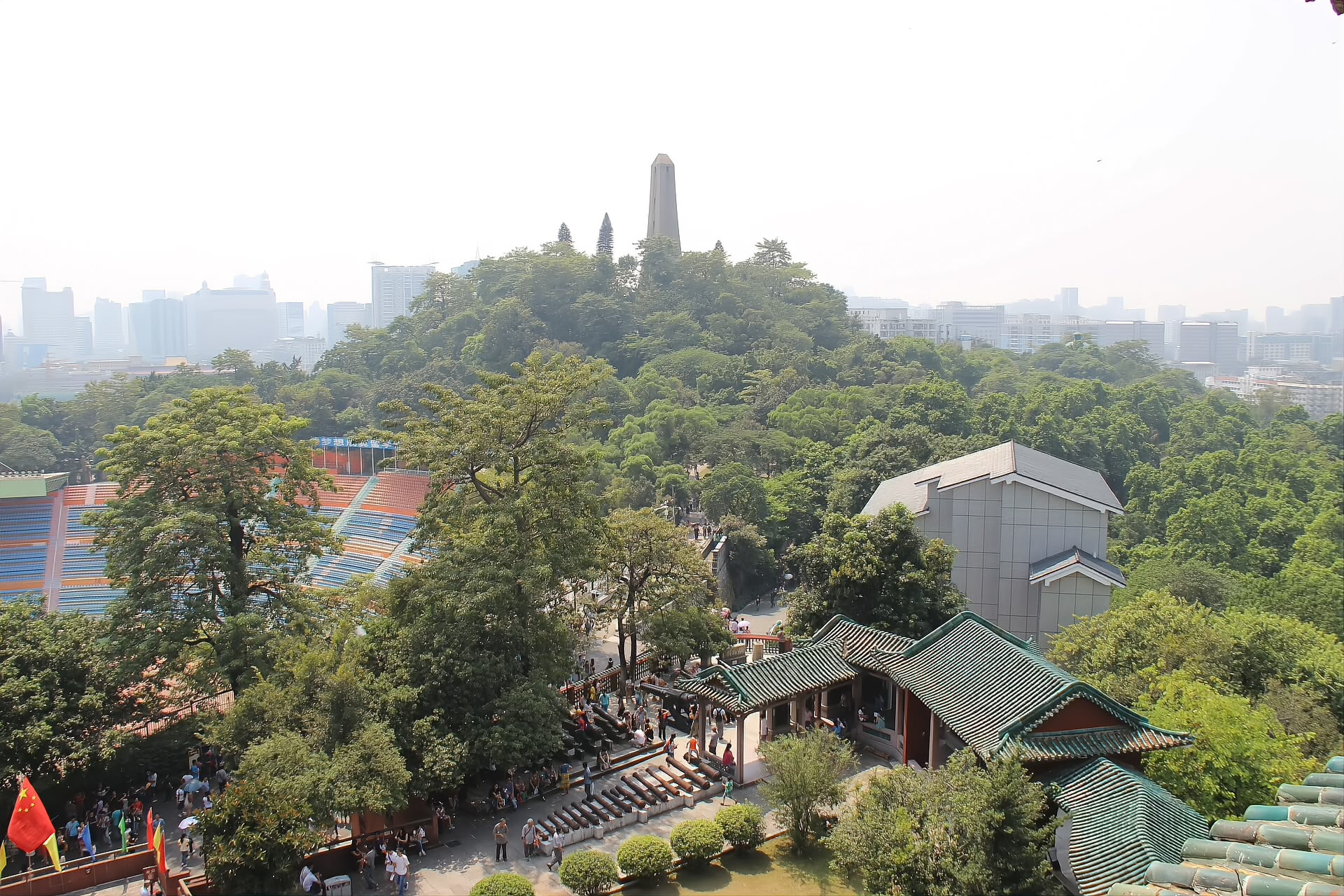
What you get at the top. The tower is still the highest point of the city's old central axis, the line that runs from here south to the river. The floors are not large and the stair is narrow — the building has always been smaller inside than it looks from the road.
The city's clock
Among the things that came into the tower was the city's clock: a bronze clepsydra cast in 1316 by two Guangzhou metalworkers, four jars stacked on a frame, with twenty names cast into the side of the largest jar listing the officials who supervised it and the men who made it. For six centuries it stood on the Gongbei Tower over what is now Beijing Road and told the city the hour. Fire in the Anglo-French attack of 1857 destroyed that tower and the clock vanished; the governor-general put a reward on it in 1860 and got it back with one jar damaged. When the city walls came down in 1919 the clock began to drift between parks and pavilions, and in the 1930s it was placed in the Five Storey Tower. The original went to Beijing in 1959 and is now in the National Museum; a copy stands in its place.
The 1547 stele and the 1928 stele stand a few metres apart outside, with three hundred and eighty years between them. Two red sandstone lions sit at the foot of the steps. And the lowest two storeys of the tower itself are built of the same red sandstone as the footings below ground — that much of the Ming building has never been rebuilt. The tower was made a provincial protected site in 1989 and a national one in 2013, together with the stretch of Ming wall it stands on: the last piece of the wall left in the city, with banyan roots grown through it. In 2019 it joined the national register of famous historic towers, alongside Yellow Crane, Yueyang and Tengwang — three hundred years after Qu Dajun said it had nothing to learn from any of them.
Going, and what to expect
Getting there. The tower stands inside Yuexiu Park, on Yuexiu Hill north of the old walled city, and the park itself is free to enter. Metro Line 2 to Yuexiu Park station, Exit B2, brings you to the park's main gate; Exit A puts you by the west gate. City buses to Yuexiu Park stop serve the main gate, and buses to Xiaobei Huquan stop serve the east gate. It is a steady walk uphill from any of them — you meet the Ming wall before you meet the tower.
Tickets and hours. Admission to the tower and museum is ¥10, with a ¥5 concession for full-time students, visitors aged six to eighteen, and those aged sixty to sixty-four; children six and under or under 1.3 metres, the over-sixty-fives, and several documented categories enter free, and groups of twenty or more pay ¥8. It opens Tuesday to Sunday, 9:00 to 18:00, with last entry at 17:30, and it closes on Mondays — public holidays excepted — like the museum it is. The museum also publishes a free-admission day each month; check its official site for the current date.
How long, and when. An hour covers the five floors and the steles outside without rushing; pair it with the rest of Yuexiu Park — the Five Rams statue, the last stretch of the Ming wall — for a half-day. Weekday mornings are quiet, and the top-floor view is best late in the afternoon, when the sun comes down the axis toward the river.
Honest notes. The founding date of 1380 is the one used by the Yuexiu district heritage survey and the city government; one literary-history essay dates it to 1374. The height is quoted as 28 metres in most official descriptions and 25.4 metres in a 2021 press feature — both figures are reported rather than reconciled. The newspaper figure of sixty to seventy thousand visitors a day in the weeks after the 1929 opening reads like the arithmetic of a proud newspaper and is repeated here as reportage, not as a count. The story of the purple cloud over the hill is retold by one literary history and called nonsense by another. Hours and prices are the museum's own 2026 figures and could shift on the day.
Walk up from the park until you meet the wall with the banyan roots, read the two steles with 380 years between them, then climb. The couplet on the fifth floor, the 1928 Shiwan ridge with its date cut into it, and the clepsydra copy tell you everything the tower has been: a fort, a poem, a museum. Then look south — you are standing on the highest point of the old city axis, and the line it ran to the river is still visible in the streets below.
Photographs and sources
Photographs from Wikimedia Commons, used under their Creative Commons licences and enhanced for this page: the tower from the front, the view from the top floor, the name plaque and the old photograph of the tower (CC BY-SA 4.0, Zhangzhugang). History drawn from the Zhenhai Lou editorial source file, cross-checked against the Guangzhou Museum's official site (the hours, the full ticket tiers with their 2026 fee-basis document, the monthly free-admission day, and the metro and bus approaches), the Yuexiu district heritage survey (the 1380 founding date), and the 2013 national listing together with the Ming city wall. Where the records disagree — the height, the founding year, the 1929 attendance figures — both versions are given rather than resolved.
There's more where this came from.
Read the latest insider notes →Two new posts a week — the things a non-resident can't know, written down before they cost you a morning.