Nanhai Temple (南海神庙)
In 594 an emperor did something no Chinese emperor had done: he built his sea god a house by the water itself, at a bend of the Pearl River east of Guangzhou. Fourteen hundred years later the temple is still there — the last whole one of China's four great sea god temples — and it carries, in stone, the entire story of Chinese sea trade: emperors' prayers, a poet's new word, a foreigner who missed his ship, and a fair that still fills the lanes every spring.
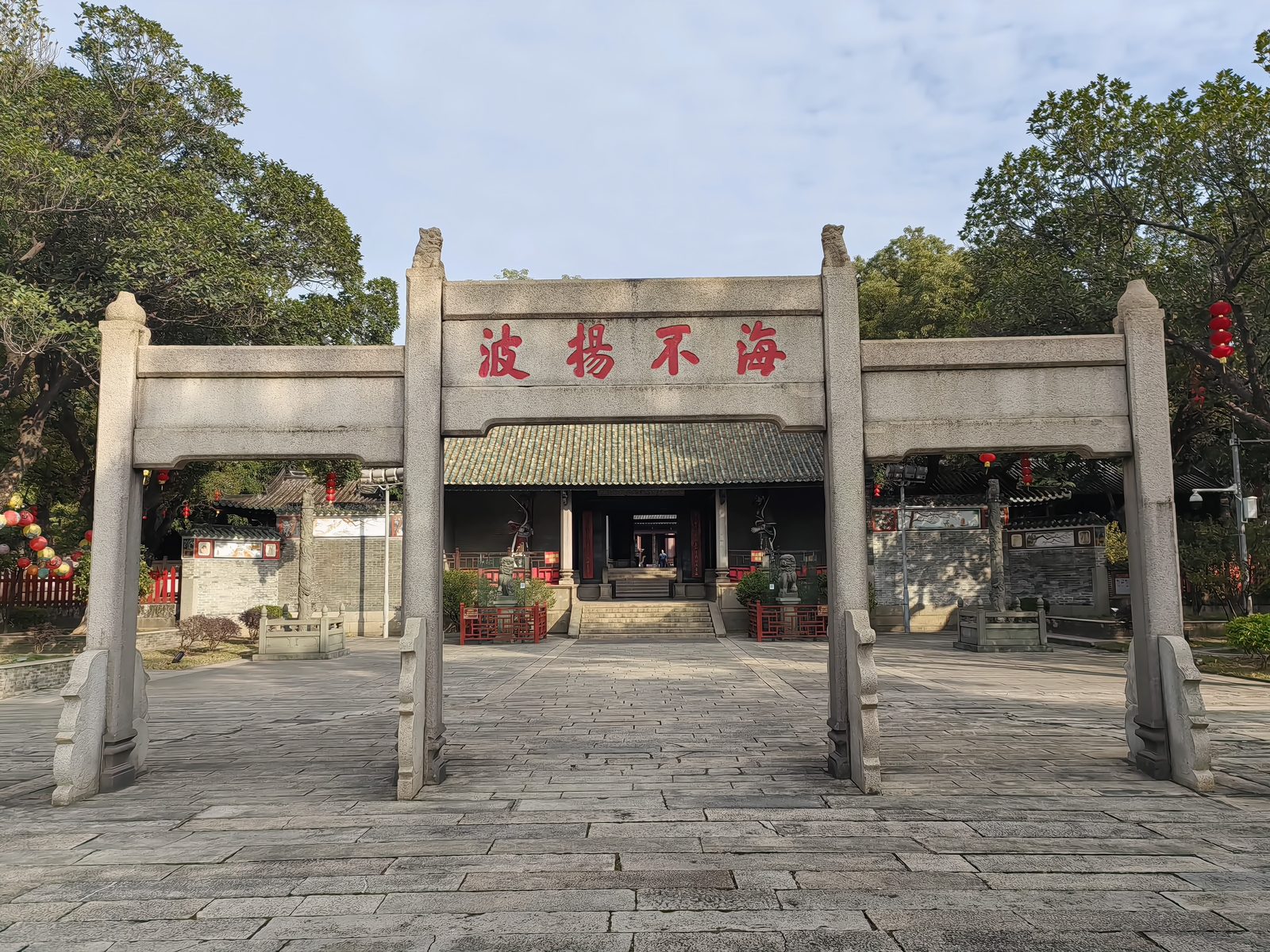
The wish over the gate. Four characters — hai bu yang bo, the sea raises no waves — on the granite archway before the first court. Everything this temple was built for is in those four words.
The temple at the river's mouth
In the fourteenth year of the Kaihuang reign — the year 594 — Emperor Wen of Sui did something no Chinese emperor had done before. Until then the emperors had sacrificed to the four seas from altars set up near the capital, worshipping the water from a distance. Wen built a shrine by the water itself. He chose a bend of the Pearl River east of Guangzhou, at a place the old records call the mouth of Fuxu and the bend of Huangmu, and he had a temple raised there for the god of the South Sea.
Fourteen hundred years on, the temple is still standing. It is the only one of China's four great sea god temples to survive whole, and it is the largest and most complete of them — a national key cultural relic since 2013, a national 4A scenic area since 2010, and one of the named historical sites in Guangzhou's bid to have the Maritime Silk Road inscribed as world heritage. The god inside is Zhu Rong, the South Sea God, and emperors kept promoting him: King of Broad Profit under the Tang in 751 — a name that means exactly what a trading port wanted, profit drawn from everywhere — further titles under the Song and Yuan, a stripping back to plain god of the South Sea by the Ming founder, and the last imperial promotion in 1724, when the Yongzheng emperor named him the Dragon King of Bright Light. With the end of the Qing, the temple's work as a place of state sacrifice ended too.
But between those dates, this was the most commercially important shrine in China. Understand why, and the temple explains itself.
The port that made the temple
A temple like this needs traffic, and the traffic was extraordinary. The water in front of it was Fuxu, Guangzhou's outer harbour in the Tang and Song dynasties — the place where foreign ships waited before sailing up to the city. The New Book of Tang records an ocean route beginning at that wharf, and it is the longest ocean route known from the eighth and ninth centuries: ninety countries and regions, eighty-nine days of sailing if you never stopped, some fourteen thousand kilometres from end to end. Every crew that passed knelt here and asked for the same thing — a quiet crossing and good trade — and the market town that grew beside the wharf, Fuxu town, became the richest in the region.
The buildings they paid for run more than thirty thousand square metres deep on a single line, five courtyards from south to north, closed in by side corridors. You come first to the granite archway and its four red characters; the Qing wharf steps still sit in front of it, and archaeologists have found the Ming wharf beneath. Then the first gate, brick and timber with splayed side walls. Then the ceremonial gate, whose middle door only the highest officials could use — the stone drums at its feet are carved with a bird, a deer, a bee and a monkey, four animals whose names in Cantonese make a pun on rank, salary and a noble title, so that everyone passing through was literally treading on a promotion. Then the ritual pavilion where the officials performed the worship, and then the great hall: green glazed tiles on a Ming-style roof, two dragons fighting over a pearl along the ridge, and inside it the South Sea God himself, nearly four metres tall with his base, flanked by six marquis gods. Against the east wall sits a bronze drum cast in the Eastern Han, a hundred and thirty-eight centimetres across and described by the temple as the third largest surviving bronze drum in China, beside an iron bell from the Ming. The last courtyard is the Palace of Bright Spirits — the bedchamber of the god's wife, honoured in the Song as the Lady of Bright Compliance, the protectress of women and children.
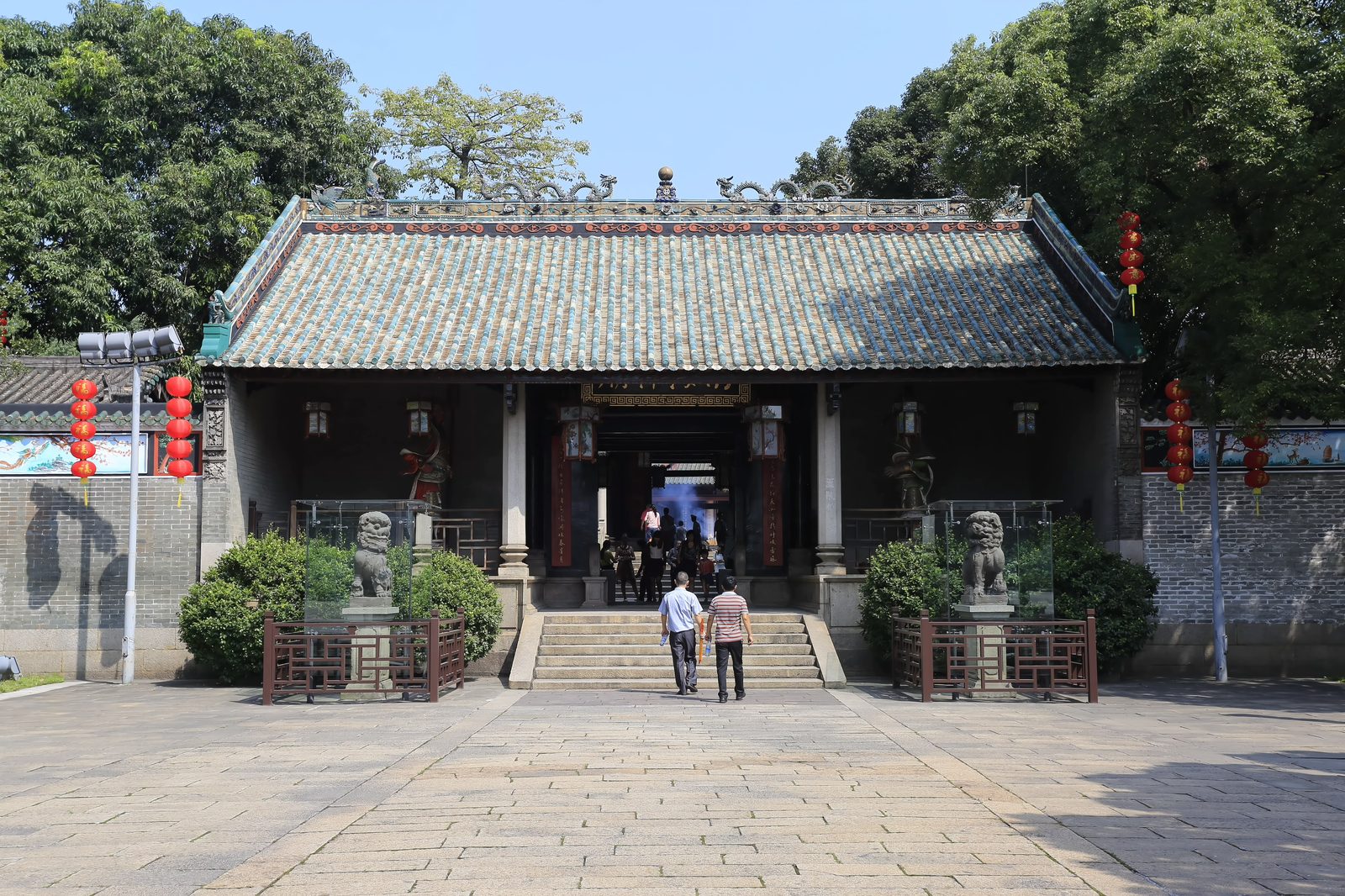
The first gate. Brick and timber in the Qing manner, the green-glaze ridge carrying its two dragons — and the incense smoke already working.
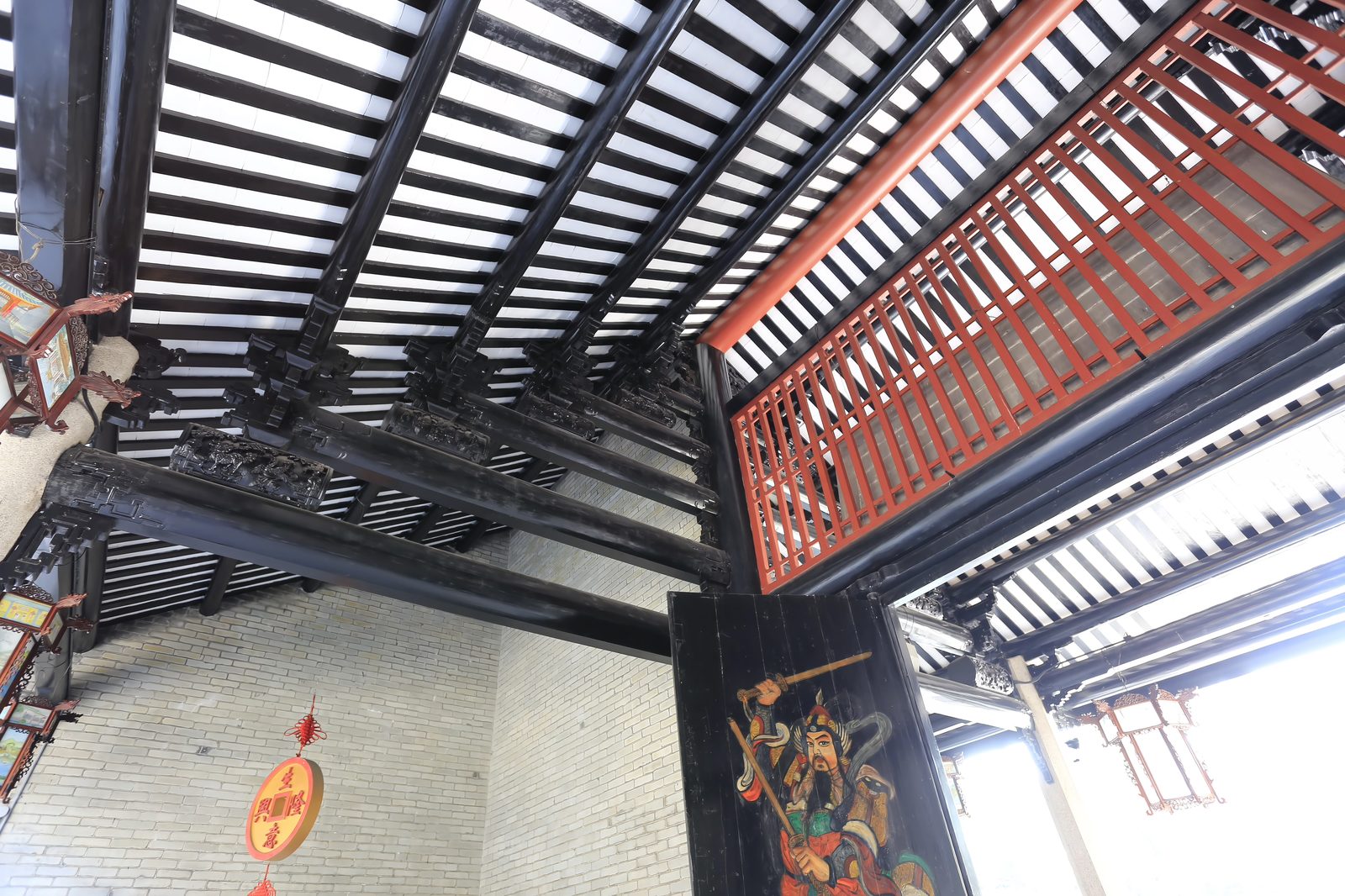
Timber and a door god. The gate's black beams and the painted guardian on the leaf — the ordinary craft of an extraordinary building.
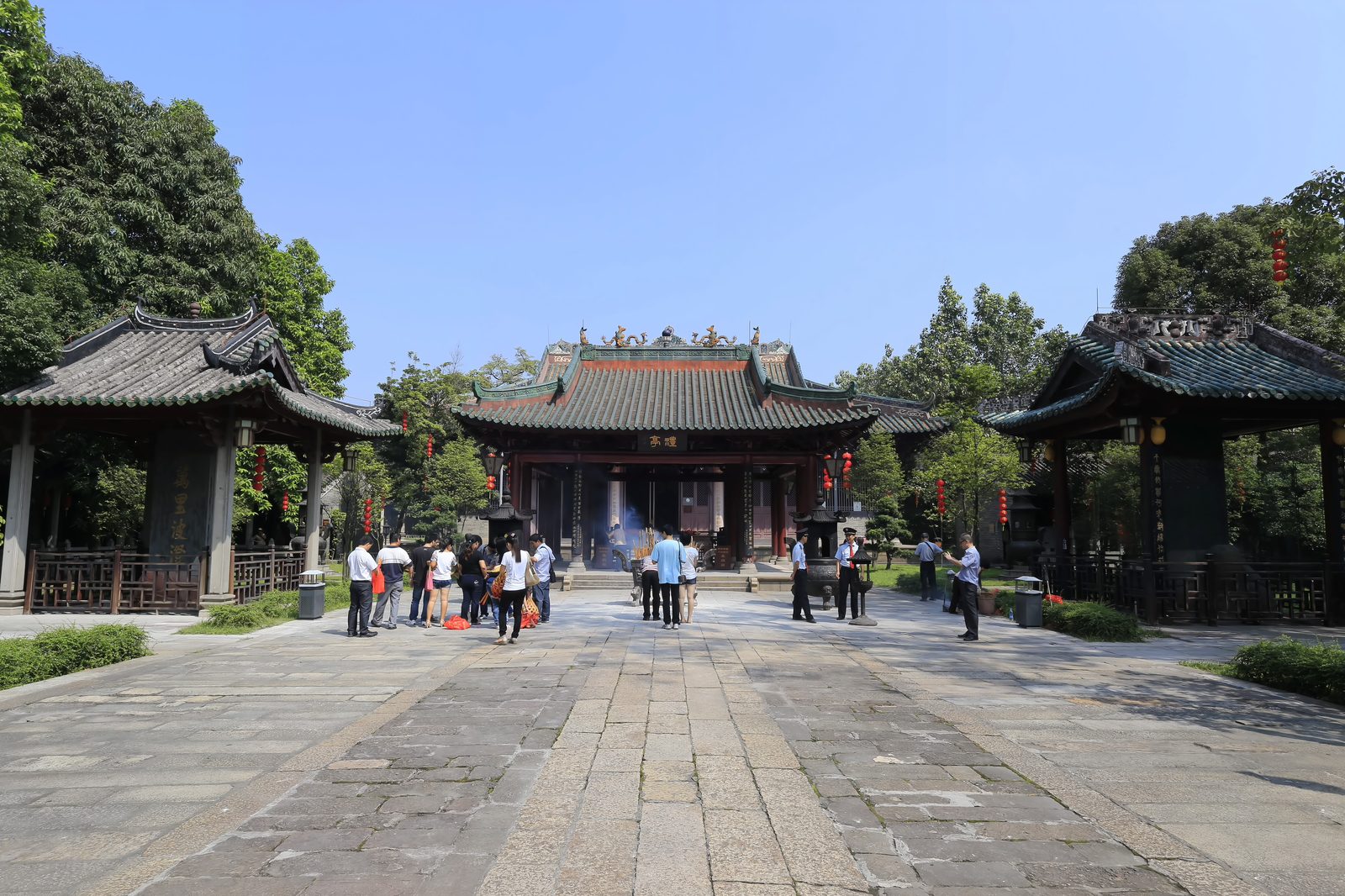
The ritual pavilion. The open hall between the stele pavilions is where the imperial officials stood to perform the sacrifice — today's visitors where the mandarins stood.
A forest of stone
The corridors hold what makes this temple different from any other shrine in the south: the steles. There are about forty-five of them today — counts vary between forty-five and forty-seven, and a Qing work on the temple records seventy or eighty in its prime — from the Tang, Song, Yuan, Ming and Qing, which is why the temple is called the forest of steles of the south. Each imperial sacrifice left a stone, so the collection is the record of a thousand years of state religion and of the trade that paid for it.
The oldest and the most famous was written by Han Yu. In 820, on his way into exile, he was asked to compose an inscription for a temple that had just been greatly enlarged, and he wrote more than a thousand characters about the rites and the rebuilding. Somewhere in that text he used a word for maritime affairs — haishi — and it is the first time the word appears in any surviving Chinese document. The term for everything ships do was born in this temple, and the modern museum beside it takes its name from the same word. Other famous hands followed: the Song stele of 973 records the founding of the maritime trade office — the first body in Chinese history with a customs-like job — the Kangxi emperor sent down four gold characters in 1703, ten thousand miles of clear water, and Su Dongpo, exiled to Huizhou and passing through, climbed the pavilion on the hill behind the temple and wrote about watching the sun come up out of the sea.
That pavilion is the Yuriting, the Bathing-Sun Pavilion, on the little hill called Zhangqiu west of the halls. The sight from it — the sun rising out of the water at Fuxu — was ranked first among the eight views of Guangzhou in Song and Yuan times. His verses, and those of the Ming scholar Chen Baisha, are cut into stone inside it. The pavilion looked straight out to sea. It does not any more, and that is the next part of the story.
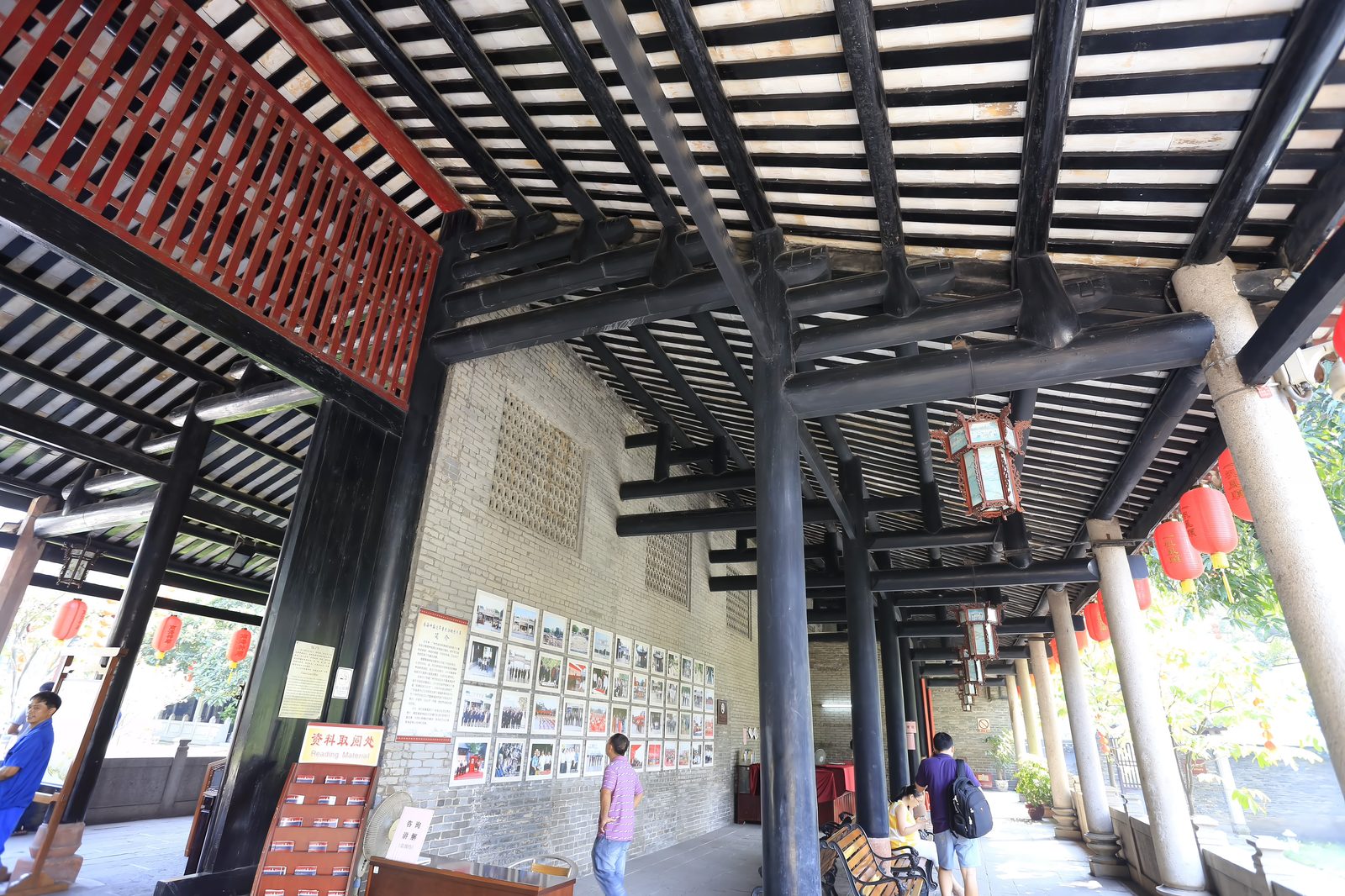
The double corridors. Black lacquered timber along both flanks — the galleries that carry the forest of steles.
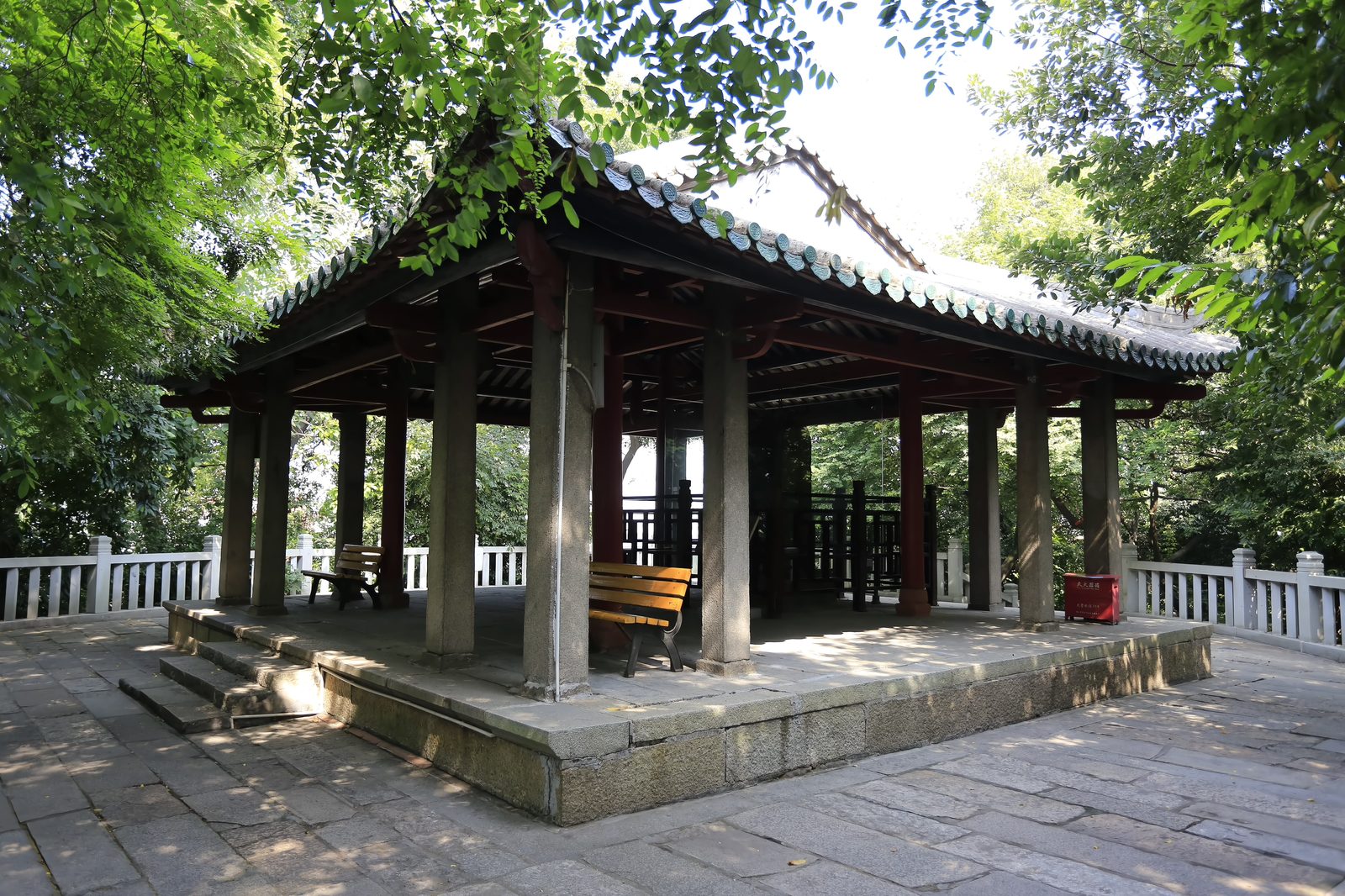
The Bathing-Sun Pavilion. On the hill called Zhangqiu, where Su Dongpo watched the sun come up out of the sea — a sea that has since become dry land.
The foreigner who waited
Ask anyone in Guangzhou what this temple is called and they will not say Nanhai. They will say Boluo, and the reason is a story. In the Tang, so the telling goes, a mission arrived from a country called Boluo, and one of its envoys, a man named Daxi, came ashore here to worship. Before he left he planted two jackfruit trees beside the temple. Then he lingered over the view, and when he ran down to the shore his ship had already raised sail and gone. He stayed. Day after day he stood at the temple gate with his left hand raised to his forehead, scanning the water for a sail from home, until he died there — or turned to stone, depending on who is telling it.
The people buried him and set up his image inside the corridor: a foreign face in Chinese official robes, the left hand still raised, staring out at the water. Locals called it the foreign devil watching for Boluo. The court gave him the rank of a minister of works, and in the Song he was raised again to Marquis Who Aids Profit — an assistant to the sea god himself, and one of the six marquis statues standing beside the god in the great hall today. A Tang dramatist wrote a poem about him standing outside the gate. The stories disagree about where Daxi came from — Guangzhou accounts make his Boluo a state under India, the Qing writer Qu Dajun tells it as a Persian mission — and the disagreement does not matter much. Either way he is a foreign trader who came by sea, was welcomed, and never left. The jackfruit trees gave the temple its second name, and the birthday festival its third.
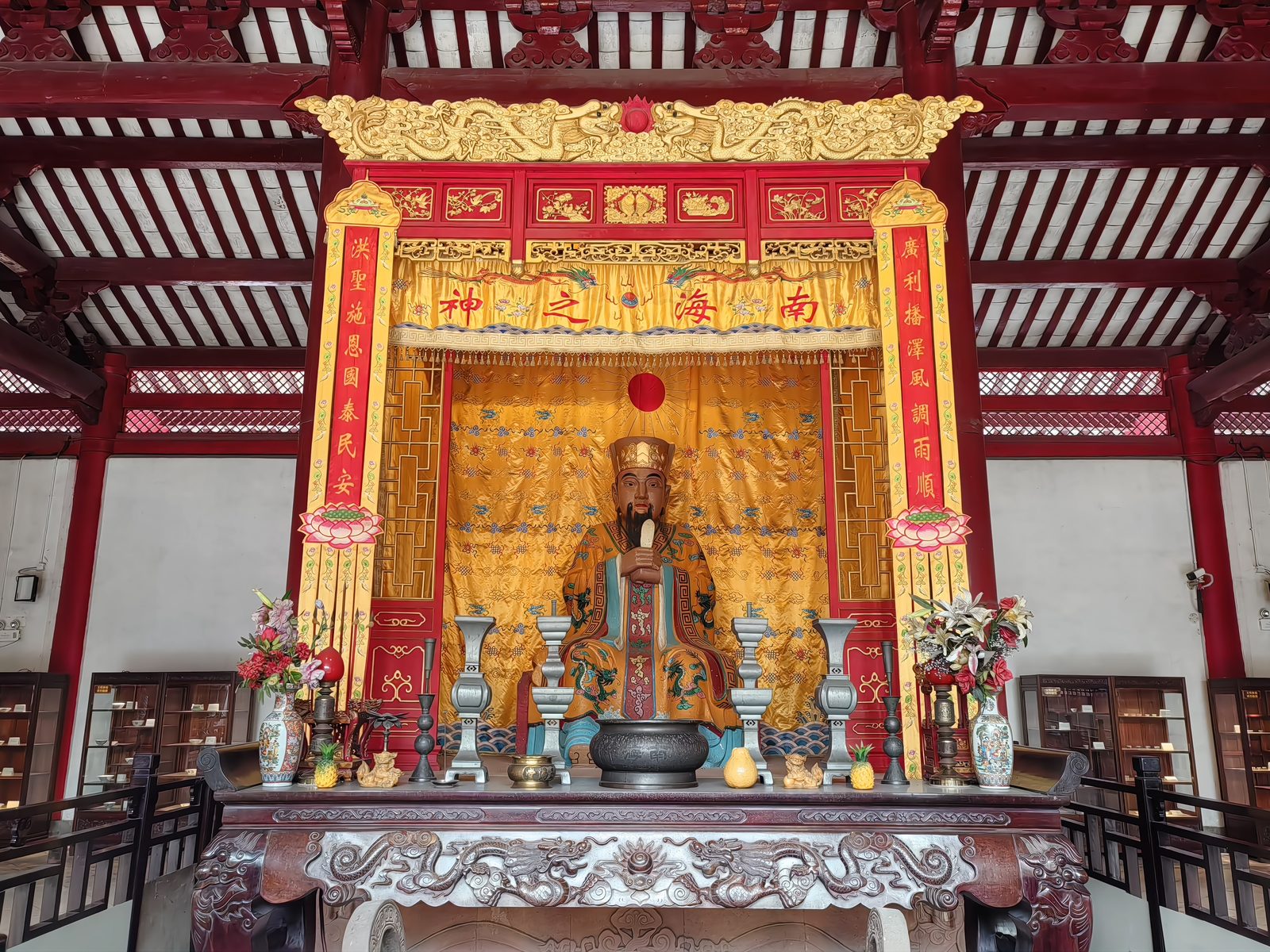
The god — and his foreign marquis. Zhu Rong, the South Sea God, gold-robed under his own name-banner. Among the six marquis figures flanking him stands the envoy who waited: promoted to Marquis Who Aids Profit in the Song.
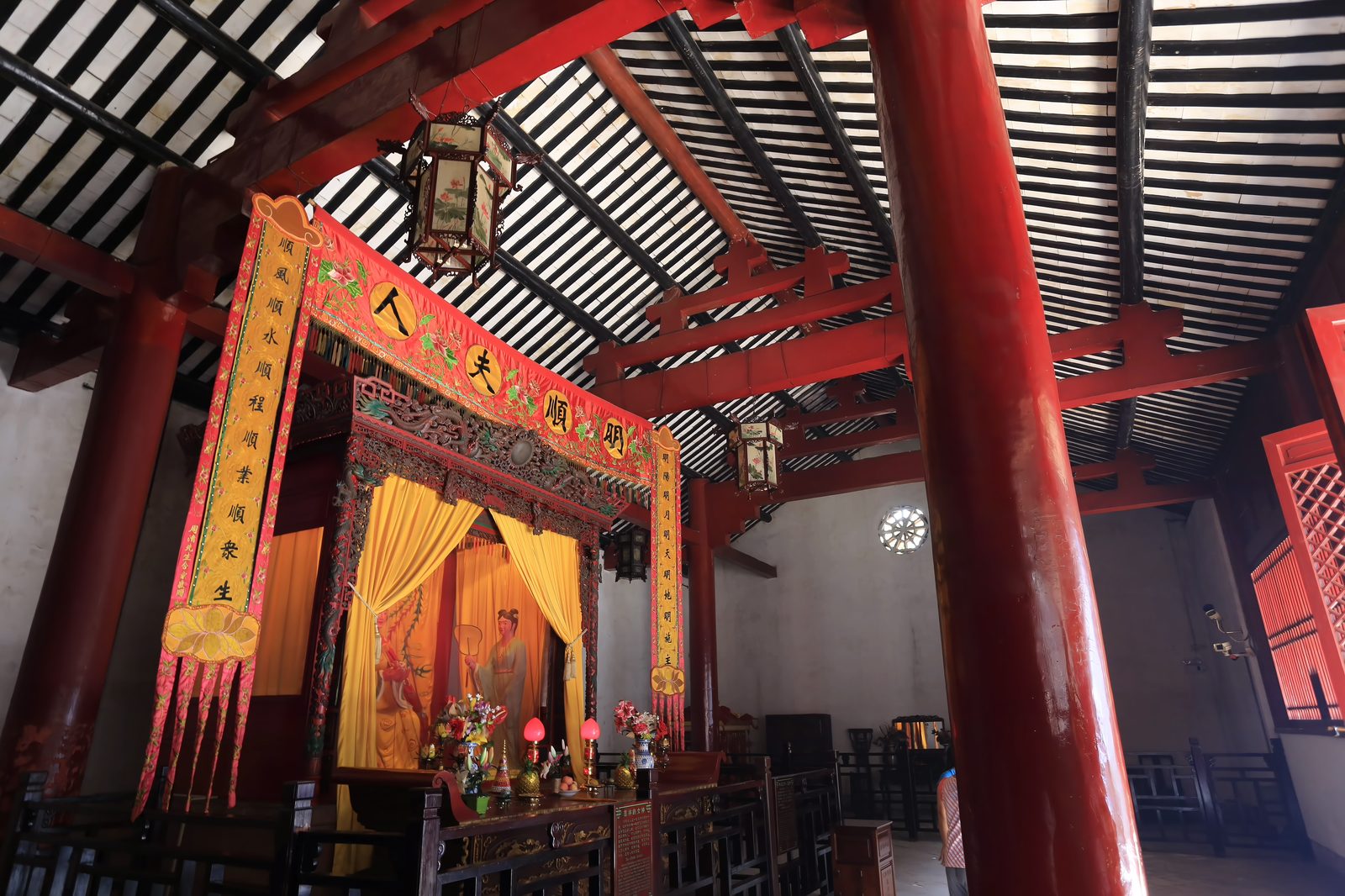
The Lady of Bright Compliance. The last courtyard is the god's wife's bedchamber — honoured since the Song as the protectress of women and children.
The birthday of the sea
Every year, on the eleventh to the thirteenth day of the second lunar month, the temple holds the birthday of the South Sea God, and the fair around it is called the Boluo birthday. It is one of the biggest folk festivals in Guangdong, on the national intangible heritage list, and the Cantonese saying that ranks it is not shy: first go to Boluo, second take a wife. The fair's own records describe the waterfront packed with shipping and every kind of goods laid out for sale — a market the size of a modern trade fair, running on prayer.
The fair has its own crafts and its own food. The Boluo chicken is a little bird modelled in clay and stuck over with real feathers, sold for luck, and it gave Cantonese a proverb — the Boluo chicken gets by on sticking, which is what you say about someone who hangs on to others for a living. There is Boluo rice dumpling as well. At the festival the village gods come to the temple in procession, five of them carried down from the neighbouring villages to pay their respects to the sea god, with the giant feathered roosters bobbing above the crowd.
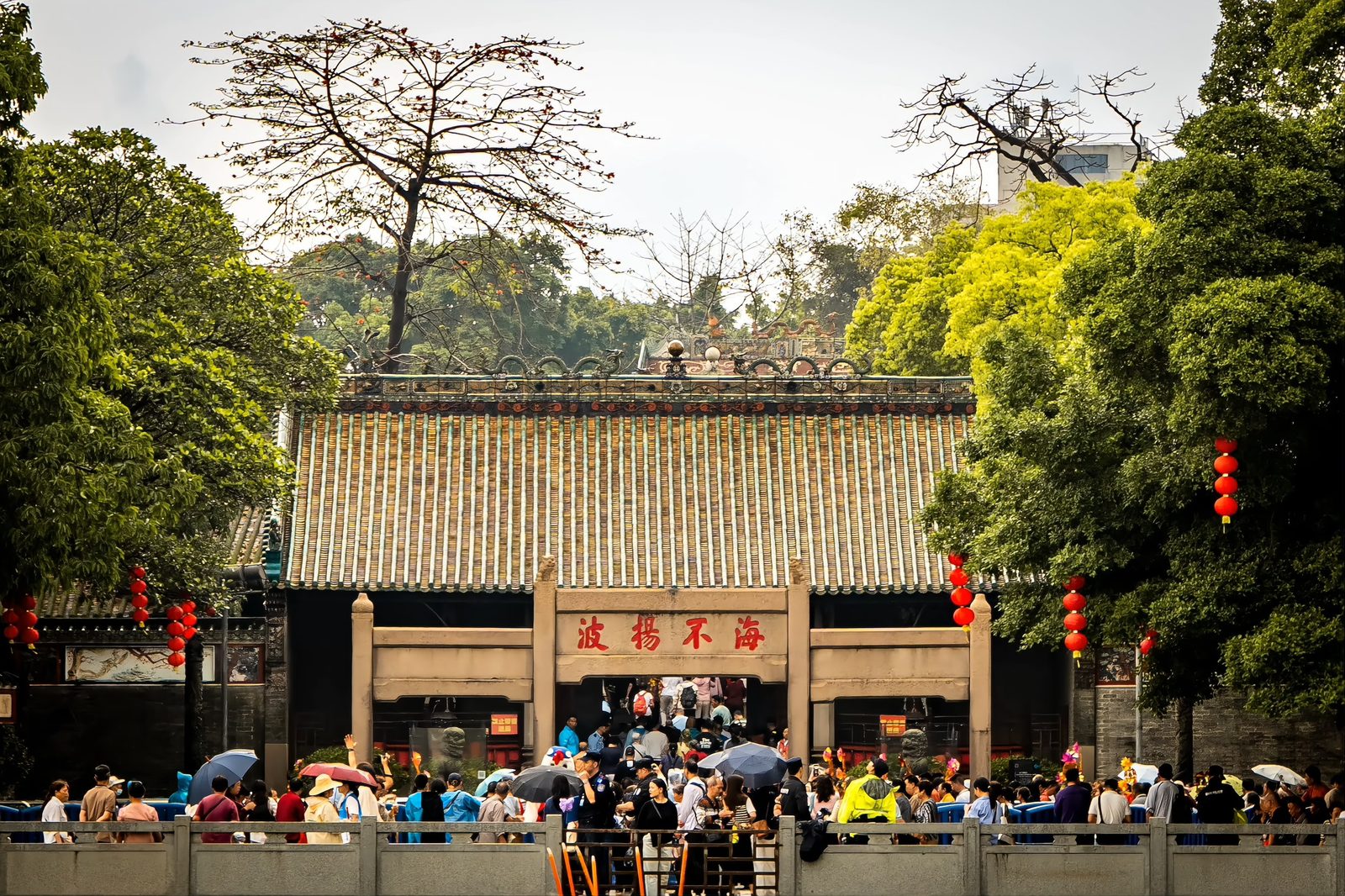
The Boluo birthday. Second lunar month, eleventh to thirteenth — the biggest folk fair in Guangdong, running on prayer for a thousand years.
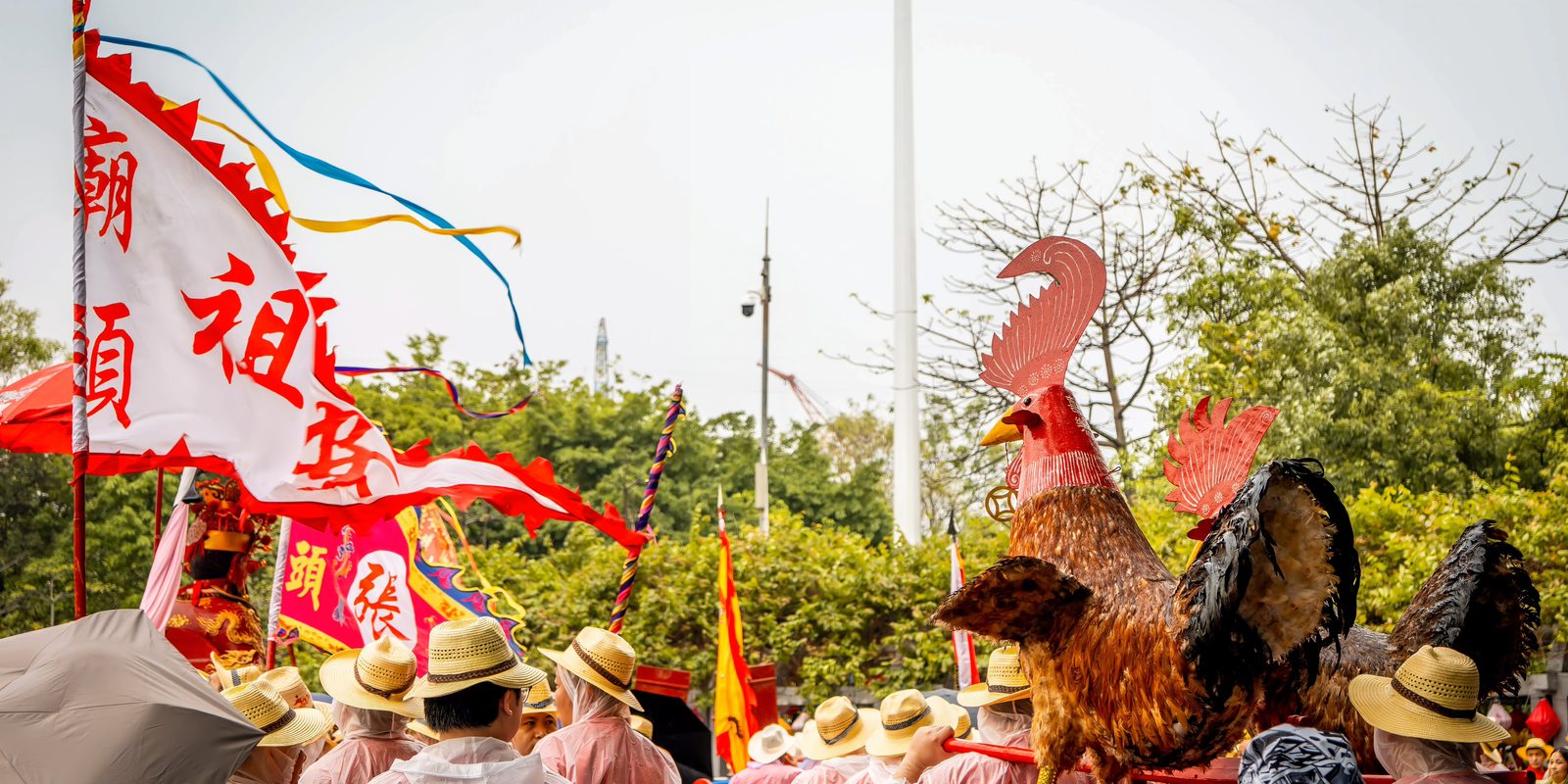
The Boluo chickens, at parade size. Clay and real feathers — the fair's luck charm, and a Cantonese proverb about sticking.
When the water went away
The temple outlived the thing that built it. The Fuxu channel and the Huangmu bend silted up over the centuries until the sea the temple was raised beside was no longer there, and the port moved downstream. The state sacrifices stopped with the Qing dynasty, and for much of the twentieth century the place was neglected; the great hall you see now is a reconstruction, the original having been destroyed in the Cultural Revolution, and the first big modern repair only began in 1985, when the temple passed to the cultural authorities.
Then the sea came back into the story, in a different way. In 1991 a UNESCO expedition sailing the Maritime Silk Road route reached Guangzhou and made this temple its first stop, confirming it as one of the places where China's maritime road began. In 2016 the temple and its wharf sites went onto the first list of heritage points in China's Maritime Silk Road world-heritage bid. The temple is managed today by the Guangzhou Maritime Museum, the only museum in Guangdong devoted to maritime affairs — the institution named after the word Han Yu coined here — which stands beside it and keeps the two thousand years of the city's sea trade.
"The sea moved away, and the emperors are gone, and the wish carved over the gate has not changed: the sea raises no waves."
The closing line of the editorial this page is built on — and the whole temple in one sentence.
Going, and what to expect
Getting there. The temple is at Miaotou village, in Huangpu district, east of the city centre on the north bank of the Pearl River estuary. Metro Line 13 has a station named after it — Nanhai God Temple station, Exit C2 — and it is a walk of three to eight minutes from the exit, which makes this one of the easiest serious heritage sites in Guangzhou to reach. BRT routes B1, B26 and B30 stop at the Nanhai Temple stop. The Guangzhou Maritime Museum stands next door and is free.
Tickets and hours. A ticket is ¥10, with a ¥5 concession for students and visitors aged sixty to sixty-four, and free entry for the over-sixty-fives and children under 1.2 metres. The temple opens 9:00 to 17:00, with last entry at 16:30, and it closes on Mondays the way museums do — public holidays excepted — because it is run as a museum site by the Maritime Museum, whose WeChat official account handles advance booking and is the only official channel.
How long, and when. Two to three hours covers the five courtyards, the stele corridors, the hill and its pavilion with room to read the stones — and the pairing with the free Maritime Museum next door turns it into a half-day on the theme of the sea. Weekday mornings are quiet. If you can come in spring, the Boluo birthday fair in the second lunar month is the temple at full volume; expect crowds to match.
Honest notes. The founding date of 594 is the temple's own tradition and the standard account; the Tang enfeoffment that made the god King of Broad Profit is dated to the tenth year of Tianbao, 751, by both the provincial and city accounts. The stele count is given as about forty-five in one source and forty-seven in another, with seventy or eighty recorded in the temple's prime; the smaller figure is used. The archway's date varies by account — some guides call it Ming — while the four characters are attributed to the Kangxi emperor's own hand. The envoy Daxi's homeland is told two ways, and both are kept here. The bronze drum's third-largest-in-China ranking comes from the temple's own description. Hours and prices are the 2026 figures and could shift on the day.
Come in under the four characters, read the stone drums at the ceremonial gate for the promotion pun, stand in front of the Han dynasty drum in the great hall, then walk the corridor of steles to the stone where the word for everything ships do was born. Finish on the hill at the Bathing-Sun Pavilion — and look at the dry land where the sea used to be. Then do the Maritime Museum next door; it is free, and it is the same story indoors.
Photographs and sources
Photographs from Wikimedia Commons, used under their Creative Commons licences and enhanced for this page: the archway and the god in his hall (CC BY-SA 4.0, Yumeto), the first gate, the ritual-pavilion courtyard, the corridors, the timber, the Lady of Bright Compliance and the Bathing-Sun Pavilion (CC BY-SA 4.0, Zhangzhugang), and the Boluo birthday fair and its rooster procession (CC BY-SA 4.0, LIYONGSI). History drawn from the Nanhai Temple editorial source file, cross-checked against the Guangzhou Maritime Museum's official site (which manages the temple; the founding date, the four great sea god temples and the temple's status), the Guangzhou city government's culture pages (the 751 enfeoffment, the Han Yu inscription and the first appearance of the word haishi), the Guangdong provincial gazetteer office (the 2013 seventh-batch national listing and the 2016 Maritime Silk Road heritage-point list), and Guangzhou Daily's heritage series (the 1985 transfer and first repair, the 1991 UNESCO expedition visit). Where the records disagree — the stele count, the archway's date, the envoy's homeland — both versions are given rather than resolved.
There's more where this came from.
Read the latest insider notes →Two new posts a week — the things a non-resident can't know, written down before they cost you a morning.