Guangxiao Temple (光孝寺)
Guangzhou has a proverb about this place: before there was the City of Rams, there was Guangxiao. The temple's own historians will tell you that is an exaggeration — but only just. This one patch of ground north of the old walled city has been a king's house, an exile's garden, a translation office where Indian sutras became Chinese, six kinds of school, an art college, offices and flats, and a monastery again. In 676 a former firewood seller named Huineng was ordained here, and Chan Buddhism's southern school began.
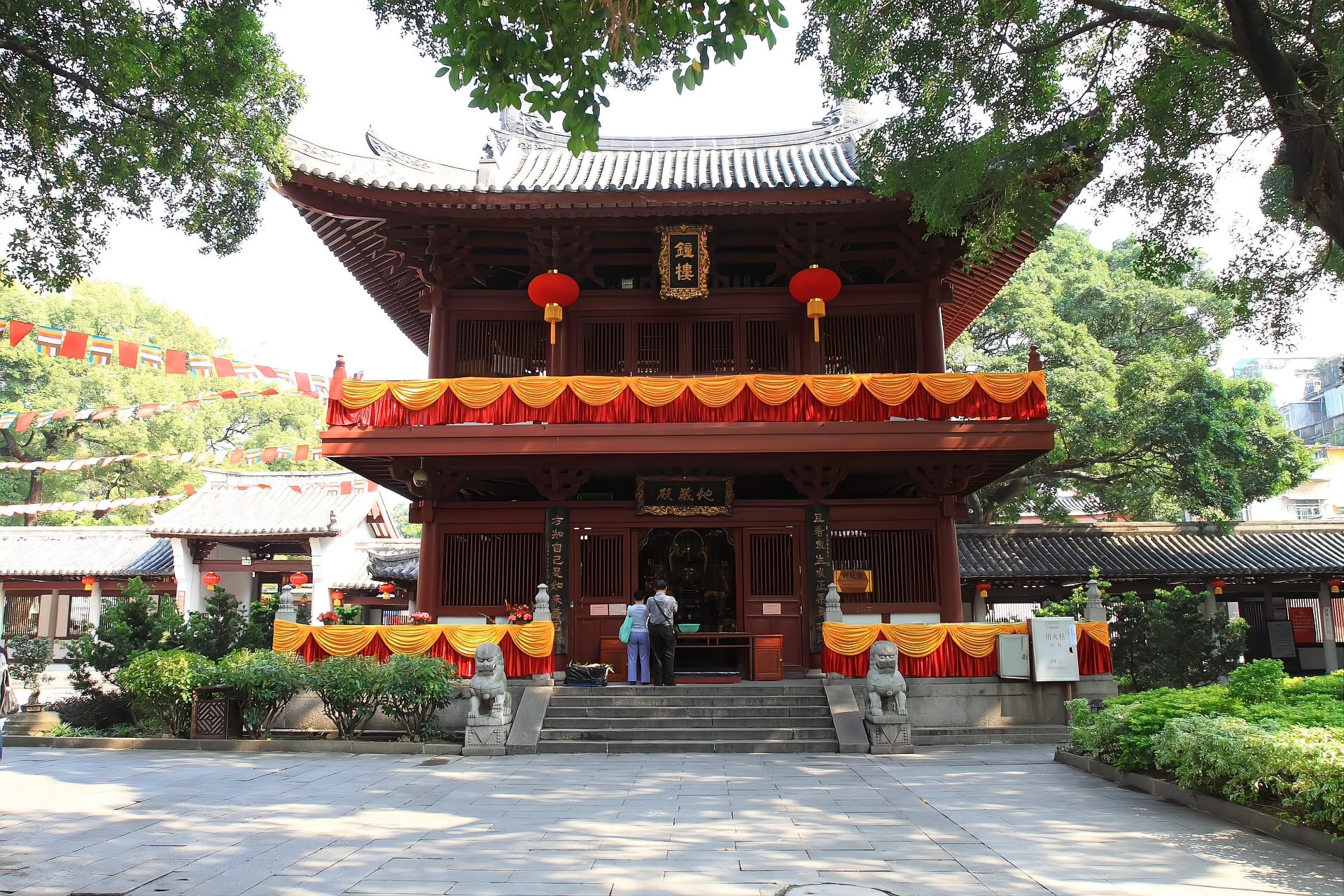
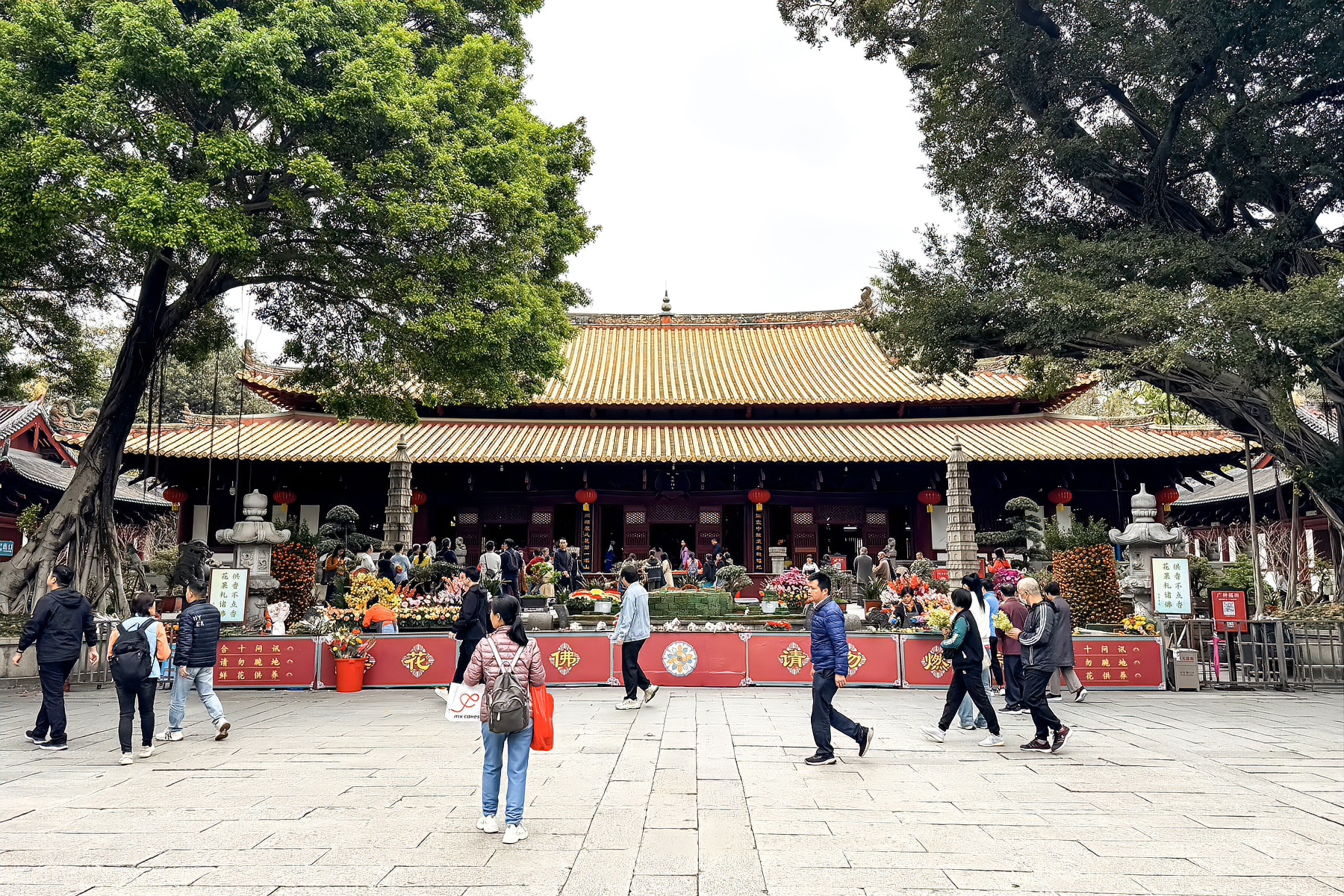
The great hall. The largest monastic hall in Lingnan — seven bays, just over thirty-five metres across, under a double-eave roof. It was widened from five bays in 1654, and the morning office still runs in it while the traffic goes past outside the wall.
A king's house, an exile's grove
The kingdom of Nanyue was founded by Zhao Tuo, a Qin officer who took the south when the empire fell apart and ruled it as his own for most of a century. It ended in 111 BC, when Han armies took Panyu — the town on the Pearl River that became Guangzhou. The last king was Zhao Jiande, and according to the temple's own chronicle his house stood on this ground. Nothing of it survives above ground; what survives is the plot, which people have been entering through a gate for the better part of seventeen centuries.
The next owner was an exile. Yu Fan, an officer of the state of Wu and a scholar of the Book of Changes, was sent south in the third century because he could not keep his opinions to himself. He built a house on the old royal ground, taught there for years, and filled the garden with myrobalan trees — the chebulic myrobalan whose dried fruit is medicine across Asia. People called the place Yu's garden, and because of the trees, the myrobalan grove. When he died his family gave it to the monks, and it became a temple. One myrobalan tree still stands behind the great hall; a garden tree does not live seventeen hundred years, so what is there is almost certainly a successor in the same line, kept because of who is supposed to have put the first one in the ground.
The ships that came
For the next three centuries the monks arrived by sea. Guangzhou was the port where ships from the Bay of Bengal, the Malacca Strait and the coast of India made landfall, and a temple with an ordination platform and a guest hall was the first thing a travelling monk looked for. In 401 a monk from Kashmir built a hall five bays wide and began translating under imperial orders. In 435 Gunabhadra built the ordination platform and translated the sutra the early Chan masters argued over for generations — and set up a stone saying that one day a flesh-body bodhisattva would be ordained there. In 502 another monk arrived with a sapling of the tree under which the Buddha is said to have awakened, planted it beside the platform, and left his own stone: a hundred and seventy years from now, it said, a flesh-body bodhisattva would open the highest teaching beneath it. Both stones were waiting.
Paramartha, one of the great translators of the age, lived here about twelve years and is credited with fifty works. In 705 the Surangama sutra — still recited in the daily office — was translated on these premises. The temple counts Bodhidharma, the first patriarch of Chan in China, among the monks who stayed: it says he dug the well in the east courtyard, still called the bowl-washing spring, and told the men who dug it that gold that can be measured in taels is not the gold he meant. A different site across the city claims to be where he landed, and no source settles it. What is not contested is the sequence of buildings: the translation hall came first, the pilgrimage came later.
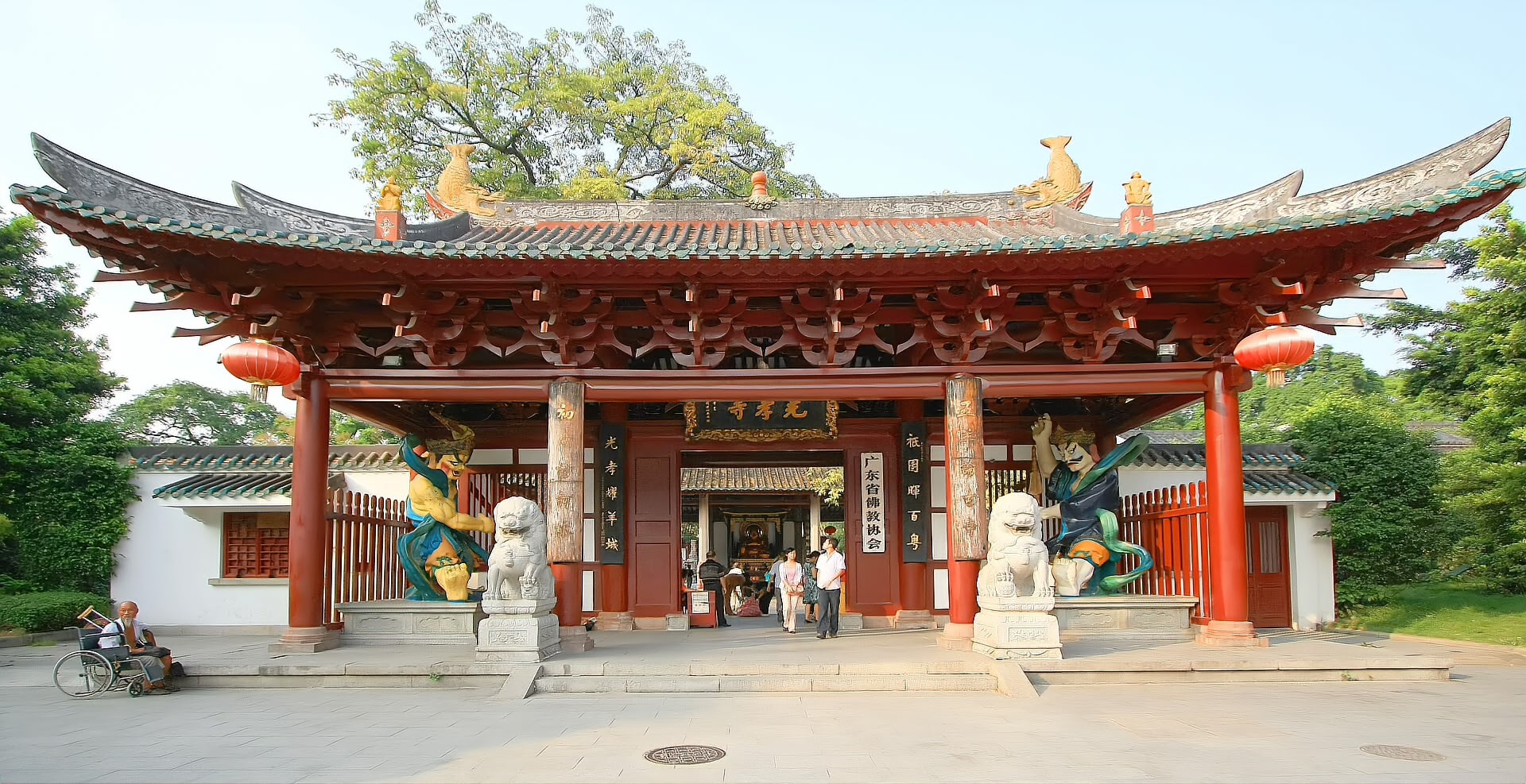
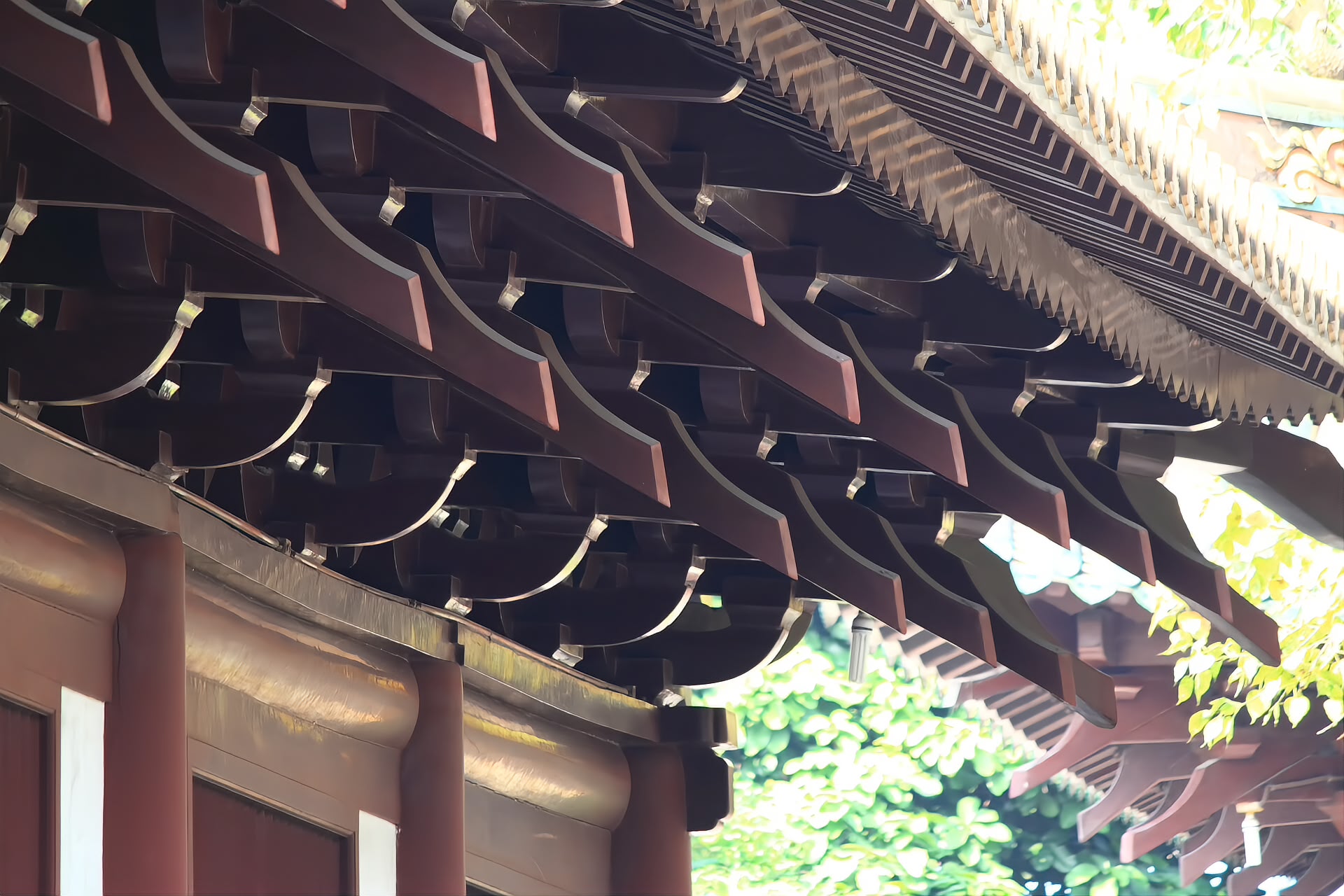
The wind and the flag
Huineng was born in the north into a family exiled to Guangdong. His father died early; the boy sold firewood in the market, heard a single line of the Diamond Sutra read aloud in the street, and dropped everything. He walked to the monastery at Huangmei, was put to work treading the rice-hulling pestle for eight months, and when the fifth patriarch asked for a verse to test his students, produced the one everybody knows: the bodhi tree was never a tree, the bright mirror was never a stand; fundamentally there is not a single thing, so where would dust collect. He was given the robe and the bowl in the middle of the night and told to run. He spent something like fifteen years living with hunters in the hills.
He walked into this temple in 676, while the abbot was expounding the Nirvana sutra. A wind came up and the banner in the courtyard moved. One monk said the wind was moving; another said the banner was; a third said it was causes and conditions combining. Huineng — a layman standing in the crowd — said it was neither the wind nor the banner: it was your minds moving. The abbot questioned him, saw the robe he had carried for fifteen years, and knew the man the whole country had been looking for. On the fifteenth day of the first month, ten masters shaved his head under the bodhi tree. On the eighth day of the second month he took full ordination on the platform Gunabhadra had built two hundred and forty years earlier. The hair was buried at the foot of the tree, and a tower was raised over the place where it went into the ground — an octagon of seven storeys, about seven and a half metres tall, still called the hair-burying tower. Both stones had come true, and the temple has been dining out on it ever since.
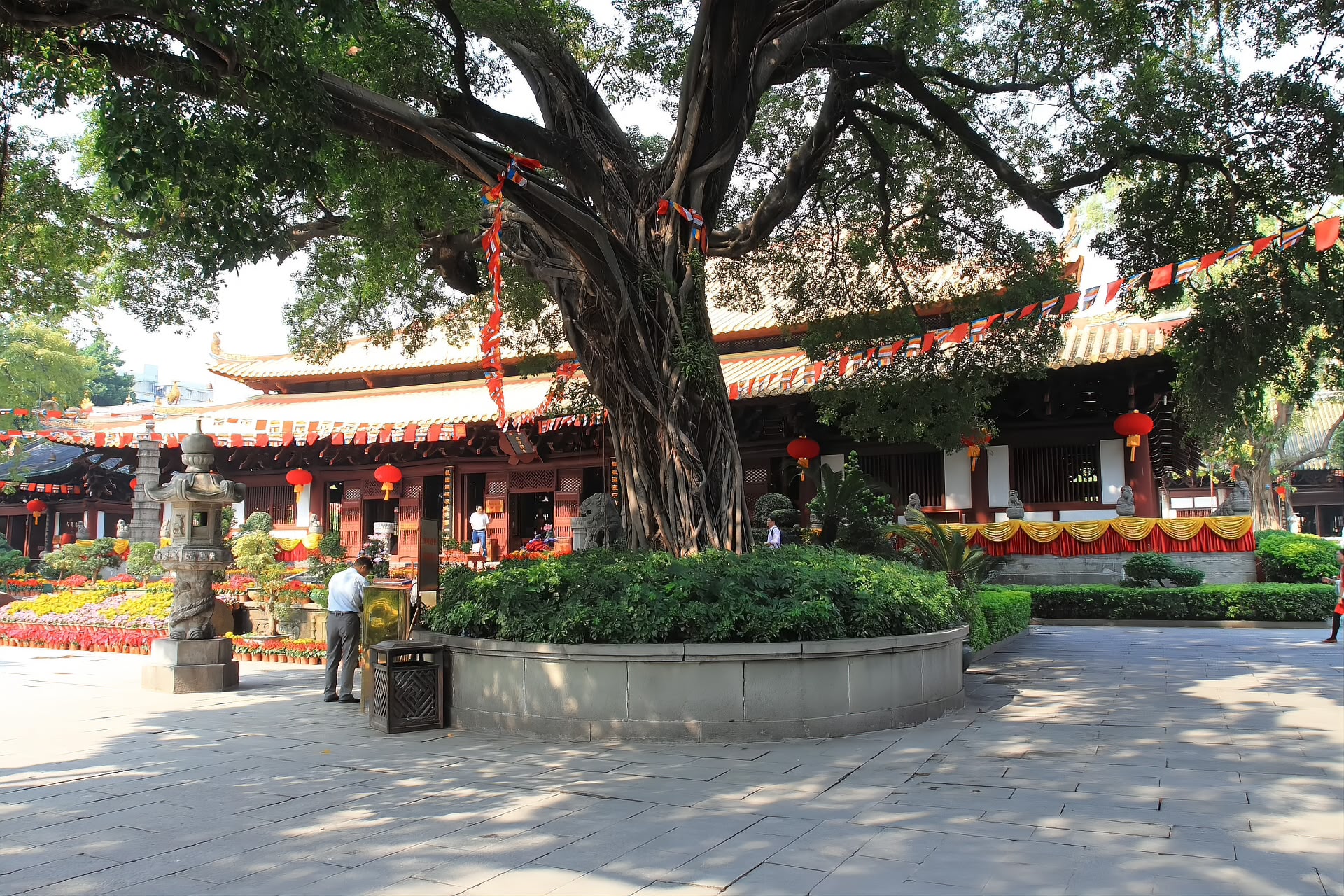
The bodhi tree he was ordained under was blown down in a typhoon in 1797. Monks took a cutting from the tree at Nanhua, the monastery up the river where Huineng spent the next thirty years, and planted it in the same place — the tree standing there now, trunk more than two metres through, is that cutting's descendant. Every bodhi tree in China is said to descend from the sapling planted here in 502.
The two iron towers
In the tenth century the south was ruled by its own dynasty, the Southern Han, out of this same city, and its last emperor liked religion in expensive forms. The west tower was cast in 963 by the palace eunuch who ran much of the government, together with a lay patron named on the casting. It is the oldest large iron tower in China with a securely known date — square, originally seven storeys, of which three remain at about three metres, the rest crushed when a building collapsed onto it during the war years. Five hundred and eighty small buddhas have been counted on the surviving storeys, ranged around a larger seated figure on each face, under eaves cast with apsaras, cranes and phoenixes.
The east tower followed in 967, cast in the emperor's own name for the health of his person and the peace of the realm — the inscription praises its own calligraphy in eight lines. It is a little under eight metres tall, all seven storeys complete, which makes it the oldest intact iron tower in the country, with twenty-eight large buddhas and close to a thousand small ones covering it. It was cast for another monastery and moved here in the 1230s; a Qing poet wrote about the pair standing east and west of the hall, both gilded the same colour, holding the place up by the strength of a thousand years of elephants and dragons.
The years it was a school
In 1903 two schools moved into the temple, and it never got the buildings back for seventy years. A law school, a police school and a history office took space in 1913. Under occupation a puppet army headquarters used it. After the war the Guangdong Provincial Academy of Art put its art, music and drama departments into the halls; after 1949 its successor dispersed the remaining monks and levelled the courtyard steps, and students broke up the gate figures and opened the buddha in the great hall — the Tang beads and small buddhas found inside are now in the provincial museum. In 1953 a song-and-dance ensemble was given the site, and its members' sons were nicknamed little monks. In 1961, in the middle of all that, the State Council named the temple one of the country's first batch of national protected sites — at a point when it was not a temple at all.
A full restoration began in 1974. The gates opened for worship in 1986, and the monk Benhuan — eighty years old, sent at the head of the national Buddhist association's request — walked in from Shaoguan on New Year's Day of 1987 and spent the next decade raising money for the great hall, the sixth patriarch hall, the hair tower and the rebuilt gate, bell tower and drum tower. He died in 2012 at the age of a hundred and six. In 2000, digging for new monks' quarters, workmen found building foundations running from the Five Dynasties into the Song — under a part of the site that had been a school playground for most of the century.
What is still standing
The great hall is the largest monastic hall in Lingnan, and its north side still carries the original Song stonework — five or six of the original thirteen Song stone lions are whole, beside the Song-style balustrades installed in the 1980s. The sutra column in the courtyard dates from 826 and is the oldest dated stone in the temple: a green stone pillar a little over two metres tall with the Great Compassion mantra cut on eight faces, most of it worn smooth. The sixth patriarch hall was first paid for by a donor around 1008, burned in 1269, rebuilt in 1692 and taken apart and rebuilt again in 2004. Guangzhou counts four great monasteries, and this is the one that has never been anywhere else.
Going, and what to expect
Getting there. The temple is at 109 Guangxiao Road, in the streets north of the old walled city. Metro Line 1 to Ximenkou station, Exit C, leaves a walk of about five hundred metres. The Luoxong Temple and its flower pagoda stand a few minutes' walk further north, and the two make a natural pair in a morning.
Tickets and hours. Recent listings and press put entry at ¥5, paid on the day without booking; the district government's own heritage page still lists the temple as free, so treat the fee as small and changeable rather than certain. Hours are 8:30 to 16:30, with last entry at 16:00. This is a working monastery and a no-incense one — you bring flowers, not smoke — so dress for worship, and note that the Buddha figures may not be photographed.
How long, and when. Forty-five minutes to an hour covers the axis, the hair tower, the two iron towers and the courtyard stones with room to sit under the trees. Mornings have the office chanting; the light through the bodhi leaves that was once counted among the eight views of Guangzhou still happens, just with the city in the background of it now.
Honest notes. The proverb is not literal — the city is several centuries older than the monastery, which dates to 401. Most accounts date Huineng's ordination to 676; one account puts his arrival in 667. The ordination platform is credited to Gunabhadra by the temple and to a different Indian monk elsewhere. The west tower's four lost storeys are blamed on a collapsing building in the war years by most accounts and on a 1930s typhoon by others, and its lay patron appears as the thirty-second daughter of her family in one inscription and the thirty-third in another. The east tower's buddha count is given variously as twenty-eight large with nine hundred and ninety-six small, over nine hundred niches, or about a thousand figures. The Bodhidharma well claim is the temple's own, and another site in the city claims the same landing. Hours and fees are the 2026 figures and could shift on the day.
Walk the axis from the gate to the hair-burying tower, and read the two stones' story on the way: the prophecy of 435, the sapling of 502, the ordination of 676 — then the two iron towers either side of the hall, one broken and oldest, one whole and older still. Everything else in Guangzhou is younger than the ground you are standing on.
Photographs and sources
Photographs from Wikimedia Commons, used under their Creative Commons licences and enhanced for this page: the great hall, the front gate, the courtyard, the eaves timber and the old trees (CC BY-SA 3.0, Zhangzhugang). History drawn from the Guangxiao Temple editorial source file, cross-checked against the Yuexiu district government's temple page (the proverb, the 1961 first-batch national listing, the address and the metro approach) and current 2026 ticketing and press listings for hours and the entry fee. Where the records disagree — the ordination date, the iron towers' buddha counts, the entry fee — both versions are given rather than resolved.
There's more where this came from.
Read the latest insider notes →Two new posts a week — the things a non-resident can't know, written down before they cost you a morning.