Zhaoqing (肇庆): Seven Star Crags (七星岩)
An hour west of Guangzhou, seven limestone towers stand in a lake in the shape of the Big Dipper — and almost nobody tells you the lake is new and the mountain is old. The West River used to run under these rocks; the channel silted up a thousand years ago; and in the winter of 1955 tens of thousands of citizens dug the marsh back into a lake by hand, six and a half square kilometres of water, without losing a single one of the poems cut into the rock since 727.
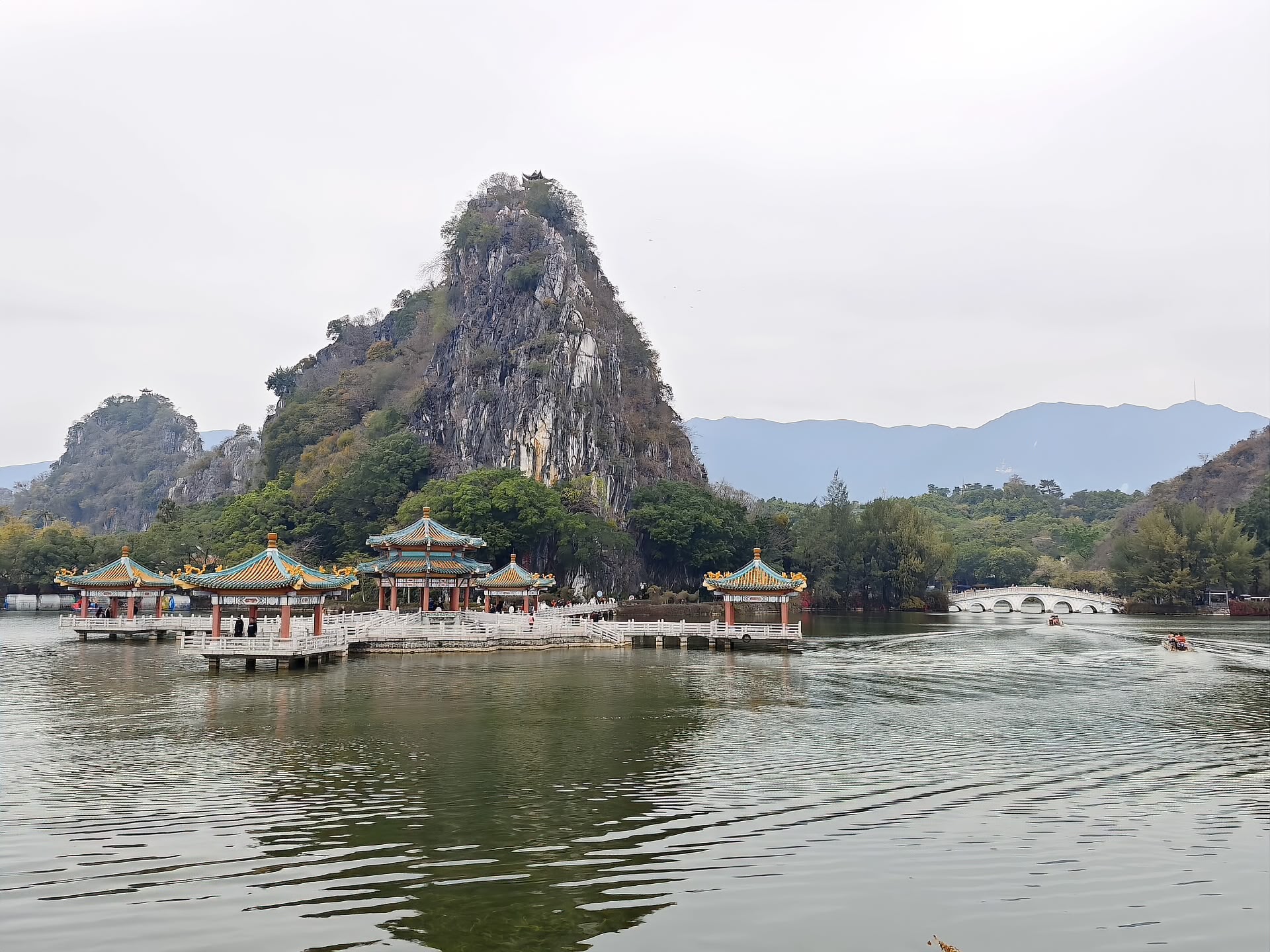
Seven stars, standing in water. The Wulong Pavilion and the Qixing Bridge on Star Lake, with the crags behind. Locals borrowed a line for it: a ring of West Lake water, and Yangshuo's seven mounds of rock, moved over.
English will not get you far at a ticket window or in a taxi here, and none of these places are called by their English names on the ground. These are the seven worth having on your phone — the first three are the ones you will actually say out loud:
肇庆 Zhàoqìng — the city
七星岩 Qīxīngyán — the seven crags; this is the name on the ticket and on every bus stop
星湖 Xīnghú — the lake they stand in
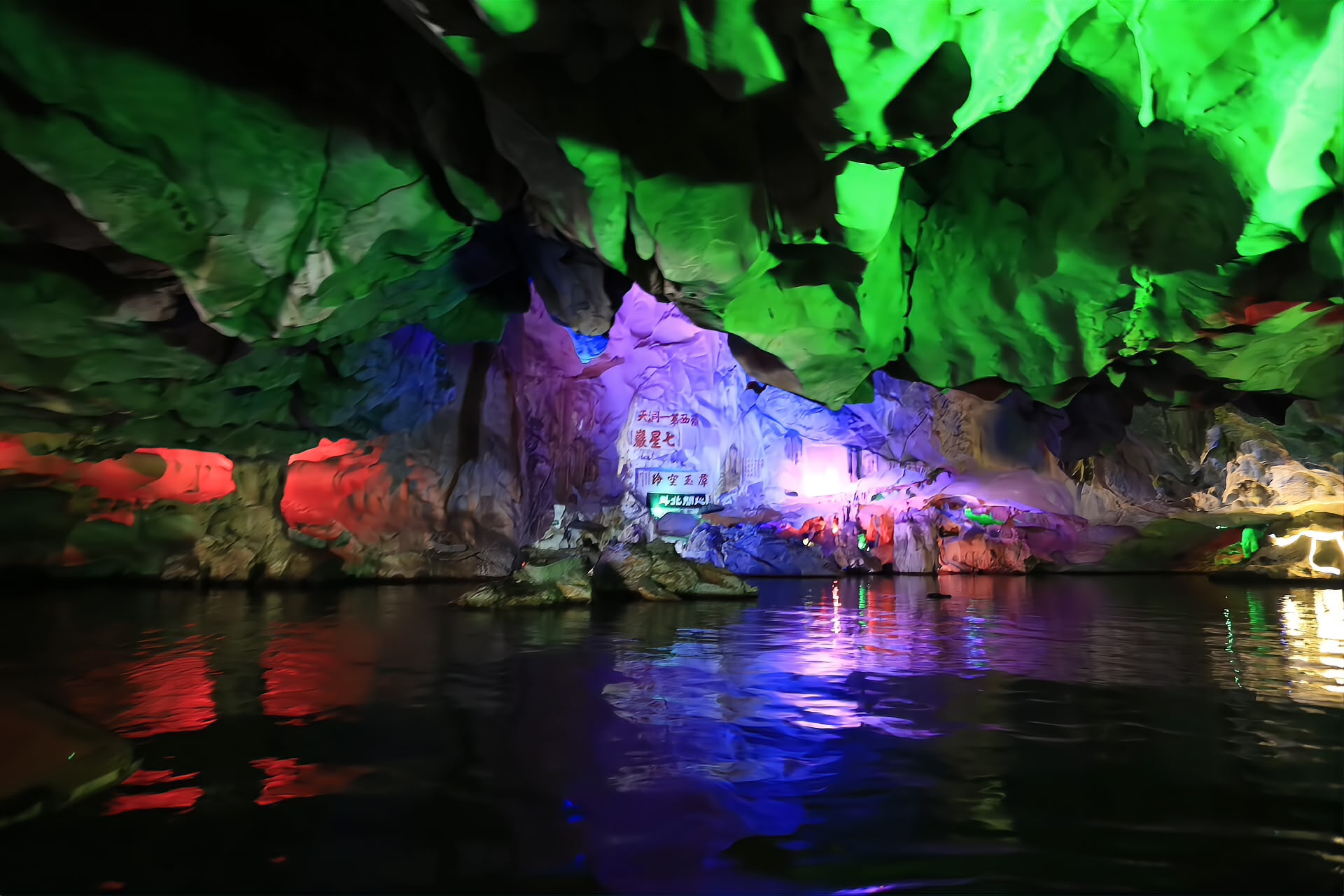
龙岩洞 Lóngyán Dòng — the water cave you enter by boat
千年诗廊 Qiānnián Shīláng — the thousand-year corridor of poems, cut into the rock since 727
仙女湖 Xiānnǚ Hú — the lake you stand beside to watch the equinox sunset
卧佛含丹 Wòfó Hán Dān — the reclining Buddha holding the elixir, that same sunset going into the stone mouth
For a driver: 七星岩景区东门, 西门, 北门, 南门 are the east, west, north and south gates of the scenic area, and there is a fifth entrance through the wetland park. The west and north gates put you closest to the crags.
The river that used to be there
Before the lake there was a river. The West River — the Xijiang (西江) — once ran north of what is now the city of Zhaoqing, and the northern channel of that wide brown river passed directly beneath these rocks. A record written by the calligrapher Li Yong in 727 describes the site as sitting between the river and the water's edge: ships went by, fishermen worked, and the peaks were an obstacle to shipping — which is exactly why they became famous. The channel silted up in the late Tang, Song engineers raised dikes and made the silting permanent, and what was left was a string of shallow ponds that stayed shallow for nine hundred years, full of wild lotus, water chestnuts and eels. The rock towers stood in a marsh. The poetry started anyway.
Seven rocks, one dipper
The seven are Langfeng (阆风岩), Yuping (玉屏岩), Shishi (石室岩), Tianzhu (天柱岩), Chanchu (蟾蜍岩), Xianzhang (仙掌岩) and Apo (阿坡岩), and their arrangement is not decorative: they trace the Big Dipper, which is where the name comes from — Qixingyan (七星岩), Seven Star Crags. Shishi is the one with the cave and the writing, and it is the rock everything else orbits. Tianzhu is the tallest, a single pillar with a pavilion on top. Chanchu is capped by a boulder shaped like a toad facing the sky, waiting for rain. Apo, the western anchor, holds a two-hundred-and-seventy-metre cave that was once an underground river and still drains from two ends. The rock is limestone laid down in a warm sea; the ground rose, the river cut down through the soft stone, and the harder mass of each peak was left standing — a process that takes geological ages and produces, by accident, a perfect diagram of a star pattern.
The lake men dug (星湖)
The lake in the photographs is not old. In the winter of 1955, on the argument of a provincial leader who had walked the crags and decided the ground should be known nationally and worldwide, tens of thousands of Zhaoqing citizens came with their own tools and their own rations and dug by hand — a campaign called the largest public works project in the city's history. They excavated more than six hundred hectares of lake, raised close to twenty kilometres of bank, tied the five bodies of water you see today together with over twenty kilometres of dike, and multiplied the standing water forty times. The pool that existed before was, in the words of one local gazetteer, half farmland and half flood swamp, and the folk rhyme warned families not to marry their daughters in front of the crags. That harvest failure and that anxiety are what the lake fixed. The name had come first, though — in 1636 a visitor carved a poem in the stone chambers saying the lake and the crags lay tangled together for miles, glittering like a night sky, and Star Lake (星湖) entered the world from that inscription. The total surface today, about six and a half square kilometres, is very slightly larger than Hangzhou's West Lake.
The corridor of stone (千年诗廊)
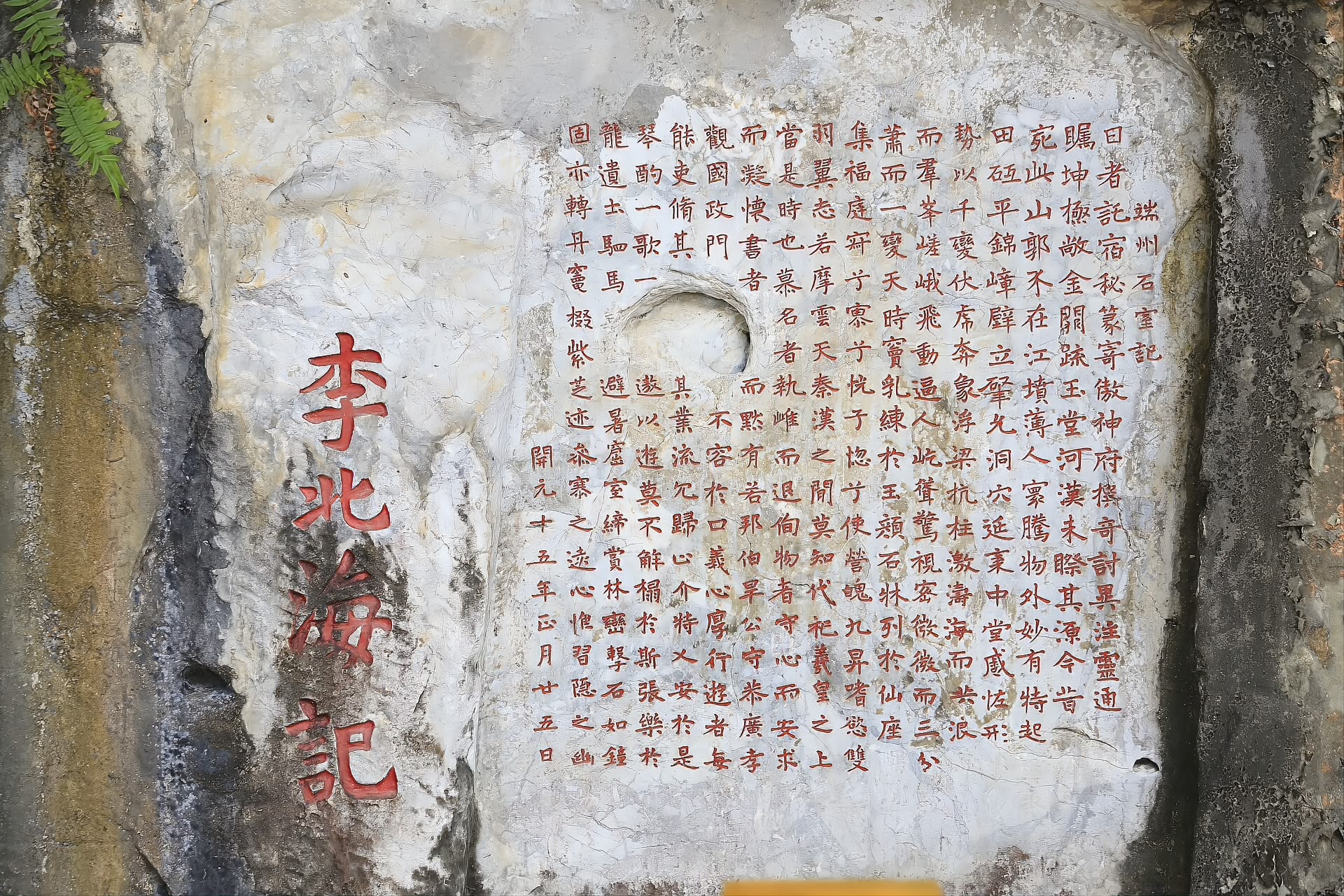
In 727 Li Yong climbed to Shishi, wrote a record of the place and cut it into the wall at the cave mouth — the first entry in what locals call a thousand-year corridor of poems. Every serious writer who came to Zhaoqing afterwards put something on the rock, and the rock accepted everything. The list is a roll call of Chinese officialdom: the Tang poet Li Shen; the Song administrator Bao Zheng, who governed Duanzhou and is remembered for governing it without ever once taking a gift; the philosopher Zhou Dunyi; the Ming naval commander Yu Dayou, whose two couplets on the cliff read like an argument with heaven — the constellations of the north have turned to stone and fallen here; if heaven had not made this strange rock, who would have held up the sky for all eternity. Later came Qing poets, generals and officials, and in the twentieth century two marshals, Zhu De and Ye Jianying. Ye's couplet is the one every guidebook in the city prints: I borrowed a ring of West Lake water here, and moved Yangshuo's seven mounds of rock over; add a few threads of willow to the bank, and the picture can stay in the world for ever. Chen Yi gave the corridor its name in five characters: on the wall, written verses; a thousand years, and it becomes a hall of poetry.
The calendar in the rock
Two things happen here on a schedule, and both of them are free with the landscape. Chumi Cave (出米洞), in the Lion Head Rock (狮头岩) inside the wetland park, runs north and south straight through the hill, with a natural skylight about ten metres above the floor. Around the summer solstice — from about the eleventh of June to the first days of July — the noon sun drops straight down that opening onto a stone tortoise on the floor, and a pole stood on the tortoise stops casting a shadow: the shadowless pole. On the winter solstice night the moon comes down the same opening and hangs there, which is why the cave is called the Supreme Balance. And twice a year, within about ten days of each equinox, the sunset lands in a mouth: from the viewing platform on the east side of Xiannü Lake, five peaks line up into a reclining figure about a kilometre and a half long — eyes, brows, lips, coiled hair, all of it plain landform, nobody carved it — and around six in the evening the sun comes down the ridge of the mouth and sits in it, a gold disc held in stone. The event was named the reclining Buddha holding the elixir (卧佛含丹), and it began as a photography-club project: the name it has now was coined by a city newspaper editor in October 1995, and it stuck. The alignment is exact enough that the viewing spot has to move north by roughly two metres a day through the window; photographers arrive forty minutes early with tripods.
Going, and what to expect
Getting there. High-speed trains run from Guangzhou South to Zhaoqing East in about thirty-five minutes; from the station, the K02 bus runs to the East Gate Square for a couple of yuan, or a taxi takes about half an hour. The park has five entrances. On the routings published by the city's own broadcaster, bus 19 terminates at the west gate (西门), 28 and 29 serve the north gate (北门), and 10, 21 and 26 stop near the east gate (东门) and again at the wetland-park entrance (星湖湿地公园) — signed locally as the Xiannü Lake stop (仙女湖站). The north and west gates put you closest to the crags; drivers use the north-gate car park.
Tickets and hours. The park opens 8:00 to 18:00 daily, with entry stopped from about 17:30 — one ticketing source says 18:00, so treat the earlier time as the safe one. Admission is ¥70, with a ¥35 concession for full-time students and visitors aged sixty to sixty-four, and free entry for children under 1.2 metres and the over-seventies. The sightseeing bus is ¥20, and the boat into the Dragon Grotto is ¥20 extra — both are worth it, and both are optional.
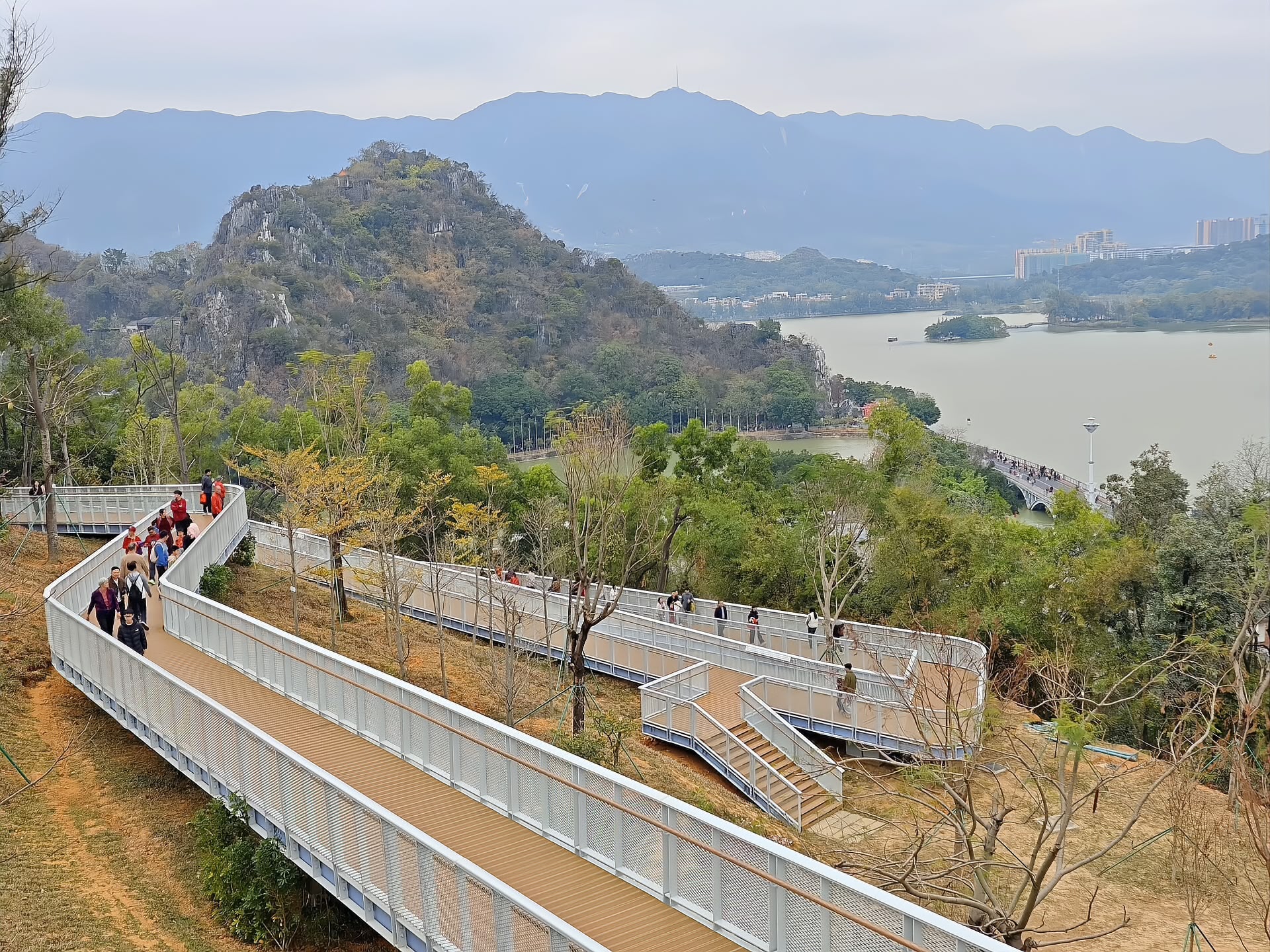
How long, and when. A brisk half-day covers the lake loop, the cave and the corridor of poems; a full day adds the wetland park and the temples. Spring brings mist that makes the crags perform, and autumn the clearest light. If your dates land within ten days of an equinox, plan one evening for the reclining Buddha — and arrive early, because tens of thousands of other people will have read the same almanac.
Honest notes. The number of cliff inscriptions is genuinely contested — five hundred and thirty-one, five hundred and seventy-nine, more than six hundred, and more than six hundred and thirty all appear in official and press accounts, with over three hundred and thirty-three inside the Stone Chamber cave alone — so no single figure is asserted here. The lake surface is given as about 6.49 square kilometres by the provincial records and about 6.3 by others, and the reclining figure as about one kilometre long by some sources and one and a half by others. The Star Crag Song that gave the lake its name in 1636 has no reliably attributed author, so none is given. Hours and prices are the 2026 figures and could shift on the day.
Walk the middle dike in the late afternoon, boat into the Dragon Grotto, then climb to the corridor of poems and read the wall until the light goes. The lake was made, the crags were not, and every person who came here put themselves on the stone anyway — the writing has not stopped since 727, and it never did.
Photographs and sources
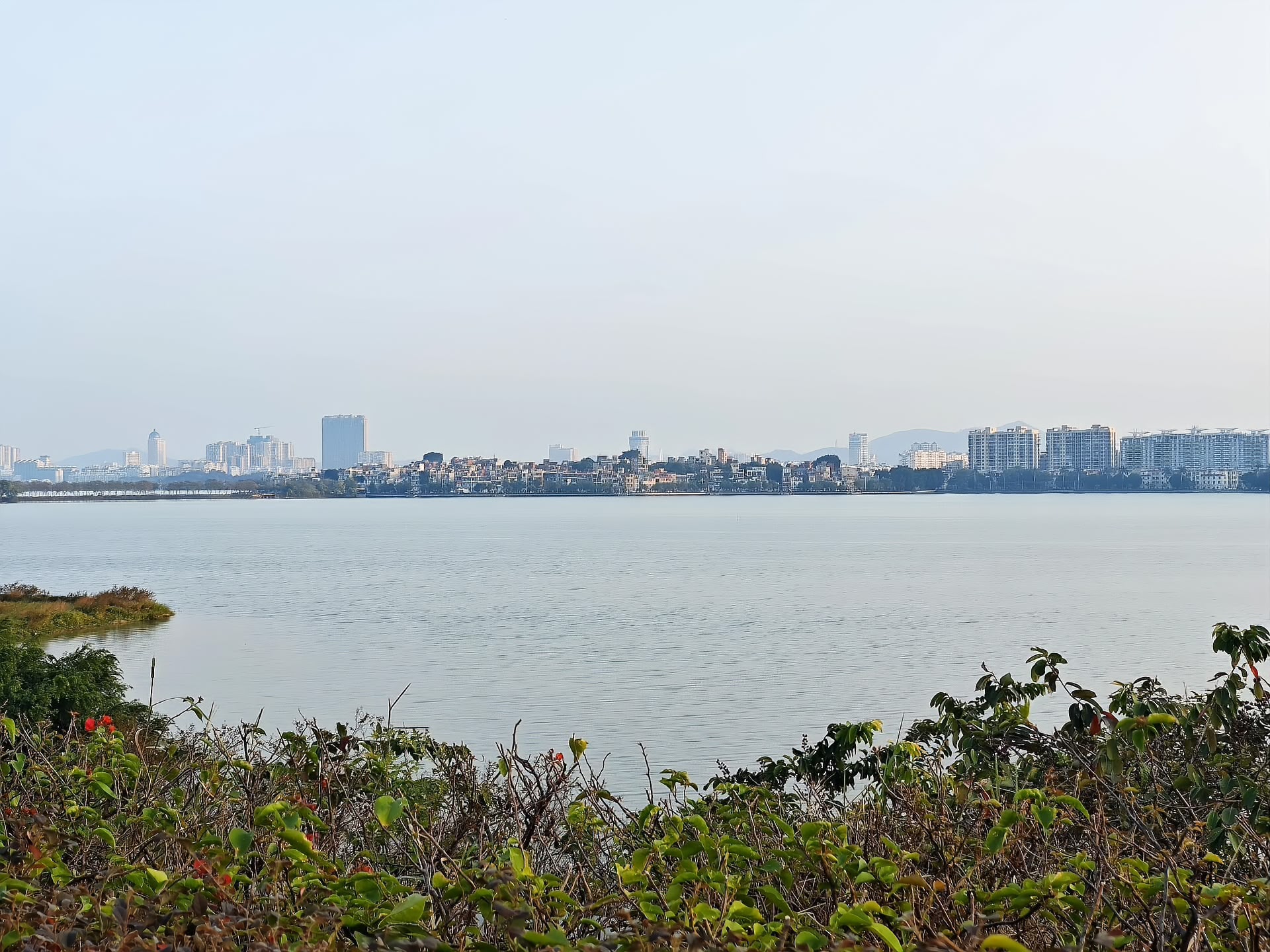
Photographs from Wikimedia Commons, used under their Creative Commons licences and enhanced for this page: the pavilion and bridge, the cliff inscriptions, the Dragon Grotto, the lakeside greenway and the lake with the city behind it (CC BY-SA 3.0, Zhangzhugang; CC BY-SA 4.0, Jasonjiang.1998). History drawn from the Seven Star Crags editorial source file, cross-checked against the scenic area's 2026 ticketing listings (hours, ticket tiers, the sightseeing bus and cave boat, and the high-speed-rail approach), the entrance-by-entrance bus routings published by the city's own broadcaster, and the park's designations — a national scenic area from the first batch of 1982 and a national 5A attraction since 2020. The Chinese names given on this page are the forms used by the Zhaoqing municipal government and the Star Lake scenic-area administration. Where the records disagree — the inscription count, the lake's area, the length of the reclining figure, the last-entry time — both versions are given rather than resolved.
There's more where this came from.
Read the latest insider notes →Two new posts a week — the things a non-resident can't know, written down before they cost you a morning.
More on the region: the Guangdong region guide · the Guangzhou city guide · Foshan · Chao Zhou · Jiang Men and the diaolou