The Nanyue King's Tomb (南越王墓)
In June 1983 a machine levelling a hill in north Guangzhou hit stone, and the foreman on the site made a phone call instead of lighting the fuse. Under the hill was the tomb of the second king of Nanyue — unrobbed, untouched, twenty metres down since roughly 122 BC. What came out of it rewrites the beginning of Guangzhou: a king in a suit made of two thousand jade plaques, a gold seal that settled a two-thousand-year argument, and a silver box that reached his grave by sea.
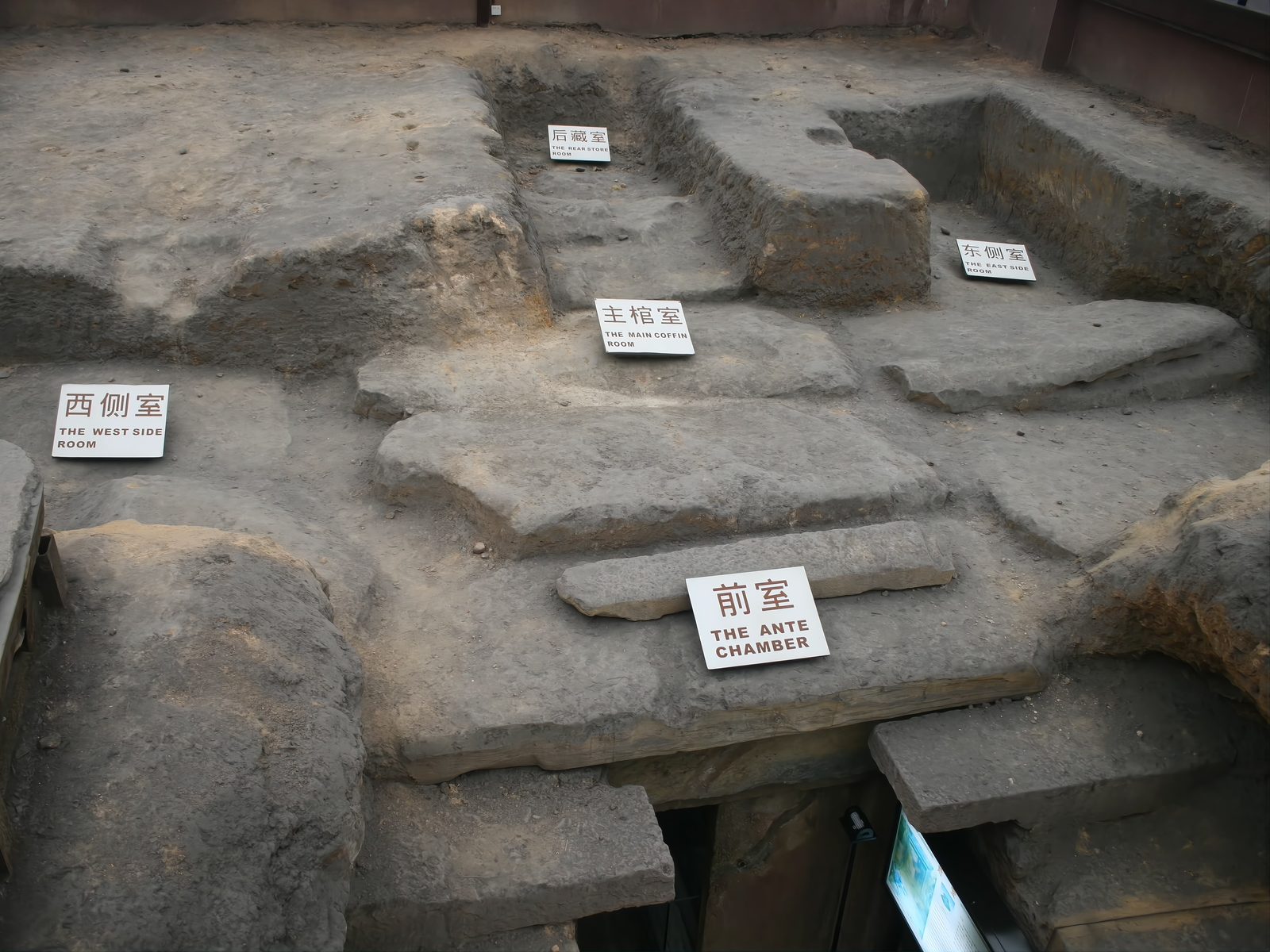
The tomb as it was found. Seven stone rooms cut into the heart of the hill, red sandstone on a central axis — and nothing taken out of it for twenty-one centuries.
The ninth of June
On the ninth of June 1983, on Xianggang Hill in the Yuexiu district — a hill forty-nine point seven one metres high, a kilometre from the old city centre — a machine was clearing ground for an apartment block. It hit a stone slab, then another, then a wall of them, laid in courses, going down. On a construction site in 1983 the usual answer to inconvenient rock was explosives. The foreman on this site stopped the work and called the municipal cultural relics administration instead.
That phone call is why there is a museum on Jiefang North Road today. Under the hill was a tomb twenty metres deep, cut into the rock, and it had been waiting there — by the usual reckoning — for two thousand one hundred years. Every Han royal tomb that archaeologists had opened before it had been emptied, most of them within a generation of the burial. This one was whole. Its occupant was the second king of a kingdom most people outside Guangdong have never heard of.
The excavation ran from August to October 1983. It was, by the standard account, the biggest thing Chinese Han-dynasty archaeology had found since the Mancheng tombs and Mawangdui. More than a thousand pieces and sets of objects came out of it — two thousand four hundred of them jade — and it remains the largest and richest tomb ever found in Lingnan, the lands south of the ranges.
The kingdom, and the man who built it
Nanyue began with a Qin general who refused to go home. Zhao Tuo was born around 240 BC in what is now Zhengding, in Hebei — the far north — and came south as a young officer with the army that pacified the Hundred Yue. The Qin took Lingnan, split it into three commanderies, and posted Zhao Tuo to run one of them. Then the Qin collapsed, and while Liu Bang and Xiang Yu fought over the centre, Zhao Tuo sealed the mountain passes, took over the other two commanderies, and in 203 BC declared himself king. The state he built ran across modern Guangdong and Guangxi, the south of Guizhou and the north of Vietnam, with its capital at Panyu — the core of today's Guangzhou, which is why the city has been the political centre of the south ever since.
He accepted investiture from the Han in 196 BC, broke with it when Empress Lü's government moved against the south, took the title of emperor, and made peace again under Emperor Wen. He ruled for sixty-seven years, pursued a deliberate policy of blending the Yue and Han peoples, and died at a hundred and three — the only centenarian monarch in Chinese history. Nanyue itself lasted ninety-three years and five kings, ending in 111 BC when Emperor Wu of Han conquered it and burned the capital. And then, for two thousand years, almost nothing physical survived of any of it: a few paragraphs in the Grand Historian's records, some scattered finds, and a question — which king was buried where? — that nobody could answer.
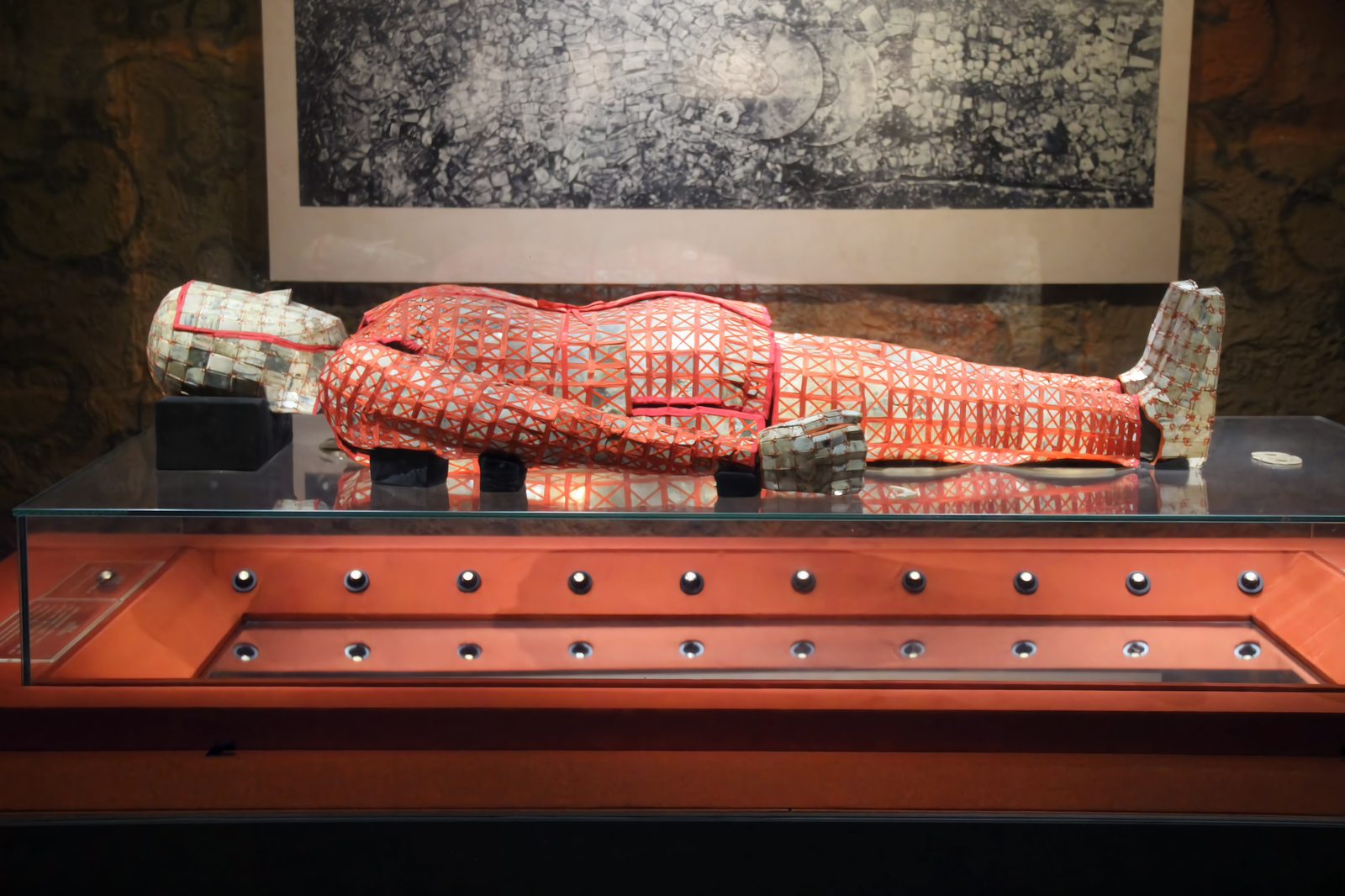
The silk-threaded jade suit. 2,291 plaques, each cut and drilled, tied with silk ribbon over a hemp backing — the earliest complete jade suit ever excavated in China.
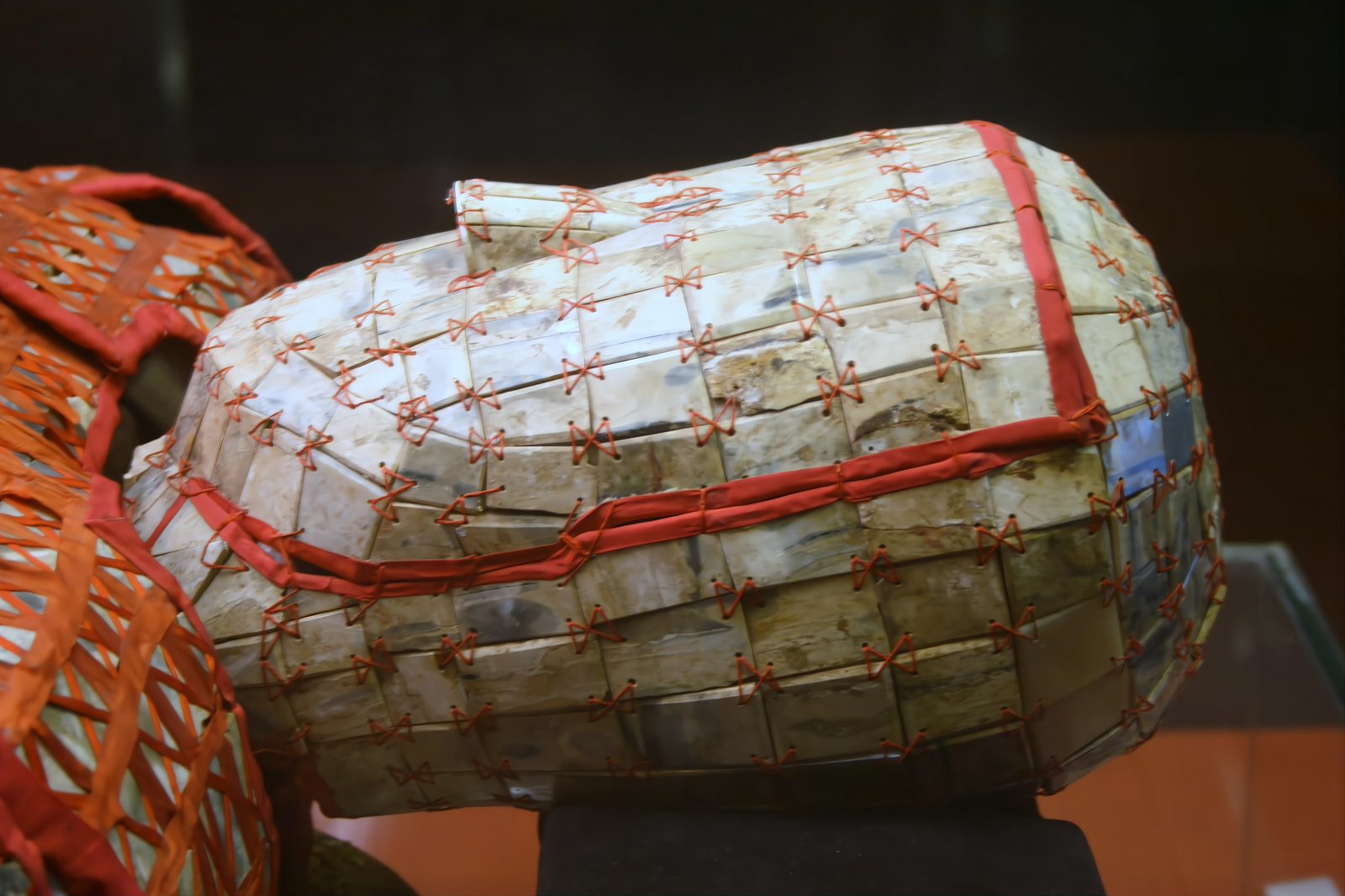
Silk, not gold. Han princes up north sewed their suits with gold wire. The mask-shaped head cover that went over the king’s face — silk ribbon, cross by cross, plaque by plaque.
What was in the dark
The tomb is a house built for one man, about a hundred square metres of it, in seven rooms. The builders split the hill twenty metres down from the top, cut a shaft shaped like the character for protrusion, tunnelled sideways from the front to make the side chambers, and approached it by a sloping ramp from the south. The rooms are built of red sandstone — more than seven hundred and fifty blocks of it, quarried at the old Lotus Flower Mountain quarry in Panyu and laid out the way a palace was: an audience hall in front, sleeping quarters behind, everything on one central axis. Twenty-four great stone slabs close the roof, and the front chamber's door still carries its painting — red and black cloud scrolls, faint but there, after two thousand years underground. It is the largest painted stone-chamber tomb of the Han era ever found in Lingnan.
Because it was never robbed, the objects in it are not stray survivals but a complete set — the entire furniture of a royal life, where it stood when the doors closed. The jade suit alone used 2,291 plaques, each cut and drilled, threaded with silk and backed with hemp, assembled into a casing 173 centimetres long with a head cover, sleeves, gloves and shoes. It is the earliest complete jade suit known in China, roughly a decade older than the gold-wired suits of the princes at Mancheng, and its jade matches stone from older sites in the region — strong evidence that the Nanyue court made it themselves.
Then there was the seal problem. Scattered through the rooms were the objects that would settle who lay here: a gold seal, jade seals, a silver box from the far side of the sea, and a bronze ding with a city's name cast into its lid. Sorting that out took until the afternoon of the twenty-second of September.
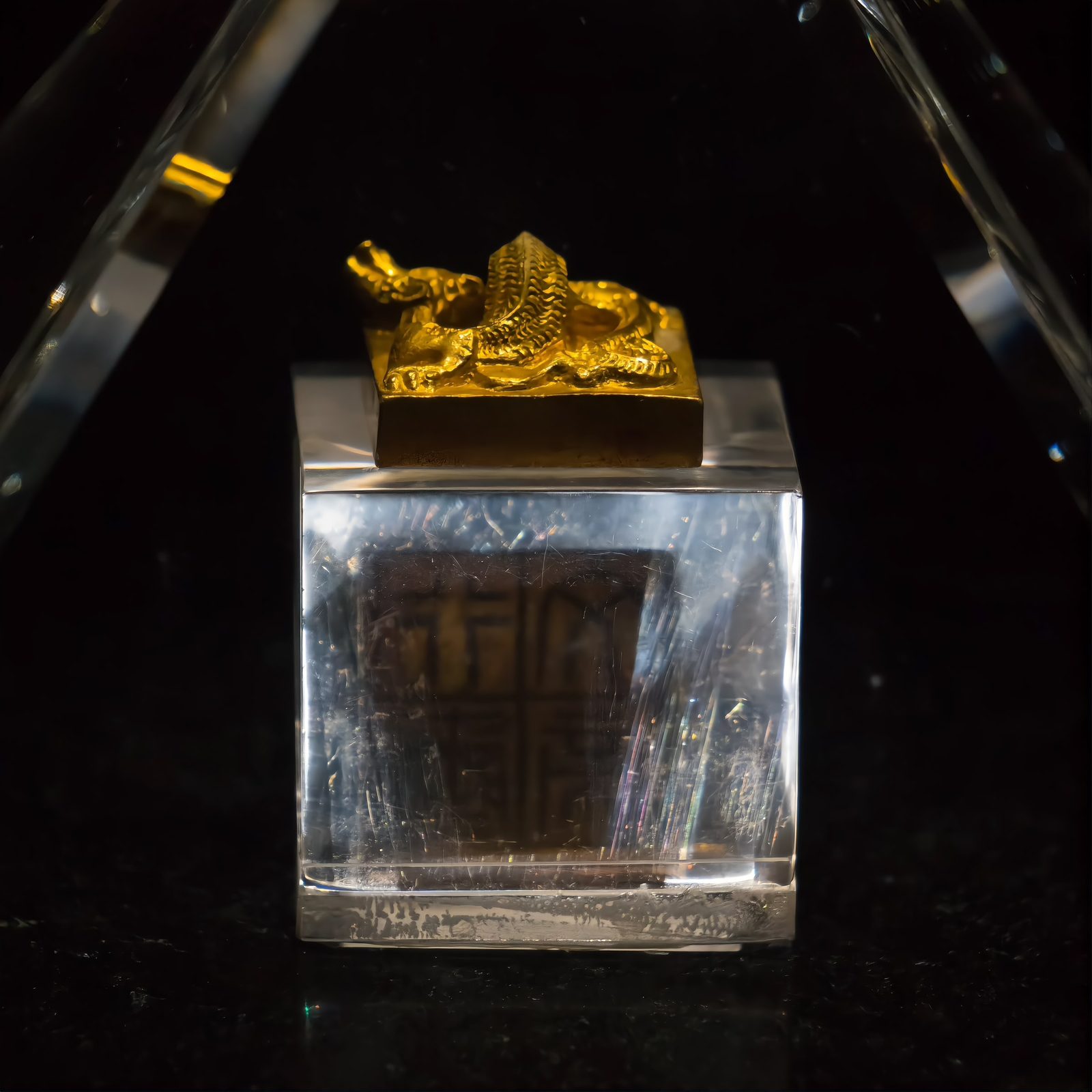
The seal that answered the question. Four characters in seal script — the travelling seal of Emperor Wen — under a coiled dragon. Found lying on the king's own chest.
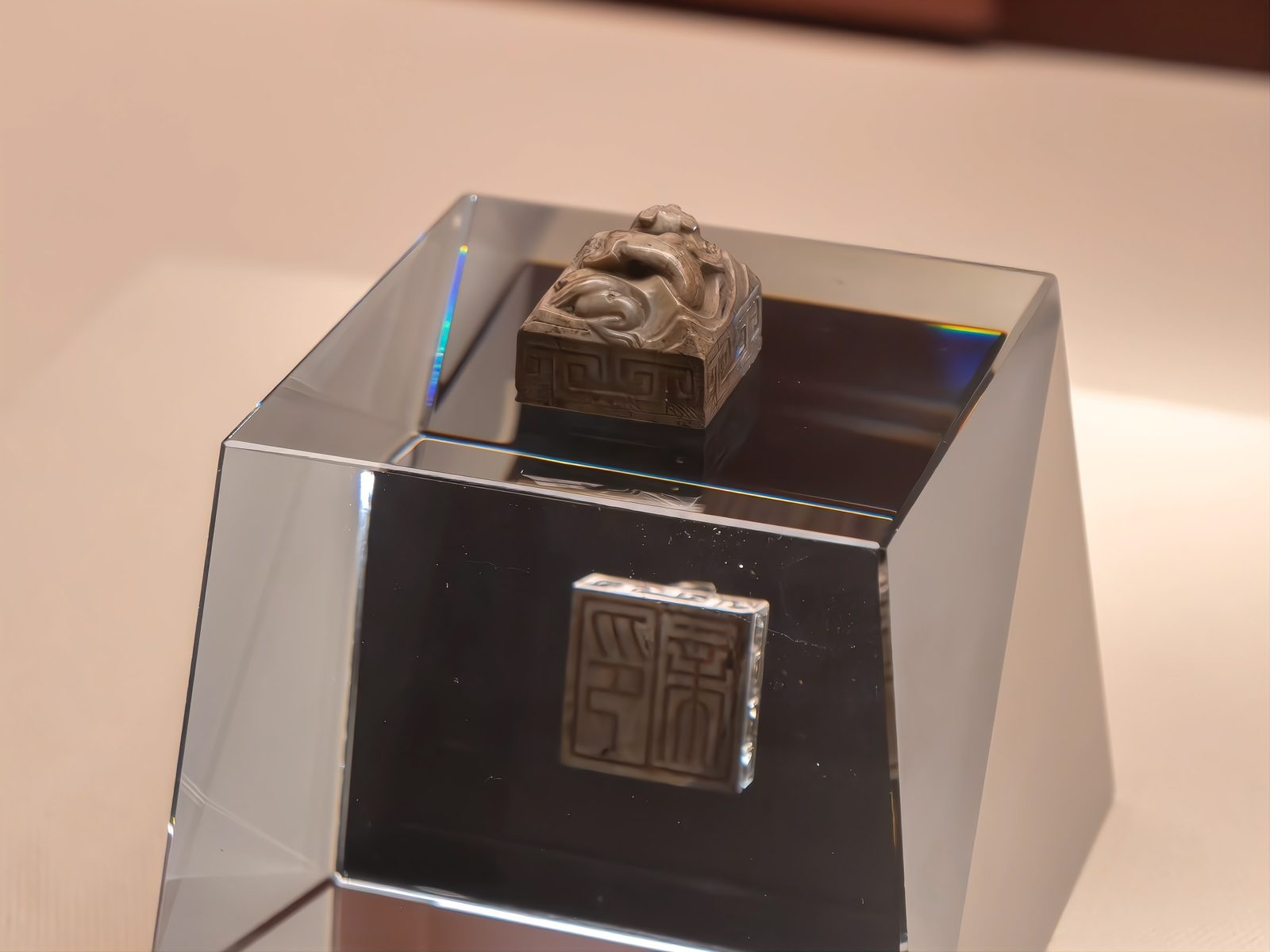
The emperor's jade seal. Pale jade with a beast knob, reading simply Imperial Seal — the second king's own title, hidden in the tomb after the third king gave the imperial style up.
The twenty-second of September
For six weeks the team worked inward through collapsed stone, and the objects that came out were good, and then better, and still nobody knew whose tomb it was. On the afternoon of the twenty-second of September 1983 they reached the body. On it lay seal after seal — nine in all — and the one that mattered was gold, with a coiled dragon for a handle and four characters cut into its face: the travelling seal of Emperor Wen.
The man in the suit was Zhao Mo, the second king of Nanyue, grandson of Zhao Tuo — a ruler whose entire recorded existence was a single paragraph in the Grand Historian's account of the south. The gold seal is the largest Western Han gold seal ever excavated and the only Han imperial seal with a dragon knob, and it broke the rulebook besides: the Son of Heaven was supposed to seal documents with white jade and a mythical beast. A jade seal reading simply Imperial Seal lay with it, and a jade name seal reading Zhao Mo settled the identification that two thousand years of readers had argued about — some older accounts give the name as Zhao Hu, and museum labels kept the older reading for years after the stone said otherwise.
The records explain the seal's odd location. After the third king dropped the imperial title and made his peace with the Han, the story goes, he hid the seals of the two emperors before him — which is how an emperor's seal ended up in a grave instead of a treasury. Zhao Mo had ruled for about sixteen years and died somewhere between forty and forty-five. He lay in a coffin within an outer coffin, both long since rotted, wearing the jade suit.
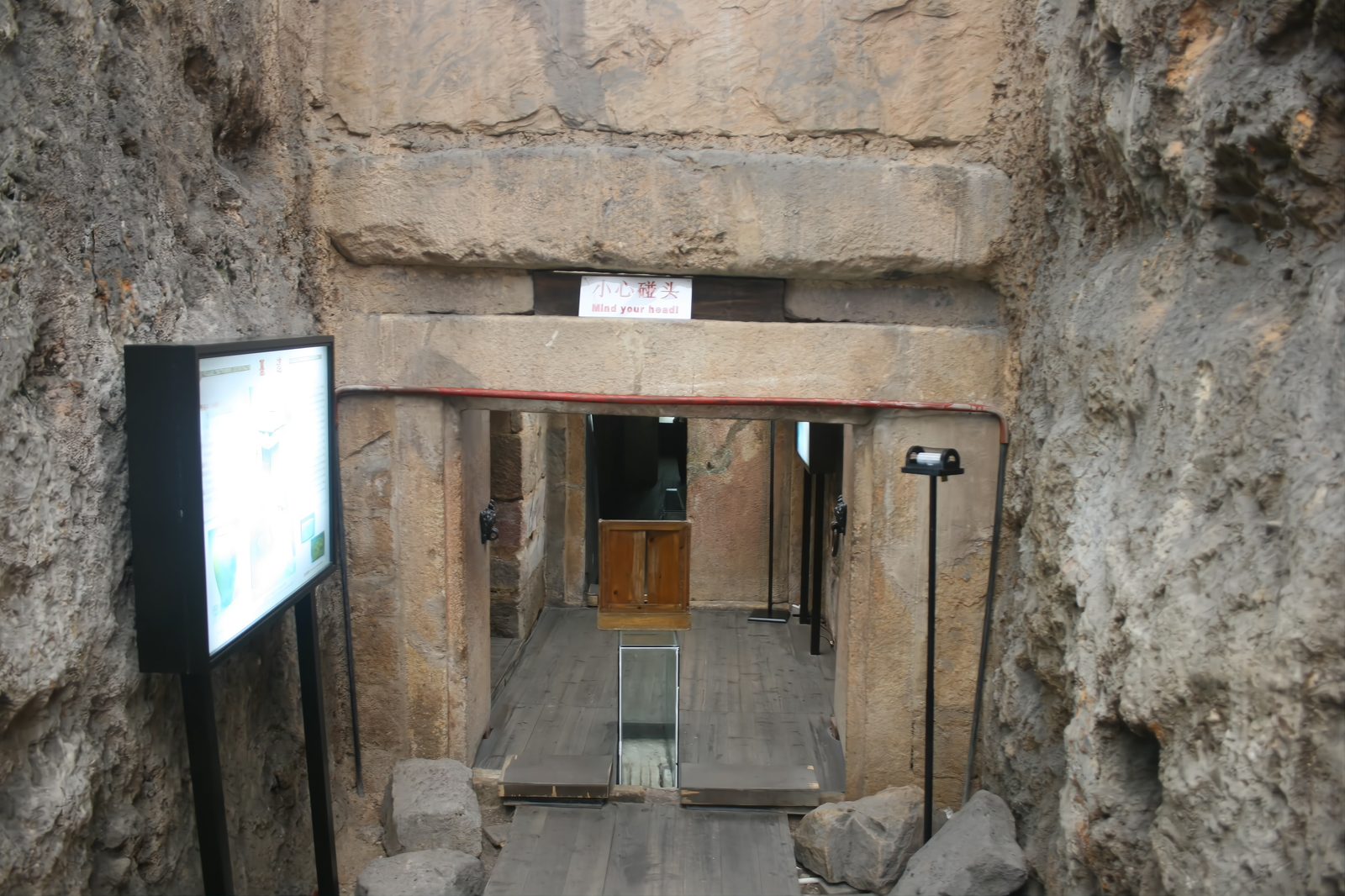
The door that held. The tomb's stone passage — through this door, in the autumn of 1983, came the first objects to see daylight in twenty-one centuries.
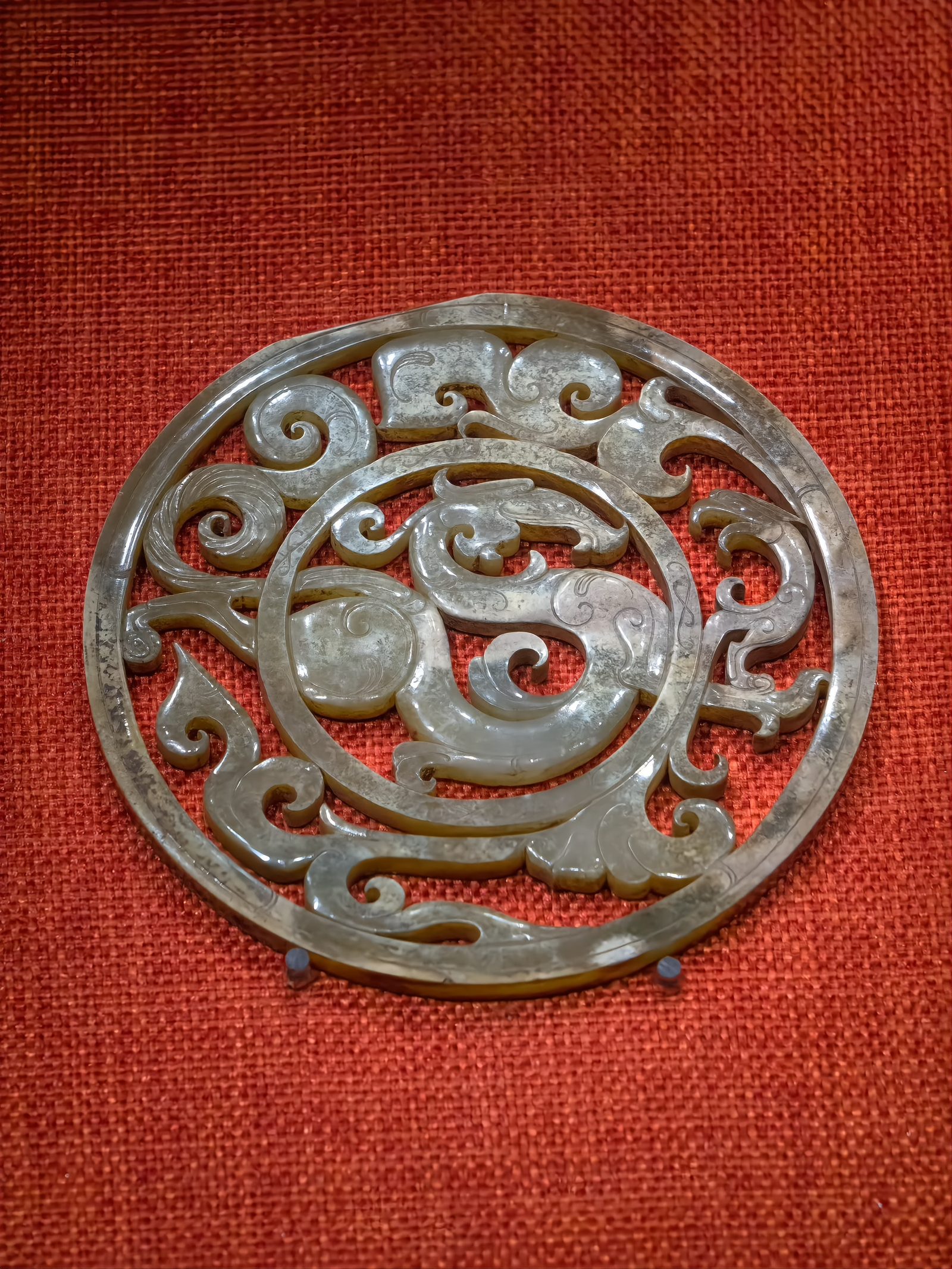
The dragon and phoenix disc. Openwork jade from the ornaments laid across the king's shoulders — Han carving at the edge of what a drill can do.
The household
The rooms are a household arranged for the dead, and each room tells you who lived in it. The master chamber at the centre held the coffin and the king: thirty large jade discs laid above and below the suit, a silk veil over his face set with eight peach-shaped panels of hammered gold, three openwork jade ornaments placed before his head and across his shoulders, a string of composite jade pendants over his chest, and ten iron swords along both sides — laboratory work puts the steel at medium carbon, and four of the swords carry jade fittings. The nine seals on his body included a tortoise-knob gold seal reading Crown Prince, evidence that Nanyue followed Qin and Han practice by pre-appointing its heir.
To the east lay the consorts' chamber: four wives, each with her own seals and ornaments, the first among them holding a gold seal that read Seal of the Right Consort — an imperial style — and an ivory seal reading Zhao Lan. To the west was the kitchen, with seven people in it and no coffins among them, and pigs, oxen and sheep at the back of the room. Behind, the storehouse: more than a hundred large bronze, iron and pottery vessels, stacked, most still holding the bones of poultry and livestock and the shells of seafood. In front, model carriages on one side and a charioteer on the other, buried with a bronze seal with a fish handle reading Seal of the Jingxiang Magistrate. In the east side-room, among two sets of bronze bells and stone chimes, lay a musician — the instruments and the player together. Outside the tomb door, in the outer coffin pit, seventeen great pottery jars, carriage fittings and ceremonial weapons, with two more sacrificed people, one of roughly a gate constable's rank.
Count them: one king, four consorts, one charioteer, one musician, seven kitchen staff, and two more at the door. Fifteen people went into the ground so that one man could keep his household. Some accounts give lower totals because the pair at the entrance are easy to miss — the Guangzhou government's own archaeological report reaches fifteen only when the musician is counted — but fifteen is the number the excavation literature stands on.
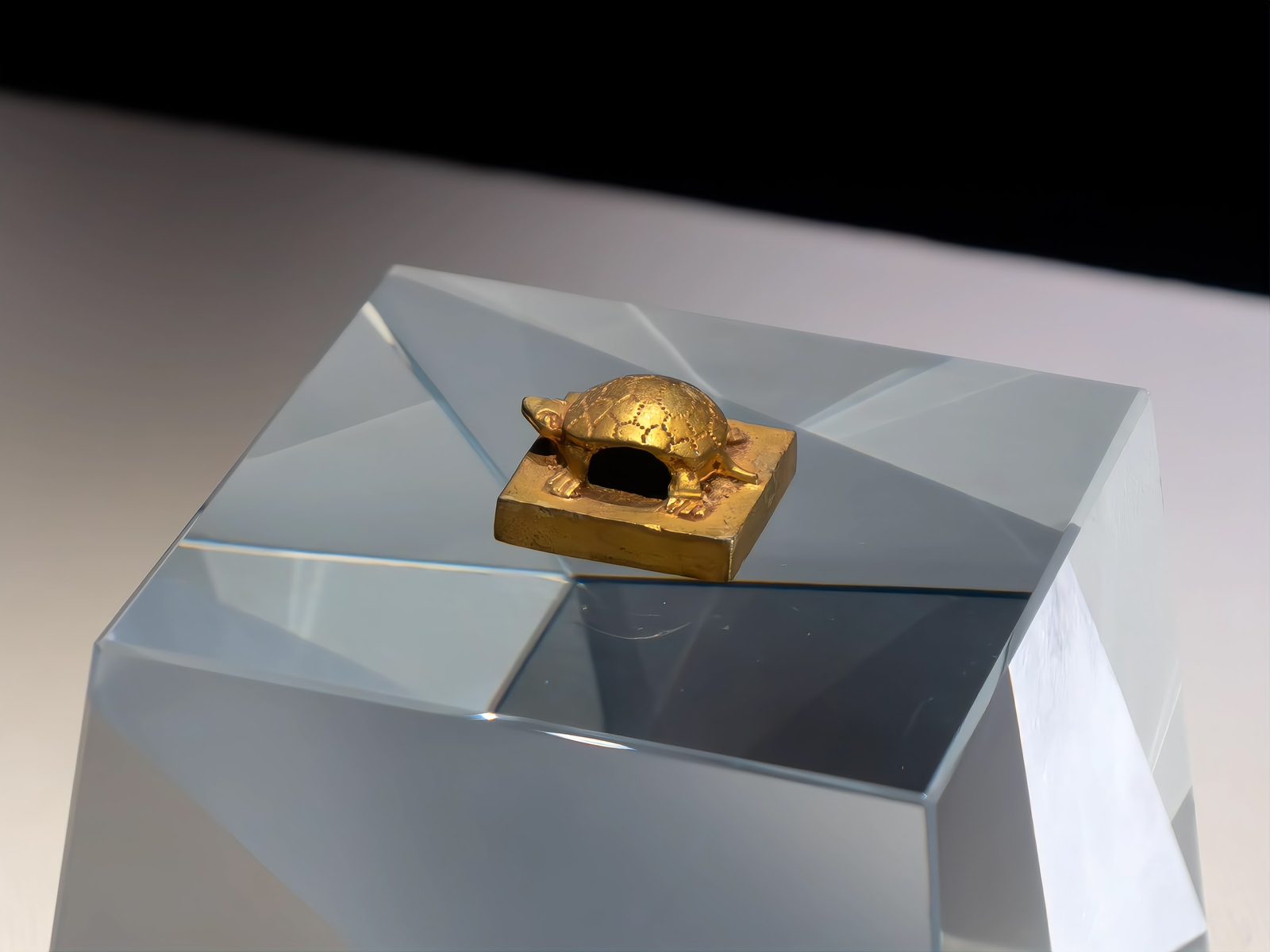
Crown prince, in gold. One of nine seals found on the king's body — the mark of an heir appointed before he was needed, kept beside its owner to the end.
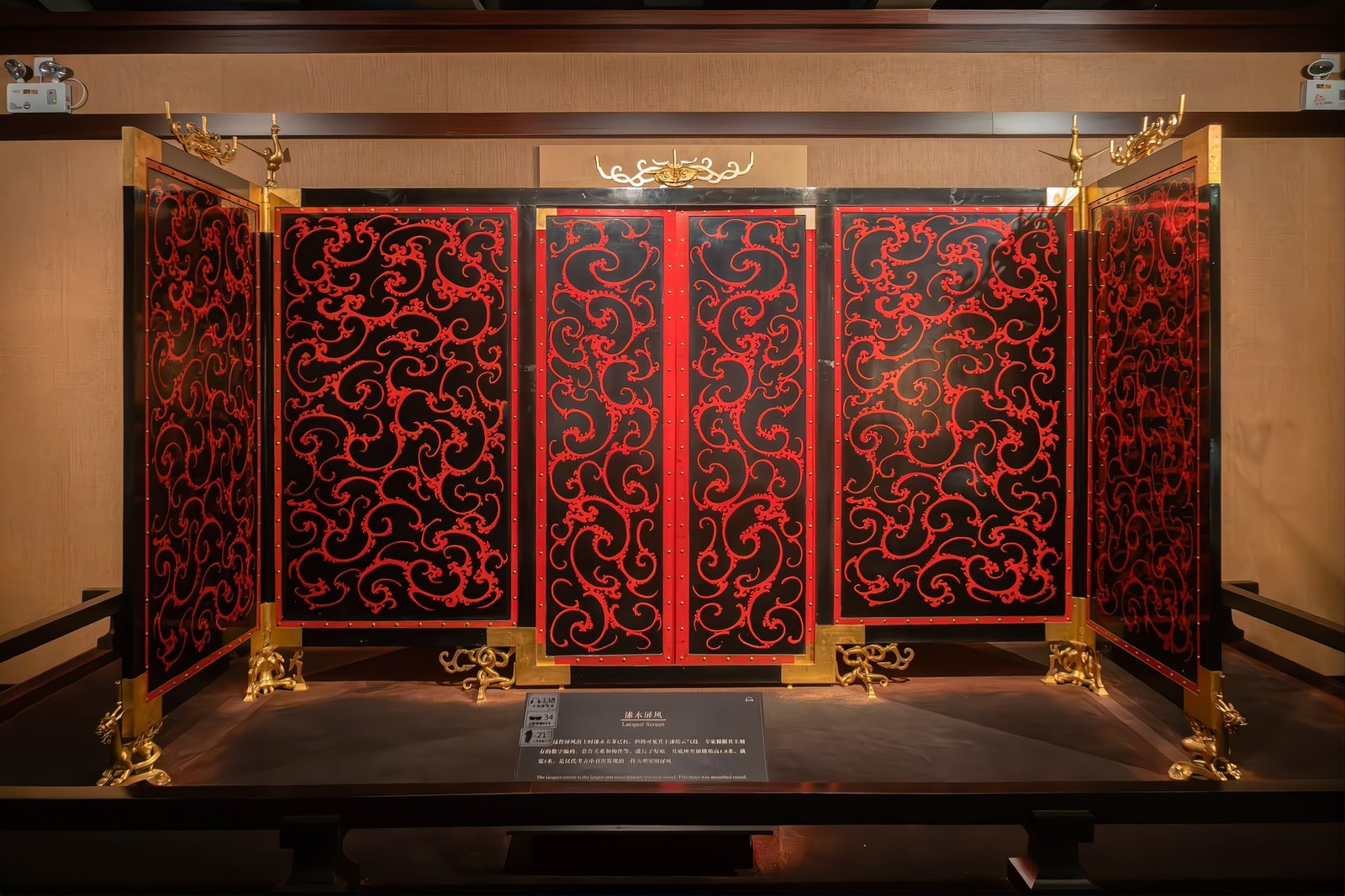
The screen, standing again. The front chamber's great lacquered screen, rebuilt from its gilt bronze fittings — the audience hall furnished as the excavators found it.
What the objects say
Some of the finds are now the standard treasures of Guangdong. A jade cup shaped like a rhinoceros horn, the only one of its kind. A bronze ding with the characters Fanyu cast into its lid — the direct physical evidence for Guangzhou's old name, and for the city's two-thousand-two-hundred-year continuity on one site. A bronze tiger tally with an inlaid gold inscription. A great bronze bucket whose walls are worked with boats. Two hundred and forty sets of jade, in workmanship that ranks among the finest Han jade anywhere in China.
And then the objects that change the picture. The garlic-patterned silver box, West Asian in style, came to rest at the foot of the jade suit among a pile of imitation-jade pottery discs, with half a box of pills still inside it. Five whole African elephant tusks lay in one of the side rooms, the longest 126 centimetres — raw material for the ivory carvers, freighted in by ship, nothing like the teeth of local elephants. A silk pouch under the king's head held four hundred and seventy small pearls, a pillow. A bronze bucket worked with boats, and a state whose people were famous on water. Nanyue sat on the South China Sea with a long coastline and a dense river network, and its trade ran south and west long before anyone called it a silk route. Guangzhou's claim to be an eastern starting point of the maritime silk road rests on things like this box — freight that arrived by sea and was buried in a king's grave by 122 BC.
The kingdom's last day is in the ground too. Han troops burned the capital in 111 BC, and the palace site in the middle of today's city still holds the burnt layer and the charcoal, with broken roof tiles beneath it stamped with officials' marks and inscribed with wishes that the king live ten thousand years — physical confirmation of a single line in the Grand Historian: at dusk the ships attacked and burned the city.
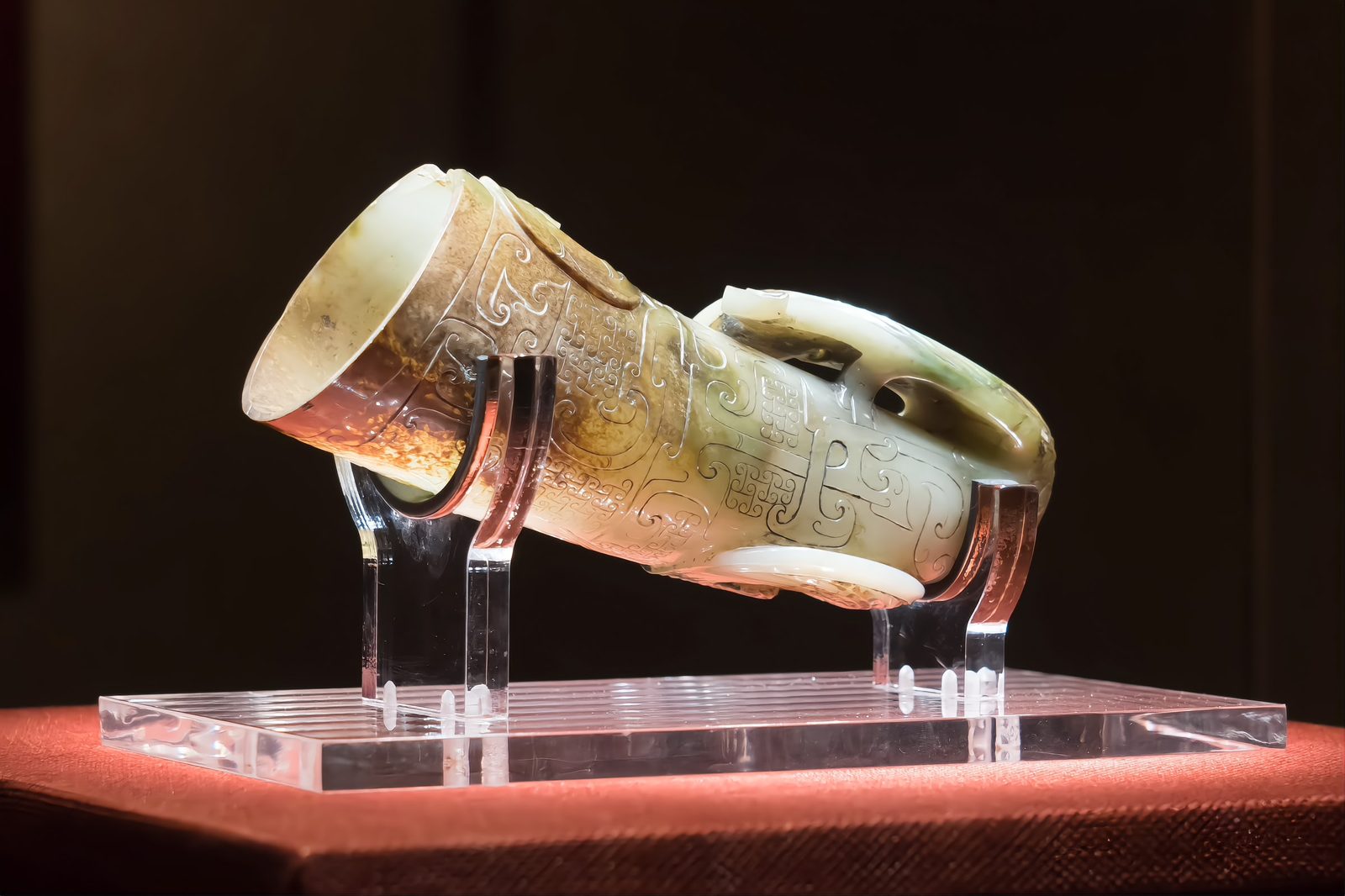
The rhinoceros-horn cup. Carved from a single piece of jade in the shape of a horn, on its own gilt bronze stand — the only cup of its kind known.
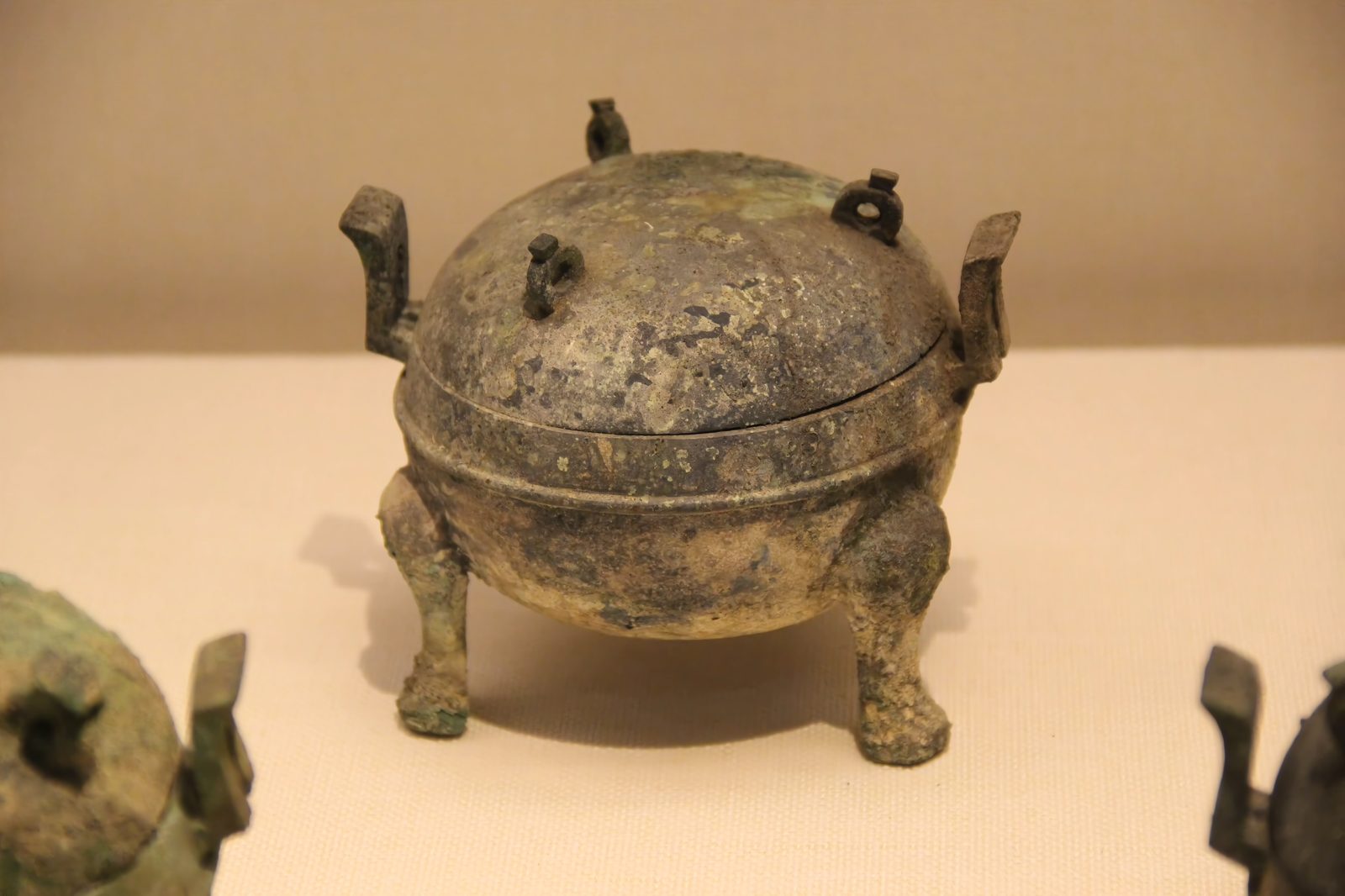
The ding that names the city. A bronze cooking vessel from the tomb's stores — its lid carries the two characters Fanyu, Guangzhou's old name, cast into the bronze two centuries before the Common Era.
The box that came by sea
The silver box deserves its own paragraph, because it is the one object in the tomb that is not Chinese and not Nanyue. Its shape, its garlic-lobe patterning and its workmanship are West Asian; nothing like it was made in Lingnan or in the Han heartland. It reached a royal grave in Guangzhou with pills still in it, which means it was used, not just kept — a possession that meant something to the man who owned it. Set beside the African tusks and the boat on the bucket, it is the earliest hard evidence in the city for the trade that would later be called the maritime silk road, and the museum tells that story in a whole gallery of its own.
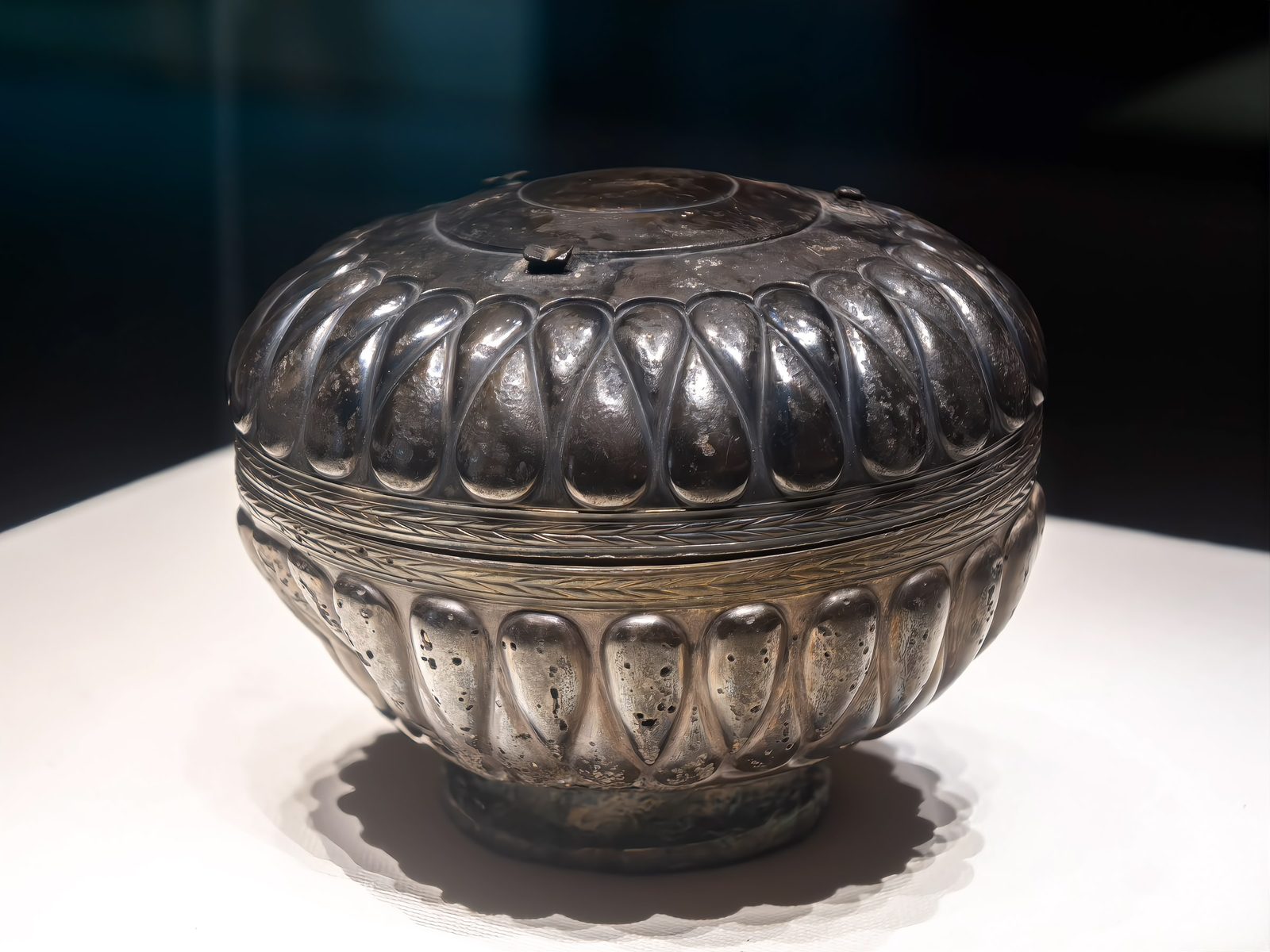
Freight from the far side of the sea. The West Asian silver box — garlic-lobe pattern, foreign workmanship, half a box of pills — found among imitation-jade discs at the foot of the jade suit.
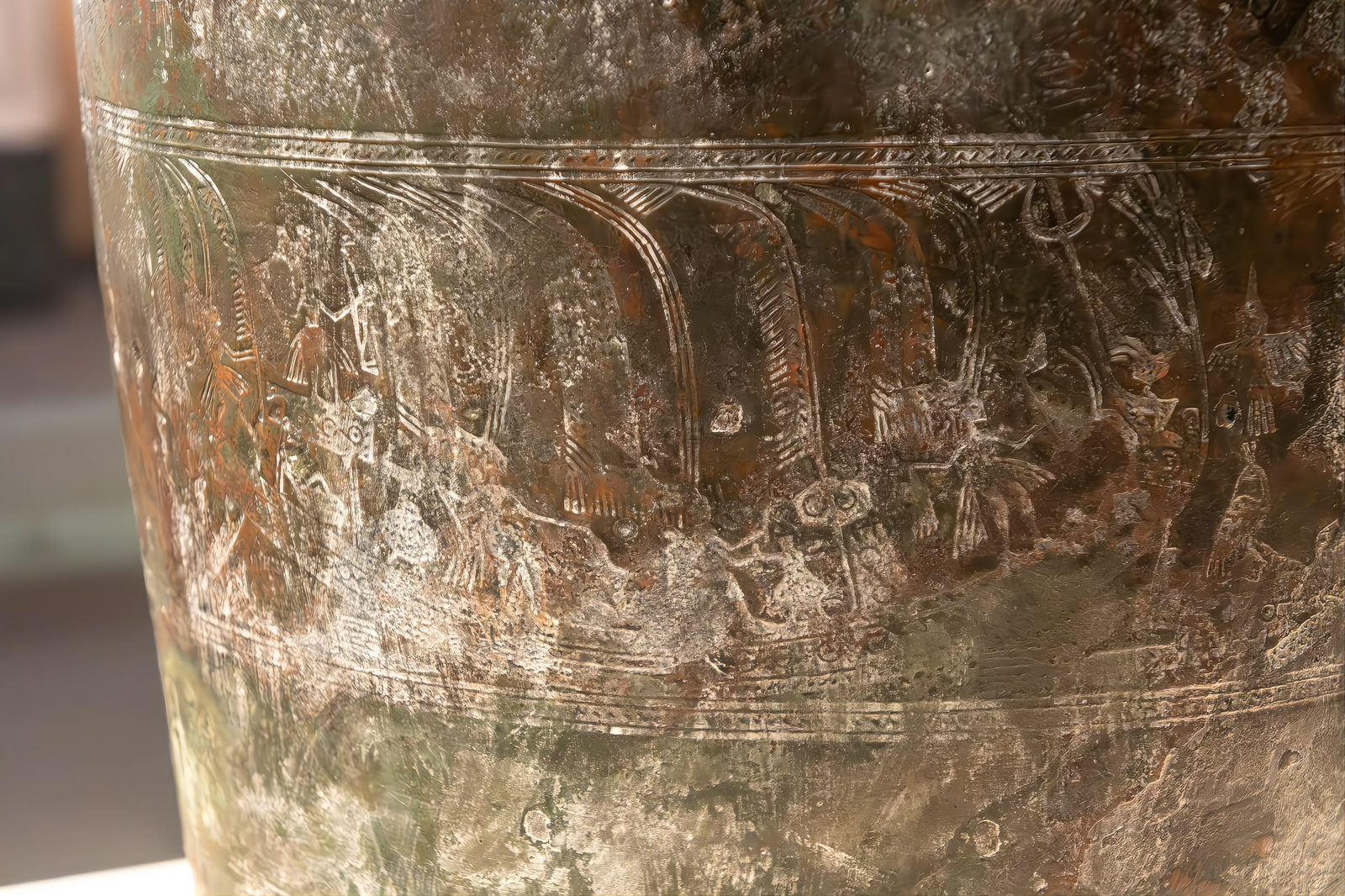
Boats on the bucket. The bronze bucket's incised walls carry rowed vessels with figures aboard — a kingdom that thought of itself from the water.
What is there now
The tomb was left where it was. The museum was built over and around it — a national first-class museum, its mausoleum-site area covering some fourteen thousand square metres, opened in 1988 and completed in 1993, with a great glass canopy over the chamber stepped like the mound of the Han emperors' own mausoleums. You walk in and look down into the actual rooms: the red sandstone courses, the seven chambers, twenty metres below the top of the hill, exactly as the excavators left them. The objects live in the exhibition building beside it, arranged in six galleries — the king himself, the jade, weapons and carriages, the sea route, daily vessels, and court music.
The tomb was listed as a national key cultural relic in 1996, and in 2021 it was named among the hundred great archaeological discoveries of Chinese archaeology's first century. Twelve years after the tomb, the other half of the kingdom turned up: in 1995 the Nanyue palace site was found under the streets at Zhongshan Fourth Road, complete with a great stone pond and a winding stone channel that are the earliest royal garden of the Qin-Han era yet found in China. So both ends of Nanyue are now open to visitors in one city — the palace where it was governed, under the shopping streets; the tomb where its second king lay, under a hill that a bulldozer opened in June 1983. The one thing missing is the founder. Zhao Tuo, who lived to a hundred and three and built the state, is not in this tomb, and after two thousand years of searching nobody has found his. It remains the great open question of archaeology in the region.
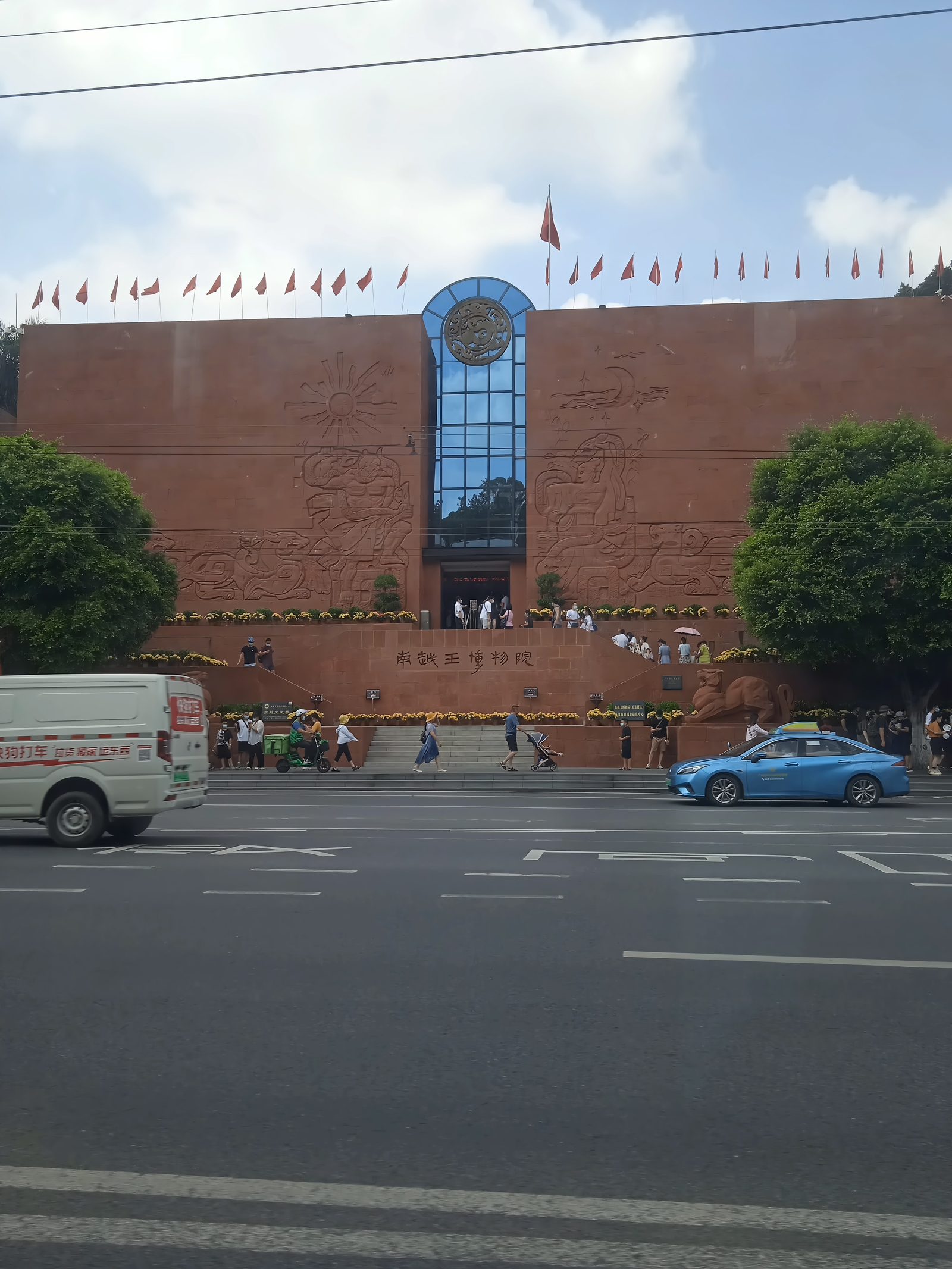
The museum over the tomb. Built on and around the find in 1988, its glazed hall marking the canopy over the chamber below — the tomb stayed home.
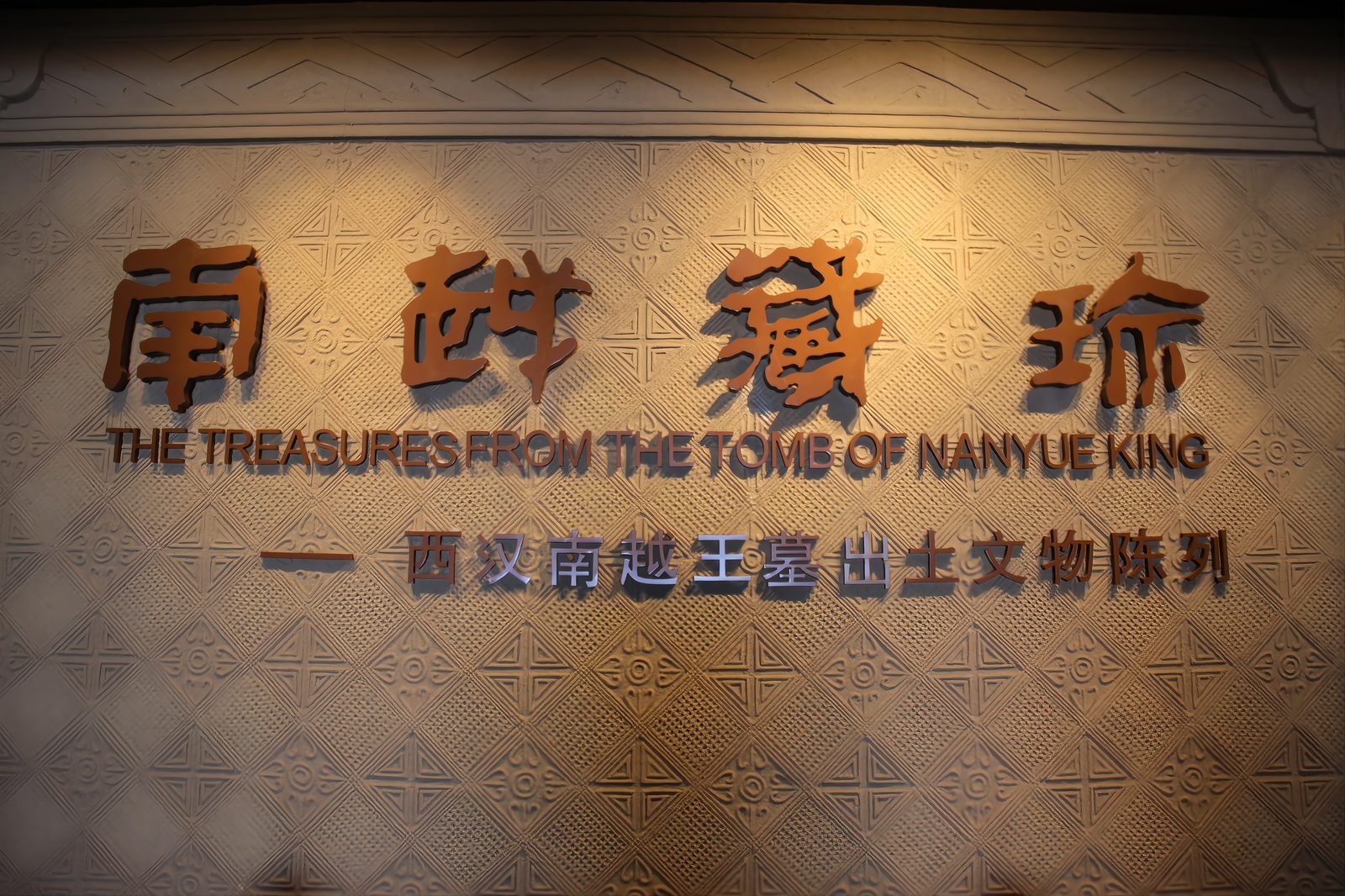
Where the objects live. The exhibition building's entrance hall — the jade suit, the seals and the silver box wait in the galleries past this wall.
Going, and what to expect
Getting there. The mausoleum site is at 867 Jiefang North Road in Yuexiu. Metro Line 2 to Yuexiu Park station, Exit E, leaves a walk of about three minutes, which makes this one of the simplest major museums in the city to reach. Buses to the Yuexiu Park, Jiefang North Road or Panfu Road stops put you at the door. The palace-site half of the museum, where the royal garden is displayed, is free and stands near Beijing Road at the other end of the old city — the two make a natural pair, and the metro runs between them.
Tickets and hours. Entry to the mausoleum site is ¥10, with a ¥5 concession for students and visitors aged sixty to sixty-four; the over-sixty-fives, the under-eighteens, and a list of others enter free. Everyone books a real-name ticket through the museum's WeChat official account or buys on site with ID. The site opens Tuesday to Sunday, 9:00 to 17:30 with last entry at 17:00, and closes on Mondays the way museums do, public holidays excepted; summer and holiday periods sometimes run to 18:00. The visit has one extra door: the lower level of the tomb chamber itself takes only limited visitors and needs its own free reservation, bookable a day ahead through the same WeChat account. A free docent tour runs at 9:30 daily.
How long, and when. Ninety minutes covers the chamber, the jade suit and the seals without hurry; two to three hours if you read the galleries properly, and a full day if you add the free palace site across town and follow the sea-trade story through both. Weekday mornings are quiet. The jade suit and the gold seal are the things people come for — and the gold seal is small, smaller than a matchbox, which is its own kind of lesson.
Honest notes. The total object count is given as more than a thousand pieces and sets in the museum's own figures and as over ten thousand items elsewhere; the smaller figure is used, with two thousand four hundred jade items. The sacrificed attendants are counted as fifteen in the excavation literature — four consorts, seven kitchen servants, a charioteer, a musician and two at the entrance — but totals of thirteen and fourteen circulate in older summaries, depending on how the pair at the door is counted. The king's name is written Zhao Mo in current official usage; older sources, including the first reports of the discovery, give Zhao Hu. The jade suit's dating to about 122 BC follows the standard account of the burial. The tomb's occupant ruled about sixteen years and died between forty and forty-five; the imperial-title story and the hiding of the seals rest on the Grand Historian's paragraph. Hours and prices are the museum's 2026 figures and could shift on the day — the lower-chamber reservation in particular is limited and worth booking before you plan the rest of the day around it.
Go in the morning, take the 9:30 docent tour if the timing works, and do it in this order: look down into the chamber first, then find the jade suit, then the gold seal — small, and worth the pause — then the garlic-patterned silver box and the rhinoceros-horn cup, then the ding with the city's name on its lid. Finish at the rail above the stone rooms and look at where all of it came from. If the day has room left, the palace site across town is free, and it is the other half of the same story.
Photographs and sources
Photographs from Wikimedia Commons, used under their licences and enhanced for this page: the tomb pit, the tomb's stone entrance, the jade suit and its head covering, and the Fanyu ding (CC0, Gary Todd); the gold seal, the rhinoceros-horn cup and the dragon-and-phoenix disc, and the exhibition-hall wall (CC0, Gary Todd and Shujianyang); the imperial jade seal, the crown-prince seal, the restored screen, the silver box and the boat bucket (CC BY-SA 4.0, Shujianyang); and the museum front (CC BY-SA 4.0, 中少). History drawn from the editorial source file, cross-checked against the Nanyue King Museum's own visitor guide and site notices (the address, hours, ticket rules, the lower-chamber reservation, the 2021 merger and the six galleries), the Guangzhou culture and tourism bureau's archaeological report on the tomb (the hill's height, the sacrifice count, the chamber construction and the Lianhua Mountain quarry), and People's Daily and China Social Sciences Net coverage (the 1988 opening, the canopy's model, the identification of the king). Where the records disagree — the total number of objects, the count of sacrificed attendants, the king's name in older reports — the differing versions are given rather than resolved.
There's more where this came from.
Read the latest insider notes →Two new posts a week — the things a non-resident can't know, written down before they cost you a morning.