Lianhuashan (莲花山), the quarry that built the city
Climb nine storeys of an old brick pagoda on a low red hill above the Pearl River estuary and the view runs in every direction at once: cargo ships queuing down the Lion Ocean toward Hong Kong, the flats of the delta going green and grey to the horizon, and below the tower a landscape no other city has — because it was not made by water or by volcano, but by people with chisels.
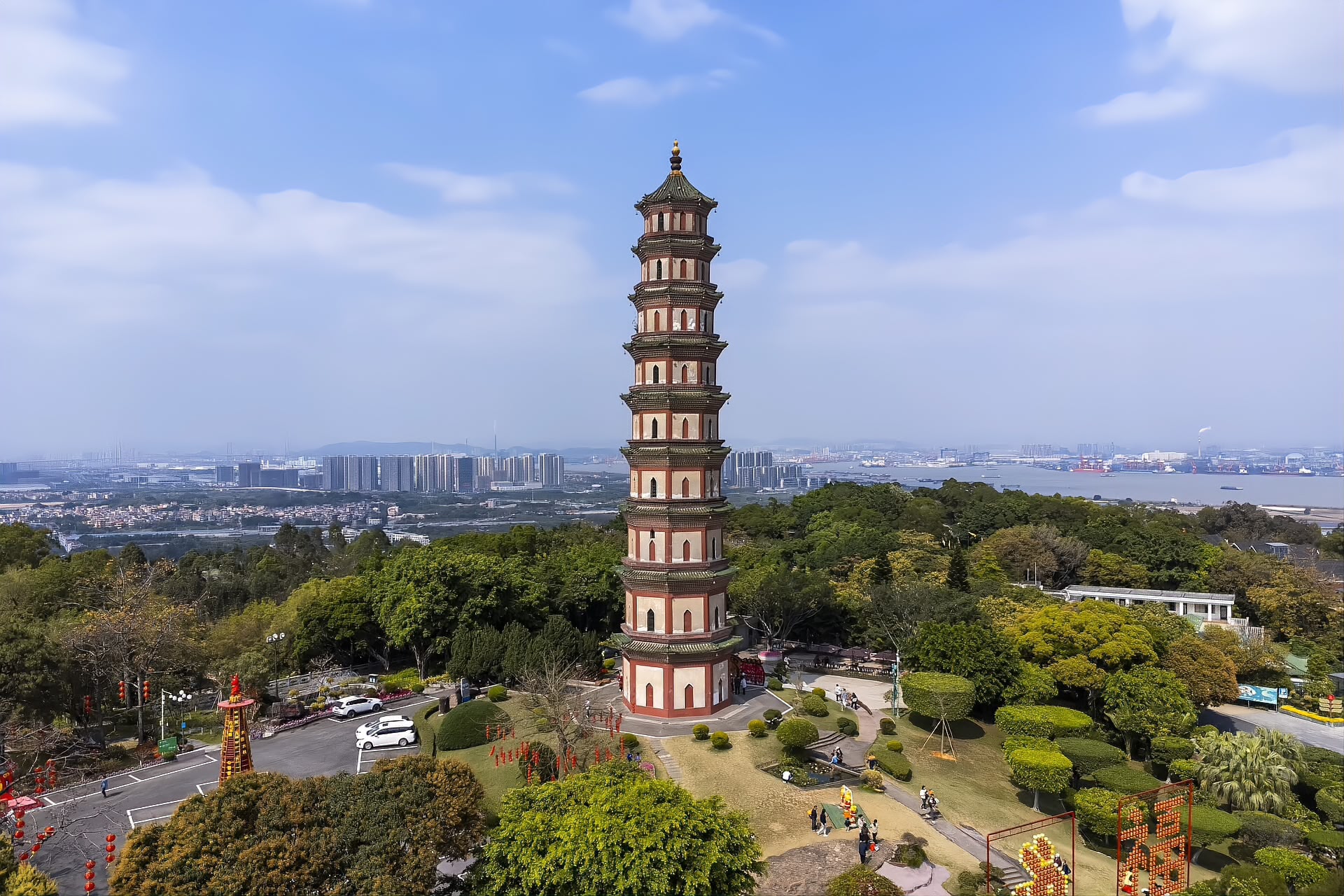
The provincial capital's ornamental column. A brick pagoda of 1612, built partly to press down the hill's veins after two thousand years of quarrying. Writers called it the first and last thing on the river.
Start here, because there are two Lianhuashan in this part of the world and bookings, taxis and map apps do get them mixed up. This one is the quarry hill in Panyu, signed as the 莲花山旅游区 scenic area. The other is the park in Futian, Shenzhen, which has its own page.
莲花山 Liánhuāshān — the Lotus Flower Mountain itself
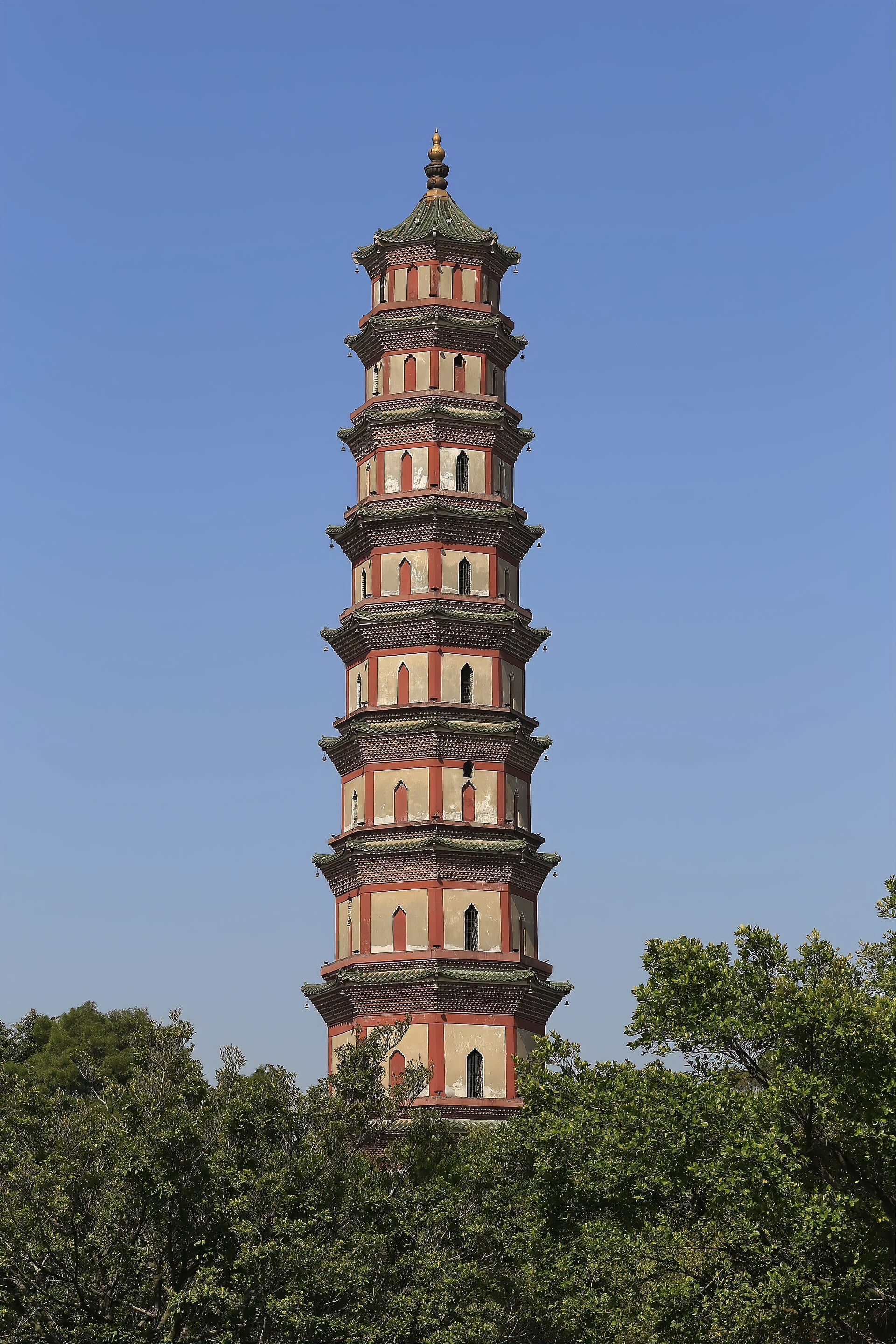
莲花塔 Liánhuā Tǎ — the Wenchang pagoda of 1612
莲花城 Liánhuā Chéng — the Qing Lotus Fortress of 1664
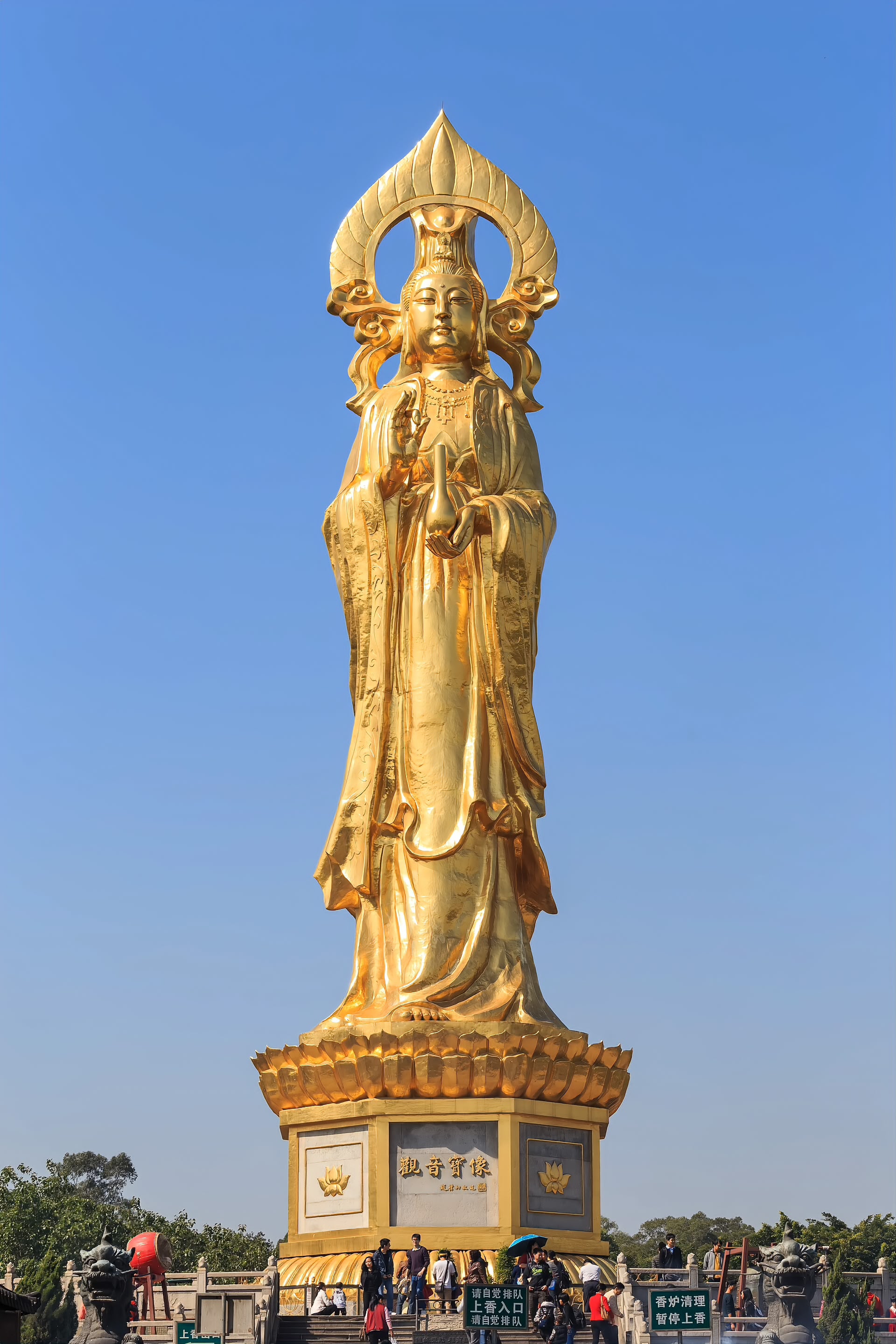
望海观音 Wànghǎi Guānyīn — the gilded bronze Guanyin gazing over the sea, 1994
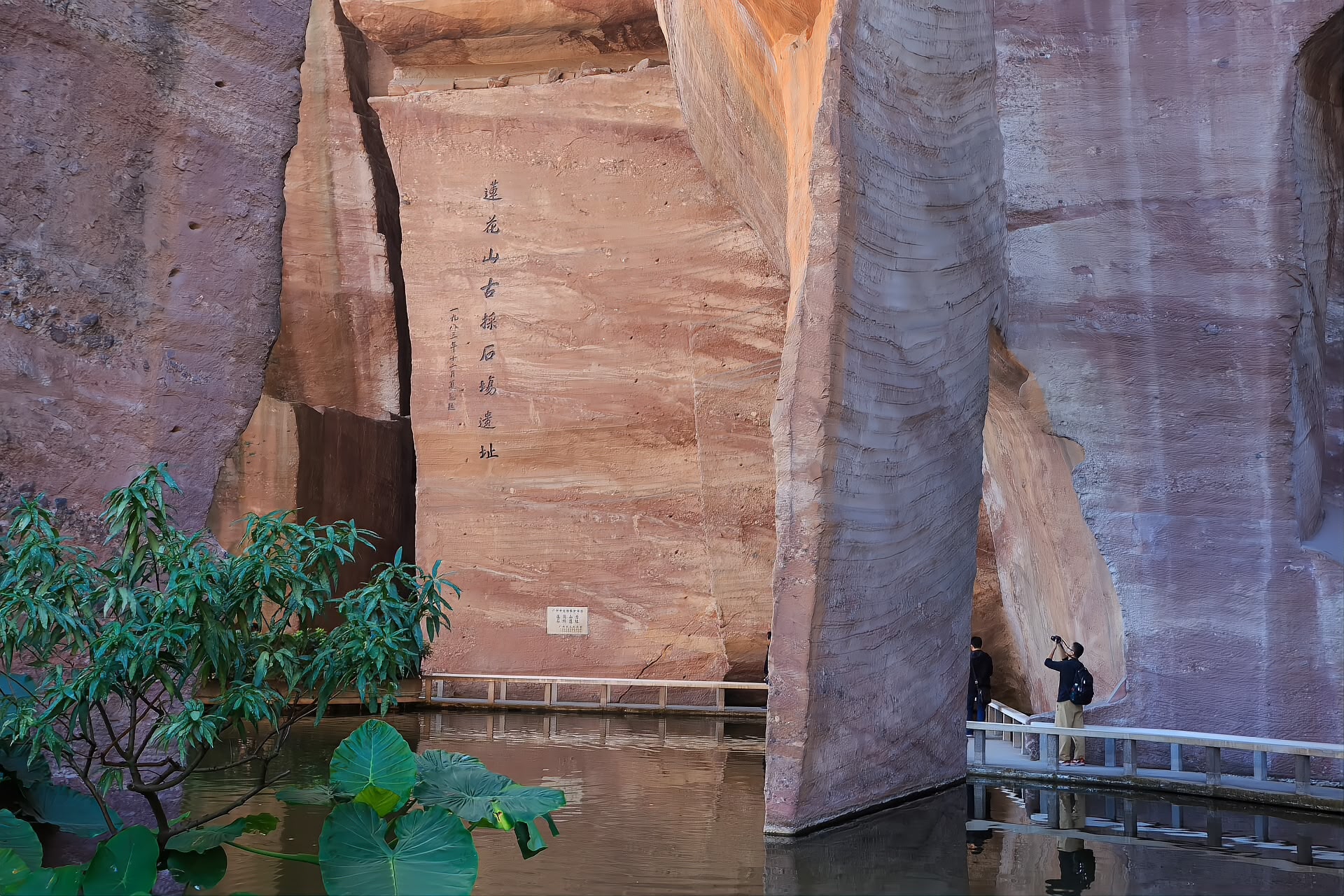
古采石场 Gǔ Cǎishíchǎng — the ancient quarry, the reason to come
狮子洋 Shīziyáng — the Lion Ocean, the reach of estuary below the hill
莲峰观海 Liánfēng Guānhǎi — Lotus Peak over the Sea, the name voters gave the view in 2002
For transport: metro Line 4 to 石碁站 (Shiqi), Exit A, then bus 番92 to the 莲花山车站 stop. From Panyu's own centre, 番128 from Shiqiao station also serves the hill.
The rock
The hill is one of about forty-eight low hills of red sandstone running along this shore, laid down when this coast was a basin. It has two qualities that mattered. It is soft enough to cut and dress with iron tools, and it weathers into a warm red that the delta has always read as festive and auspicious. A temple door frame, a bridge pier, a clan ancestral hall, a city wall: in the towns of the Pearl River delta, if the stone is red, there is a good chance it came from here.
The name comes from the top. A peak carries an outcrop weathered into the shape of a lotus flower, and the hill took the shape for its name. But the geology is the plot: a convenient outcrop of good stone sitting beside a deep, wide channel with a straight run down to the sea ports and up to Guangzhou. Stone is heavy, and moving it is most of the cost of using it — and here the cost was a short cart track to a barge. That accident of geography is the whole commercial case, and it is why a hill barely taller than a church tower supplied a province.
The stone that went north
How long this has been going on was answered by accident. In 1983 the tomb of the second king of Nanyue was found intact under a hill in the middle of Guangzhou, its chambers built of dressed sandstone blocks that were red. A research programme led from the Chinese Academy of Sciences institute in Guangzhou took samples from the tomb and from a dozen or more candidate quarries around the delta, comparing mineral make-up, bedding and weathering, and the answer came back in 1989: the tomb stone was quarried at Lianhuashan.
That single finding rewrote the site's age. The tomb was built in the western Han, around two thousand two hundred years ago, so the quarries were already being worked at scale by then — and the red stone of Panyu was being loaded onto barges and shipped sixty-odd kilometres up the estuary to build a royal tomb in the capital of a southern kingdom. The temple palaces of the same kingdom, the city walls of Guangzhou, and centuries of ancestral halls, bridges, forts and graves across the delta drew on the same source.
The masons worked the hill the way miners work a seam, from the top down and along the beds of stone. The cuts follow the grain of the rock so cleanly that the walls they left look machined. Where the stone is red and the jointing is tight, the trade routes of two millennia run backwards from it to this shore. The quarries ran, with interruptions, from the western Han into the Qing; the site was named a national key protected site in the fifth batch in 2001, and in 2022 the city put the quarry on its first list of industrial heritage. The description that has stuck is the plain one: the source of the city, cut open.
The quarrying, banned
By the late Ming the cutting had gone deep enough that the gentry of the county began to panic, and their reasons survive in a petition recorded in the county gazetteer. The scholar Cui Qiguan and others argued that the hill guarded the mouth of the river below and the provincial capital above, that the whole province's fortune sat on its feng shui, and that hollowing it out was injuring the region itself. The Ming prefecture issued bans on quarrying more than once. They failed, as such bans usually did, because the trade was good and the shore was long.
The geographer Qu Dajun, writing in the seventeenth century, left the sharpest description of the industry at its height: thousands of men on the hill hammering day and night without pause, shafts sunk to the third spring, a thousand caverns hollowed out, the veins of the hill cut through. He wrote it as an elegy and meant it as one. The gazetteer records that the prefecture issued bans repeatedly through the Ming and that private quarrying went on regardless. It is one of the oldest arguments in regulation: an industry worth money to thousands of households on one side, a landscape worth its meaning on the other, and an inspectorate that could not be everywhere along sixty kilometres of shore.
The gentry's remedy was architecture. If the hill's spirit could not be protected by law, it could be pinned down by a building — and the building they wanted was a pagoda.
The tower
It went up in 1612, the fortieth year of the Wanli reign, paid for by subscription among the local literati: two raised degree holders, Li Weifeng and Liu Ruxing, and a group of scholars led by Chen Kuiju. The stated reasons were published in full — to raise the literary fortune of the region, to strengthen the prefecture, to bind the mouth of the river, and after the quarrying, to press down the earth's veins, in the middle of a run of plagues. Pagodas of this type were the Ming equivalent of infrastructure for luck.
It is brick, fifty metres tall, nine storeys outside and eleven within, octagonal on the plan of the eight trigrams, with a bronze bell hung at every eave corner — seventy-two in all — and a statue of Confucius rather than a buddha at the top, which tells you whose luck it was built to promote. It was first called the Wenchang pagoda, for the god of examinations, and it stood at the seaward gate of Guangzhou so visibly that writers called it the provincial capital's ornamental column: the first thing and the last thing on the river.
In 1938 the Japanese navy shelled it and blew open the south-east faces of the second, third, fourth and seventh storeys. The tower did not fall. It stood wounded for forty years until 1981, when the Macau-based brothers He Tian and He Xian, who came from this county, paid for the repair. There is a family thread worth pulling: the same He family, twelve years later, put up the statue at the top of the hill. One family, one hill, two acts of patronage a generation apart — first the repair of what the county had inherited, then the addition of what the county would be known by.
The fort
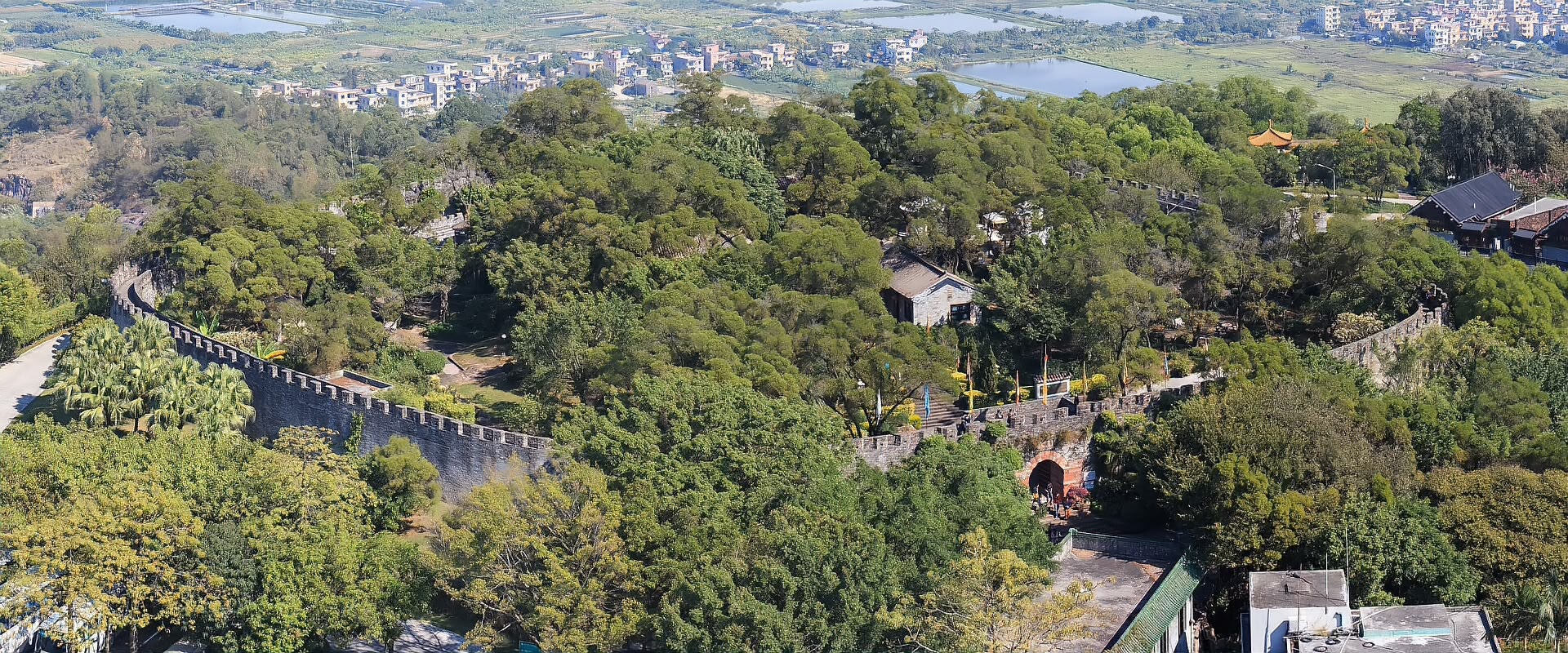
The second building belongs to the same imperial disaster that emptied the coast. After the Shunzhi court ordered the southeastern coast evacuated inland in 1661, the empty shore had to be watched, and the magistrate of Panyu, Peng Xiang, was ordered to build. He had no budget worth the name, so the order was levied: materials and labour were taxed from two local districts, and bricks and stones were pulled from the houses the evacuation had just emptied. A fort built from demolished homes, to watch an empty sea: the Lotus Fortress, finished in 1664, its walls ten metres high with parapets and a patrol path.
In January 1841, during the first Opium War, the British negotiator Charles Elliot and the imperial commissioner Qishan met inside this small fort to try to settle the future of Hong Kong. The talks moved to boats in the waters off the fort and produced no agreement that either court would accept. Within the year the war had gone north, the treaty of Nanjing had been signed, and Hong Kong had been ceded. A fort built to watch an empty sea ended up hosting the conversation that moved a border.
The fort decayed into farmland and was repaired in 1983, after Dong Biwu, visiting in 1958, had told the county to look after both the tower and the fort. The four characters over the south gate were written by the palaeographer Shang Chengzuo. The walls, parapets and patrol path are the ones the levied villagers built, and the fort now carries exhibitions on the coastal defence of the two dynasties that used it.
The statue
The most conspicuous thing on the hill is the youngest. In 1994 a gilded bronze standing Guanyin — the bodhisattva of mercy — was raised on the summit ridge: just under forty-one metres tall, cast from about a hundred and twenty tons of bronze, its robe and face covered in gold leaf to a total of a hundred and eighty liang. The project was proposed by Ho Hau Wah, later the first chief executive of Macau, whose family came from this county, with his father's welfare foundation and a crowd of donors behind it. A pair of stone qilin at the base carry the wishes of the donors: peace for the country, rain in season.
The town's promoters add a claim you will meet in the official brochure: that since the statue went up, typhoons rarely make landfall at this stretch of the estuary. It is a folk claim offered with a straight face rather than a finding, and it tells you something about the kind of place this is. Pilgrims come on the goddess's feast days and on the first and fifteenth of each lunar month, and the temple below keeps a hall of Guanyin images in every material the workshops of the region produce. The calendar is lunar: her birthday on the nineteenth of the second month, her enlightenment on the nineteenth of the sixth, her departure from home on the nineteenth of the ninth, and the treasury opening on the twenty-sixth of the first, when devotees come to ask for a year's luck with money. On those days the road up is a queue, and the deal that runs this hill — half scenic area, half temple — shows itself plainly.
In 2002 the city ran a public vote for a new set of eight views of Guangzhou, the first since the Qing. The winning view from this hill was named Lotus Peak over the Sea (莲峰观海): the tower, the water, the ships. What the voters chose, knowingly or otherwise, was the composition — a Ming tower on a red hill above an estuary full of ships, with a gilded figure standing behind it. That is every period of this hill's history in one frame, which is a fair summary of the place.
What the cutting left
The quarry never had a modern life. It simply stopped, and what it left behind is the strangest park in the delta: a labyrinth of red cliffs and tunnels where barges used to load, deep square pits that filled with groundwater and became lotus ponds, an eagle cliff and a swallow cliff where the rock was cut away in vertical sheets, a bath pool of the immortals ringed on three sides by cut faces, and the lotus-shaped rock at the summit that named the whole hill. These were working features before they were scenery: the cliffs are the working faces, the caves are the tunnels, and the pools are the pits, flooded to the water table the day the pumps stopped.
The ponds now grow lotus in competitive numbers — over twelve hundred varieties of lotus and six hundred of water lily for the summer festival — and the lake at the foot of the hill holds tens of thousands of egrets that commute in at dusk. In the festival months the restaurants at the foot serve a lotus banquet in which every part of the plant appears: seed, core, stamen, root, leaf, stem and pod, matched against the river fish and prawns of the estuary. It is tourism, and it is also an old delta habit — a landscape that produces one thing in bulk ends up eating that thing in twenty ways.
Two thousand two hundred years of cutting, one tower to pin the luck, one fort to watch the sea, one bad negotiation, and a statue at the top with gold on her robe. The stone is mostly gone. What it bought is everywhere: in the walls and halls of the delta, in a royal tomb two hours north, and in the red cliff faces that still stand in the order the masons left them.
Going, and what to expect
Getting there. Metro Line 4 to Shiqi station (石碁站), Exit A, then bus 番92 for about fifteen minutes to the Lianhuashan stop, a short walk from the entrance. Alternatively, Line 3 to Shiqiao station (市桥站) and bus 番128 serves the hill. There is also a boat: passenger services from Guangzhou's Tianzi Pier run down the river to the Lianhuashan fishing port, about ten minutes' walk from the gate. Drivers should navigate to the west gate, which has the main car park; it is forty to sixty minutes from central Guangzhou.
Tickets and hours. The scenic area opens 07:00 to 17:00 year-round, with ticket checks stopping at 17:00. Admission is ¥54 for adults and ¥27 for children roughly 1.2 to 1.5 metres, full-time students and visitors aged sixty to sixty-four; free for children under 1.2 metres, the over-sixty-fives, military personnel and people with disabilities as set out at the gate. Two extras are worth knowing: the sightseeing bus, which saves most of the climbing on a large site, and a small separate fee to climb inside the pagoda. Official listings also note holiday discounts and group rates, so it is worth asking.
How long, and when. Three to four hours at a walking pace for the full loop — quarry, pagoda, fortress, statue and back through the lotus ponds. Summer into early autumn is the lotus season and the reason most people book the trip; November is the other good window, when the weather clears and the estuary light is best. Pilgrimage days in the lunar calendar bring crowds and a queue on the hill road.
Practical notes. Expect stone steps and some slope — wear shoes with grip. The site is exposed, so bring sun protection. Large incense sticks cannot be brought in; the temple supplies incense free at its own hall.
Honest notes. The date at which quarrying began was long given loosely as the Song, the Ming or simply the distant past; the 1989 study that matched the Nanyue tomb stone to this hill is what pushed it back to the western Han, and the national listing followed in 2001. The size of the scenic area is quoted as 2.33 square kilometres in the local press and 2.54 in a Macau daily. The tallest gilded bronze standing Guanyin is the operator's own description and their own category, not a surveyed record. The typhoon claim belongs to the site's promotional material and has no meteorological backing. And the negotiation of 1841 is the delicate part: Chinese accounts state that Elliot and Qishan met here and that the arrangement reached partly on boats off the fort was never ratified by either court before the Nanjing treaty superseded it — whether Qishan ever agreed to cede Hong Kong is a live dispute among historians. The fort hosted the talks, the talks failed, and the cession happened anyway.
Go into the ancient quarry first, before you climb anywhere else, and run your hand over a cut face — the whole reason this hill exists is in those vertical sheets. Then walk up to the pagoda and look down at it from the terrace, which is the view voters named Lotus Peak over the Sea. Finish at the fortress, and read the 1841 negotiation where it happened.
Photographs and sources
Photographs from Wikimedia Commons, used under their Creative Commons licences and enhanced for this page: the aerial view of the pagoda, the ancient quarry faces, the brick tower at close range, the gilded Guanyin and the fortress walls (CC BY-SA 4.0; CC BY-SA 3.0). History drawn from the Lianhuashan editorial source file, cross-checked against 2026 ticketing listings for the hours, admission tiers and concession categories, and against transport listings for the metro and bus approach. Where the records disagree — the area of the scenic area, whether the Guanyin is the tallest of its kind, what Qishan agreed to in 1841 — both versions are given rather than resolved.
There's more where this came from.
Read the latest insider notes →Two new posts a week — the things a non-resident can't know, written down before they cost you a morning.
This is not Lianhuashan Park in Shenzhen — that hill has its own page. Also in Guangzhou: the city guide, all fifteen sights · Zhenhai Lou · Guangxiao Temple · Yuyin Shanfang