Guangdong — south of the ranges
For most of Chinese history this coastline was the empire's worst posting: convicts marched here in shackles, and roughly three in ten never arrived. Today it has led China's economy for more than thirty years running. The road from one of those facts to the other is the story of the place you're about to visit.
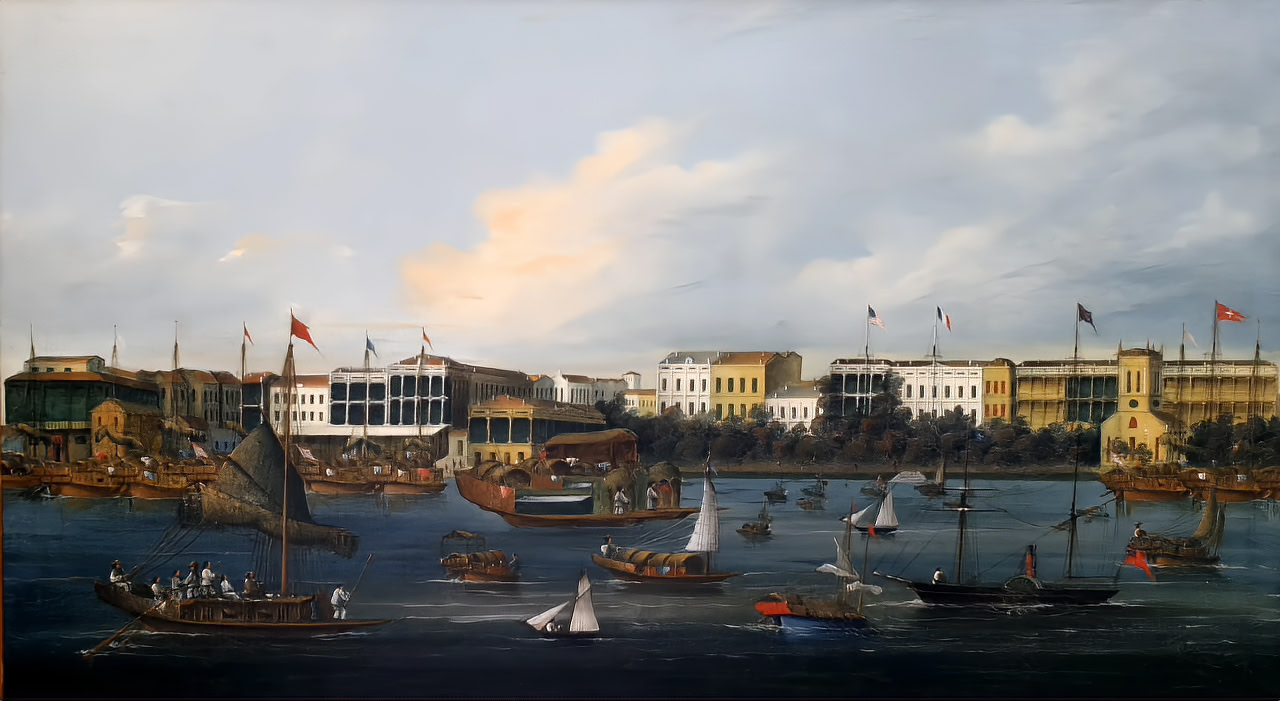
The river that made the province. The Pearl River at Guangzhou, circa 1855. The same waterfront that, two thousand years earlier, was the far end of an exile road. Image: public domain, via Wikimedia Commons.
What "Lingnan" means
The Chinese name for this region, Lingnan, is plain: south of the ranges. The ranges are five mountain chains — the Yuecheng, Dupang, Mengzhu, Qitian and Dayu ridges — running east to west and standing between this land and the capital like a wall with no gate in it.
For two thousand years the court used that wall. If you wanted to remove a rival without the cost of killing him, you sent him over the mountains: no road home, no appeal. Han Yu, one of the great prose writers of the Tang, was sentenced to a magistracy in Chaozhou in 819 and told his nephew to ship his bones home, because he expected to die there. He was fifty-one. The northern leg of the journey alone, over the Meiguan pass, he described as snow blocking the Blue Pass and his horse refusing to move.
The part people get wrong is the rest. The killer was not the politics. It was the place. Northern officials arrived in a subtropical monsoon they had no defence against — heat, standing water, and a mosquito that, in the valley bottoms, worked with an efficiency no northern experience had prepared them for. One Song-era account puts the exile death rate at about three in ten. In an age when a bad harvest could take a tenth of a village, that was an annihilation rate.
How a punishment became a population
The Qin state moved something like five hundred thousand people south in 214 BC — convicts and settlers — and settled them among the Yue, the region's original inhabitants. That is how rice farming reached the delta and how the south began to speak a form of Chinese. Looked at from the other end, exile was also a settlement policy: the court had land it wanted filled and no volunteers to fill it.
The people who survived were, by definition, the stubborn ones. And a great deal of what southern China became was built by exactly those people — and by the traders, and the refugees, who kept arriving after them.
The Qin march south
About 500,000 settlers are moved into Lingnan and settled among the Yue. Rice farming reaches the Pearl River delta; the south begins to speak Chinese.
Han Yu in Chaozhou
Eight months as magistrate: he organised a crocodile hunt, reopened the local school with his own salary, and ended debt bondage. Chaozhou's examination graduates went from three in the Tang to over 170 under the Song.
Su Shi on Hainan
Exiled at 62 to Danzhou. He dug wells, taught rice transplanting, and opened a school. Hainan's first examination graduate came out of his room.
A place you went, not a place you were sent
By the late imperial era Lingnan is prosperous and cultured. The exiles have been absorbed, or remembered — and the surnames of millions quietly become the same.
The one open door
Qianlong closes every other port; Guangzhou becomes China's sole legal window on foreign trade for 83 years. The Thirteen Hongs grow rich; the merchant Wu Bingjian's wealth is estimated near half the Qing state's annual revenue.
The door opens
The Treaty of Nanjing ends the monopoly. Five ports instead of one, and a system built on personal guarantees cannot survive gunboats and industrial production.
The special zones
Shenzhen, Zhuhai and Shantou — on the Guangdong coast — are among the first Special Economic Zones. Guangzhou had been a trading port for two millennia; its new advantage was adjacency to Hong Kong and the sea.
The survival rate of Tang convicts marched to Lingnan, by one Song-era account. It was not a migration programme — it was a meat grinder with a schedule, which means the people who lived were the stubborn ones.
Ancestral tablets in the Chen Clan Academy in Guangzhou alone — paid for by families with no genealogical connection to each other, who needed a reason to be counted. The diaspora this region sent out starts here.
1757: the one open door
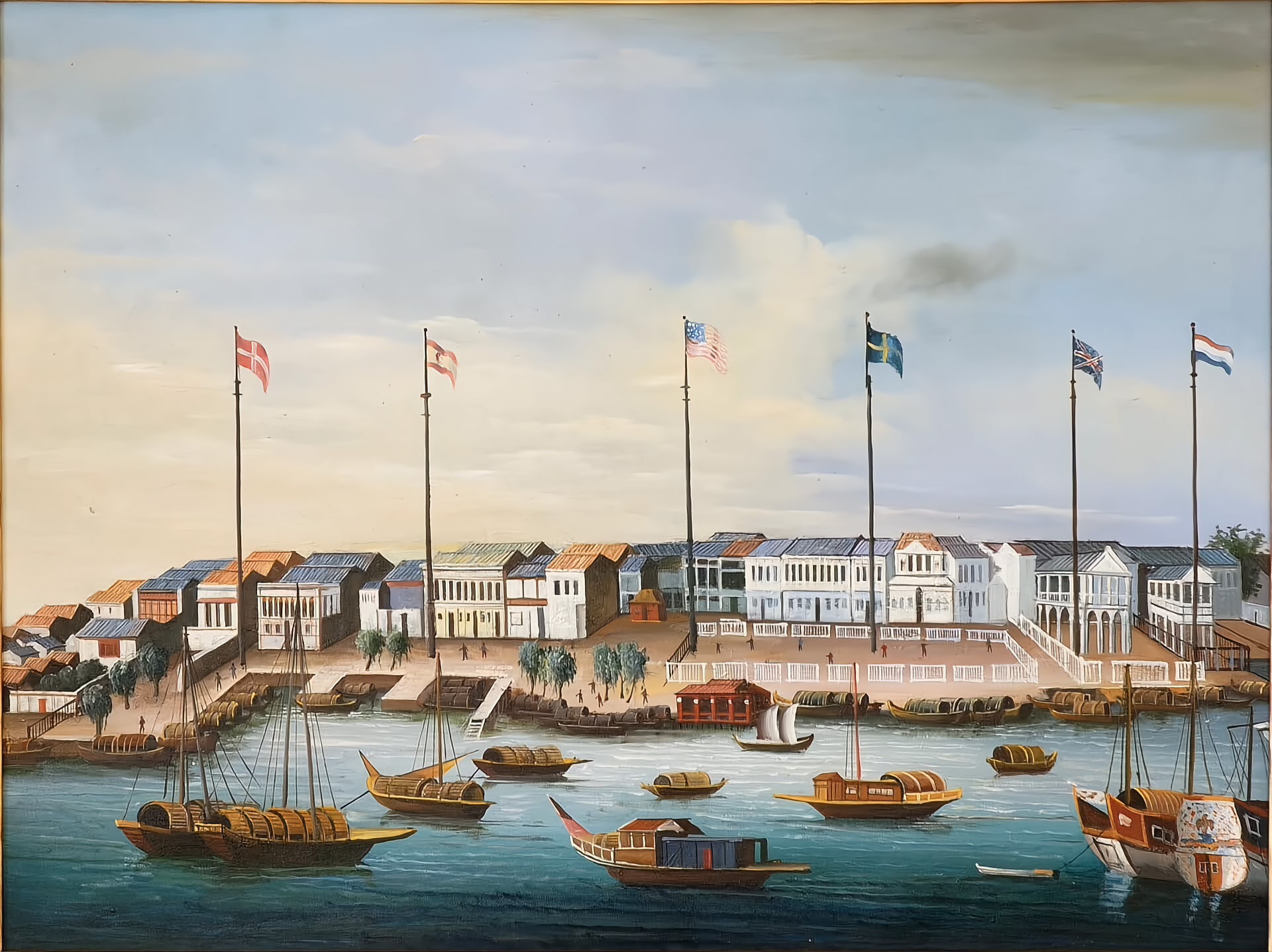
In 1757 the Qianlong emperor closed the ports at Ningbo, Zhangzhou and Yuntai Mountain and left Guangzhou as the only legal port for foreign trade in all of China — for 83 years. Every ship that wanted to trade with China had to come here. The Thirteen Hongs, the licensed merchant houses, became the richest men in the empire; the merchant Wu Bingjian is estimated to have held assets worth close to half the Qing state's annual revenue.
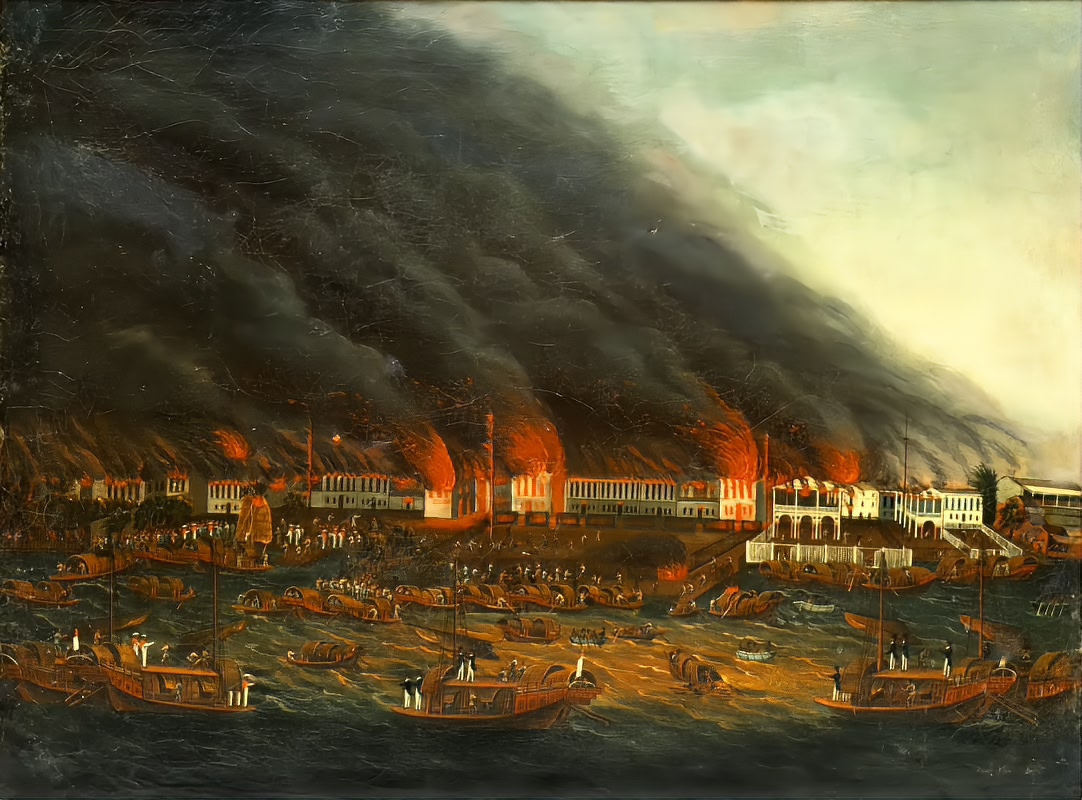
And then, in 1822, the Thirteen Factories burned. The story goes that molten silver ran into the gutters and lay there in strands a mile or two long. It is probably a legend. The size of it is not.
The climate that killed your ancestors
Here is the quiet footnote. The same heat, the same humidity, the same rain that made a southern summer lethal to a man from Kaifeng is the reason the province can grow tropical fruit at all. A visitor to Guangzhou in January now finds a city in shirtsleeves, with lychees in December and mangoes in spring. Nothing about the place changed. Everything about the people in it did.
Which is the part worth carrying into your trip. The Guangdong you are visiting — the food, the dialect, the instinct to trade — was made by people who were sent somewhere and decided, against the available evidence, to stay and make it work.
Where to start
Guangdong is big, and most visitors land in Guangzhou. These are the four corners the rest of this site is built around.
There's more where this came from.
Read the latest insider notes →Two new posts a week — the things a non-resident can't know, written down before they cost you a morning.
More on the region: the Guangzhou city guide · insider notes · the Chen Clan Academy, whose twelve thousand tablets sit at the centre of this whole story.