Qinghui Garden (清晖园)
In a lane in Daliang, in Shunde, a family bought the ruined estate of a discredited top scholar and spent two centuries and an enormous fortune turning it into a machine for producing examination graduates. What they built along the way is the oldest and most admired of Guangdong's four great gardens — and the whole thing was, they said, a repayment.
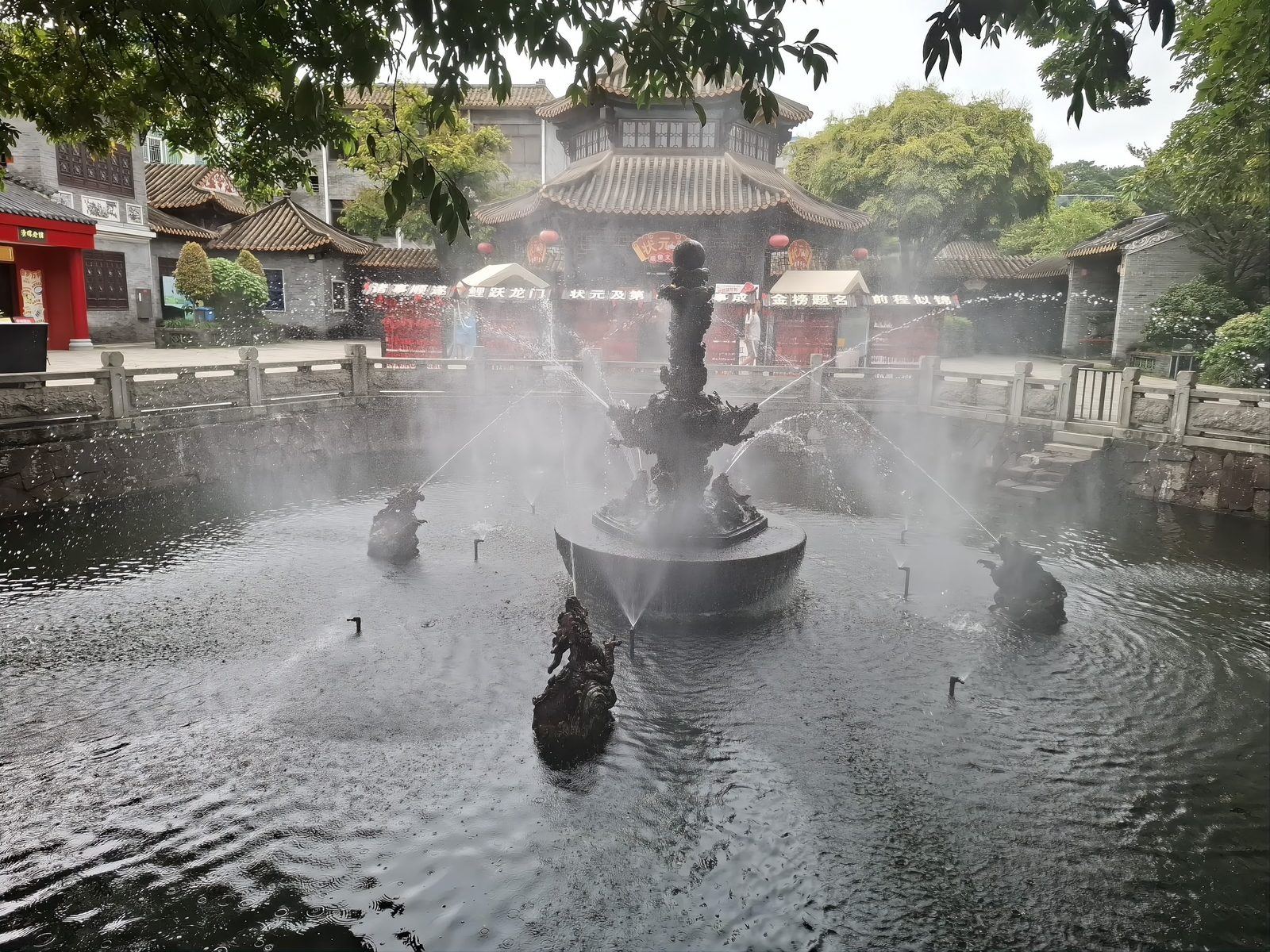
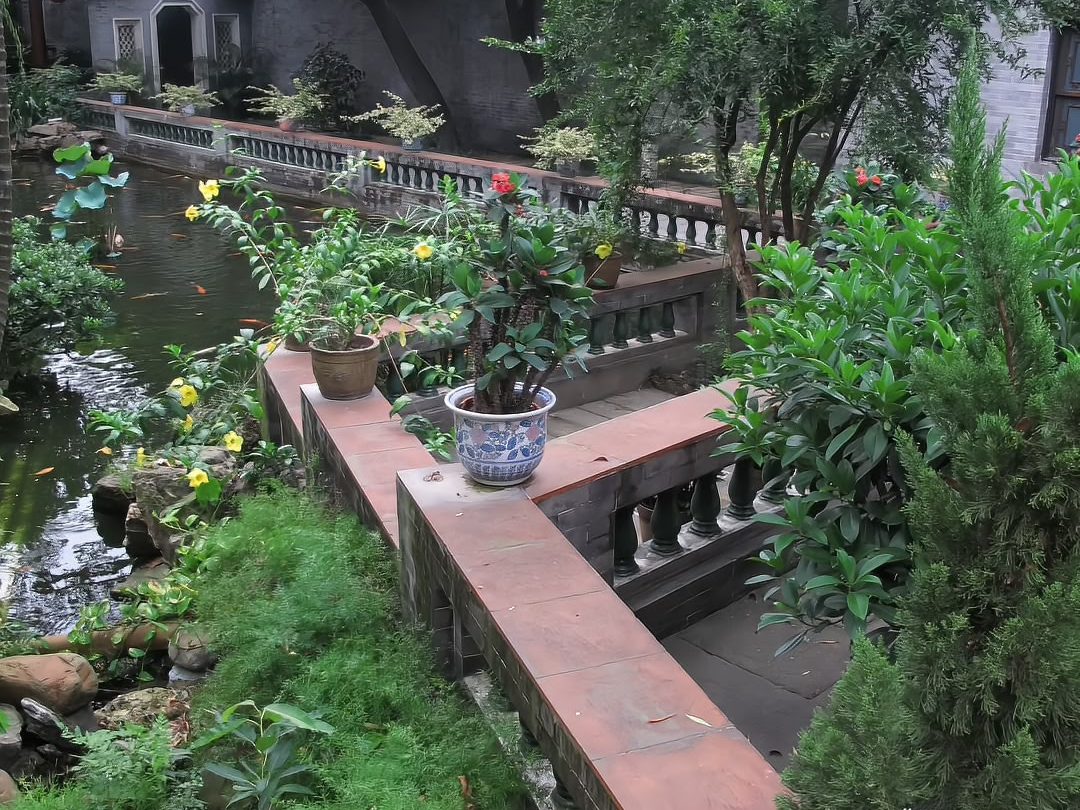
The garden from the rockery side. Water first, as it is in every Lingnan garden — the pond, the rockery, and the trees that have had two centuries to grow into the design.
The name is a debt
The garden's name is a line of poetry, and the line is about a debt. Meng Jiao, a Tang poet with no money and a mother who had spent everything on him, wrote the line every Chinese person knows: who says the heart of a three-inch grass can repay the sunlight of three springs? The grass is the child. The sunlight is the mother. When the Long family named this garden, they were not being decorative. They were saying that the building was an attempt at repayment.
It stands at 23 Qinghui Road, in Daliang, in Shunde, in the city of Foshan — an hour from the centre of Guangzhou by metro, in a district that was its own county-level city until the State Council folded it into Foshan in December 2002. It covers twenty-two thousand five hundred square metres. It is one of the four great gardens of Guangdong, alongside Liang Yuan in Foshan, Yuyin Shanfang in Panyu and Keyuan in Dongguan, and it is the oldest of them. It is on the national list of key cultural relics, and it is the only garden in Guangdong on the list of the ten great gardens of China.
And almost everything beautiful in it was bought by a family who had more money than anyone else in the county.
The man who came first
Before the Long family, there was Huang Shijun. He was born in 1570 in Ganzhu, in the west of Shunde, and in 1607, in the thirty-fifth year of Wanli, he came first in the palace examination. He was thirty-seven years old and he was the top scholar in the empire — the first Shunde had produced since the county was founded. He rose to Minister of Rites and then to Grand Secretary, which is to say he reached the level of the imperial inner circle, one man below the emperor.
He was also, by the standard account, a disappointment. He served for more than thirty years and resigned three times. The second resignation was to attend his dying father, which is not controversial. The other two were withdrawals. The first came in 1622, when the faction of Wei Zhongxian was running the court and Huang, then a tutor to the crown prince, found a reason to leave. The third came in 1638, when the country was collapsing and the chief minister Zhang Zhifa had pushed him out, and he went in anger. He was, by the accounts of the time, personally honest. He was not, by any account, effective.
Then came 1644. The Chongzhen emperor appointed him a grand secretary and summoned him to Beijing; he had not yet set out when Li Zicheng's army entered the city and the emperor hanged himself on the hill behind the Forbidden City. Huang grieved, and then he did the thing that decided how history would treat him: he joined the resistance. He served the Hongguang, Longwu, Shaowu and Yongli courts of the Southern Ming, all four of them, through a decade in which each one lasted less time than the last. He lived until 1661, long enough to see everything he had served disappear.
His house, built in 1609 in a lane in Daliang the records call Huagaili, was known as the Top Scholar's Mansion. Around 1621 he added an ancestral hall, a pavilion called Tianzhang and another called Ling'a, with gardens around all of them. That cluster is the seed of what is now Qinghui Garden. He did not build the garden you can walk today — it is his ghost that haunts the place, and the garden's own museum keeps a hall for him.
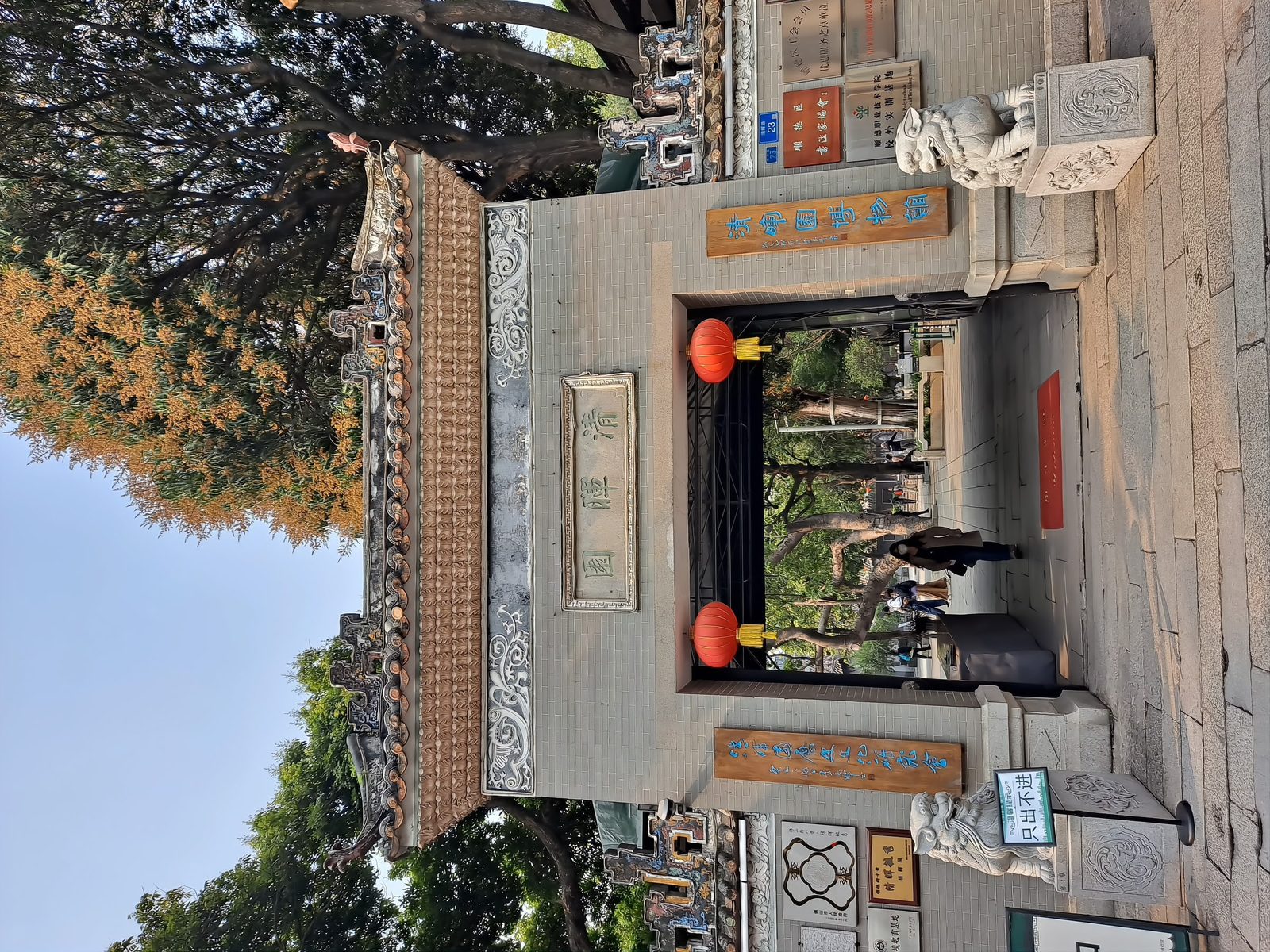
The gate on Qinghui Road. The wall does the work of a fence here: everything behind it belongs to a different century.
The family who bought it
In the Qianlong reign, the Huang estate had fallen into ruin, and it was bought by a man from Daliang named Long Yingshi. Long Yingshi was a jinshi — a graduate of the palace examination — and he bought a derelict property from a discredited dynasty. What his family then did with it over the next two centuries is the actual subject of this garden.
The Long were, by the standard description, the largest landowners in Shunde from the founding of the county: among the great houses, they were the greatest. Between them they effectively ran the county's politics and its economy, and they bought materials for their garden accordingly. Over roughly two hundred years, through the Jiaqing, Daoguang, Xianfeng, Tongzhi, Guangxu, Xuantong and Republican periods, five generations of the family expanded, rebuilt and repaired the place, and each phase used the best materials and the best craftsmen available. Some of the materials were imported directly from Europe.
The examination record is the number that tells you what kind of family this was. The Long produced six jinshi and a dozen juren. Three of those jinshi came in three consecutive generations — Long Yingshi, his son Long Tinghuai, and his son Long Yuanren — which is the phrase that gets repeated in Shunde: three jinshi of one line. A contemporary garden in Panyu, built by a family of comparable wealth, managed three juren. The Long managed three palace graduates.
And the family's in-laws were not negligible either. Long Yuanxi, the son of Long Tinghuai's brother, rose to second rank in the imperial bureaucracy. And the man who wrote the plaque over one of the garden's buildings was Li Wentian, third-place graduate of the Xianfeng examination, a minister of Rites and Works and one of the great calligraphers of his generation. He was the father-in-law of the garden's fifth-generation owner. He was, in effect, family.
So this was not a garden built by a rich man. It was built by a dynasty.
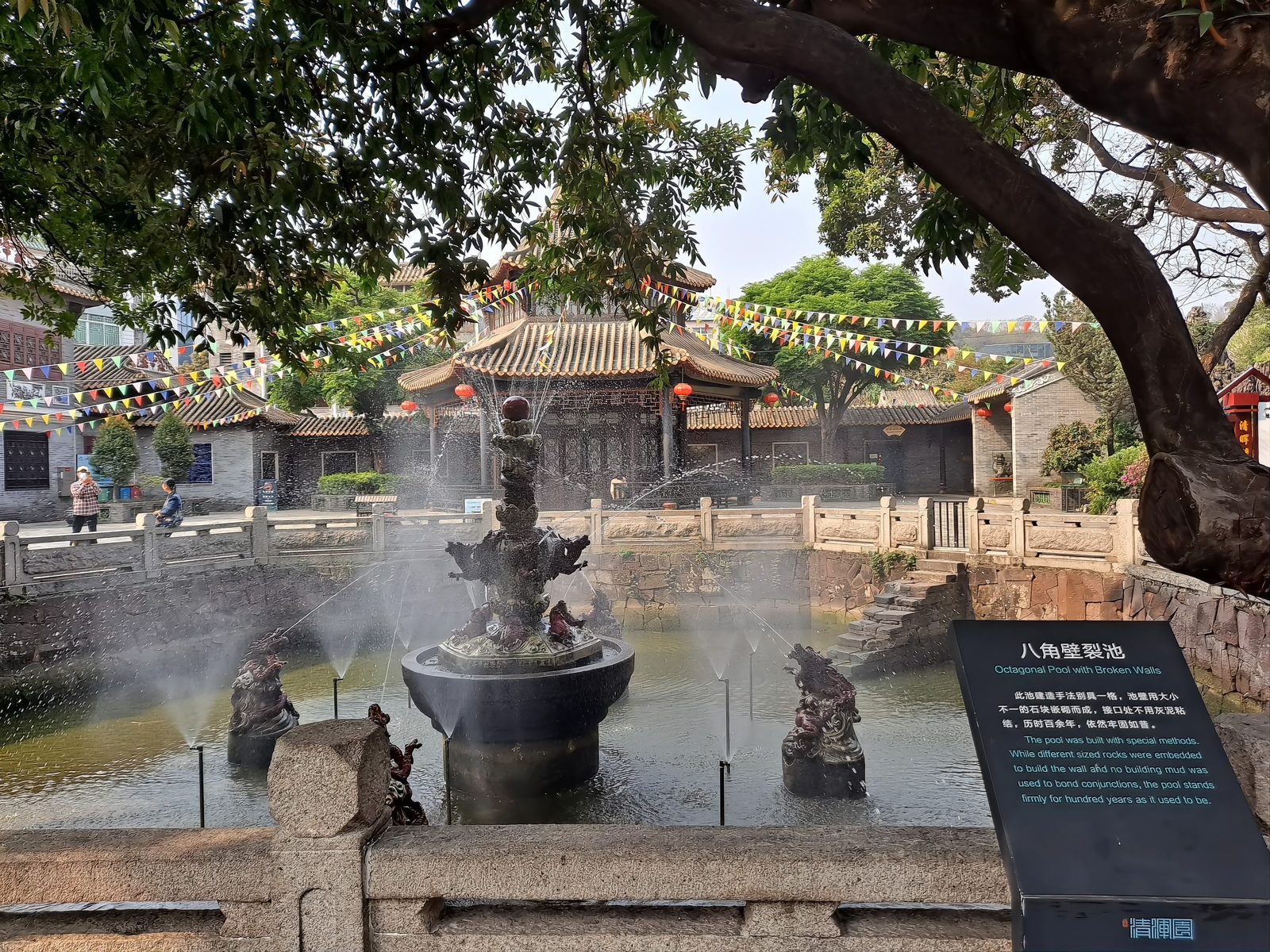
The octagonal pool. The first thing past the gate: red sandstone fitted without mortar, and stable for a century anyway.
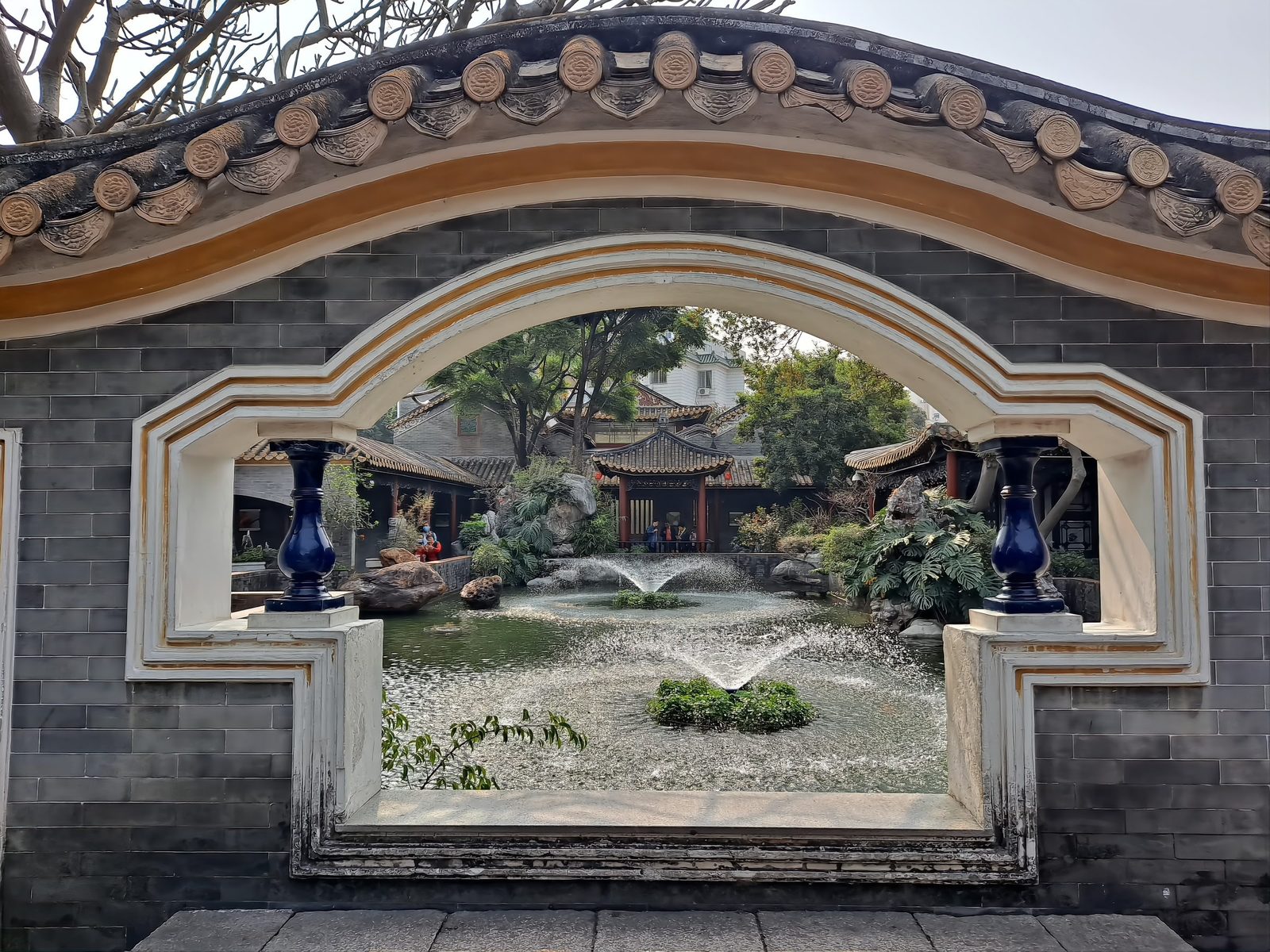
A round window, doing a big job. The Lingnan trick of framing: a small garden, borrowed from a larger one through a hole in a wall.
A house for his mother
The reason the garden exists at all is a resignation. Long Tinghuai, the son of the purchaser, was a jinshi and an official, and in the Jiaqing reign he resigned his post and came home. His father had bought the estate; his father was now dead; and what Long Tinghuai wanted was a place to keep his mother.
He took the middle section of what his father had acquired and built a garden for her. He laid it out deliberately for the climate. The front is sparse and the back is dense; the front is low and the back is high. In a subtropical county with monsoon rain and typhoons, that arrangement moves the air through the whole compound and gets the light in, and the whole design is oriented around one old woman's comfort.
That is why the oldest surviving building in the garden is called the Clear Stream Thatched Hall. It was her residence. It is a low, single-storey house of ground brick along the water, built in 1846, the sixth year of Daoguang. Its front door is a circular opening — the builders call it a round-light cover — and the frame of it is carved as two bundles of bamboo crossing. Bamboo for safety and for constancy, and the circle for completeness. The reason a man of his wealth would call his mother's house a thatched hall is the whole point: it is the vocabulary of a retired official pretending to be a hermit, which is what a man does when he has decided that the court is not worth it.
His son Long Yuanren expanded it, and it was he who gave the place the name by which it is now known. The records give the name two origins — a line by the Southern Dynasties poet Xie Lingyun about clear light in landscape, and Meng Jiao's poem about a mother's love. Both are told here because both are told in Shunde.
The ninety-six longevities
On the two screen doors of the Clear Stream Thatched Hall, in three different scripts, are carved ninety-six characters. All of them are the character for longevity. All ninety-six are written differently. The set is called the Hundred Longevities.
There is no hundred of them, and the garden is entirely open about this, and the reason is the best story in the building. The owner commissioned a craftsman to carve the set for his mother's birthday. The craftsman, working to a layout, fitted forty-eight characters into each of the two doors. When the owner came to inspect, he counted, and he counted again, and he arrived at ninety-six both times, at which point he became furious.
The craftsman said that there was a design in it. Nine is the sound of long-lasting, he said. Six, in Cantonese, is the sound of emolument and fortune. Ninety-six is therefore fortune and long-lasting, which is the most auspicious arrangement available.
The owner was not stupid. He said that whatever the virtues of ninety-six, it was not a hundred, and a set of ninety-six could not be called the Hundred Longevities.
The craftsman said that the remaining four were hidden. Ninety-six were visible, he said, and four were concealed, because concealing longevity is how you keep it. The owner asked where. One large character is hidden in each of the two doors, the craftsman said. And of the remaining two, one is concealed in you, and one is concealed in me. Put them all together and you have a complete Hundred Longevities.
The owner laughed and paid him double. The museum, which tells this story itself, adds a footnote: the Long family were famously long-lived, and Long Qiming, a descendant who flew for the Flying Tigers and lived to ninety-one, is offered as evidence that the concealed longevities worked.
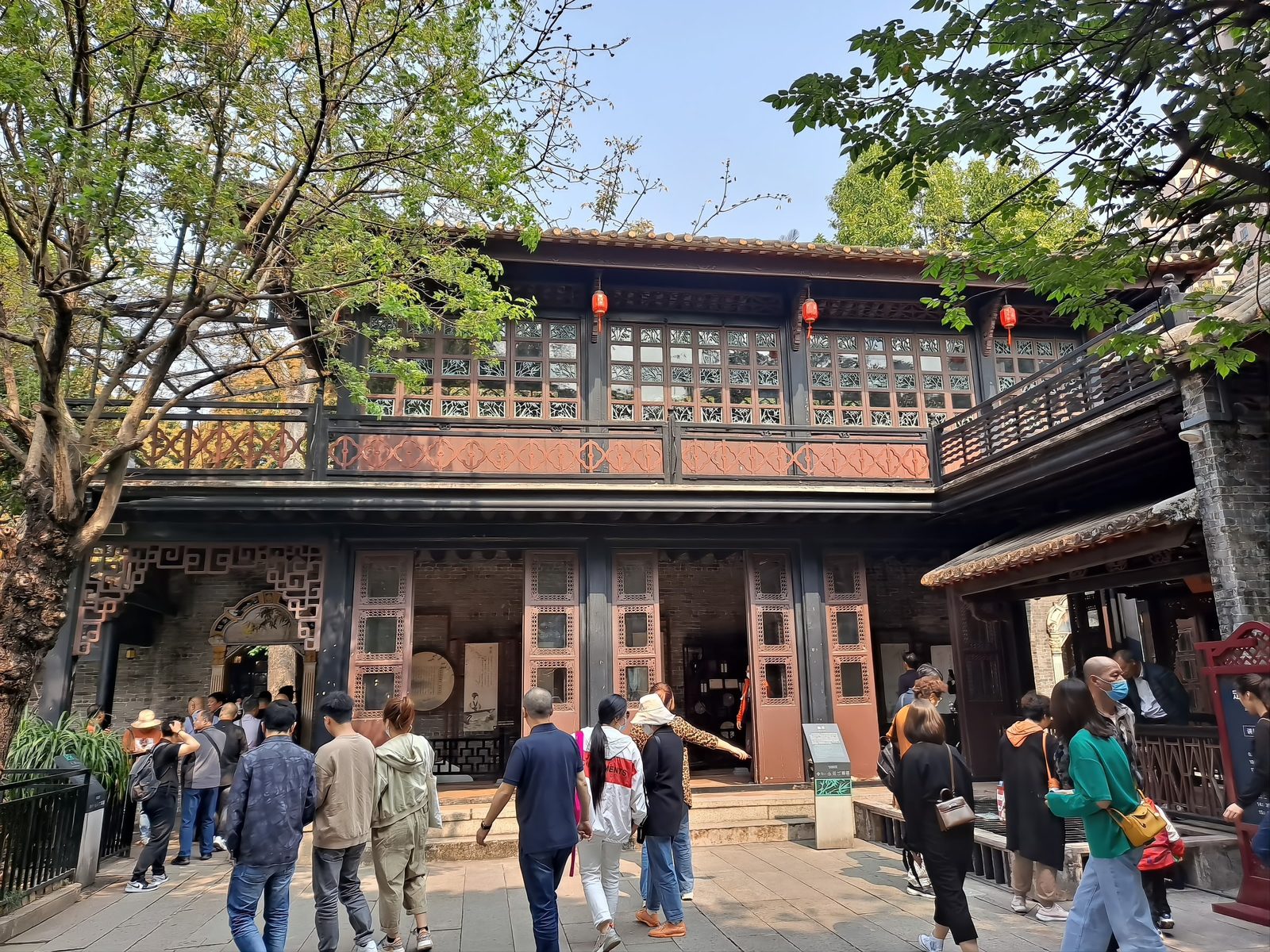
The Boat Hall — a ship in a field. Two storeys of brick and timber modelled on the Zidong pleasure boats, with the upper corridor as the gunwale and a wisteria trained through a willow at the bow to do the work of a mooring rope.
The boat that never sails
The largest building in the garden is the Boat Hall, and it is a ship in a field. It was built in the Jiaqing reign, two storeys of brick and timber, modelled on the Zidong pleasure boats that worked the Pearl River delta. The corridor on the upper floor is the gunwale. The railing is carved in wave patterns. At the bow the family planted a willow and trained a wisteria through it, so that the vine hangs down like a mooring rope tying the vessel to the bank. It is, by the assessment of people who study these things, the finest boat hall in Lingnan.
It was also, they say, the daughter's quarters, which is why it is called the Miss's Tower. And in its windows is the most valuable thing in the garden.
The coloured glass in the Boat Hall was imported from Europe during the Qing, then brought to China, where craftsmen etched it, ground it and painted it by hand and set it into traditional wooden frames. The technique is now almost entirely lost. But the set that matters most is at Muying Stream, a covered walkway on the east side of the garden: eight panes of etched gold-film glass, each carrying one of the Eight Sights of Old Guangzhou — the Qianlong-era ranking of the city's views, the one with names like Evening View over White Cloud and the Moon over the Pearl River. The set is described as a national-grade cultural relic, and as the only surviving set of Qing engraved Eight-Sights glass in existence. A European material, a Cantonese subject, a Chinese technique, and a Lingnan room. The window is the whole garden in four inches.
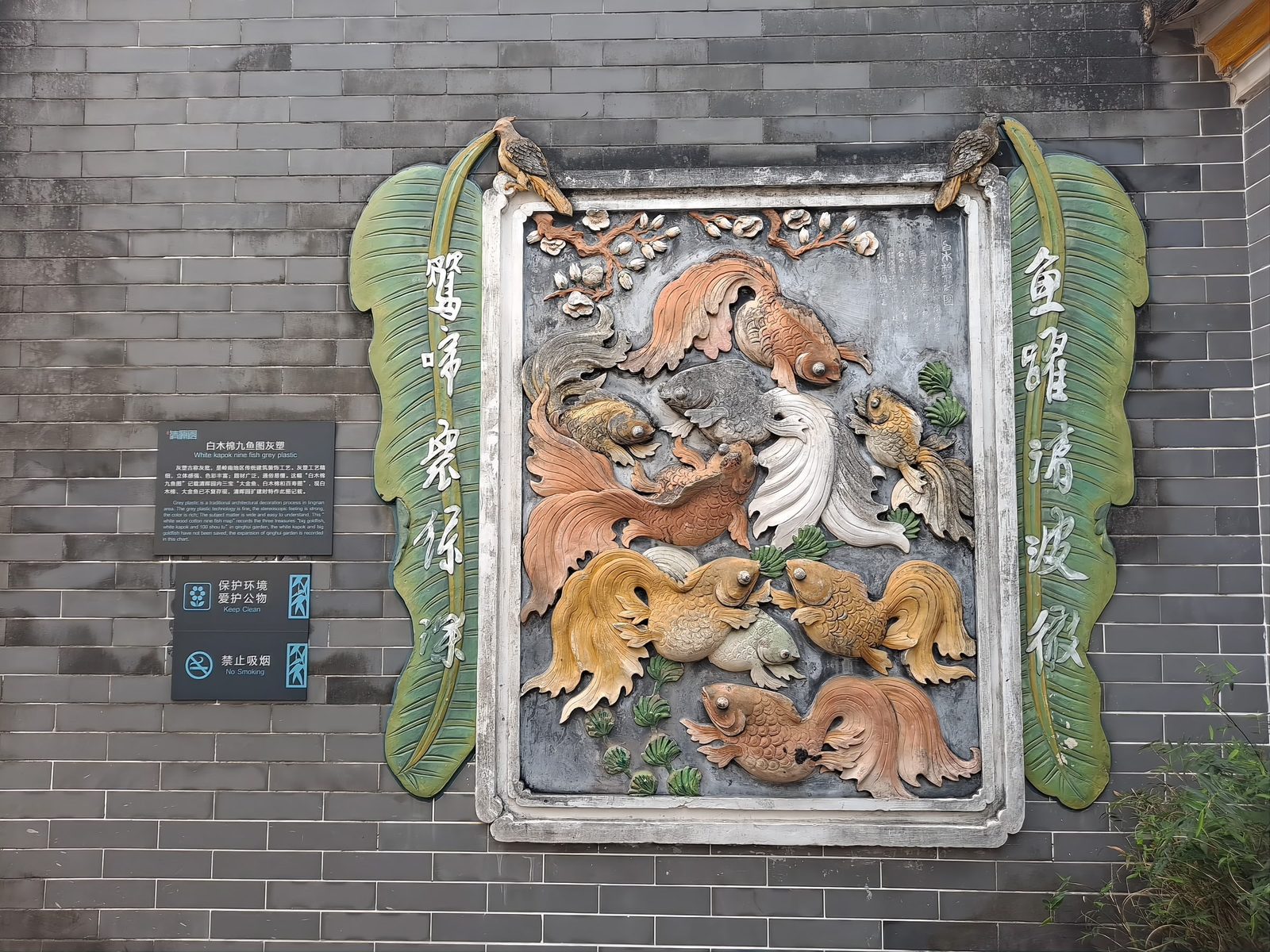
Nine fish, in lime plaster. The three carvings and the sculpture — wood, brick, stone and lime — that run through every wall of the garden.
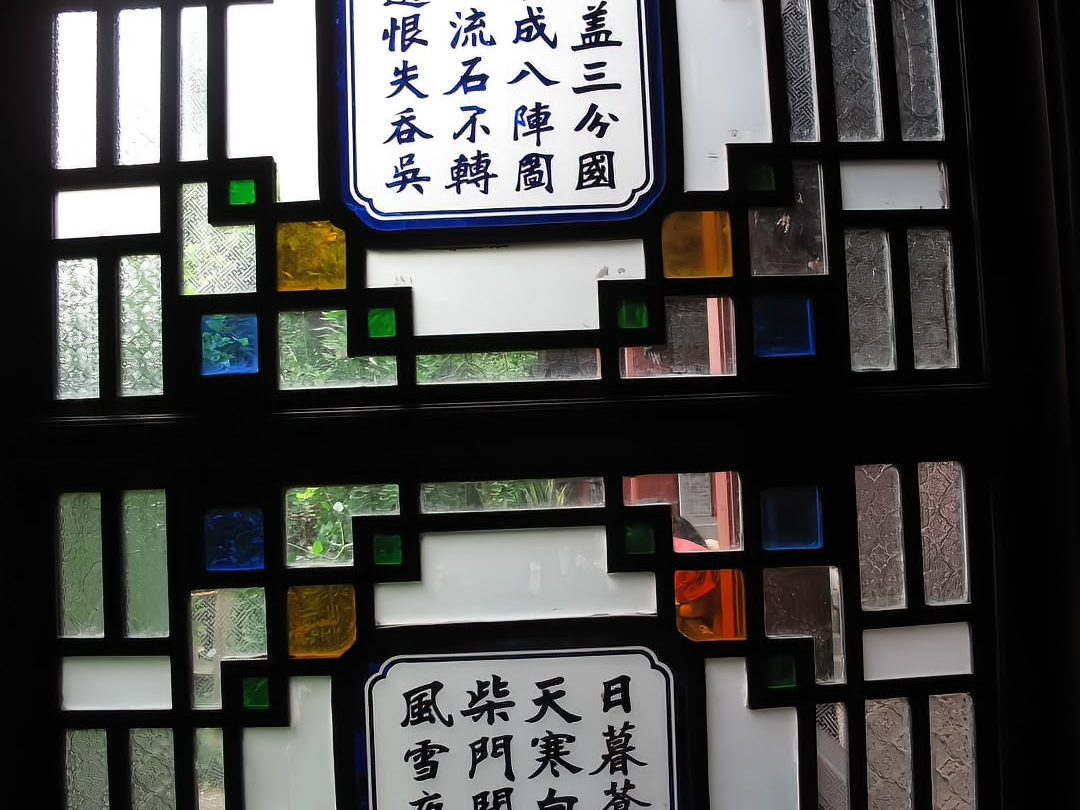
Coloured glass in a wooden frame. Imported panes, etched and painted by Chinese hands — the technique is now almost entirely lost.
Shells from a sea that left
In the Clear Ripple Pavilion, the water pavilion that extends into the largest pond in the garden, the windows are not glazed. They are shell. Thin sheets of ground shell — a natural Lingnan material that transmits light without being transparent — and the sheets in this pavilion date from the late Ming. They have been in the building for more than three hundred years.
The shells are there because Shunde used to be underwater. When the sea retreated it left behind enormous deposits of shell along the coast, and the builders used what the geology of their own county provided. The same material appears as oyster shell set into walls in place of glass, all over the garden.
So the pavilion's windows are a piece of evidence. They record the moment when this part of Guangdong stopped being seabed, which is the same event that produced the silt the garden is built on, and the fish ponds the family farmed, and the whole of the county's agricultural wealth. Eight screen doors open onto the pond, and each one frames a different view. That is the point of the pavilion: you sit inside it and the garden is presented to you eight different ways, and you choose.
What the family were for
Walk to the back of the garden and the tone changes from pleasure to purpose. The Cherish Shade Study is a private school for the clan's children, and its name is an instruction: value your time, and read. Its plaque, Green Clouds Deep, was written by Yongxing — Prince Cheng, the eleventh son of the Qianlong emperor and a celebrated calligrapher. The True Inkstone Study, built in the Daoguang reign, is the same kind of room. Its roof is deliberately asymmetric, lower at the front than the back, because in a subtropical county with heavy rain and typhoons that shape sheds wind and water better. Its screen doors are unusually tall and wide, for the same reason the mother's house faces the way it does: to move the air and let the light in.
A little further on is the Brush That Grows Flowers, named for the story that the Tang poet Li Bai dreamed his brush blossomed, which is the standard Chinese metaphor for literary talent arriving. The lime plaster on its west window carries a scene of Su Wu herding sheep, more than a century old, which is the standard Chinese image of an official who endured disgrace without surrendering his loyalty.
And at the north end of the garden is the Top Scholar's Hall, which has a seated statue of the first owner, and beside it a reconstruction of an imperial examination cell, and a display of the county's examination history. The numbers in that display are the argument the whole garden is making. Shunde, since the Song, produced four top scholars, one third-place graduate, two hundred and sixty-one jinshi and one thousand two hundred and eighty-eight juren. It produced more top scholars than any other part of Guangdong. Three of its four were civil, one was military, and the three civil ones are a third of the nine civil top scholars in the entire history of the province.
So this is what the garden was for. Not pleasure. A family that had bought its way into the county's elite spent two hundred years and an enormous fortune building a machine for producing examination graduates, and then filled it with objects that said so: the shells that prove the county's geology, the boat that never sails, the ninety-six longevities, the brush that flowers, the man herding sheep. A garden as an argument.
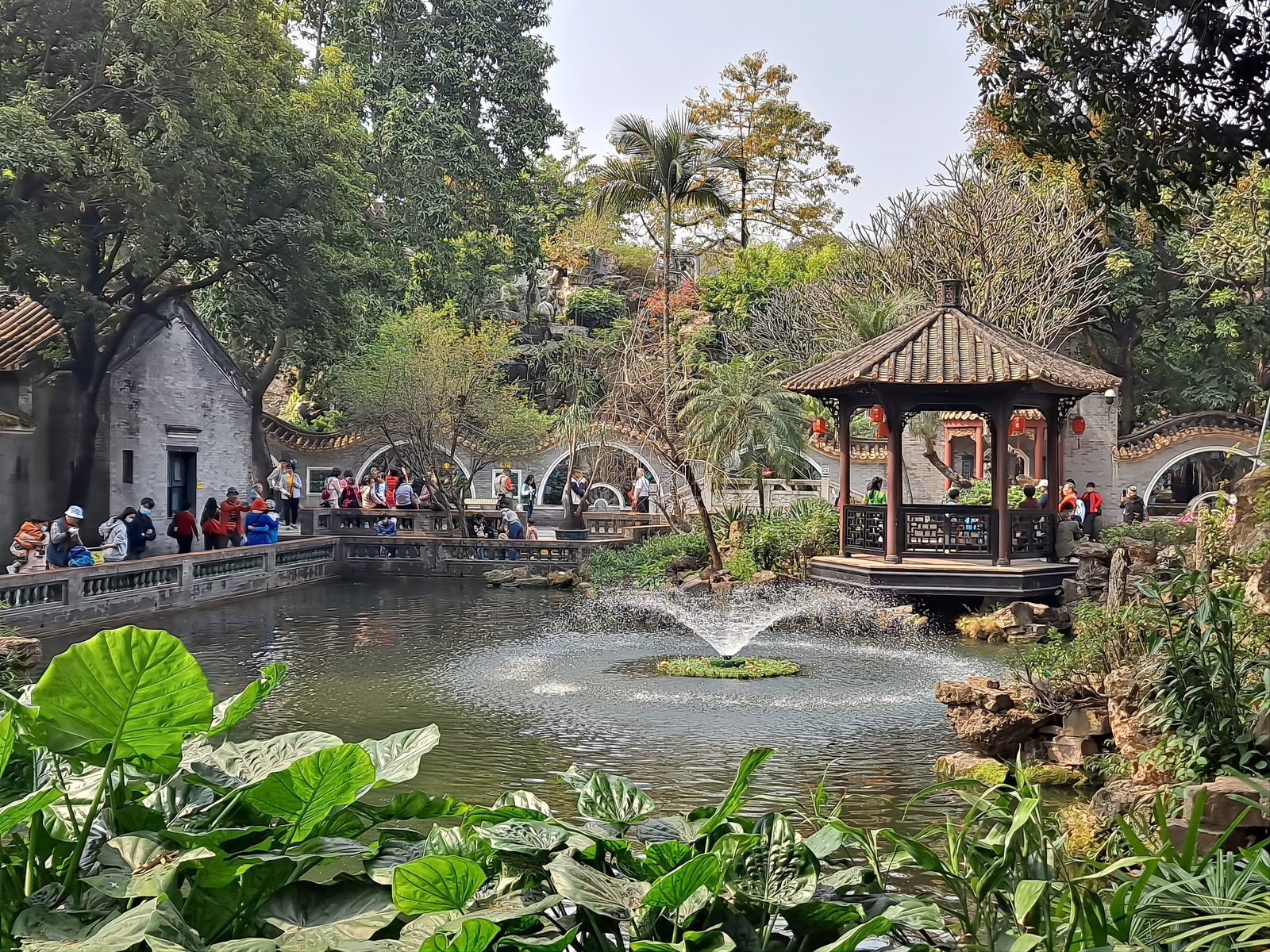
The hexagonal pavilion in the pond. The garden is laid out around water, and the buildings sit in it rather than beside it.
Koi under the rockery. The waterfall off Phoenix Peak runs into the first pond — the garden's smallest residents are its most reliable.
"The grass never repaid the sunlight. It built it a house instead, and then carved ninety-six characters on the door, and then let the state take it back."
The closing line of the editorial this page is built on — and the shortest summary of what the garden is actually about.
What is standing there now
The garden did not survive by itself. In 1938, in July, the owner Long Zihui died. In October the Japanese occupied Daliang. The family scattered, mostly to Hong Kong, Macau and abroad, and the garden began to rot. After 1949 it was used as ordinary housing, with families living in it.
Then, in 1959, Tao Zhu, then the party secretary of Guangdong, came to Shunde, looked at the place, and ordered it restored. Provincial funds were allocated and the county carried out the work. In the process, the three separate properties the Long family had divided among themselves — Qinghui Yuan, Guangda Yuan and Chuxiang Yuan, along with two more buildings, Jiemei Hall and Jingqin Hall — were merged back into a single site and given one name. The garden that had been split between three branches of a family was reassembled by the state.
It then became the county's first guesthouse. Guo Moruo visited in 1962 and wrote a poem about the fish ponds and the sugarcane — a thousand acres of pond and a thousand acres of cane, ten thousand households of mulberry and ten thousand of song — which is the standard description of the Pearl River delta's agriculture and is still quoted. Deng Xiaoping stayed in 1984.
In November 2011, an eighty-eight-year-old man named Long Qiming came back with other descendants of the family and handed the government the garden's original land deed and house deed. With them came photographs of the family's ancestors, documents, and Long Qiming's own photographs and letters from his time as a Flying Tigers pilot. Close to a hundred items. The family had kept the title to their garden through a war, a revolution, a dispersal across three continents and seventy-three years. And then they gave it away.
What stands there now is twenty-two thousand five hundred square metres, restored by the county government in the late 1990s and patched repeatedly since. The rockery called the Phoenix Peak, twelve point eight metres high and built from more than two thousand tonnes of granite, is a modern addition from that restoration, not a historic feature — and it is the largest granite rockery in the province. The pond at the entrance is octagonal, of red sandstone, laid without mortar and stable for a century anyway.
And the Clear Stream Thatched Hall still stands where it was put, with its circular bamboo door, its ninety-six longevities, and a longan tree of two hundred and twenty years beside it that has lost almost all its trunk to age and still puts out leaves. The garden has been a national AAAA tourist site since 2007, a seventh-batch national key cultural relic since March 2013, and a national third-class museum since 2024. More than a million people come through the gate every year.
Going, and what to expect
Getting there. The garden sits in the middle of Daliang, the seat of Shunde District, at 23 Qinghui Road. From Guangzhou, take Metro Line 7 to Beijiao Park and change to Foshan Metro Line 3 for Daliang Bell Tower station; from Exit E it is a 450-metre walk along Qinghui Road, about an hour from central Guangzhou in total. From Foshan's old city, Line 3 runs direct to the same station, or take the Guangfo Line to Dongping and change. Buses 301, 303, 305, 309, 314, 319 and a dozen more stop at Qinghui Garden. Entry is through the museum's south gate. Parking is limited; the commercial lots around the New World Centre are the practical option if you drive.
Tickets and hours. The museum opens 9:00 to 17:30, last entry at 17:00, and sells timed entry in four slots across the day (roughly 08:30–11:00, 11:00–13:00, 13:00–15:00, 15:00–17:30) — book the slot you want, especially at weekends. A regular ticket is ¥15, groups of fifteen or more pay ¥12, and there is a ¥7 concession for students and visitors between sixty and sixty-five. Residents of Shunde — by household registration, residence permit or school enrolment — go free, as do visitors over sixty-five, children under six or under 1.5 metres, and the usual categories of servicemen, veterans, disabled visitors, journalists and guides. The museum's WeChat official account is the only official ticket channel; there is a free electronic guide inside, and no reason to buy one anywhere else.
How long, and when. The garden is small: an hour and a half to two hours at a walk that stops at windows. Weekday morning is the emptiest and the light is best; weekends and holidays bring the crowds and the coach groups. The obvious pairing is the food street — Huagai Road pedestrian street starts at the garden's corner, with the old double-skin-milk shops, the beef offal stalls and the fried milk, and Jinbang street's buffalo-milk sweets a short hop further. Occasional evening openings run around festivals; check the museum's WeChat account if you want the garden at night.
Honest notes. The story of the ninety-six longevities is a legend, not a record — the museum tells it itself and presents the craftsman's wordplay as the explanation. The garden's name is given two origins in the sources, and both are kept here. The Long examination total is given variously as six jinshi with twelve juren and six jinshi with sixteen; the smaller figure is used. The Phoenix Peak rockery is a late-1990s addition, not a historic feature, and the museum says so. Hours and prices are the museum's own 2026 figures and could be wrong in detail on the day you arrive.
Enter at the south gate, take the octagonal pool first, walk the Boat Hall slowly with the light behind you, and finish at the Clear Stream Thatched Hall — the mother's house, the round bamboo door, the ninety-six longevities and the longan tree that will not die. Then walk out the gate into Huagai Road and let Shunde do the rest.
Photographs and sources
Photographs from Wikimedia Commons, used under their Creative Commons licences and enhanced for this page: the pond and rockery (CC BY 4.0, TarnishedPath), the entrance, the octagonal pool, the Boat Hall, the grey-plaster fish relief, the moon gate, the hexagonal pavilion and the koi pond (CC BY-SA 4.0, EditQ), and the window with its poem (CC BY-SA 4.0, Wiki shangteam). The Shunde banner on the Foshan page is by EditQ (CC BY-SA 4.0). History drawn from the Qinghui Garden editorial source file, cross-checked against the Foshan Shunde Qinghui Yuan Museum's official site (hours, tickets, transport, the museum's own account of the 1959 merger and the 2011 deed handover), the national museum registry's annual report (the 2013 seventh-batch listing; the 2024 museum grading), People's Daily (the 1990s expansion, the family's donation) and the State Council's 2002 decree making Shunde a district of Foshan. Where the records disagree — the two origins of the garden's name, the size of the Long examination total, the founding year of the garden (Jiaqing 5, 1800, against Jiaqing 10, 1805) — both figures are given rather than resolved.
There's more where this came from.
Read the latest insider notes →Two new posts a week — the things a non-resident can't know, written down before they cost you a morning.