Zhujiang New Town (珠江新城) and the Canton Fair (广交会)
The half of Guangzhou that did not exist in 1990: a new axis, an open kilometre of plaza, two free museums, a driverless train running under the square, and — across the river on Pazhou island — the trade fair that has run every spring and autumn since 1957. Almost all of it is free, and the best of it is outdoors.
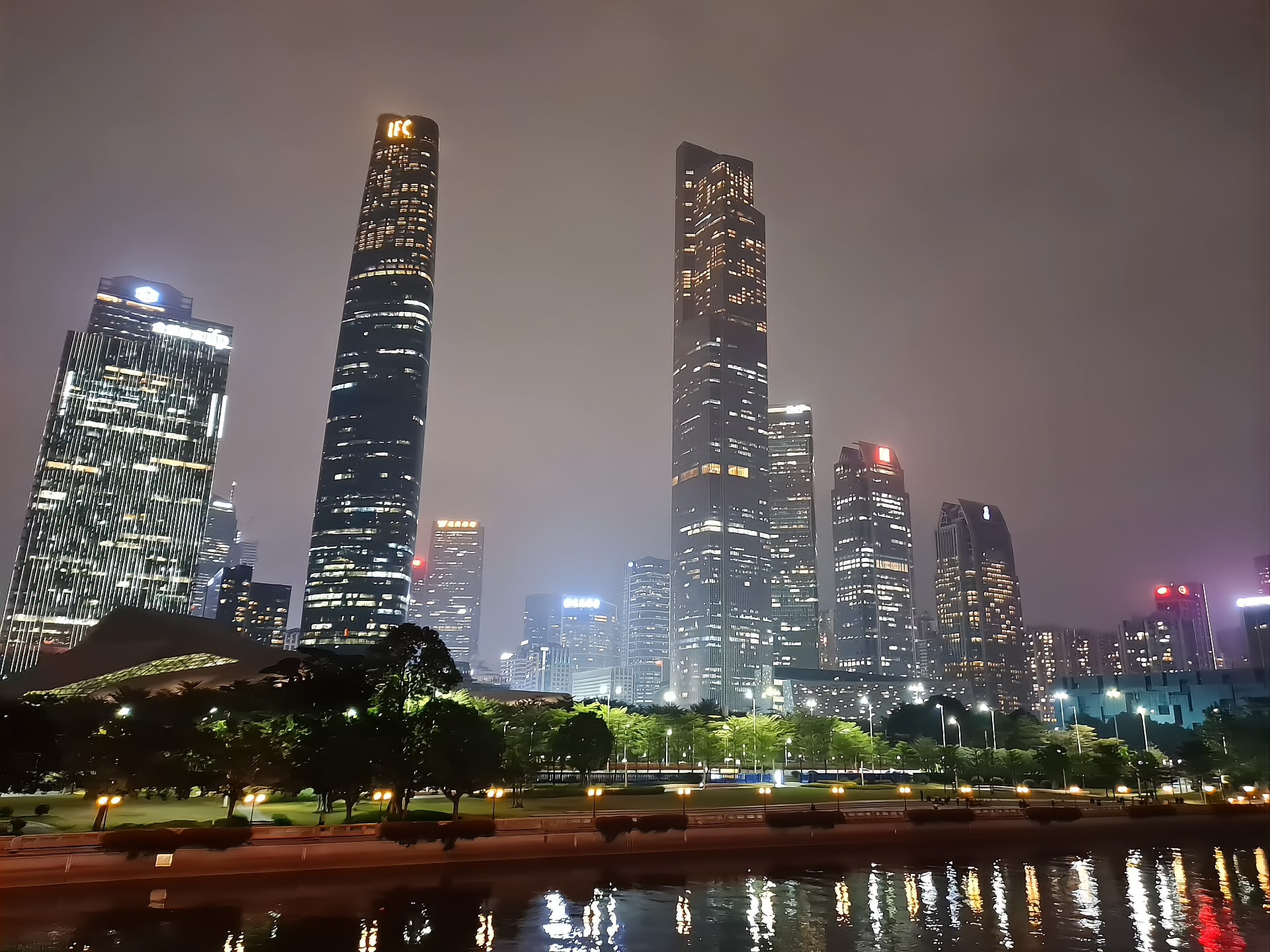
Zhujiang New Town after dark. The plaza below the towers is free, ungated and open to anyone. This was vegetable ground in 1985.
Walk the axis
Guangzhou has two centres now, and the new one is a line rather than a place. It starts in the hills at Yanling Park in the north, runs through Tianhe Sports Centre, south through Zhujiang New Town, across Huacheng Square, over the river onto Haixinsha island and finishes at the Canton Tower on the south bank. You can do the whole of it on foot in an afternoon, or break it and come back for the evening, when the towers light up and the plaza fills with people flying kites.
- Tianhe Sports Centre 天河体育中心. Metro Line 1 to 体育中心站, or the APM to 体育中心南站. Built from 1984 on the retired Tianhe Airport, opened for the 1987 National Games, and the reason this side of the city exists at all.
- South down the axis. Lines 3 and 5 to 珠江新城站 (Zhujiang New Town). The walk from here to the river is about twenty minutes without stopping, and you will stop.
- Huacheng Square 花城广场. Free, no gate, no booking. The city calls it its living room. Underneath it runs 花城汇, a multi-kilometre underground mall opened in 2010, connected to the APM stations at 花城大道, 妇儿中心 and 黄埔大道 — the way to cross the whole square without going outside in August.
- Guangdong Museum 广东省博物馆. 2 Zhujiang East Road. Free, but you need a real-name reservation; see the box below. Closed Mondays except public holidays.
- Guangzhou Library 广州图书馆. 4 Zhujiang East Road, directly opposite the museum. Free, and open late.
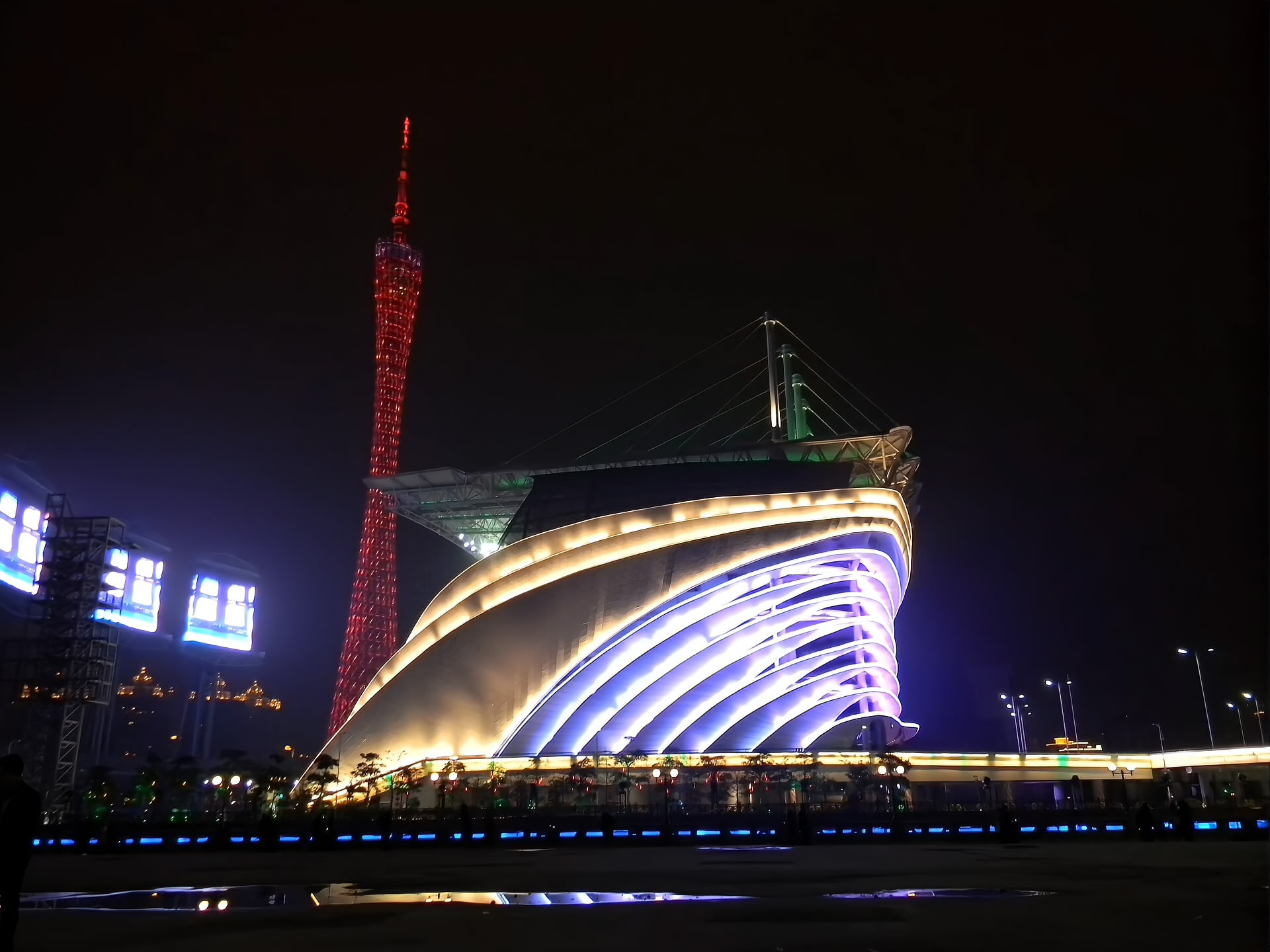
- Guangzhou Opera House 广州大剧院. Zaha Hadid won the competition for it in 2002 with a scheme she described as two pebbles left by the river. It opened in May 2010, seats about 1,800, and has almost no right angles at ground level. Walking round the outside is free and takes twenty minutes; going in means buying a performance.
- The twin towers. Guangzhou IFC, the West Tower, 439 metres and 103 floors, opened in 2010. The CTF Finance Centre, the East Tower, 530 metres and 116 floors, opened in 2016 and is the tallest building in the city, with lifts that run at 21 metres a second. Neither runs a walk-up observation deck, so the views worth having are the ones you take of them — from the square, and from across the river.
- Haixinsha 海心沙. An island in the river, built to hold the opening ceremony of the 2010 Asian Games and kept afterwards as a park, free since September 2012. It is a venue as well as a park, so it can be shut for an event. If it is, the promenade on the north bank gives you the same water from fifty metres further back.
- Canton Tower 广州塔. Six hundred metres, lit after dark. The view of it is free from the riverbank; the view from it is not, and there is a separate page about that trade. APM to 广州塔站, or Line 3.
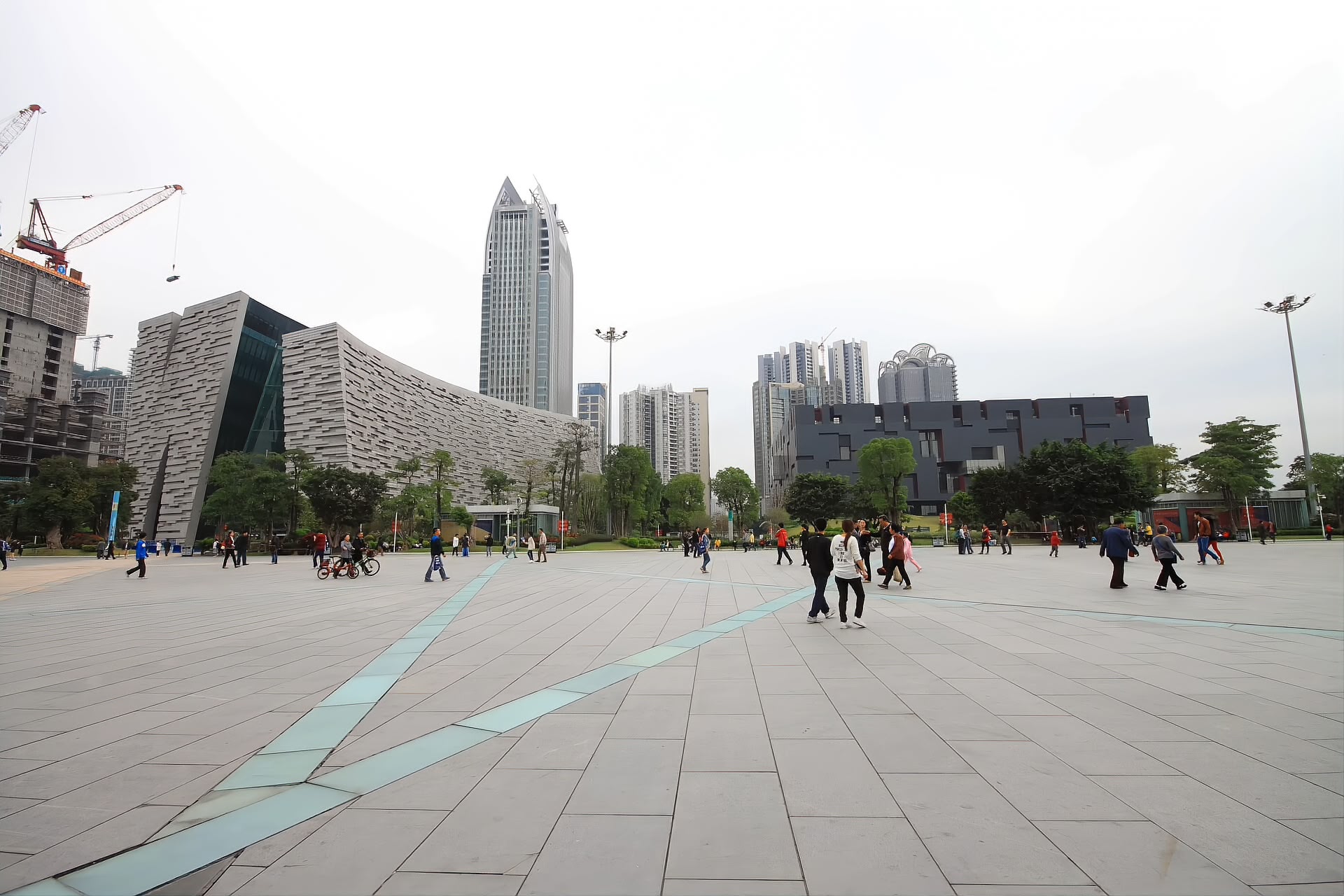
The Guangdong Museum is free and needs a real-name time-slot booking for everyone, children included. Slots for the next seven days are released daily at 22:00; one booking per account per fourteen days, five people per order, and three no-shows gets you locked out for ninety days. Bring the original document — a passport for foreign visitors — because the west gate checks it.
Hours are Tuesday to Sunday, 09:00 to 17:00 with last entry at 16:00, closed Mondays except public holidays, and extended to 21:00 with last entry at 20:00 from 1 July to 30 August. If the free slots have gone, the museum also sells tickets to its paid special exhibitions, which include general admission — a workaround rather than a plan.
Getting there: APM to 大剧院站 Exit B, three minutes to the west gate; or Lines 3 and 5 to 珠江新城站 Exit B1, about ten minutes on foot. The library is next door at 09:00 to 21:00, closed Wednesdays according to the library's own notices — some listing sites say Monday, so check before a long walk.
The train with no driver and no exit gate
The APM line opened on 8 November 2010 and is the first fully underground automated people mover in China: 3.94 kilometres, nine stations, all of them below the square, running from Linhe West in the north through the Opera House and Haixinsha to Canton Tower in the south. The trains are driverless rubber-tyred two-car sets with no cab, so you can see the track ahead of you through the front window, and they run at up to 60 km/h.
The quirk worth knowing: the APM charges on entry only. Tap in at the gate on the way in and walk straight out on the way out. There is no reader at the exit. It is the only line in the network that works this way, and it catches people every day.
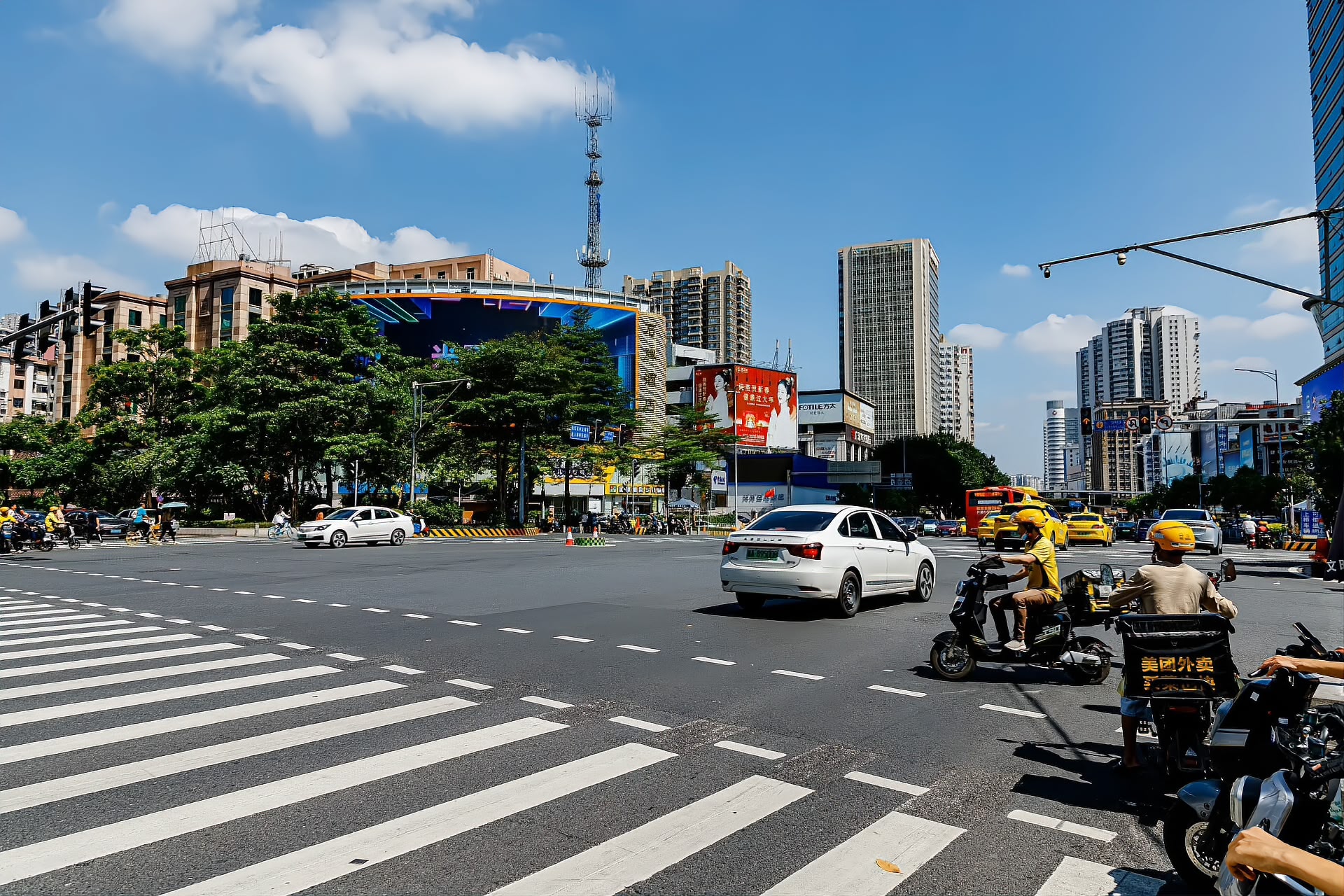
Tianhe Road. The shopping belt — nine complexes along 2.8 kilometres of it, inside a business district of 4.5 square kilometres that the city's figures put at 1.5 million visitors on an average day. This is where Guangzhou's crowds actually are. Image: CC BY-SA 4.0, via Wikimedia Commons.
Across the river: the Canton Fair
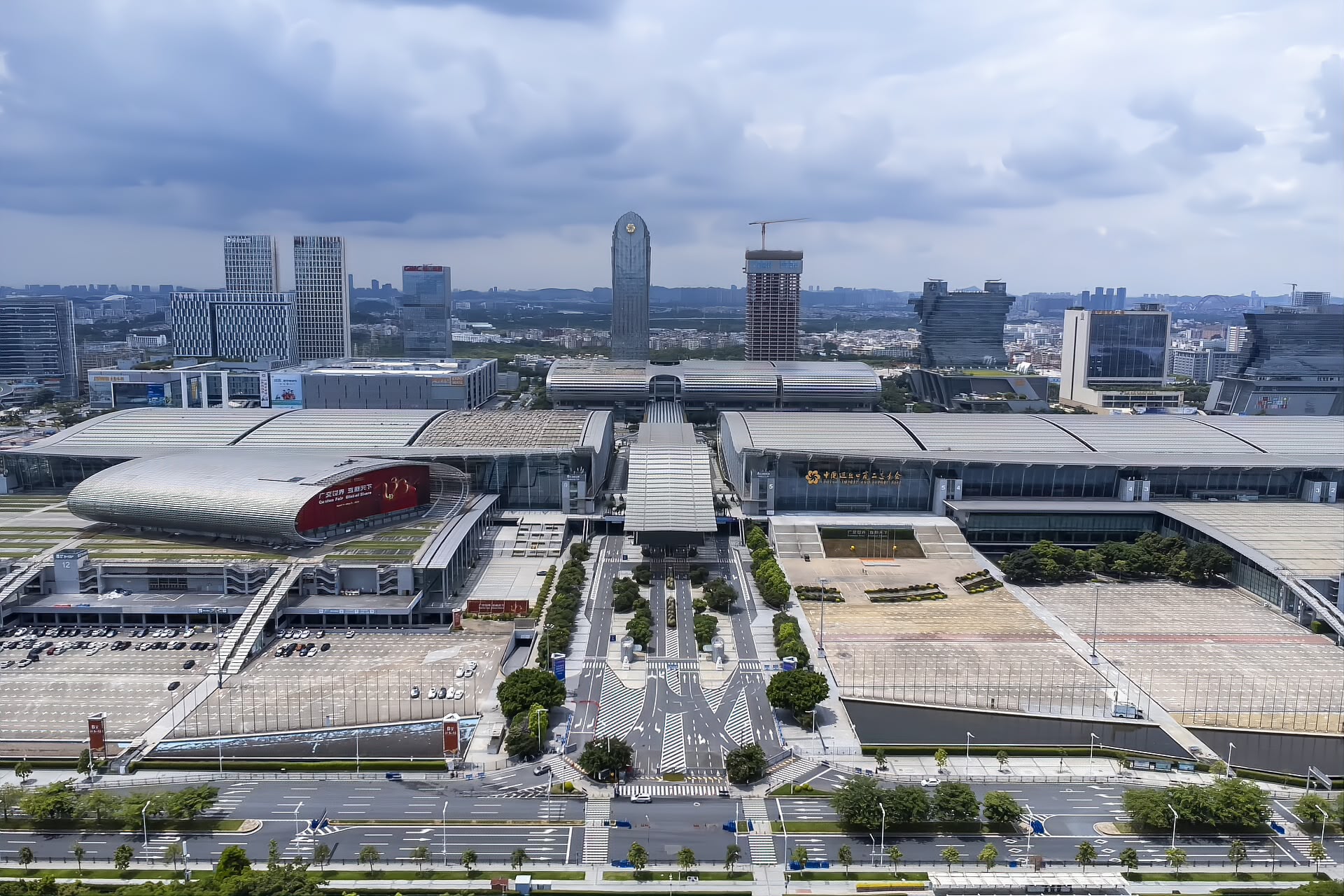
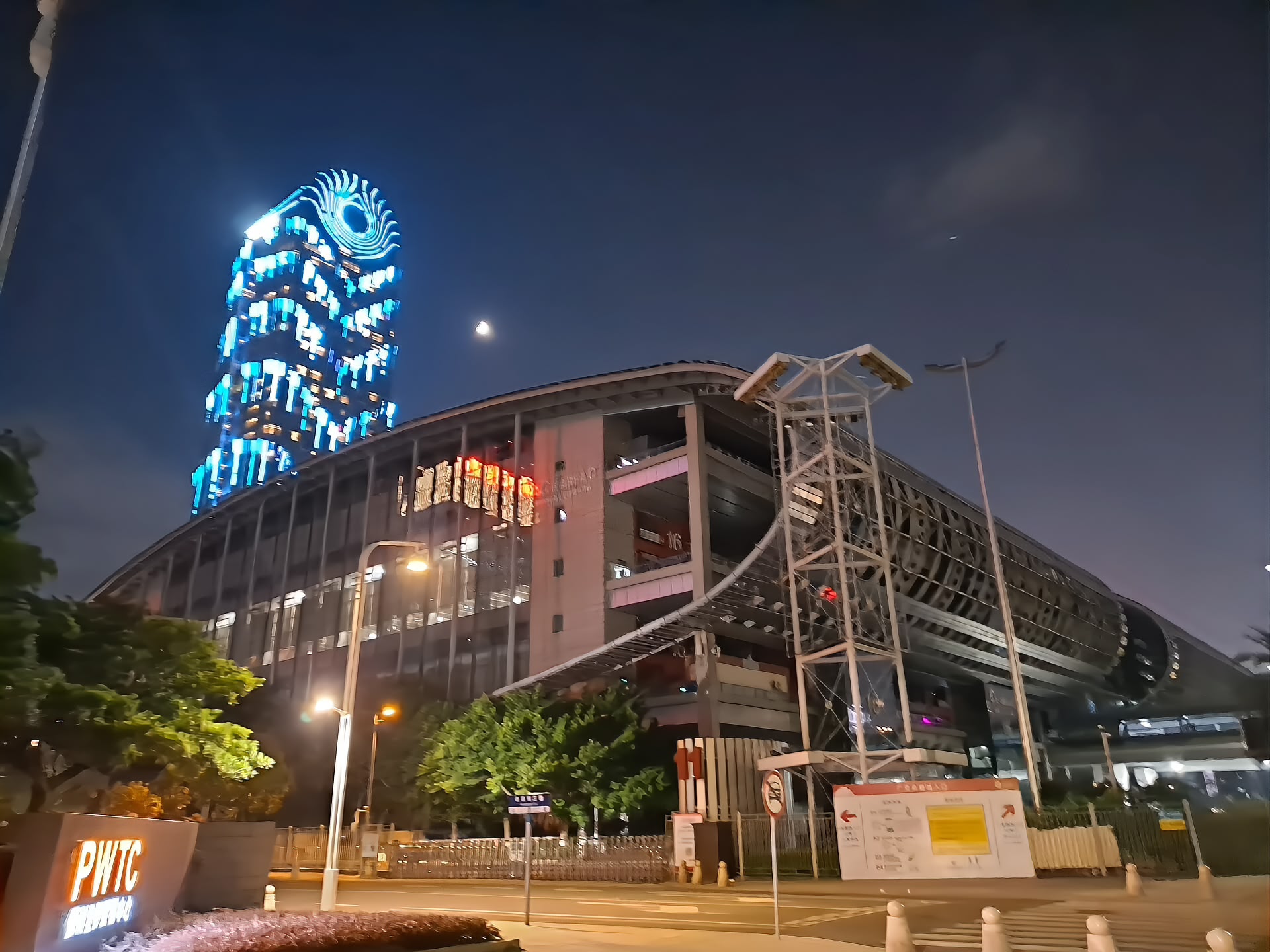
The fair sits on Pazhou island in Haizhu, on the other side of the river from the tower, at 380–382 Yuejiang Middle Road. It is a trade event: there is no ticket to buy and no way in as a sightseer. What follows is how to find it and what it is, which is as much as a traveller needs.
Metro Line 8. 新港东站 Exit A reaches Zone A; 琶洲站 Exits A and B reach Zone B; 琶洲站 Exit C is a 300-metre walk west to Zone C. The line runs roughly 06:00 to 23:30. Taxis can only set down at the Zone A taxi channel and the east side of Zone C — the rest of the road frontage is off limits, which is worth knowing if you are being dropped.
When it runs. Twice a year, spring and autumn, in three phases each. The 140th session opened on 15 October 2026: Phase 1 to 19 October for advanced manufacturing, Phase 2 from 23 to 27 October for home goods and gifts, Phase 3 from 31 October to 4 November for apparel, food and health. The halls close between phases for changeover on 20–22 and 28–30 October. Each phase runs about 09:30 to 18:00.
Getting in. A real-name buyer badge, matched to your face at the turnstiles. The first badge is free for overseas buyers who register in advance through the fair's own site with a passport and a business card; a replacement costs ¥200. Thirteen exhibit sections and fifty-four product categories, more than 75,000 booths, and — at this session — booth-level indoor navigation across the whole venue, which is a reasonable response to a building that size. Anyone selling you a way in is not selling you anything real.
If you have a genuine sourcing or purchasing reason to be there, register as an overseas buyer well in advance — it is free, and the queue at the registration desks during a phase is the worst part of the day. If you don't, walk the riverfront on the Haizhu side instead, where the complex is visible across the water and costs nothing, and read about it here. The two things not to do are buying a badge off a stranger and turning up at the gate with a suitcase and a hope.
About that Times Square
There is a shopping centre in Guangzhou actually called Times Square — 时代广场, at 28 Tianhe North Road, built in 1998, opposite CITIC Plaza — and it is a mall. The name has nothing to do with the New York one, which was called Longacre Square until a newspaper moved into it. Guangzhou's civic square is Huacheng Square, and it is a plaza: long, open, planted, with no advertising canyon and no theatres.
The screens, the crowds and the noise are somewhere else. They are on Beijing Road in the old city, where the excavated street layers sit under glass in the pavement, and on Shangxiajiu 上下九, the arcade pedestrian street in Liwan, where the storefront signs stack four deep and the food is on the street rather than in it. And they are along Tianhe Road east of here, which is nine shopping complexes in a row. Guangzhou's density is in its streets and its food, not in one square — which is either a disappointment or the better news, depending on what you came for.
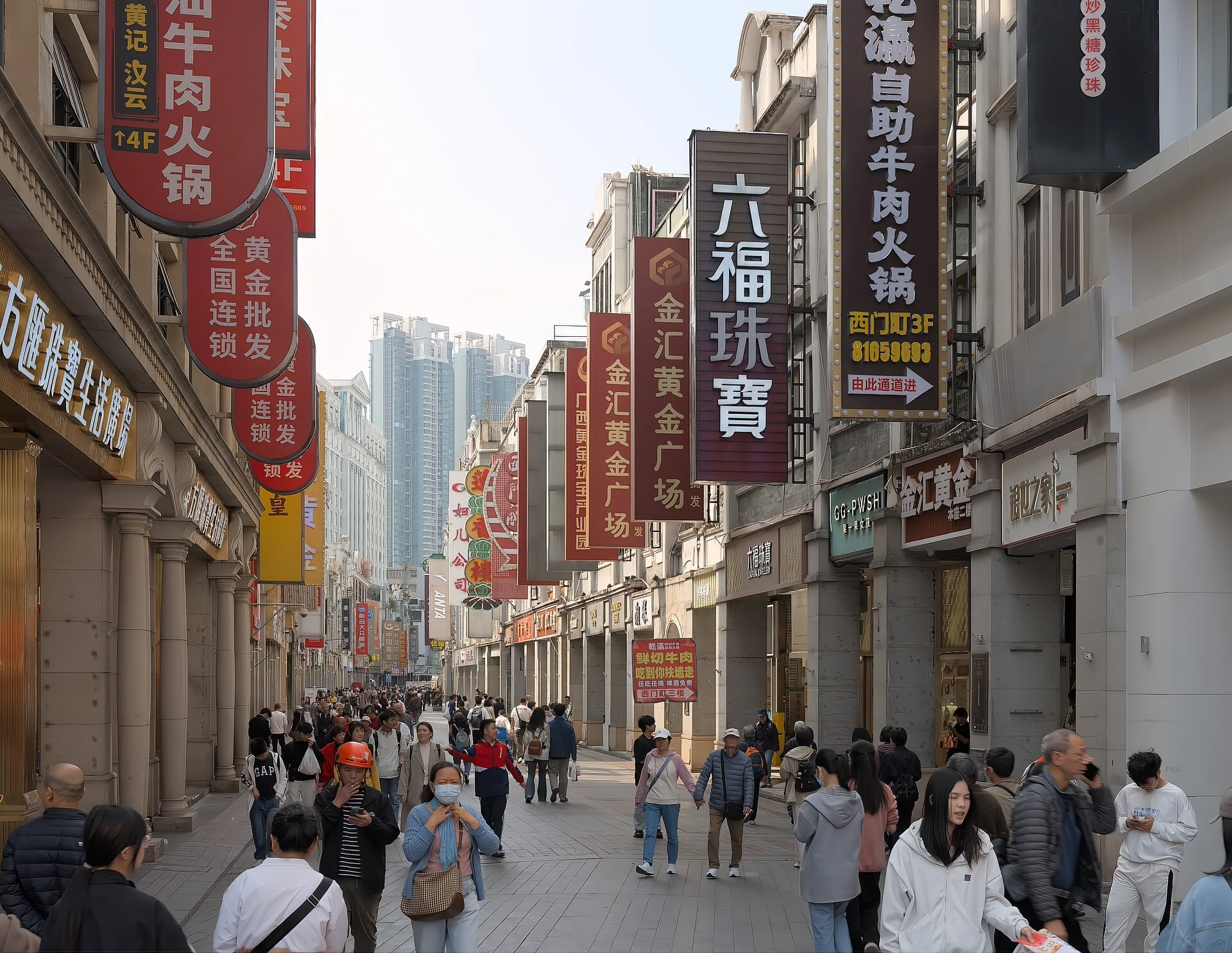
Shangxiajiu, in Liwan. The arcade pedestrian street in the old west — this is the closest Guangzhou gets to a screen-and-crowd square, and it is a street rather than a plaza. Image: dllu, CC BY-SA 4.0, via Wikimedia Commons.
The museum needs a reservation and the library's closed day is reported inconsistently, so check both before you walk over. Haixinsha is a working venue as well as a park and can be shut without much notice. Neither tower has a public observation deck you can walk into. The Canton Fair is trade-only and has no visitor tickets at all.
Two hours is enough for the axis at a brisk pace; half a day if you go into the museum. Come back after dark for the same walk — it is a different place, and it is the better of the two.
Photographs and sources
Photographs from Wikimedia Commons, used under their Creative Commons licences and enhanced for this page: Zhujiang New Town at night, Huacheng Square with the library and museum (Zhangzhugang, CC BY-SA 3.0), the opera house and tower (Ecow, CC0), Tianhe Road, Shangxiajiu Pedestrian Street (dllu), and the Canton Fair Complex above and at night (Tim Wu and 钉钉, CC BY-SA 4.0). The growth figures, the Canton Fair session data, the metro network totals and the airport figures come from the Guangzhou municipal government and statistics bureau, the fair's own site, and the Guangzhou Metro operator. Museum hours and the reservation rules come from the museum and the library's own notices; where listings disagree — the library's closed day, the area of the business district — both versions are given rather than resolved.
There's more where this came from.
Read the latest insider notes →Two new posts a week — the things a non-resident can't know, written down before they cost you a morning.
More on the region: the Guangdong region guide · the Guangzhou city guide · Canton Tower & the Pearl River · Beijing Road · Shenzhen · Foshan