Gankeng Old Town (甘坑古镇)
Ten minutes' walk from the end of metro line ten, a city gate appears at the end of the road: grey brick, upturned eaves, two characters over the arch. Beyond it the paving turns to stone slabs, the lanes narrow, and the noise of the city thins out. It is a controlled effect, and it is supposed to be — what is easy to miss is that the transaction is recent, the village is not, and the reason either survived is a hat.
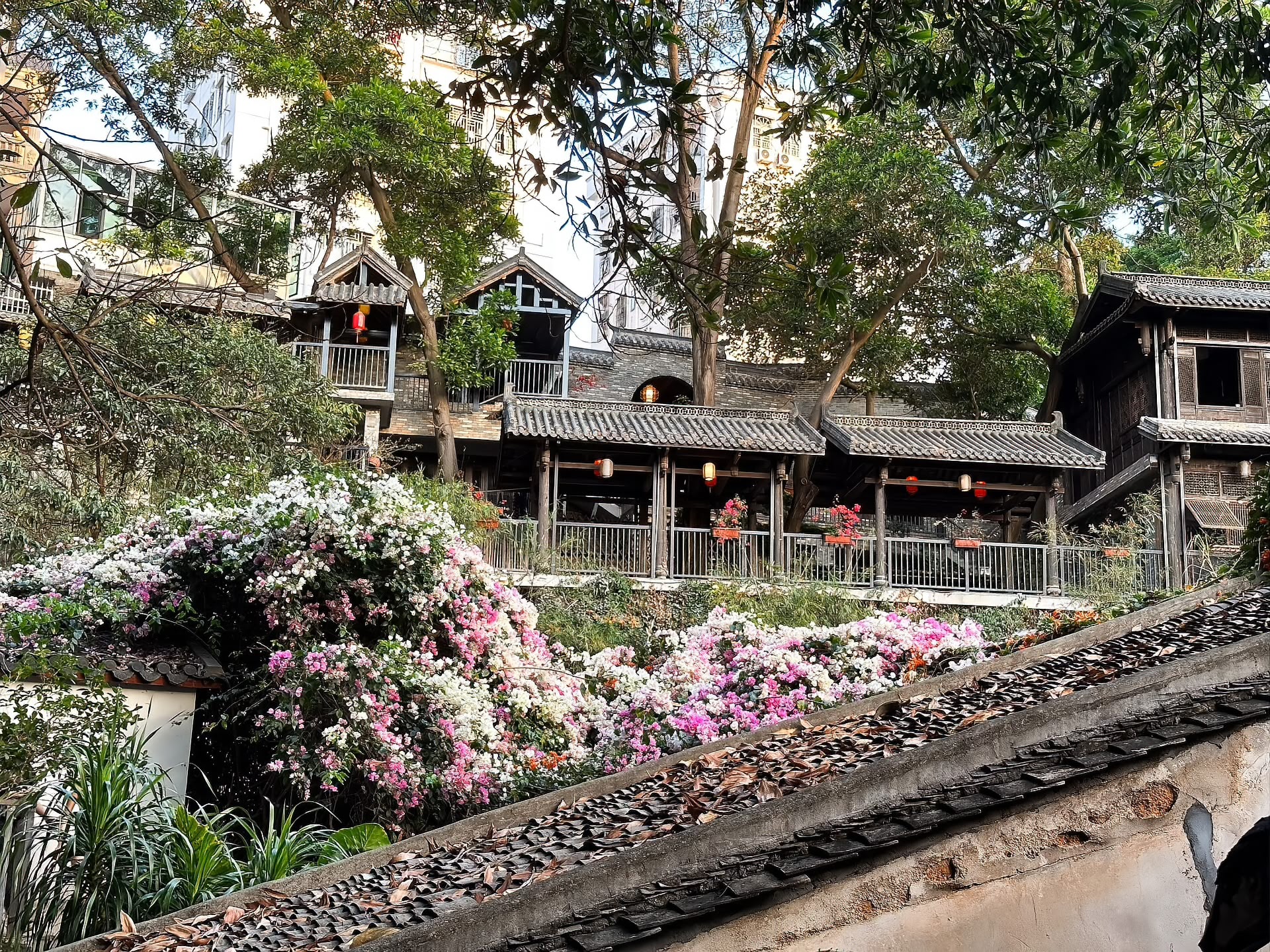
A hollow in the Longgang hills. The lanes follow the drainage of the valley floor, which is why they curve — one of several things here that were not redesigned.
Four words will carry you most of the way around this place, because everything it is known for has a name that English translations mangle.
甘坑古镇 Gānkēng Gǔzhèn — Gankeng Old Town; older signage and much local usage still say 甘坑客家小镇, Gankeng Hakka Small Town
客家 Kèjiā — Hakka, the people and their dialect
凉帽 liángmào — the cool hat the village made famous
小凉帽 Xiǎo Liángmào — Little Cool Hat, the mascot drawn in 2016
炮楼院 Pàolóuyuàn — the gun tower
二十四史书院 Èrshísì Shǐ Shūyuàn — the Twenty Four Histories Academy, on the north side
七都116 Qīdū 116 — Seven Du One One Six, the market street named from the Xin'an county gazetteer
For the metro ask for 甘坑站 (Gankeng, Line 10), Exit B, then follow the crowd for about ten minutes.
A name for the water
The name is a description. In Hakka, keng is a small stream or a gully between hills, and gan means sweet. The valley floor here is low and wet, springs came up all over it, and the water in the streams tasted sweet rather than brackish, so the settlers named the place for its drinking water. A place called sweet gully was worth settling, and that is more or less the whole founding logic.
Before the Hakka arrived, the valley had an earlier name and earlier people. Local histories call it Chizhu — the red bamboo — and describe it as a Yao settlement, the bamboo being a native cane that grew on the slopes and that the hat makers would later split fine. The Xin'an county gazetteer records that in the late Ming the county was divided into three districts, seven du, and five hundred and nine villages, and it lists Gankeng under the seventh du as village number one hundred and sixteen. The town kept the catalogue entry and made it the name of its market street: Seven Du One One Six.
The move south had a context. When the coast was reopened in 1669 after the evacuation of the 1660s — the same imperial order that emptied the walled town at Nantou, an hour and a half away by modern road — the emptied land was thrown open to new settlers, and most of those settlers were Hakka families coming down from the crowded hills of the east. Gankeng's founders are recorded as two households, Xie Wenming and Zhuo Meifa, who came south from Meizhou, the Hakka heartland, in the seventeenth century. They settled, farmed the wet ground, built the ancestral hall, and their descendants are still the majority clan. The family hall, the gun tower and the schoolroom are the three buildings they left, and the three oldest things in the town.
The hat
The craft that made the village known was the liangmao (凉帽), the cool hat: a wide, shallow circle of woven bamboo with a cloth crown and a fringe of fabric hanging to the shoulders. It shades the face and the neck, it lets air move, and it folds into a basket — the practical answer to a climate that is hot, wet and bright all at once.
The Gankeng version has been woven here for something over two hundred years, and at its height every household worked at it. Local bamboo was split into strips fine as thread, woven into a cap, sized, dried, fitted with the cloth crown and edged with the fringe — a process counted in roughly three dozen steps from the standing bamboo to the finished hat. The red bamboo the valley was named for gave the hats their colour and their near-weightlessness: a finished hat more or less floats, and a woman could wear one all day in the fields. In the Hakka districts the fringe, the binding and the colour of the crown cloth carried social information, the way a collar or a sleeve does elsewhere.
The hats travelled further than the trade. The village became one of the largest cool hat producers on this stretch of coast and shipped them to Southeast Asia and, by the accounts that survive, to Britain and France. Families leaving for overseas carried one in their luggage, and the hat became the object that stood for home: shade in a foreign sun, and a shape that meant the village. That double life — farm tool at home, emblem abroad — is why a hat rather than a building became the town's symbol when the town needed one.
The craft is listed at provincial level as intangible heritage, in the fifth Guangdong batch; some press accounts call it national, which it is not. Its most recent bearer of record, Zhang Guanxian, worked at it for fifty years and made the point plainly in interviews: the older generation passed it on hoping it would not be lost. Whether it lives now depends on whether anyone still has a reason to make one, which is the problem the town spent a decade solving.
The tower
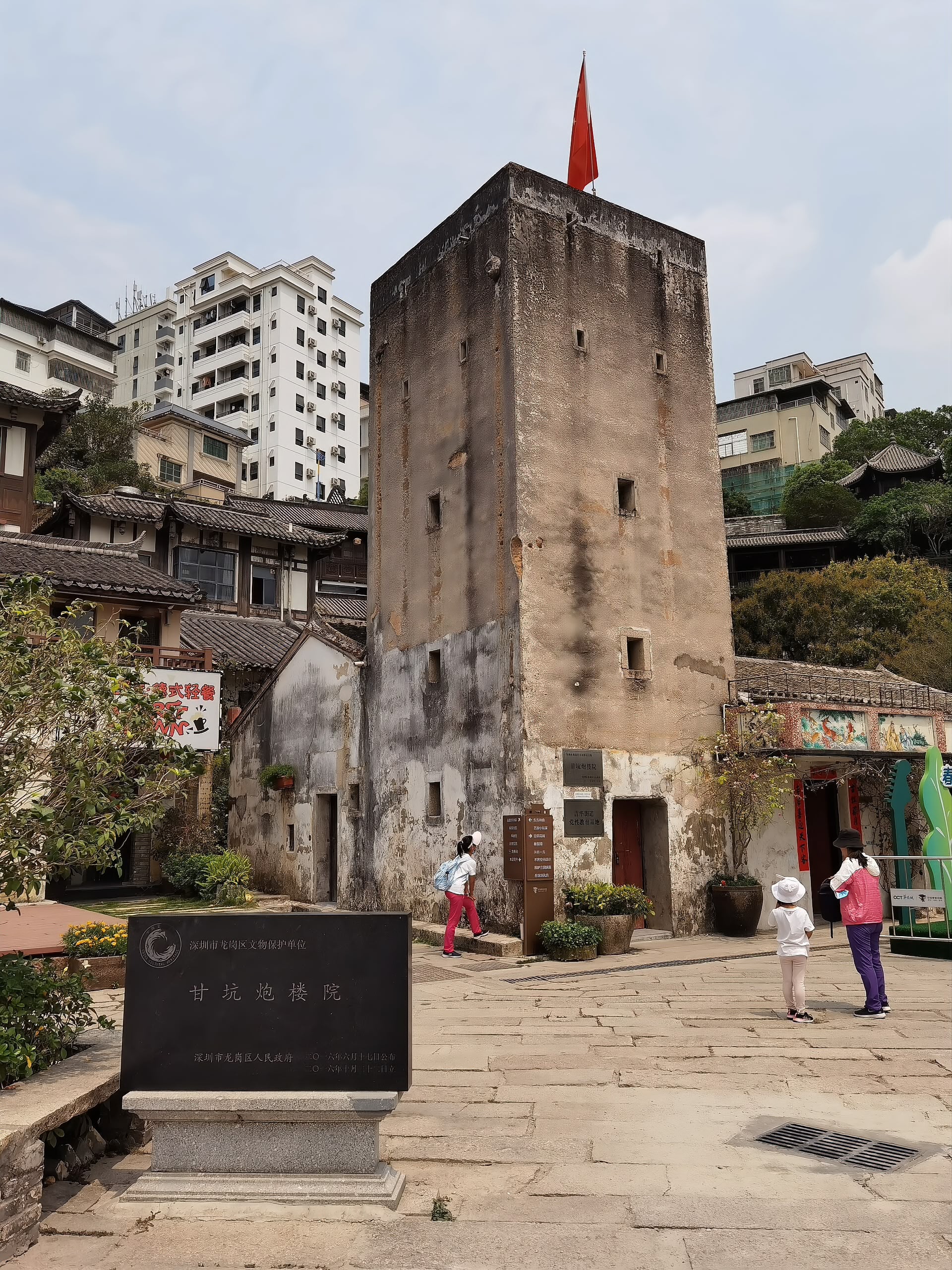
The strangest building in the valley is a gun tower, built in 1919: three storeys, thick-walled, with narrow windows and firing slits, standing about forty-five square metres at the base. It is the architectural signature of a nervous decade. Bandit raids, clan feuds and armed conflict between native and settler communities were chronic in the Shenzhen hills of that era, and a village that could not defend its stores did not keep them.
The tower's second life is why it is protected. In the war years the hills around Gankeng were on the edge of the Dongjiang guerrilla zone, the column that fought the Japanese occupation behind the lines in the Pearl River delta, and village houses and the tower itself served as cover for guerrilla units. Zeng Sheng, the column's commander, is recorded as having recuperated from wounds in Gankeng. A farm tower built against bandits became part of a war against an army, and the town keeps it as its memorial to that. The district listed it in 2016, and the ground floor now carries an exhibition on the column and on the village's part in the fighting.
The years it was left behind
Reform came late to Gankeng and in the wrong shape. The valley floor floods, the hills block expansion, and for years the village was the least developed part of the Buji area, the sprawl of towns north-east of the old special zone line. Its factories in the eighties and nineties were plastic flowers, hardware and cheap toys — the industries that arrive where land is cheap. The houses were brick and timber. Fire trucks could not enter most of the lanes.
Fire was the waking call, more than once. A senior official of the Buji street office recalled watching the village burn repeatedly through the first decade of this century, with furniture workshops, quilt makers and mattress stalls packed into timber buildings, and a fire roughly every month. In 2010 the city listed Buji as a fire-hazard rectification area, and the crackdown followed.
Out of that enforcement came the decision that saved the village. The community's shareholding company — the legal entity that held the collective property — took leases on the old houses of the whole village, fifteen years, paying the going rate. Demolish and rebuild was on the table and would have paid better. What settled it was partly sentiment and partly an example: a delegation went to study the narrow alleys of Chengdu's Kuanzhai quarter, the planner behind it came to advise, and the village chose to become a heritage town instead. In 2012 it commissioned Peking University's design institute to draw the plan, with six zones for culture, workshops, farming, wetland, orchards and hillside sport.
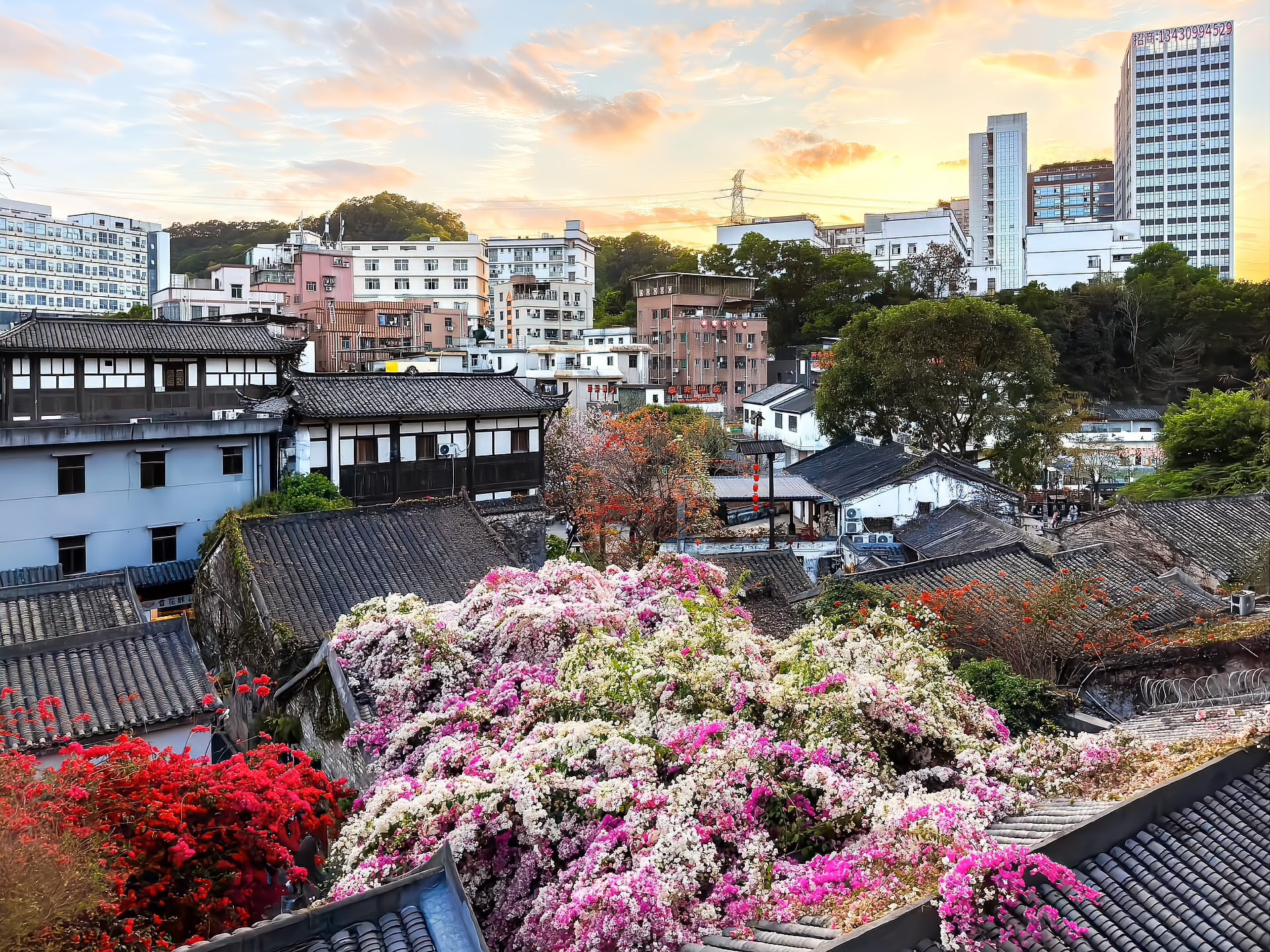
The plan covered far more than the old houses. It folded about 231 hectares of village land, wetland and hillside into one scheme, took leases on more than four hundred old rooms, and left the street plan alone — the lanes inside the gate still follow the drainage of the valley floor, which is why they curve.
The company that arrived in 2016
In May 2016, at the Shenzhen cultural fair, the state-owned OCT group signed with the Longgang district government and set up a cultural company in Gankeng. The planned investment was around thirty billion yuan, the project area grew from the old village to twelve square kilometres of hills and water around it, and the strategy got a slogan: culture, tourism and urbanisation. OCT's method had a name too — three repairs and one upgrade: repair the culture, repair the way of life, repair the ecology, upgrade the industry. In practice that meant keeping the footpaths and the old houses, clearing the river that flooded the valley to a fifty-year flood standard, and pushing the plastic flower factories out.
Recognition followed quickly: in 2017 the town was in the first national group of cultural tourism towns; in 2018 the province named it a culture tourism demonstration site; in 2022 it took a national 3A rating and a place on the province's night-time culture list. In December 2021 the name changed from Gankeng Hakka Small Town to simply Gankeng Old Town.
Two things happened along the way that had nothing to do with tourism. The river was re-engineered — the channel that used to flood the valley floor was dug out and armoured, which is the unglamorous project underneath everything else. And the town became a teaching site: the party school lists it as a field site for its training programme for village party secretaries from old revolutionary base areas, with two dozen cohorts and several thousand trainees having come through to look at how a village can turn itself around without selling itself.
That last point is worth being clear about, because it is the most interesting thing here. The houses still belong to the villagers, through the shareholding company. What was rented was the right to operate. The rent underwrites the village, the company carries the capital and the risk, and visitors supply the cash flow.
The little cool hat
OCT's most consequential move was not a building. The cultural company went looking for a symbol, settled on the hat the village had already made famous, and in August 2016 drew it: a small girl in a woven cool hat, named Little Cool Hat (小凉帽). The character went into picture books, then animation, then a virtual-reality film, a themed hotel with forty-six rooms, a farm where children plant vegetables, and a theatre for shadow puppetry — which is itself listed heritage. The animation won prizes at the Venice festival's Asia Pacific section, and the character now appears on the town's signs, its manhole covers and its merchandise.
There is a fair critique of turning a labour craft into a mascot, and the defence is arithmetic: it gave a reason for the weaving to continue, in demonstrations and workshops and souvenir counters, where a museum case would have ended it. On the north side, the Twenty Four Histories Academy opened in 2022 — eight named reading rooms around a pond holding thirty thousand volumes. It is new construction in old clothing, and it is crowded, which is the test that matters.
The buildings that came from elsewhere
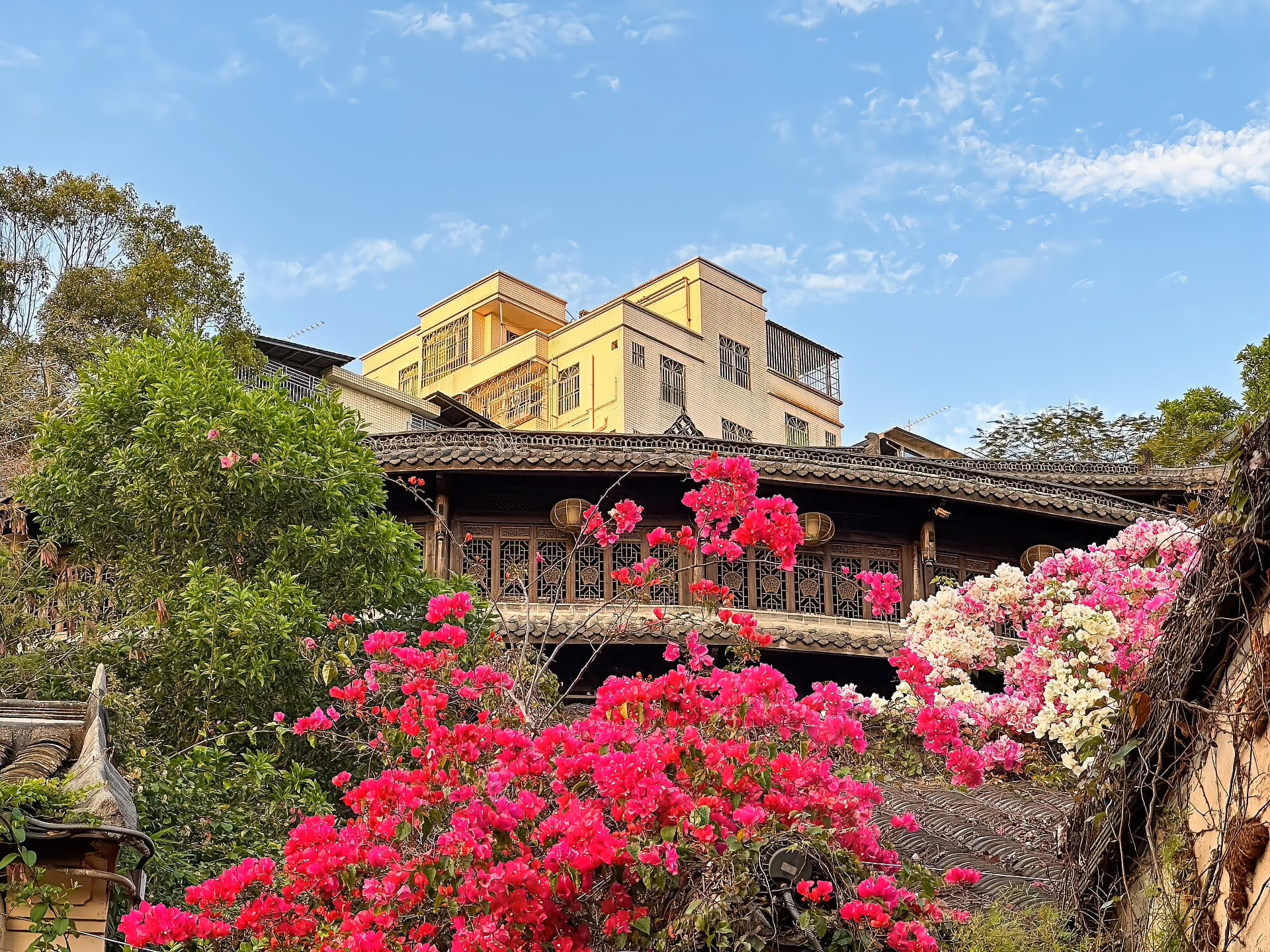
The honest answer to what is original here is: the water, the layout, the gun tower, the ancestral hall, and a few streets of farmhouses. Several of the showpiece buildings were moved in. The Nanxiang Building, a century-old house with carved beams, was transported whole from southern Fujian. The Scholars Mansion, a three-hundred-year-old house with more than a thousand carved panels, came from Wuyuan in Jiangxi. Four Huizhou-style houses in the Phoenix Valley came from Anhui. The town assembled its most photogenic heritage from three provinces, which reads either as a scandal or as a salvage operation, depending on how you feel about buildings rescued from demolition by being shipped to Shenzhen. Their histories before arrival are not documented.
What is genuinely local is the arithmetic. The shareholding company's annual income went from three and a half million yuan before the redevelopment to over forty million after it — rent, dividends and shop trade flowing to the same families whose great-grandparents dug the wells. The town claims more than thirty million visitors in total since the reopening, though that figure comes from a travel account and is not audited. The weaving survives in workshops. The tower has its exhibition. And the stream that named the place still runs through the middle of it, in a channel that has been re-dug twice.
Going, and what to expect
Getting there. Metro Line 10 to Gankeng station (甘坑站), Exit B, then about ten minutes on foot. Buses including the M268, M273 and M403 stop near the old town. Drivers can navigate to the north parking area, though spaces run short on weekends and public holidays.
Tickets and hours. The streets are free to enter and the listings give the old town as open around the clock, which is true of the lanes but not of anything indoors. Indoor exhibitions and workshops generally keep daytime hours — given as 10:00 to 18:00 in one 2026 listing and 9:00 to 21:00 in another for the shops and evening venues — with some venues closed on Mondays outside public holidays. Check the notice boards on the day. A few attractions charge their own admission, the Twenty Four Histories Academy among them; everything else can be seen for nothing.
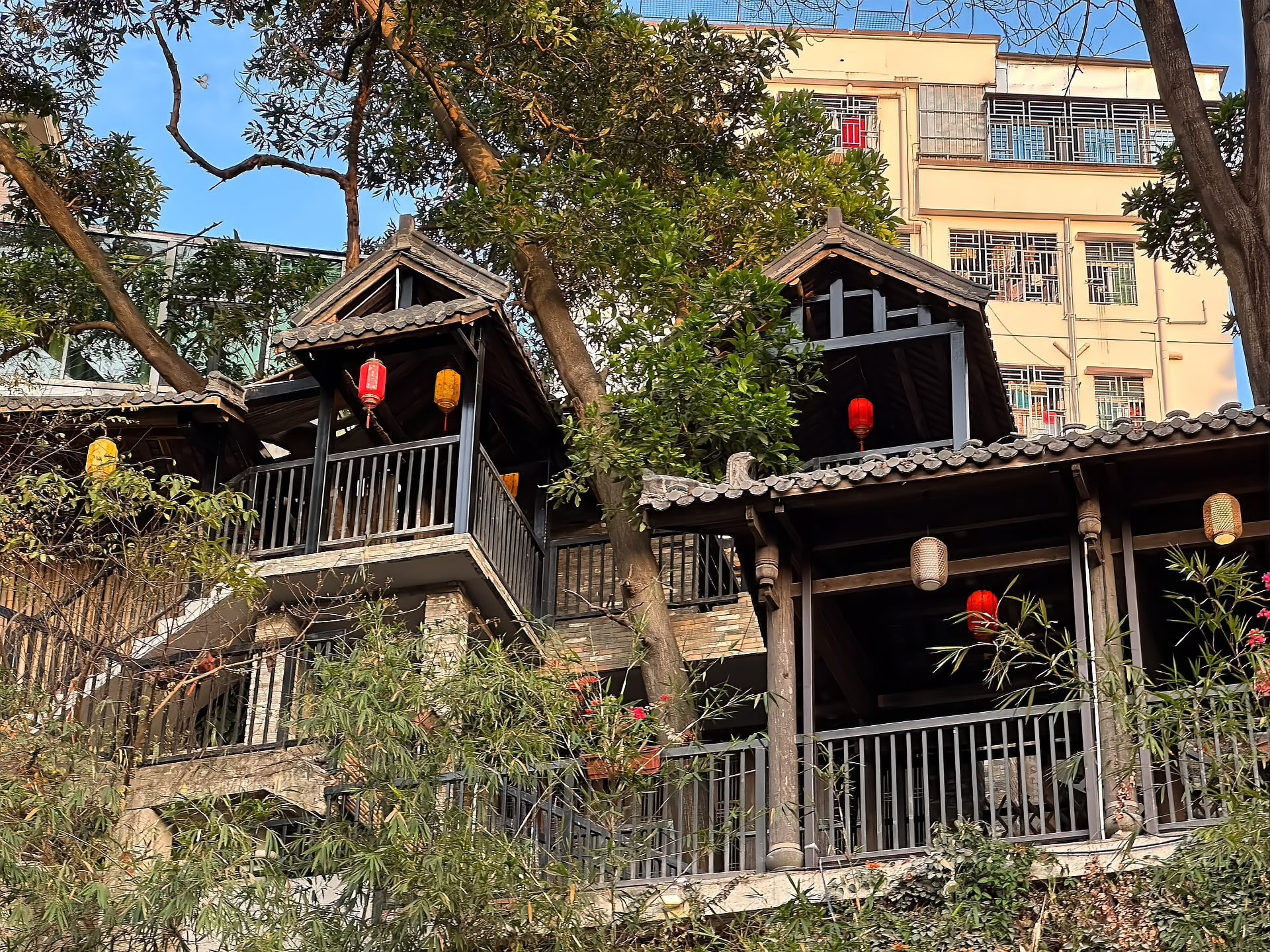
How long, and when. Half a day at a slow pace, and come late: arrive around four in the afternoon for the daylight lanes, eat the Hakka snacks while the sky goes, then stay for the lanterns, which is what the place is built for. There are said to be costumed parades and special programming around the Lantern Festival and other holidays, so it is worth checking what is on.
What to eat. The counters sell the Hakka standards: tofu stuffed with mince, rice noodles with pork, and glutinous rice cakes pounded with a wooden mallet in front of you — which is a demonstration, a snack and the old village's one remaining heavy industry in a single motion.
Honest notes. The founding date is loose. The standard account gives the two founders from Meizhou and counts three hundred and fifty years, pointing at the seventeenth century; other accounts say the late Ming or specifically the Kangxi reign. The earlier name — the red bamboo, a Yao settlement — is tradition rather than document. The steps in making a hat are counted at about thirty in one source, thirty-three in another and a dozen or so in a third. The thirty billion yuan mentioned above is the planned investment announced at the 2016 signing, not money that has been spent, and the visitor count since reopening is not audited. Finally: some of the best-looking architecture here arrived from other provinces.
Walk in through the gate, find the gun tower and read the exhibition at its foot, then look for a workshop where someone is actually splitting bamboo. Buy the rice cake hot, wait for dark, and walk the water once with the lanterns on. Everything else — including the prettiest buildings — came from somewhere else.
Photographs and sources
Photographs from Wikimedia Commons, used under their Creative Commons licences and enhanced for this page: the lanes of the old town, the 1919 gun tower, courtyards and rooflines, and the houses with their lanterns up (CC0; CC BY-SA 4.0). History drawn from the Gankeng Old Town editorial source file, cross-checked against 2026 visitor listings for admission, hours and the metro approach, and against city coverage of the OCT signing and the Little Cool Hat character. Where the records disagree — the founding century, the number of steps in making a hat, the indoor hours, whether the hat craft is provincial or national — both versions are given rather than resolved.
There's more where this came from.
Read the latest insider notes →Two new posts a week — the things a non-resident can't know, written down before they cost you a morning.
Near it: Nantou Old Town · Lianhuashan Park. Elsewhere in Guangdong: Guangzhou · Foshan · Chao Zhou · Jiang Men and the diaolou