Yuyin Shanfang (余荫山房)
Ask for the great gardens of Lingnan and you get four names back — and Yuyin Shanfang, south of Guangzhou in Panyu, is the smallest of them and the only one still standing exactly as its first owner left it. The two facts are the same fact. Built in five years on three mu of leftover clan land, finished in 1871, it packs four halls, a pond, a rockery and twenty metres of covered bridge into a garden you can cross in ninety seconds — and nobody had a reason to change it for a hundred and fifty years.
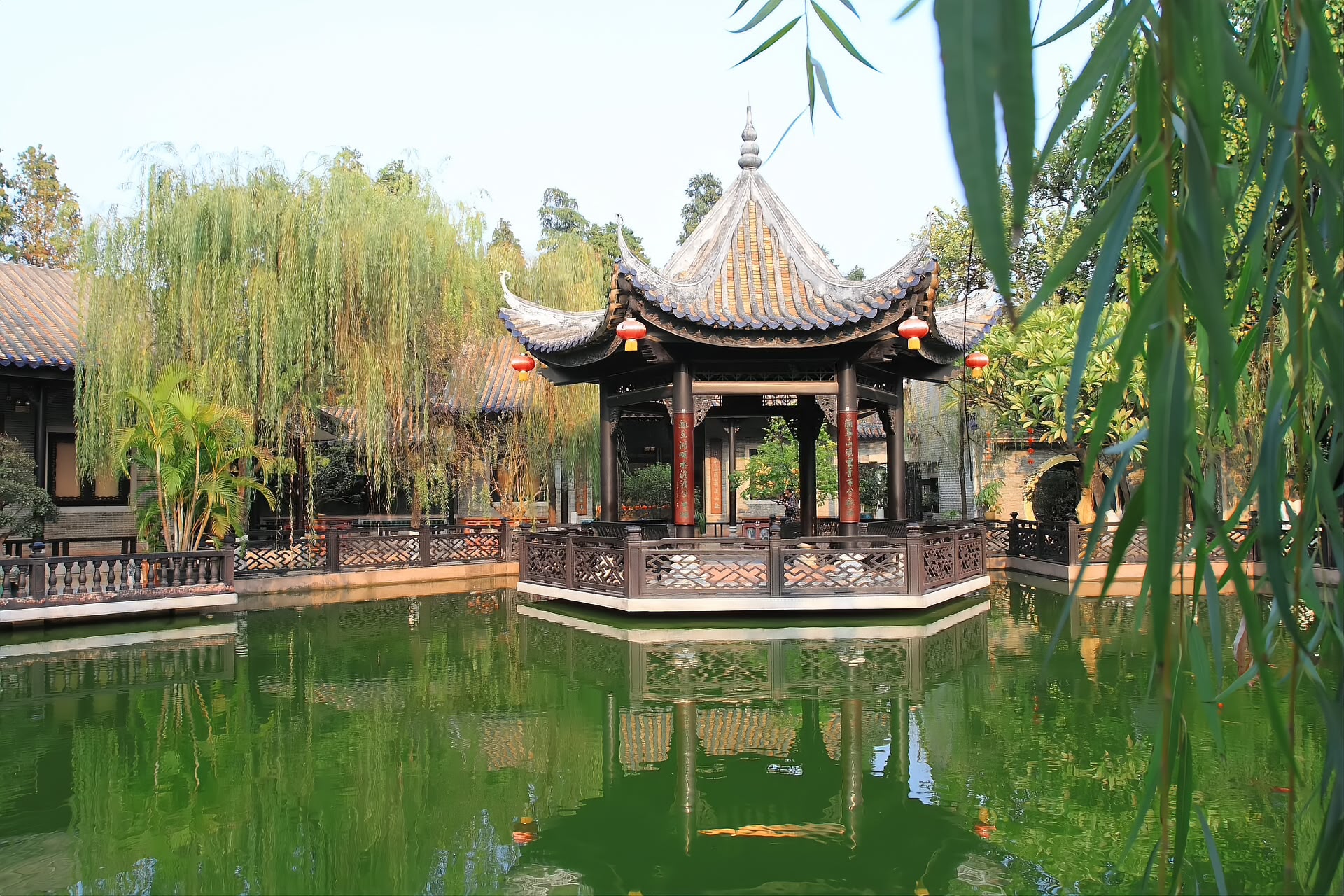
The eight-sided hall standing in the water. Windows on all eight faces — stand still, turn your head, and the whole garden comes to you one side at a time. One face of the building is the spring gate and the opposite face is the autumn gate: the room was built to receive the year.
The man who bought his office
The garden's owner, Wu Bin, was born in 1824 in Nancun, a Panyu village that is now a suburb of Guangzhou. He was nineteen when he came first in the county examination of 1843, and by the standards of the men who built the other three gardens a bureaucratic lightweight — and he knew it. In 1854 he entered service the expensive way, by purchasing a post; he transferred into the Ministry of Justice, was granted an honorary title with a second-rank stipend in 1855, served in Beijing for four years, and resigned in 1858 on the grounds that his mother was old.
Then comes the strange arithmetic. He spent the nine years after Beijing studying and buying garden designs — landscape drawings commissioned from Suzhou and Hangzhou painters, a watercolour given by a prince of the imperial clan, and the drawings of Haishan Xianguang, the celebrated garden on the Pearl River that had already burned down. In 1867, at forty-three, he passed the provincial examination and became a juren, and it was that exam — nine years after he quit office — that made him respectable enough for his clan to hand him land. His two sons followed him into the juren list; three in one household, and the family said the father and sons had broken the osmanthus branch together.
The ground the clan gave him
The land arrived by accident, which is the usual way land arrives in these stories. In 1867 the Wu clan was finishing two ancestral halls for his grandfather and his father, and what was left over — about three mu of unusable fragment between them — the clan awarded to Wu Bin. He began that year and finished in 1871, at a recorded cost of thirty thousand taels of silver. On three mu, with no hill, no stream and no borrowed scenery beyond a neighbour's wall, he built four principal halls, two small pavilions, a covered bridge, a pond and a rockery: everything a Lingnan garden needs, compressed into a space you cross in ninety seconds.
His name for it carries both halves of the story. Yuyin — remaining shade, lingering benevolence — is gratitude to his ancestors, because ancestors are the shade a descendant stands in. Shanfang, a mountain hut, is deliberately modest, because a man who has just been given three mu by his relatives does not need to announce himself.
Red rain and green cloud
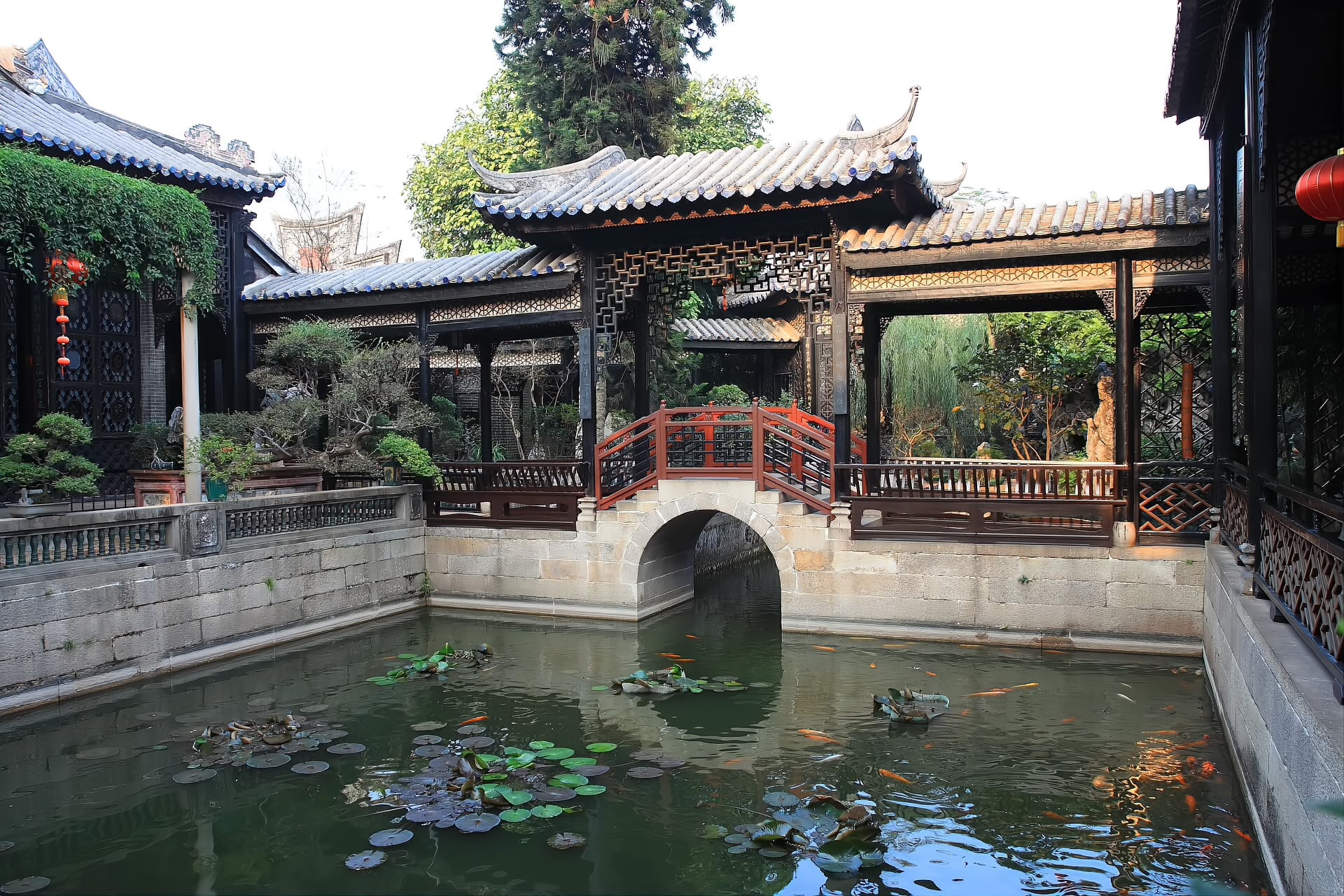
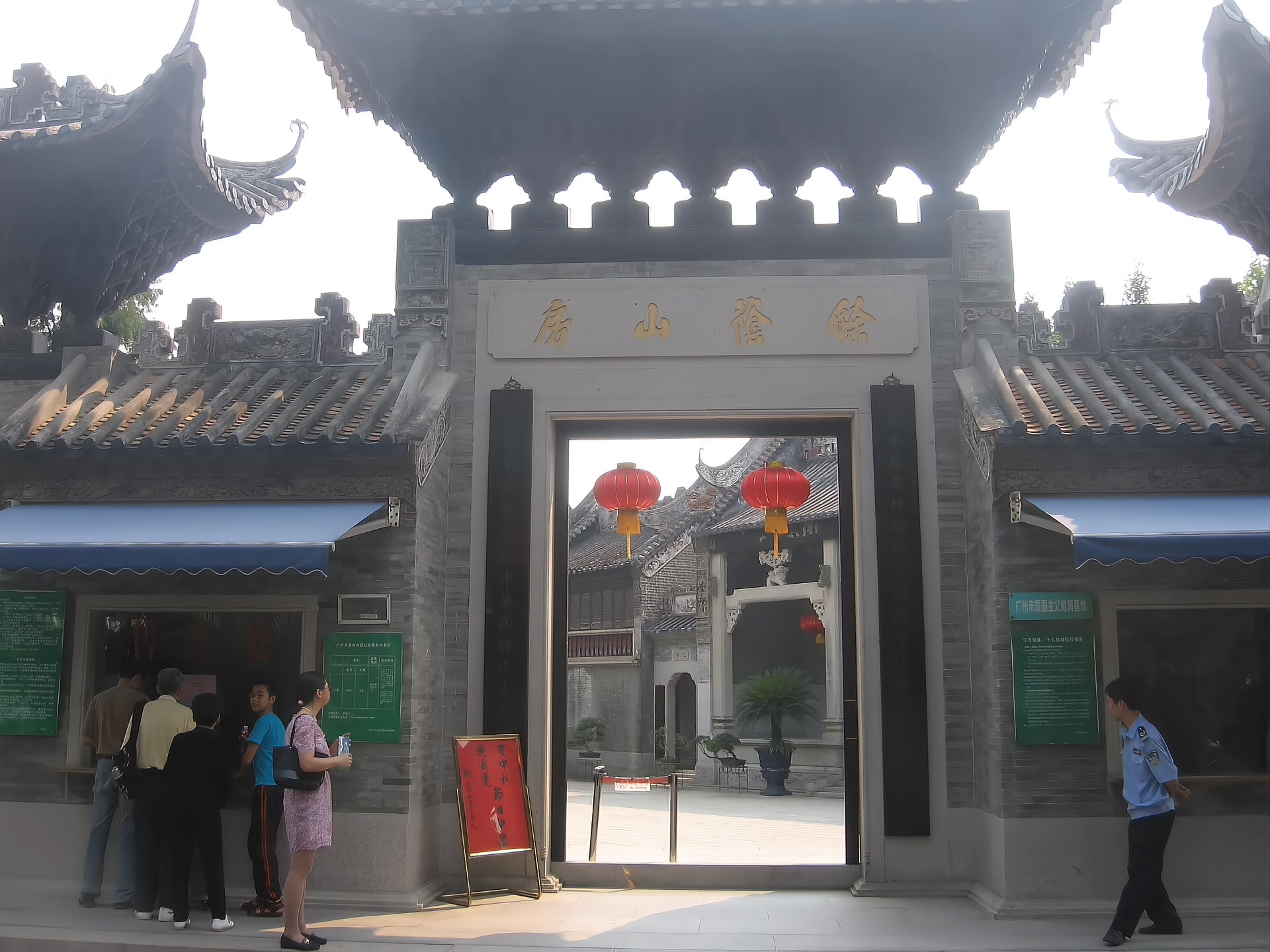
Enter through the ceremonial gate and the garden divides itself. Twenty metres of covered bridge crosses the middle of the pond, and the split is stated in the bridge's own name: washing red, crossing green. West of the water is the red half — the main hall and the flame of the cockspur shrub, which flowers in strings and drops into the pond like rain coming down sideways. East is the green, tree-shaded and enclosed. The couplet that names the whole garden is painted on the gate of the inner court: three bow spans of spare ground, red rain enough; one corner under shade, green cloud deep. A bow is an arrow's flight, so the first half is self-mockery — this whole estate is three hundred paces long.
The bridge is the thing no other garden in the group manages: bridge, covered walk, pavilion and railing combined into one continuous structure, with rails on both sides given backs, so you can sit down on the crossing without giving up the view. People believe it was modelled on the Willow Wave Bridge of the lost Haishan Xianguang garden — an attribution that rests on surviving drawings, since that garden burned before the Second Opium War.
The hall of deep willows
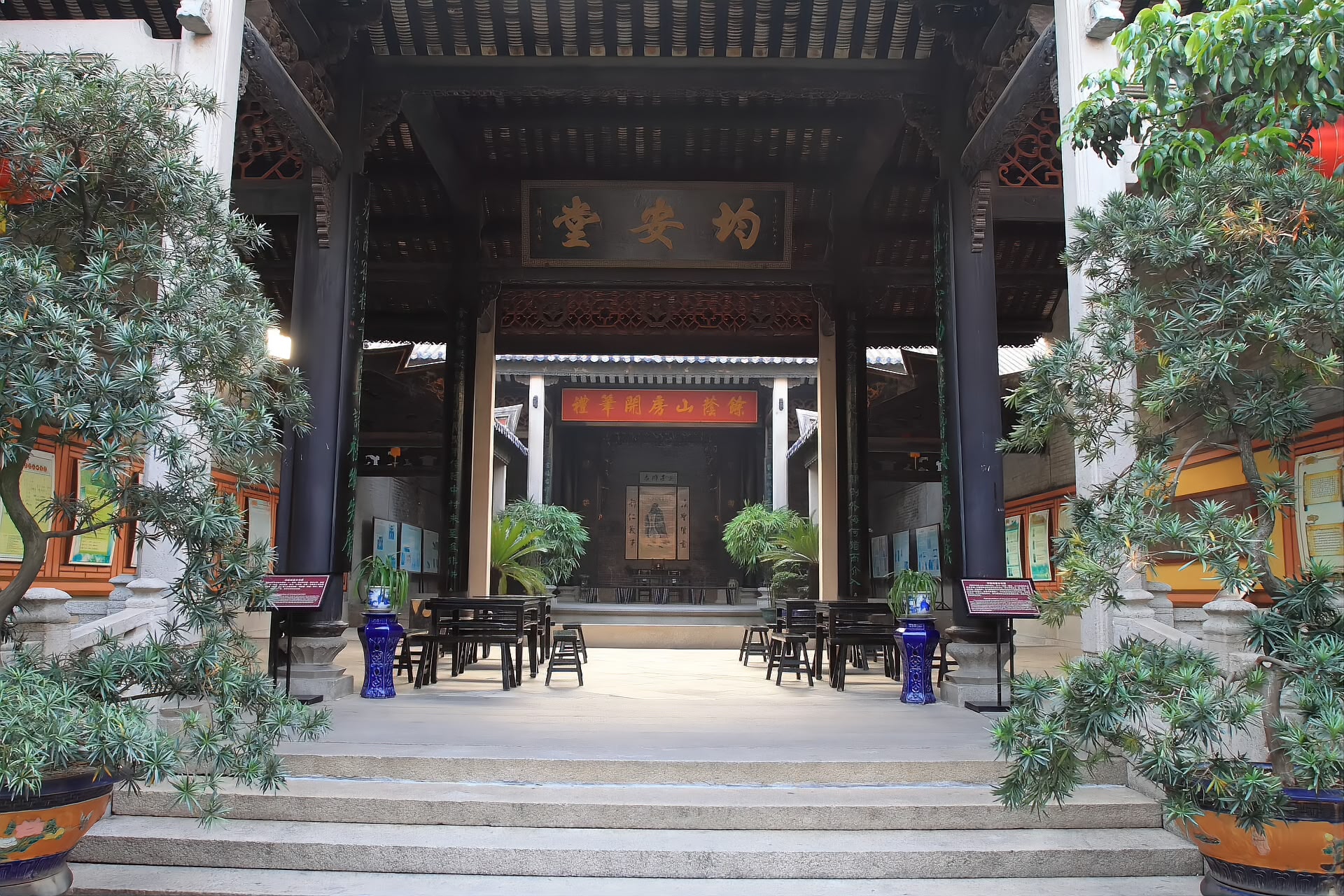
The main hall, Shenliu Tang, is the most decorated room in the garden. Its carving is the real event: two wooden flower screens stand in the front bays, and the one in the western bay depicts squirrels among grapes — carved on both faces with identical depth and detail, the way a Suzhou embroidery panel is worked from the front and the back. Nothing of that standard survives in quantity anywhere else in Lingnan, and it was made at a scale a room barely larger than a parlour can hold. Calligraphy by named Qing figures, including Liu Yong, is kept on the walls; the tablet naming the hall is by the twentieth-century Guangdong calligrapher Hu Gentian, known for weight and stillness.
Under it hangs Wu Bin's own couplet, and the first characters of its two lines — hillside and house — spell out the name of the garden. Another pair, at the columns of the covered walk before the hall, is Wu Bin accounting for his own life: why, he asks, did the goose prints in the snow hurry about, leaving the garden of my home behind while the spring flowers bloomed and the autumn flowers bloomed. It is a lament for time spent on an unremarkable career, and the answer beneath it is that his little gourd-house can still host him, scholars and plain farmers alike.
Everything here is named against fire
There is a rule running through the naming of this garden that no visitor notices until someone points it out. Fire is the enemy of wooden buildings in a hot humid delta, and the old builders answered it with words: the main hall carries willows, the waterside lodge carries a pool, a pavilion is named for a breeze, another shaped like a peacock, and the octagonal hall stands in open water with the character for water in its name twice over. Almost every name in the place is a bucket. The one building with no water in its name carries a gourd on its roof instead — the emblem of a man who has renounced office, which is precisely what Wu Bin had done — and the characters for gate and open are painted without their hooked final stroke, on the theory that a hook reads as a fire poker. Even the colour scheme is black, the old five-element colour of water.
Then, on 4 October 2015, a tornado came through Nancun in a Z-shaped path and crossed the middle of the garden in under two minutes. Roof tiles, ridge ornaments and grey sculpture were stripped away; two ancient trees were lifted out of the ground with their root balls; the covered walk between the octagonal hall and the gourd hut was crushed flat and was a total loss. The primary structure of the heritage buildings survived. The garden closed the next day and reopened on 1 July 2016 after almost eight months — the two trees righted and replanted in their original pits, the repairs made as close to the original as the rules allow, and the work left visible, so visitors could watch the craftsmen rather than be shown a garden with the evidence tidied away.
Going, and what to expect
Getting there. The garden is at Beida Street in Nancun town, Panyu district, south of Guangzhou. Metro Line 7 to Yuangang station, Exit B, then the Fan 30 bus to the Yuyin Shanfang stop at the gate; or Line 7 to Banqiao station, Exit A, for a walk of about twenty minutes. Driving, it sits just off the Nancun exit of the Nansha Port Expressway, with a car park by the entrance.
Tickets and hours. Entry is ¥18, with a ¥9 concession for full-time students, children between 1.2 and 1.5 metres, and visitors aged sixty to sixty-four; children under 1.2 metres and the over-sixty-fives enter free. It opens daily 8:00 to 18:00, with tickets sold and entry stopped at 17:00. Guided tours are offered at extra cost; the garden is small enough that the free-roaming pace is its own best guide.
How long, and when. An hour covers the garden properly, and ninety minutes covers it with the couplets actually read — which is the point of the place. It is compact enough to pair with Panyu's other sights in a day, and unlike the big name gardens it rarely feels crowded; weekday afternoons you may have the octagonal hall to yourself.
Honest notes. The garden's area is given as fifteen hundred and something square metres by the provincial records and fifteen hundred and ninety-eight by the national cultural relic listing, while the site describes its land as three mu — the whole heritage zone today, including later additions, runs to about a hectare and a half. Wu Bin's Ministry of Justice position is recorded as a fifth-rank post in some accounts and a sixth-rank one in others. The couplet naming the garden is attributed to Wu Bin's own hand by one account and to his father-in-law as calligrapher by another. The covered bridge's debt to the lost Willow Wave Bridge rests on drawings, not on anything still standing. The PDF's note on the site's 2023 tourism rating — the district's own listing describes it as a national 3A scenic area — is left aside here along with the rating itself; the 2001 national relic listing and the 2023 first batch of Guangzhou historic gardens are the firm ones. Hours and prices are the 2026 figures and could shift on the day.
Cross the twenty-metre bridge, sit down on it, and look both ways — red half and green half. Then stand in the octagonal hall and turn slowly through all eight faces. Then find the squirrel screen in the western bay of the deep-willows hall and walk around it: it is carved on both sides, on purpose, and that double face is the whole garden in one object.
Photographs and sources
Photographs from Wikimedia Commons, used under their Creative Commons licences and enhanced for this page: the octagonal pavilion, the covered bridge, the deep-willows hall, the pond and the entrance (CC BY-SA 3.0, Zhangzhugang). History drawn from the Yuyin Shanfang editorial source file, cross-checked against the Panyu district government's official site entry (the address, hours, ticket tiers, bus and metro approaches, and the layout of the wider heritage zone), the national cultural relic listing of 2001, and the first batch of Guangzhou historic gardens announced in May 2023. Where the records disagree — the garden's area, Wu Bin's rank, the couplet's calligrapher — both versions are given rather than resolved.
There's more where this came from.
Read the latest insider notes →Two new posts a week — the things a non-resident can't know, written down before they cost you a morning.