Guangyu Ancestral Hall (广裕祠)
In the spring of 1279, with the Song dynasty finished at the battle of Yamen, the chancellor Lu Xiufu put the eight-year-old emperor on his back and walked into the sea. His family's line did not end with him. Four hundred years later his descendants, settled in a walled valley village north of Guangzhou, raised a hall and put the man who drowned at the back of it, where the tablets go — and then, for six centuries, they carved the date of every major repair into the beams where anyone could read it.
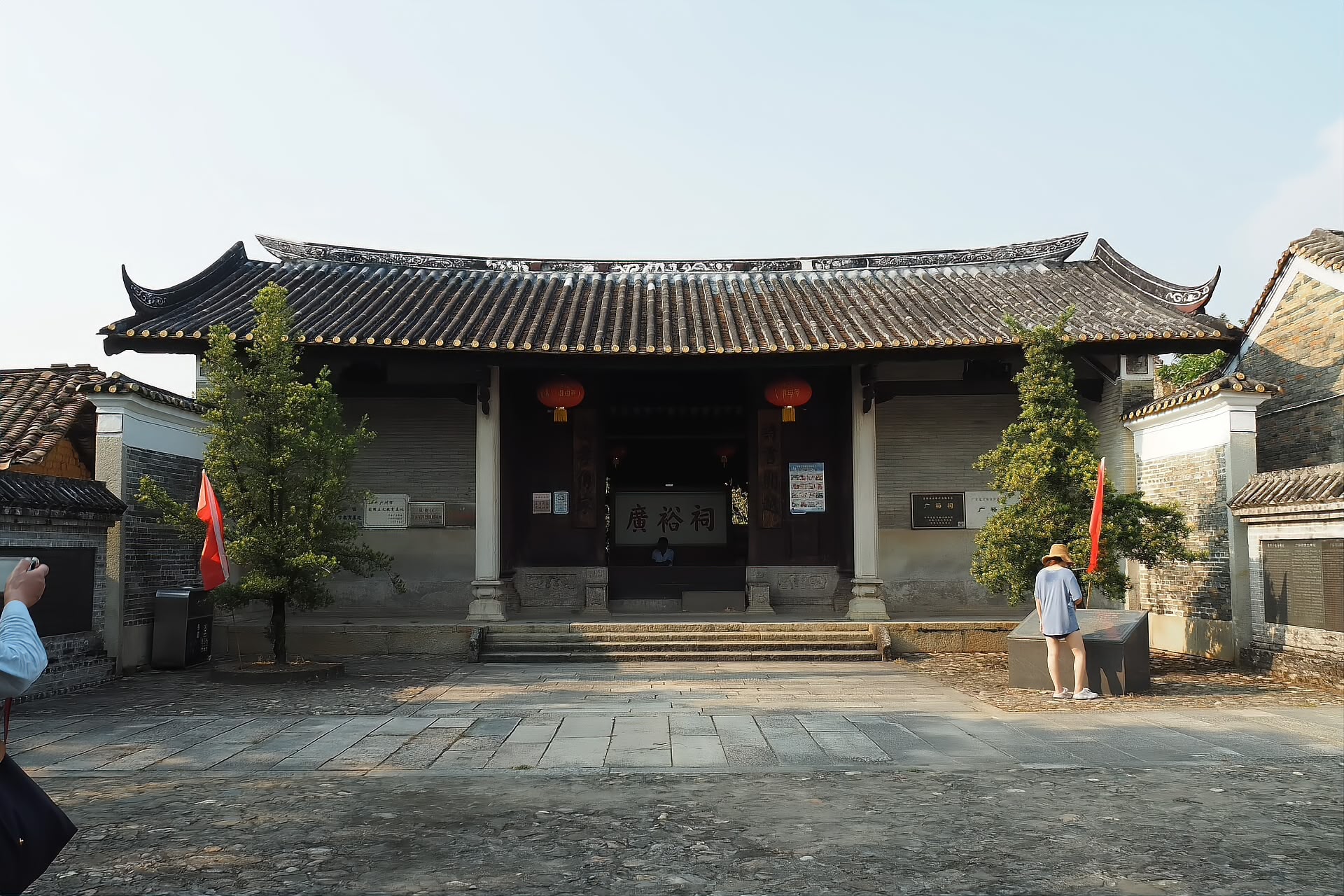
The hall and its argument. Eight characters over the gate — scholarship opens up Nanyue; loyalty and filial duty pass down the line. The first half is a Han diplomat's story; the second is the man who walked into the sea.
The man who walked into the sea
In the spring of 1279 the Song fleet at Yamen was surrounded and finished — the records say almost two thousand warships destroyed in a battle that lasted twenty-two days, and of the more than two hundred thousand soldiers and sailors who went into the water, a few hundred came out alive. Lu Xiufu, the left chancellor who had spent the dynasty's last years dragging one child emperor after another westward ahead of the Mongols, took the eight-year-old boy on his back, put the imperial seal inside his own clothes, and walked into the sea. He was forty-four. The dynasty ended with him. His family's did not.
Four years earlier the Yuan state had begun hunting the Lu clan — hunting a dead chancellor's bloodline being the cheapest way to prove the victory complete. Lu Xiufu's fourth son, holding a commission to guard the Meiling pass, heard how his father had died and went into hiding instead, taking his family south to the Zhuji Xiang settlement on the Guangdong border. By the fifth generation the family had moved again, further south into a valley of stream and paddy in Conghua where nobody knew the name Lu.
The village that was here before the county
Qianggang predates the county it now sits in. Conghua County was carved out of Panyu in 1489 — an administrative act whose name the mountain communities read as a sentence, the distant ones are from now on civilised — and the village was already two centuries old by then. Locals still put it as a proverb: before there was Conghua, there was Qianggang.
The land is a shallow bowl, hills on three sides and a stream curling around the south like a belt, and the village reads from above as a peach. The first families here were seven surnames working seven low hills called the Seven Stars Mound; the Lu family arrived later and became the overwhelming majority — which is why the place is not a normal village layout but a walled one. Four gate towers stand at the four compass points, each with a watch house beside it, linked by brick curtain wall, and the gates were shut on a schedule at night. It is a fortress that happens to be a village, and it makes sense once you know the family building it had spent its first hundred years being hunted. Inside the gates the lanes wander and cross and do not resolve into a grid — however many houses there are, there are just as many ways, as the local saying goes — and watching a visitor lose their bearings twice, the plan has done its job.
Naming the hall after a man nobody remembers
The hall is called Guangyu, after Lu Guangyu, a descendant recorded in the village genealogy as among those who built it. The genealogy is also explicit about why it exists at all, and that reason is not the man it is named for: the hall exists to hold Lu Xiufu, whose portrait and spirit tablet are still venerated at the rear. The clan record and most accounts date the building to the fourth year of the Yongle reign, 1406 — the same year work began on the Forbidden City — raised by the sixth and seventh generations of the branch. One local engineering account states that the original founding date can no longer be established, so treat 1406 as the family's own tradition rather than a settled fact. That the hall stood by the early Ming is not in dispute.
Ancestral halls in this region follow a standard argument: you honour the ancestors, the ancestors bless the descendants, the line continues. What is unusual at Guangyu is how literal the blessing became — a family that lost an empire and then, for six centuries, kept its history written on its own roof beams.
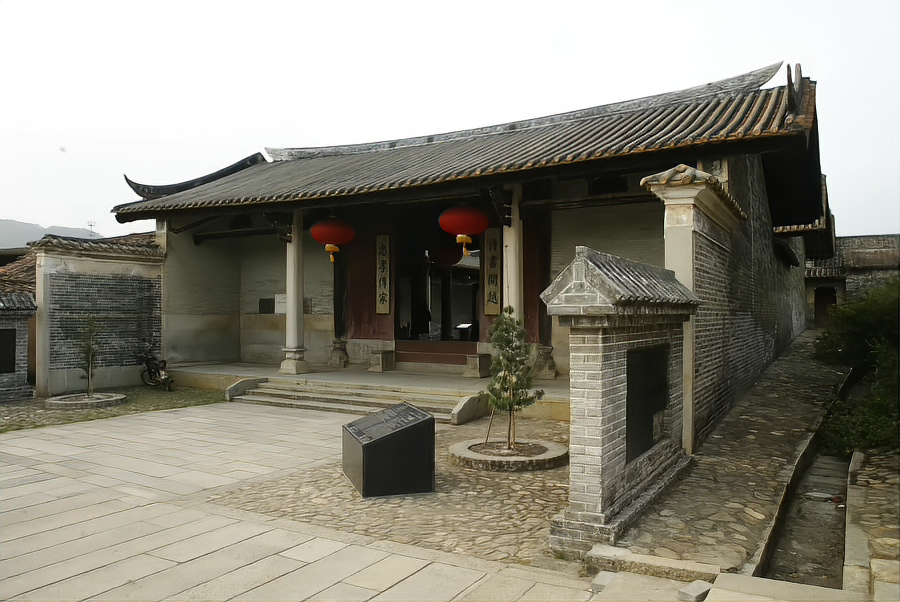
A northern roof on a southern building. The overhanging gable that pushes the ridge out past the wall, the green Xiqiao stone column bases, and the eight-shaped screen wall — the only one of its kind recorded in Guangdong — are the north the family carried with them.
A building that looks wrong on purpose
Walk into the courtyard and something is off. Almost every other ancestral hall in the Pearl River Delta is a symmetrical grid of grey brick, single storey, closed to the street. Guangyu has a roof form you would expect north of the Yangtze — an overhanging gable, the ridge pushed out past the wall so the rain falls clear of it. The column bases are green stone quarried on Xiqiao mountain, with red sandstone bases that are rare in the region alongside them. The screen wall in front of the gate is eight-shaped, a northern form used to stop windblown sand eating a courtyard, and the only one of its kind recorded in Guangdong. Unlike its neighbours, the hall has no pond in front of it — a breach of local convention that gets explained locally as bad luck.
The answer to all of these oddities is the same, and it is the most interesting thing about the building: the Lu family was a refugee family. It came from a northern plain where roofs had to overhang against wind and sand, and it built in the south with what it knew. The building carries a defensive vocabulary, too — eight-shaped screen wall, four gated towers, a closed plan. In the middle of a village of civilians, a refugee clan built a house that looks like it expects to be surrounded.
Six repairs written on the beams
Here is the fact architects and the county's heritage staff both lead with: Guangyu is — on the county heritage authority's statement — the only ancestral hall in China known to carry six dated records of major repair, carved into its own structure. Not in a book; on the timbers. In the thirty-second year of Jiajing, 1553: rebuilt, cut into a purlin of the middle hall. In the Chongzhen year jimao, 1639: repaired, on a stele in the east corridor. In the sixth year of Kangxi, 1667: the grandchildren donated silver and rebuilt, under the third hall's ridge purlin. In the twelfth year of Jiaqing, 1807: rebuilt, under the first hall's ridge purlin. In the fourth year of the Republic, 1915: the pillars renewed and the rear hall changed, on a rear crossbeam. And the sixth record is still living — the repair begun in 2001 and worked from January 2002. Each date belongs to a different hall, so the building is a stratigraphy: walk it front to back and you are walking 1807, 1553 and 1667.
The modern repair set itself a rule that explains the UNESCO prize: repair as old, replace only what could no longer stand, and do not fake the replacement to match the original, so a later reader can tell what was renewed and when. Three hundred of the village's four hundred households gave money, the governments put in over a million yuan, tens of thousands of old roof tiles were taken off, washed one at a time like washing vegetables, and laid back in mortar made the old way, from chopped straw beaten with lime.
The board carved with a whole city
In a village this size the most famous object is not sacred. It is a strip of carved wood eight and a half metres long, three and a half centimetres thick and twenty-eight centimetres wide, hanging under the eaves of the west watch house — called the River City Picture, and described as the Guangzhou version of Along the River During the Qingming Festival. Cut into that band is the whole northern bank of the Pearl River in the middle Qing, in two registers: the city above — layered hills, a foreigner in tall boots walking the riverside, chess players, an old fisherman, and along the skyline buildings still standing today, the Flower Pagoda and the Pazhou Pagoda among them — and the river below, with twenty-nine boats of different types going both directions. Forty-nine human figures, more than forty buildings, over a hundred and forty banyan trees, across less than nine metres. It is thought to be the only such carved panel anywhere recording the riverside life of Guangzhou.
During the Cultural Revolution, most decoration in the old houses was chiselled off. Qianggang did not lose this board: the villagers smeared it over with yellow clay and wrote revolutionary slogans on the surface, and it hung there under a layer of mud, passing as an object of the correct political kind. A village survey found it in May 2000; the original went to the Guangzhou Museum the same day, with a copy of its exact dimensions installed in its place. Nobody knows who carved it, or why a family of refugees in the northern mountains owned a panorama of a city sixty kilometres away. The village answer — the ancestors wanted their descendants to remember where they came from — is a good one, and there is no evidence for it.
What the world made of it
On 29 November 2003 a UNESCO regional adviser came to Qianggang and presented first prize in the Asia-Pacific Awards for Cultural Heritage Conservation — the only first prize that year, chosen from twenty-two entries by nine countries. The certificate is more specific than the medal, and its subject is the restoration, not the building: it credits the cooperation of villagers, agencies and advisers under severe financial constraint, a deliberate adherence to the Venice Charter and the Nara Document, and — in the clause that is the whole argument for the hall — the careful preservation of visible historical change. The nineteenth century's instinct was to restore a monument to a single ideal moment; what was done here was the opposite. Six centuries of repair were treated as the subject, not as damage to be corrected. The hall was listed in the sixth batch of national key cultural relics in 2006, and after a tornado damaged the gate hall's roof ridge in 2015, the repairs were again made as close to the original as the rules allow, with the work left visible.
Around it, the village does what such villages do: four hundred traditional dwellings, four ancestral halls, four gate towers, four watch houses and nine academies on roughly fifty thousand square metres, admitted to the national list of traditional villages in 2014. Its glutinous litchi holds a national geographical indication, its old post road runs twelve kilometres and still carries cyclists, and the descendant line has reached its thirty-eighth generation from the man who walked into the water.
Going, and what to expect
Getting there. The hall stands in Qianggang village, Taiping town, Conghua district — north of Guangzhou, and roughly forty minutes from the city centre by road. Metro Line 14 to Taiping station, then the Cong 804 bus toward Wenge and a walk, or a taxi of about ten minutes from the station; driving, it is signposted off the G105, and the village has parking by the gates. Do not confuse Conghua with Zengcheng, its neighbour to the east — the hall is in Conghua.
Tickets and hours. The village is free to enter and open all day; the hall itself is free as well and opens in the region of 8:00 to 17:00, with one town-government guide giving 9:00 as the opening — treat the earlier figure as the safe one and expect the hall, not the village, to close for lunch-hour quiet spells. There is no booking, no ticket window, and no crowd.
How long, and when. Half a day, honestly — the hall is twenty minutes, but the village is the point: the four gate towers, the lanes that refuse to be a grid, the old post road, and litchi trees flowering on the old stone in spring. Combine it with the Turtle Mouth old ferry crossing on the Liuxi River and the ancient litchi trees nearby for a full rural Guangzhou day that most visitors never see.
Honest notes. The 1406 founding is the clan record and most accounts; a local engineering account says the founding date can no longer be established, so it is given here as tradition. The only-in-China claim about the six dated repairs comes from the county heritage authority and is given on their authority — one summary account says five records rather than six. The UNESCO award was presented on 29 November 2003 to the restoration, not the building; one account dates it to 2015, which appears to be an error. No source identifies the carver of the River City Picture or explains why it was made, so no attribution is offered. Hours are the 2026 published figures for a village site and could shift on the day.
Walk the hall front to back and read the dates as you go — 1807 in the first hall, 1553 in the second, 1667 in the third — then stand in front of the River City Picture copy under the west watch house and find the Flower Pagoda in the skyline. Then look at the man at the back, where the tablets go. Everything else in the village is a footnote to the decision his family made on the beach at Yamen.
Photographs and sources
Photographs from Wikimedia Commons, used under their Creative Commons licences and enhanced for this page: the hall front and the side elevation with the screen wall (CC BY-SA 4.0, 古海岸遗址). These are the only two freely licensed photographs of the hall on Commons; the beams, the six carved dates and the River City Picture copy are not photographed under a free licence, and this page does not substitute pictures of other buildings for them. History drawn from the Guangyu Ancestral Hall editorial source file, cross-checked against the Taiping town government's published village guide (the free entry, the hall's hours, the Line 14 and bus approach, and the couplet), the sixth-batch national key cultural relic listing (2006), and coverage of the 2003 UNESCO Asia-Pacific award. Where the records disagree — the founding date, five repairs against six, the award's date — both versions are given rather than resolved.
There's more where this came from.
Read the latest insider notes →Two new posts a week — the things a non-resident can't know, written down before they cost you a morning.