Lianhuashan Park (莲花山公园)
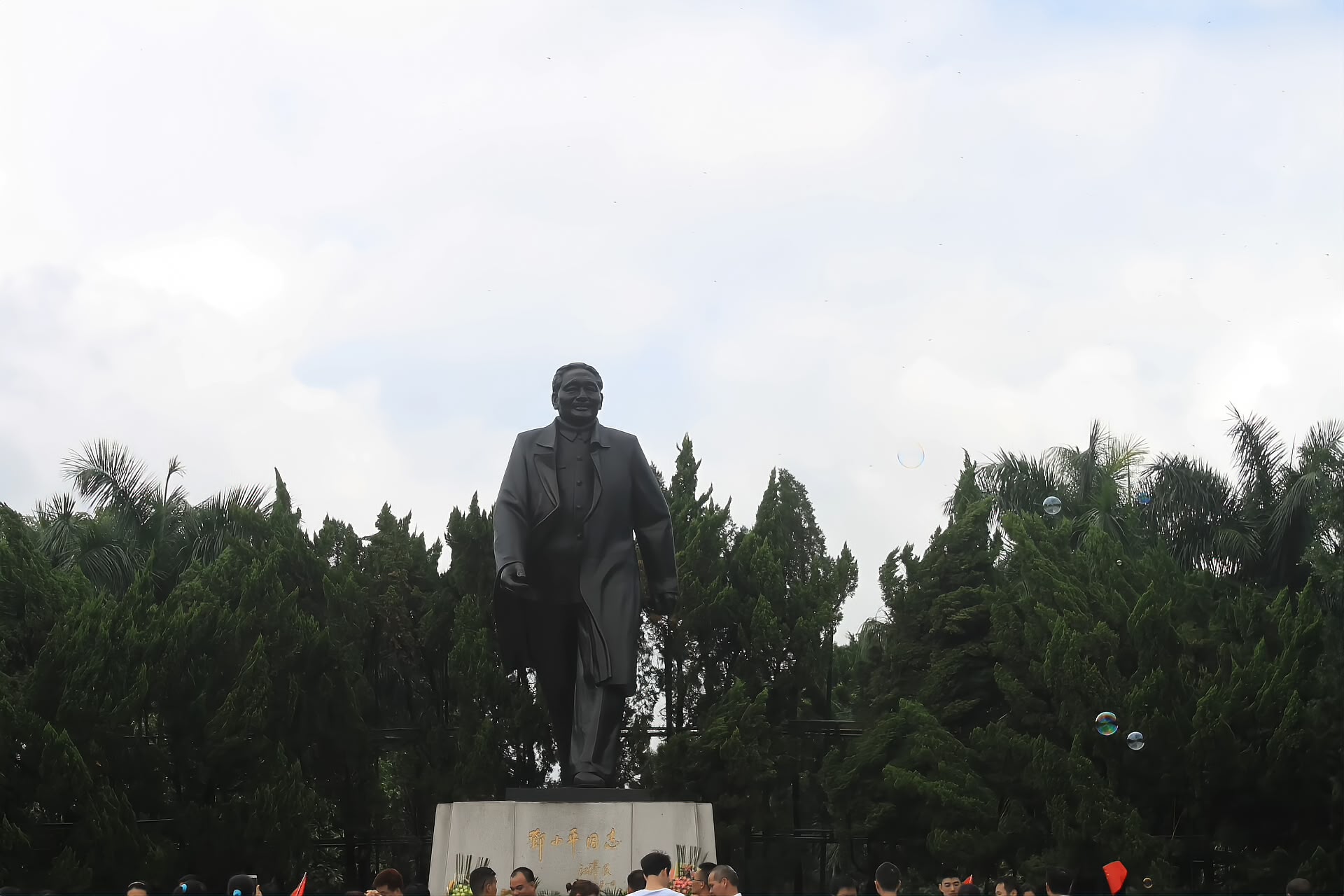
Take the path up from the south gate and in about twenty minutes you reach a paved square the size of a football pitch, four thousand square metres of stone on a summit a hundred metres above the street. Due south, in a dead straight line, runs the axis of the city's centre. At the north end of it stands a bronze figure caught mid-stride, facing the view.
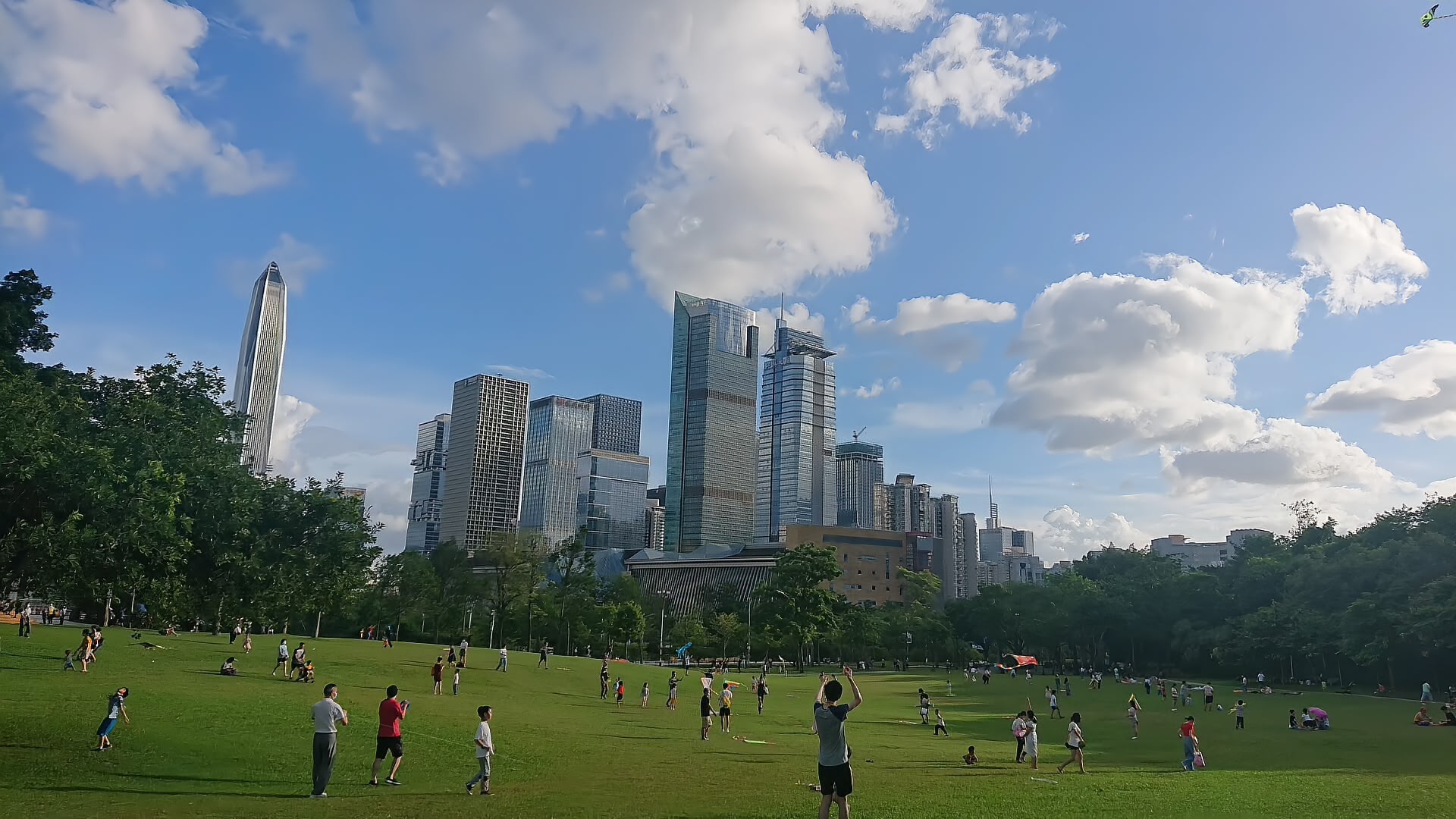
A hundred metres of green at the end of the axis. The city was drawn so that its centre of gravity would be a piece of parkland rather than a tower, and this is the result.
Lingnan has several Lotus Flower Hills, and this is the small one in Shenzhen. A hundred-odd kilometres north-west, Panyu in Guangzhou has a red sandstone quarry hill of the same name (莲花山), taken there from a rock weathered into the shape of a flower. Here the name comes from seven rounded summits said to open like one. If your taxi or your map app has offered you the other one, this is the one next to the Shenzhen civic centre: 莲花山公园, not 莲花山旅游区.
莲花山公园 Liánhuāshān Gōngyuán — the park
山顶广场 Shāndǐng Guǎngchǎng — the summit square
风筝广场 Fēngzheng Guǎngchǎng — the kite lawn, at the south-east corner
邓小平铜像 Dèng Xiǎopíng Tóngxiàng — the bronze Deng Xiaoping
黄默堂墓 Huáng Mòtáng Mù — the Song tomb
For the metro, ask for 少年宫站 (Children's Palace, Lines 3 and 4) for the south gate, 莲花村站 (Line 10) for the kite lawn, or 莲花西站 (Line 2) for the west gate.
Seven hills and a name
The hill sits at the north end of Futian district, between the roads that bound the city centre. Its shape is its name: seven rounded summits close together, which read to the planners who first drew the area as the petals of a lotus opening. Before the park there was nothing organised here at all. The slopes belonged to the villages of Gangxia, Shangmeilin and Xiameilin, and in the early years of the special zone the foot of the hill filled with the temporary housing of construction crews and job seekers pouring into the city — whole streets of board shacks with no drainage and no tenure.
The 1990s master plan for the new central district drew a green axis from the hills down to the bay, and the hill became the anchor at the top of it. That decision, more than any single building, is why the summit is a public square: the city was designed so that its centre of gravity would be a piece of parkland rather than a tower.
The oldest thing on the hill
The oldest human work here is also the least conspicuous. On a slope in the north-west, under trees, sits a large stone tomb built against the contour: a chair-shaped structure stepping down in three terraced levels, a round altar of dressed granite at the foot, a stone incense table carved in the shape of a lotus pedestal, and a hexagonal stone stupa about a metre high set into the tomb chamber. The inscription reads Mootang Huang Jushi Ta — the stupa of the layman Huang Mootang.
The archaeologist Peng Fulling found it during the city's second national relics survey, driving a cargo truck up dirt tracks on the strength of a rumour that the first ancestor of the Huang clan of Xiasha village was buried on this hill. The date in the inscription led him to the Southern Song, the Chunyou reign, around 1248 — and with it the history of Futian jumped back several centuries. A complete tomb of the Song is a rarity in Lingnan. The city listed it in 1998 and the province followed in 2002, in the fourth batch.
The tomb faces north, which runs against the local habit of south-facing seats, and whoever Mootang was, the family that raised this had money, standing, and a mason who had seen better work than a village grave. The clan is still here: the Huang of Xiasha hold it as their founding grave and keep the spring and autumn rites. The same family is famous regionally for its basin feasts, the layers of pork, duck, prawn and dried tofu served in wooden basins to anyone who turns up. The oldest object in Futian and the loudest food custom in the city belong to the same lineage — and most of the millions who climb this hill each year walk past the tomb without knowing it is there.
Building a park
The park was set up in October 1992, as the district around it was being drawn. The first years were demolition and planting: the board-shack settlements at the foot of the hill were cleared in stages, the slopes were graded and wooded, and an artificial lake was dug on the north side. On 23 June 1997 it opened to the public, in part, days before the handover of Hong Kong twenty kilometres south. The resettlement areas inside the boundary took until around 2002 to clear and plant, and only then did the park have its finished shape.
The thing that is not in dispute is the use. The lawns filled with kites, and kite flying here became one of those municipal habits that ends up in descriptions of the city itself: a hill of office workers, grandmothers and children, with nylon eagles over the central business district. The park went on to collect designations as it matured — a national key park, a national red tourism demonstration base, the category for sites of the revolutionary and reform narrative, and a provincial patriotic education base. The categories sound bureaucratic until you notice that they describe the same hill from three directions: as landscape, as political memory, and as a place where school classes are taken to be told what happened in 1979.
The statue
The idea began in 1994, in the last years of Deng's life. Its path to the summit was long: the accounts speak of eight changes of site before the summit was chosen, and the project was set aside after his death in February 1997. It came back in 2000 — the twentieth anniversary of the special economic zone — with approval from the central authorities, which is why this is described as the only statue of Deng in a Chinese city square to carry that approval.
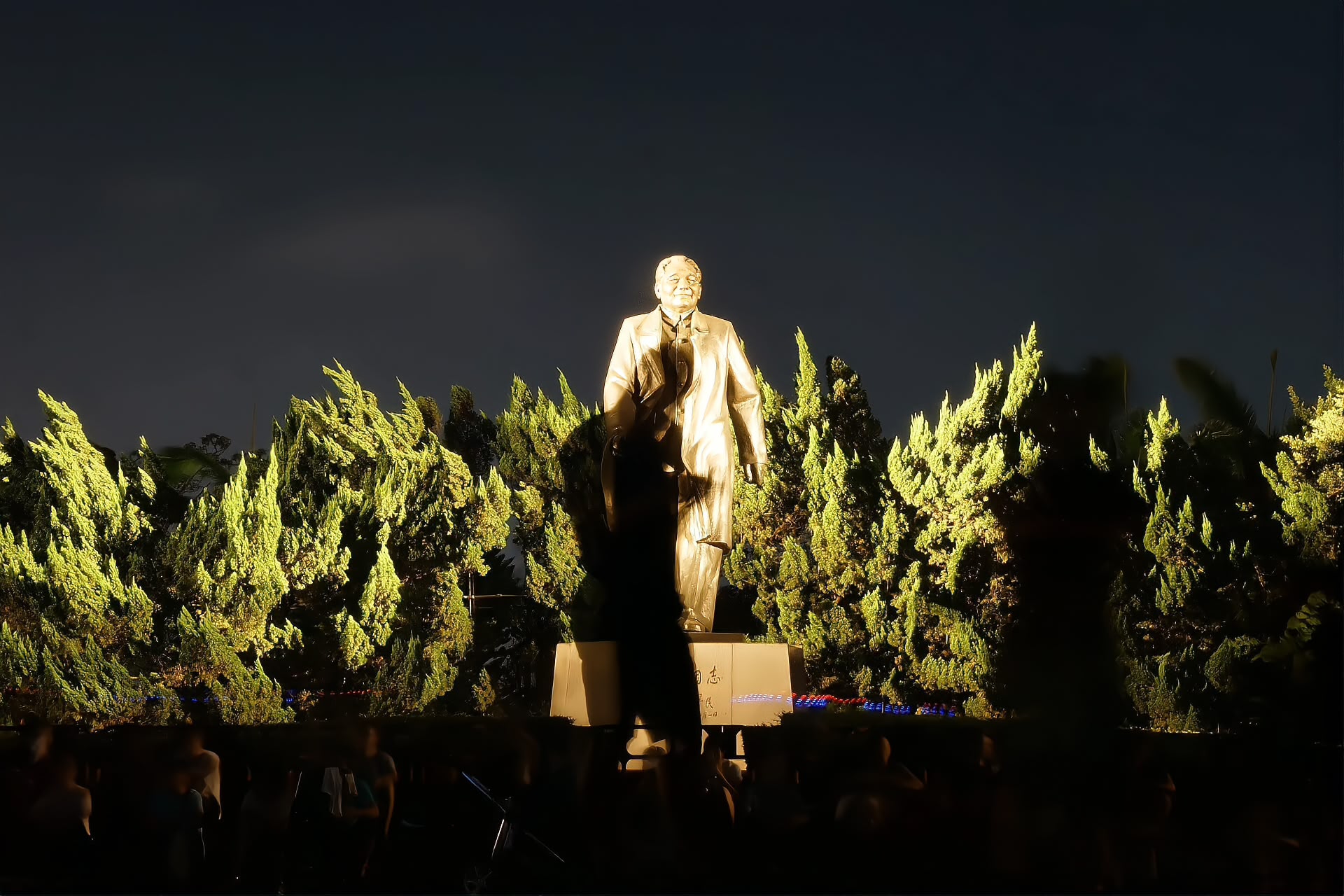
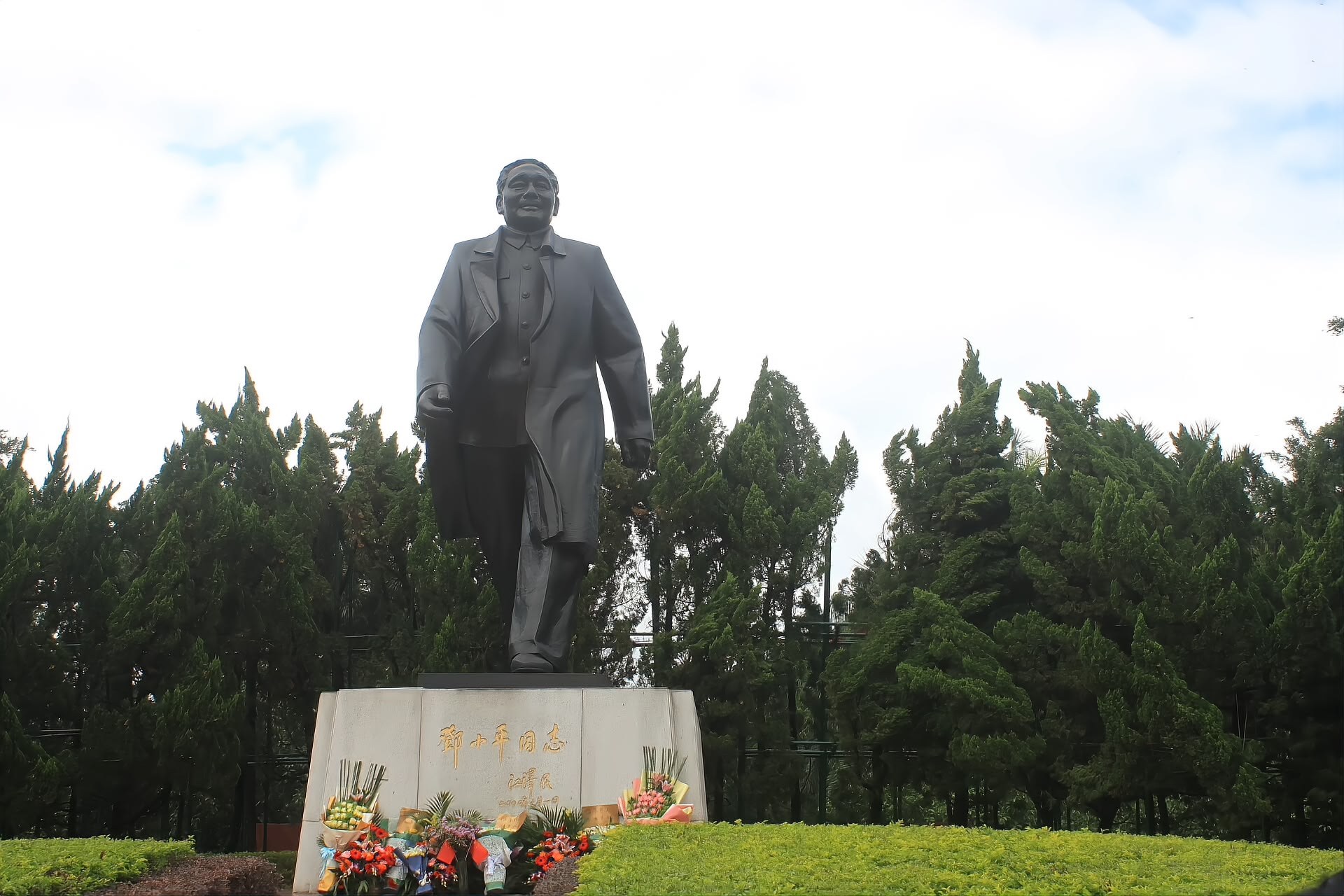
It was unveiled on 14 November 2000. The figure is bronze, six metres tall on a base of three point six eight metres, cast at the Shanghai shipyard from a model by a team of four sculptors led by Bai Lansheng; its weight is given as six tons in most accounts and seven in one. Behind it stands a screen of upright cypress, and on the north side of the square a granite wall, thirteen metres long, carries two sentences in Deng's own hand: the 1984 verdict that the policy of setting up special economic zones is correct, and the personal line, that he was the son of the Chinese people and loved his country and his people deeply.
Both sentences have their own history. The 1984 verdict was written after Deng's first tour of the zone, at a moment when the experiment had loud critics in Beijing and the visit was meant to settle the argument. The second is from later years and is the line the city reaches for whenever it wants to say what the zone meant. In 2004 the view from the summit — named Lotus Hill in Early Spring — was voted one of the eight views of Shenzhen, and the province listed the statue itself as a protected site, which makes the bronze figure and the Song tomb on the same hillside formally equal.
The tree
Eight years after the unveiling, on 8 December 2012, Xi Jinping came to the summit on his first inspection tour after taking office, laid a basket of flowers at the statue and planted a banyan in the grass beside the square — a ficus of the species that grows to enormous size in this climate. A granite marker by the tree records whose hand put it in the ground, and the choice of tree is part of the message: in this city's vocabulary the banyan stands for putting down roots and growing. In October 2020, in the fortieth-anniversary week of the zone, he came back to the same square and the same basket. The tree in the photographs of the two visits is the same tree, visibly larger.
The garden below
Down the hill from the statue, in the south-east corner, the city built itself a memory in 2010 for the thirtieth anniversary of the zone: a memorial garden whose main feature is three curved relief walls linked by an arc, half enclosing a plaza. The reliefs run in sequence — the founding years, the boom, and what came after — with the people who did the work carved into the stone alongside the bridges and towers. Designers described the arc as the character for a circle, the mark of the special zone itself, which was drawn on maps as a closed line with everything inside it allowed to change.
The rest of the park is vegetation and ritual. The south and east slopes were planted with tens of thousands of flame trees, and in early summer the hillside goes red. The bougainvillea is the city flower and the reason for the annual show every November, when lawns and borders are planted out in the tens of thousands. The lake has its herons, the kite lawn has its weekends, and the hill's two protected occupants — a Song tomb and a bronze reformer — share the slope without ever appearing in the same frame.
Going, and what to expect
Getting there. Three gates, and they are not interchangeable. For a fast climb take the south gate: Metro Lines 3 and 4 to Children's Palace station (少年宫站), Exit F1, then about three minutes on foot. For the kite lawn and a family picnic take the south-east gate: Line 10 to Lianhuacun station (莲花村站), Exit D or E. For quiet take the west gate: Line 2 to Lianhuaxi station (莲花西站), Exit A, about eight minutes' walk.
Tickets and hours. Free, and no booking required — walk in. The park opens 06:00 and closes 23:00, with last entry at 22:30; the statue area keeps shorter hours, roughly 06:30 to 22:30. Look for the signed climbing path near the kite lawn at the south gate if you want the shortest way up; it is a steady fifteen to twenty minutes on a gentle grade, and the many benches are why it works for older walkers and small children.
How long, and when. Ninety minutes to two hours including the climb; three to four if you add dinner and dusk. The best window is late afternoon — arrive around 17:00 for the sunset on the glass towers and stay for the lit skyline. Early morning before 08:00 is the quietest time on the summit and the clearest for photographs.
Practical notes. A sightseeing bus runs the route up to the summit square for a single fare, useful if you would rather not climb. There is a lift to the summit for visitors with limited mobility, but it does not run outside staffed hours, so plan around it rather than counting on it. The summit is exposed: bring sun protection by day and a light layer after dark. Park regulations ban open flames.
Honest notes. The numbers for this park move between sources. Its area is given as 181 hectares in one official account and 166 in an earlier municipal one, and as close to two square kilometres in the tourism bureau's guide, which also notes that only sixty hectares were developed and open in the early years — the accounts measure different boundaries at different dates. The main peak is a hundred metres in some accounts and a hundred and six in others. The kite lawn is two hectares in one account and sixteen in another, a difference of edges rather than of facts. The June 1997 opening is described either as a full opening or a partial one. And the statue's weight is six tons in most accounts, seven in one.
Come up through the south gate in the late afternoon, cross the kite lawn, and take the signed path to the summit for the light on the towers. Before you join the queue at the bronze, walk twenty metres around to the north-west slope and look under the trees for the Song tomb. Then come back, watch the Tai chi, the wedding parties and the kite people, and read the two sentences cut into the granite wall. Everything else is the same lesson told in a louder voice.
Photographs and sources
Photographs from Wikimedia Commons, used under their Creative Commons licences and enhanced for this page: the park against the skyline, the bronze at night and in daylight, the lawns, and a second view of the statue against the cypress screen (CC BY-SA 4.0; CC BY-SA 2.0). History drawn from the Lianhuashan Park editorial source file, cross-checked against Shenzhen park listings for 2026 covering the hours, the last-entry time, the three gates and their metro stations, the summit lift and the sightseeing bus. Where the records disagree — the area of the park, the height of the peak, the size of the kite lawn, whether the 1997 opening was full or partial, the weight of the bronze — both versions are given rather than resolved. This page is about the Lianhuashan in Futian, Shenzhen; the quarry hill of the same name in Panyu, Guangzhou, is a different place with its own page.
There's more where this came from.
Read the latest insider notes →Two new posts a week — the things a non-resident can't know, written down before they cost you a morning.
Near it: Nantou Old Town · Gankeng Old Town. The other hill of this name: Lianhuashan in Panyu