Guangji Bridge (广济桥)
Most bridges are arguments with the river. This one concedes. Every evening the middle comes apart, eighteen boats are drawn aside, and the Han is left to run free — the reason it's still standing after eight hundred years.
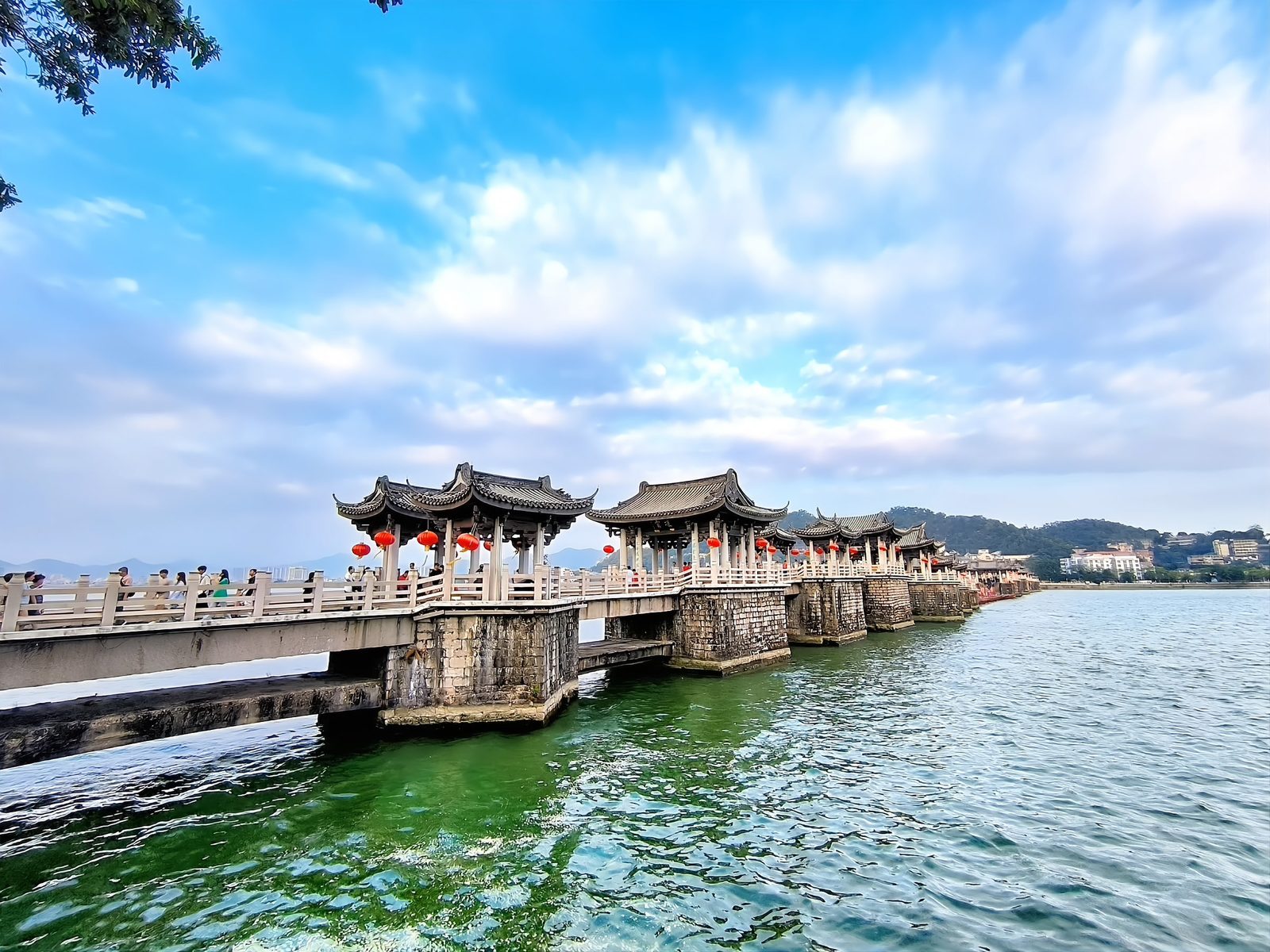
The whole span, from the east bank. Stone piers and pavilions at either end, the eighteen-boat crossing in the middle, and the Han River running underneath all of it.
Five hundred and eighteen metres of it, crossing the Han River at Chaozhou. Twenty-four stone piers at the ends, eighteen boats chained between them in the middle. By day you walk across the boats. By night, or when the flood comes, the crews unchain them, pull them aside under the stone heads, and the channel opens for ships and for the water itself.
The bridge scholar Mao Yisheng called it the earliest opening-and-closing bridge in the world, and with the Zhaozhou, Luoyang and Lugou bridges it is counted among the four great ancient bridges of China. Neither of those is the thing that stays with you, though. The thing that stays with you is watching it give way.

One frame, the whole bridge. The west beam bridge runs 137 metres, the east 283, and the eighteen boats fill the ninety-seven between.
A river that divided a city
The Han is born in the Wuyi Mountains of the north and runs south, and where it reaches Chaozhou it widens into a broad, quick channel that has always been the hard line through the town. On one side the old city. On the other, the open country and the road to Fujian. For most of the first thousand years of Chaozhou's life, crossing meant a boat, and the boatmen knew the current was a killer — one old record says plainly that even men who had spent their lives at the oar were afraid of it.
So the bridge began as a wish.
1171: one islet and eighty-six boats
In the seventh year of the Qiandao reign of the Southern Song, the prefect of Chaozhou, Zeng Wang, drove a single stone islet into the middle of the river and lashed eighty-six boats to it with iron chain. Planks on boats. It was the first time the two banks had been joined, and it started a building that would not finish for more than three centuries.
Three hundred and fifty-nine years
Zeng Wang opened the door and then left the room. For the next three centuries the bridge was a relay — each prefect adding a stone or a span, and the river taking some of it back. Within three years a flood wrecked the first floating bridge and the next prefect rebuilt it, putting up the first pavilion on the west bank: the first sign that this was meant to be more than a crossing.
Through the twelfth and thirteenth centuries the work crept outward from both shores. The west side reached ten piers, the east thirteen, and the middle stayed open water joined by boats, because the deepest part of the channel was too swift and too deep to put a pier in at all. A man named Ding Yunyuan built more piers on the west than anyone and earned the bridge a second name there — the Ding Bridge.
The shape we know came together across the Ming. In the tenth year of the Xuande reign, 1435, the prefect Wang Yuan led the great repair: piers strengthened, a hundred and twenty-six pavilions and rooms raised along the span, and the name the bridge still carries — Guangji, to ferry the people of the hundred Yue.
Then, near the opening of the Jiajing reign, the floating section settled into its final form: eighteen boats against twenty-four piers, sung in the old line as eighteen shuttle boats and twenty-four islets. One honest note: most provincial records date that step to 1530 under the prefect Qiu Qiren, but a local government account gives 1513 and the prefect Tan Lun instead. The two disagree by seventeen years on who closed the form, and both are kept here because the bridge's own records are not single.
Three kinds of bridge in one body
What makes Guangji strange is that it isn't one kind of bridge. At the ends it's a beam bridge, stone piers carrying stone beams. In the middle it's a floating bridge, eighteen boats lying side by side and chained to the stone heads at each end. And the piers themselves carry arches and pavilions, so the whole thing reads as beam, float and arch at once.
The numbers give the scale. The west beam section runs 137 metres, the east 283, the floating middle ninety-seven. The stone beams the piers carry are thirteen to fifteen metres long and weigh fifty to sixty tons each — set by people with nothing heavier than rope and leverage, in water that moves fast. To stand up to that current the piers were built like ships: six- and five-sided, with a sharp dividing nose pointing upstream to split the flow. They have held for hundreds of years against a river that has taken almost everything else.
The opening and closing is the point of the design. By day the eighteen boats are locked into a walkway and people cross from bank to bank. At night the crews unchain them and the main channel of the Han is left open — for the ships, and for the water itself. It is a bridge that knows when to get out of the river's way.
The immortals who built it
The people of Chaozhou, who had watched the real bridge rise one pier at a time, also told a faster story: that the river was too much for men, and that the finishing was done by immortals.
The tale starts with Han Yu, the poet official banished to Chaozhou in the Tang, who gave the river its name and the hills theirs — so the water is the Han and the hill is the Han hill still. Han Yu's nephew Han Xiangzi, one of the Eight Immortals, and a monk called Guangji took up the work. Han Xiangzi built the east from stones he turned into a herd of black pigs driven down from Phoenix Mountain, until a pregnant woman spoke the word that broke the spell and the last pigs would not move. Guangji built the west with stones he turned into sheep, until a local bully claimed the flock and the stones froze into a hill. With the two ends unfinished and dawn coming, He Xiangu dropped a lotus petal that became the eighteen boats, and Guangji threw his staff that became the vine binding them.
So the bridge carries two names: Xiangzi Bridge for the immortal, Guangji Bridge for the monk. The story is told against a true fact — the bridge did take hundreds of years and uncountable lives, and the legend is the people's way of holding that cost. The lotus and the vine are the boats and the iron chain, made into myth because the real engineering was already a kind of magic.
Linked by morning, apart by evening
The opening and closing is not a ceremony put on for visitors. It is the bridge's working day, and it has kept this rhythm since the floating section came back in 2007. Each morning, ahead of the gates opening, the crews bring the eighteen shuttle boats in and chain them bow to stern, laying the plank road across the gap. Each evening they undo it: the boats are drawn back under the stone heads, the cables come in, and the middle of the Han is left open for the night's traffic. Locals have a blunt name for the evening job — taking the bridge apart to cross the river.
The times are set by the river, not by the tourists. From February to the end of October the boats come apart at half past five in the afternoon. In the winter months — November to the end of January, when the shipping lanes need the channel earlier — the whole bridge closes at half past four instead. Walk the span while the light is good, then stand on the east bank and watch the gap open. It takes the crew only a few minutes, and it is the best ten minutes of the day.
Morning. Around half past nine the crews chain the eighteen boats into the walkway — the local papers call it "joining the lines to build the bridge". The gates follow at 10:00 on weekdays, 9:00 on weekends and holidays.
Day. The span is open for walking, last entry an hour before closing: 17:00 from February to October, 16:00 in the winter season.
Evening. The boats are pulled apart at 17:30 from February to October, 16:30 from November to the end of January. The admission is a small one, and the light show on the river afterwards is free.
All of it moves with the season and with maintenance work, so check the day's arrangement on the local ticketing mini-program before you set out.
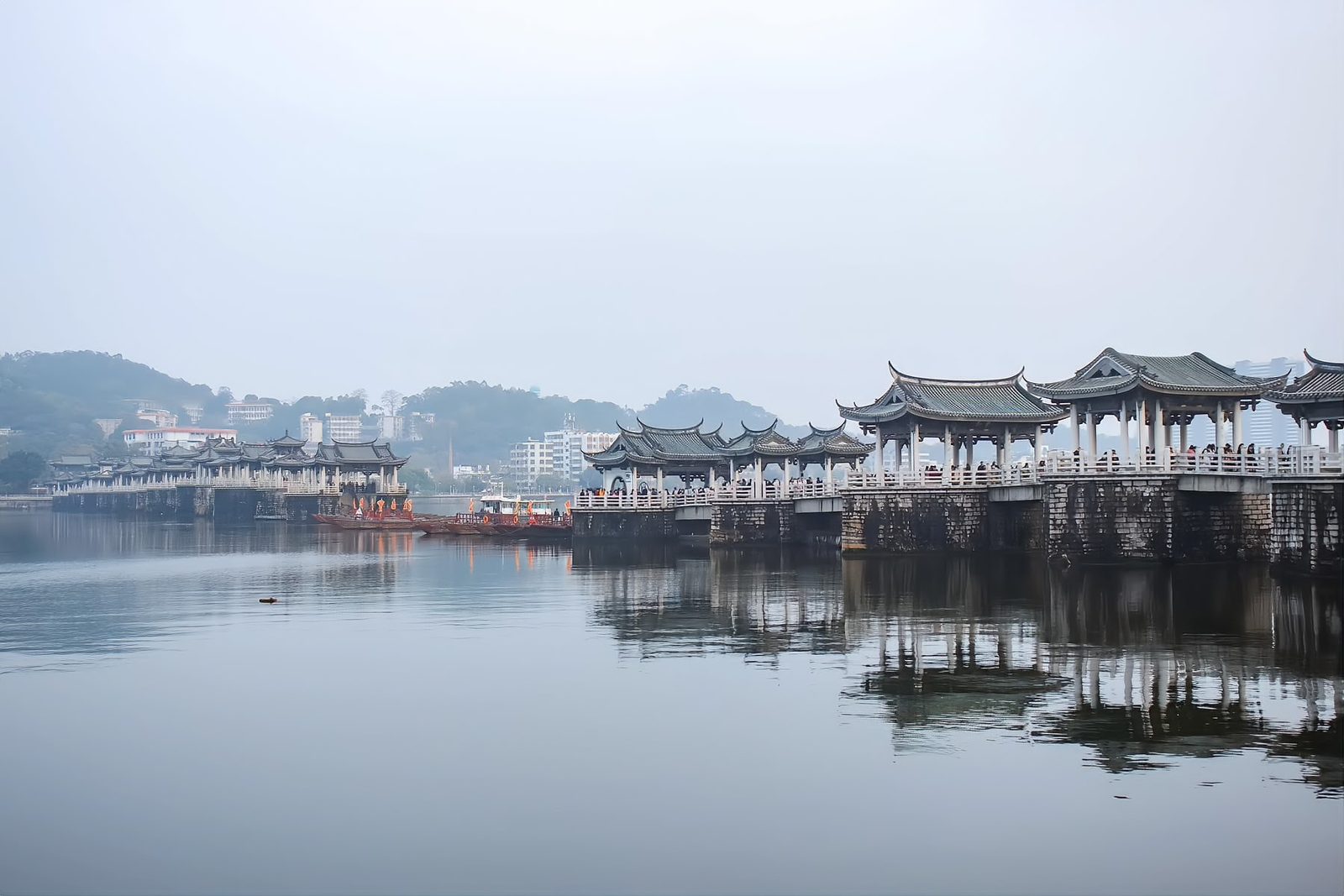
Morning, before the joining. Mist on the Han, the pavilions doubled in the water, and the shuttle boats gathered at the stone heads waiting to be chained in.
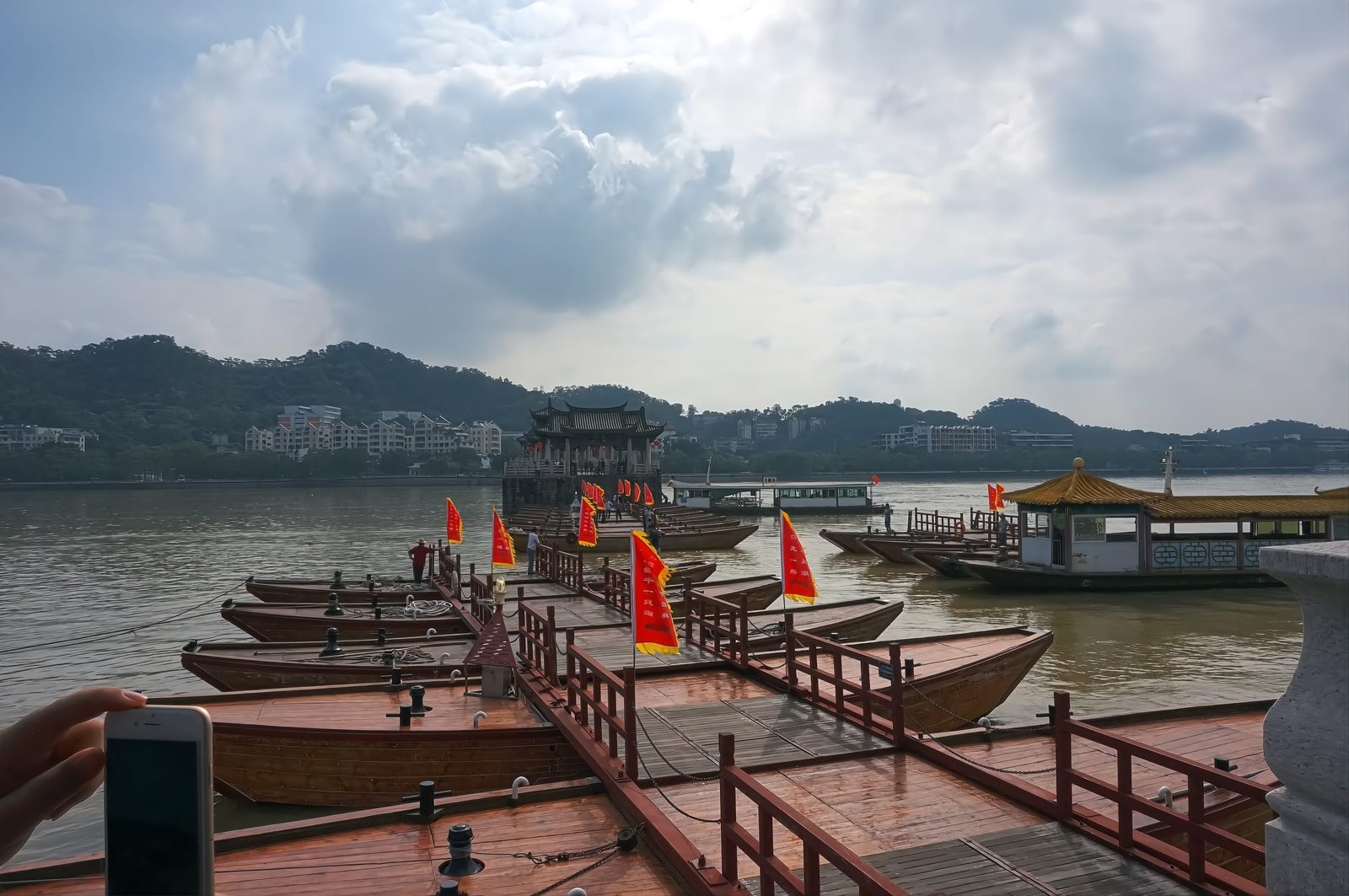
Afternoon, chained in. The eighteen boats locked into a walkway — the moment the old song calls the shuttle boats holding the painted bridge.
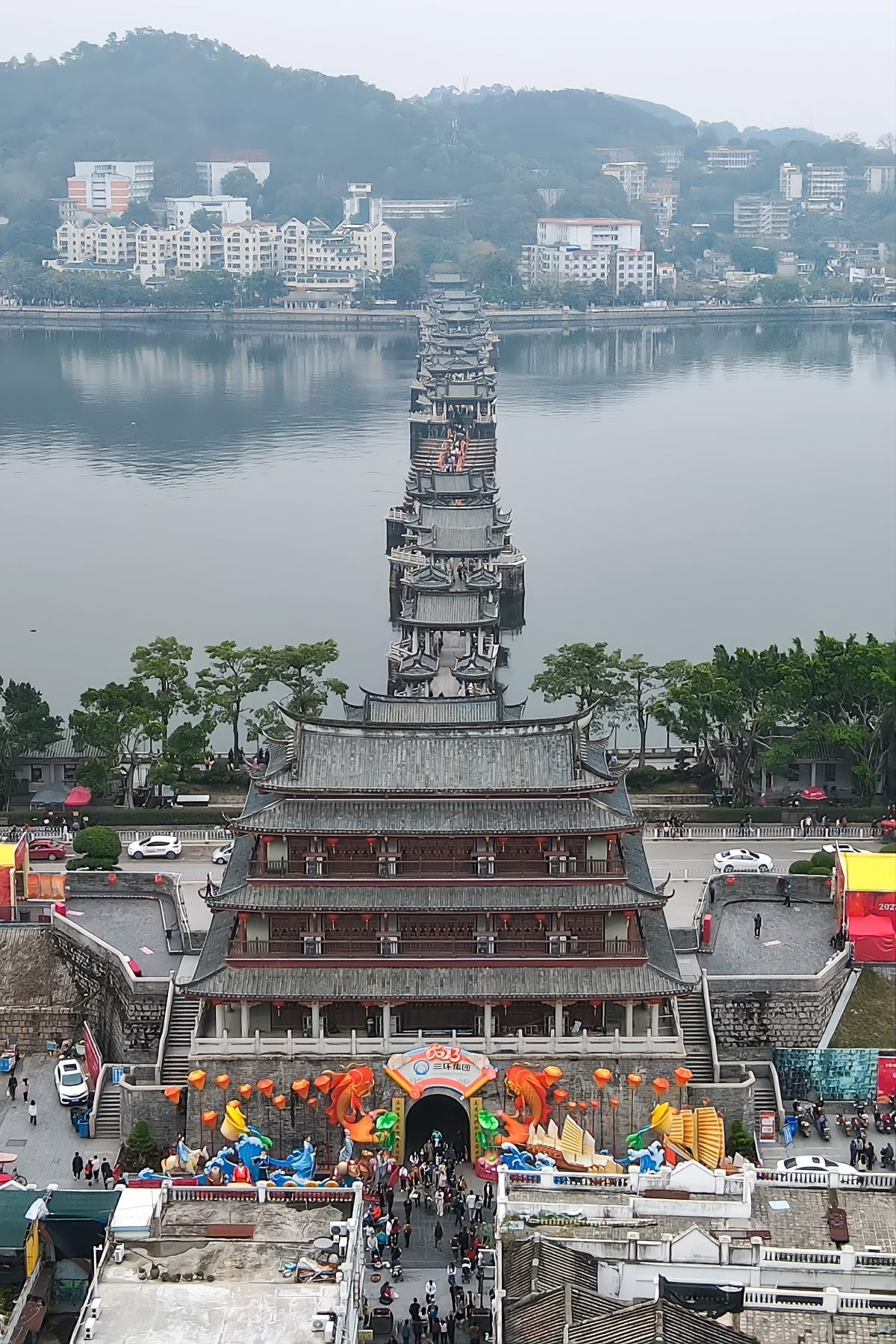
Guangji Gate. The east end of the bridge meets the old town wall — where the walk starts, and where the lanterns come on in the evening.
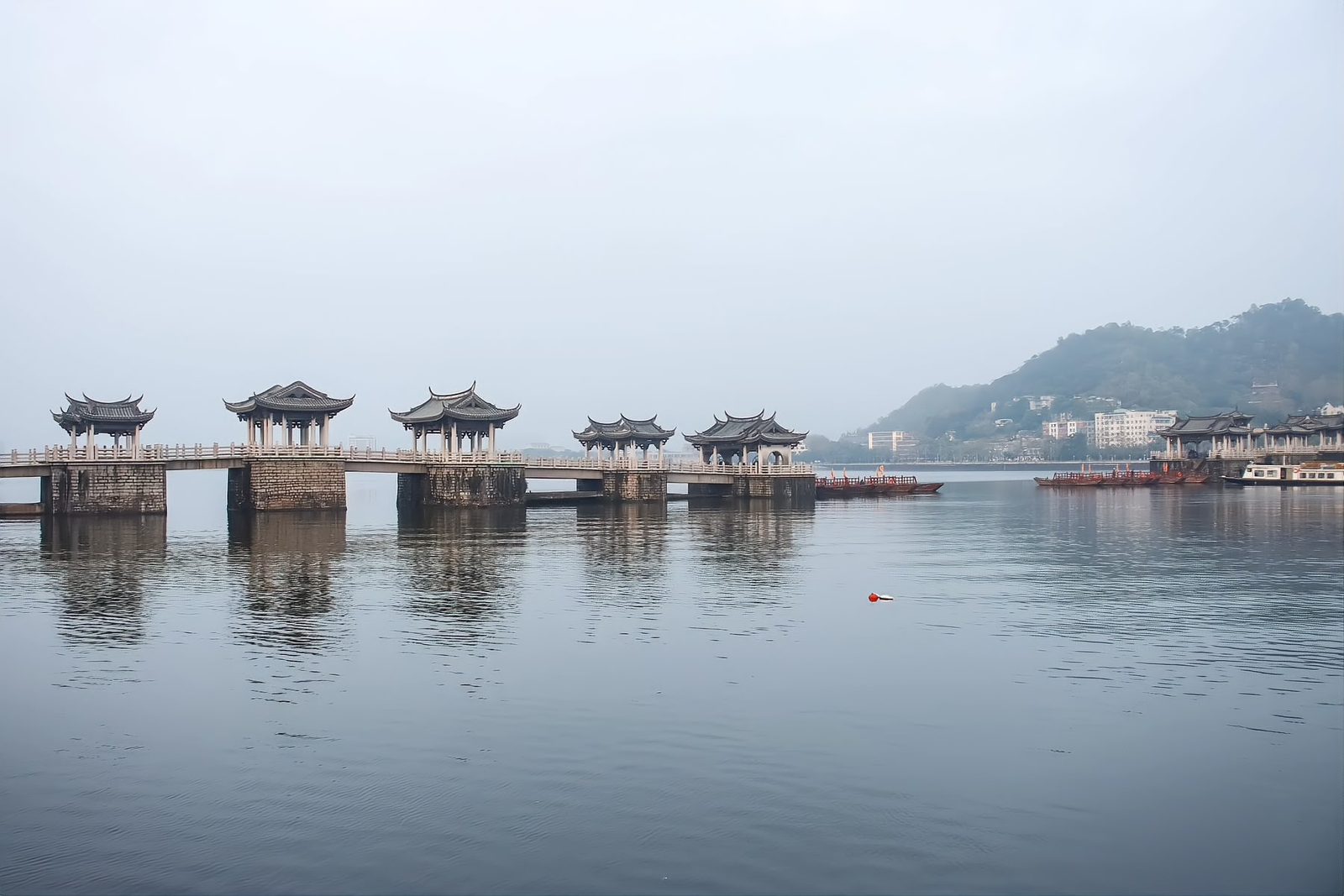
Twenty-four piers. Built like ships, six- and five-sided, with a nose pointing upstream to split the current.
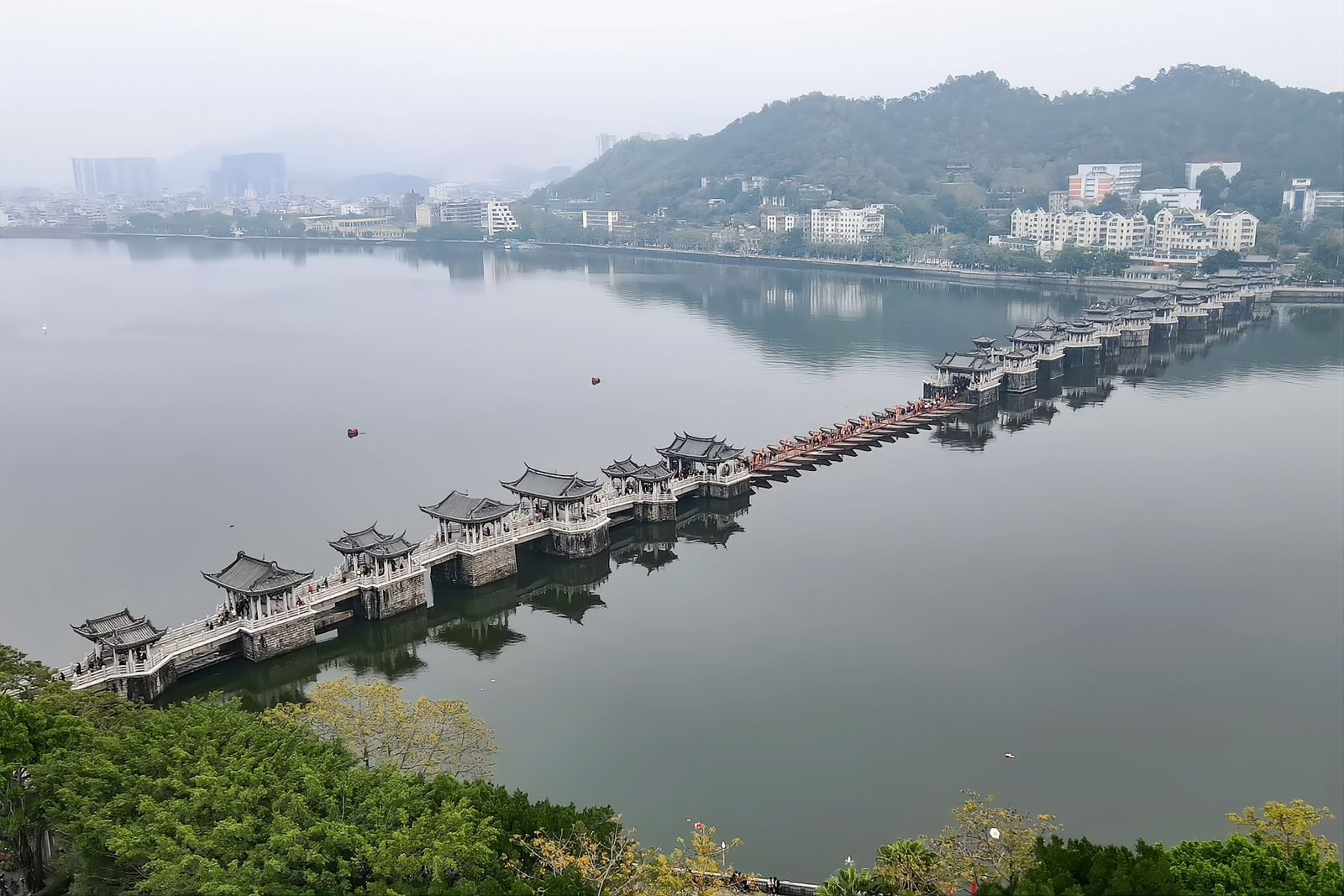
The whole bridge from above. Beam sections at either end, the eighteen boats chained down the middle — and on the far bank, the hills the night show traces in light.
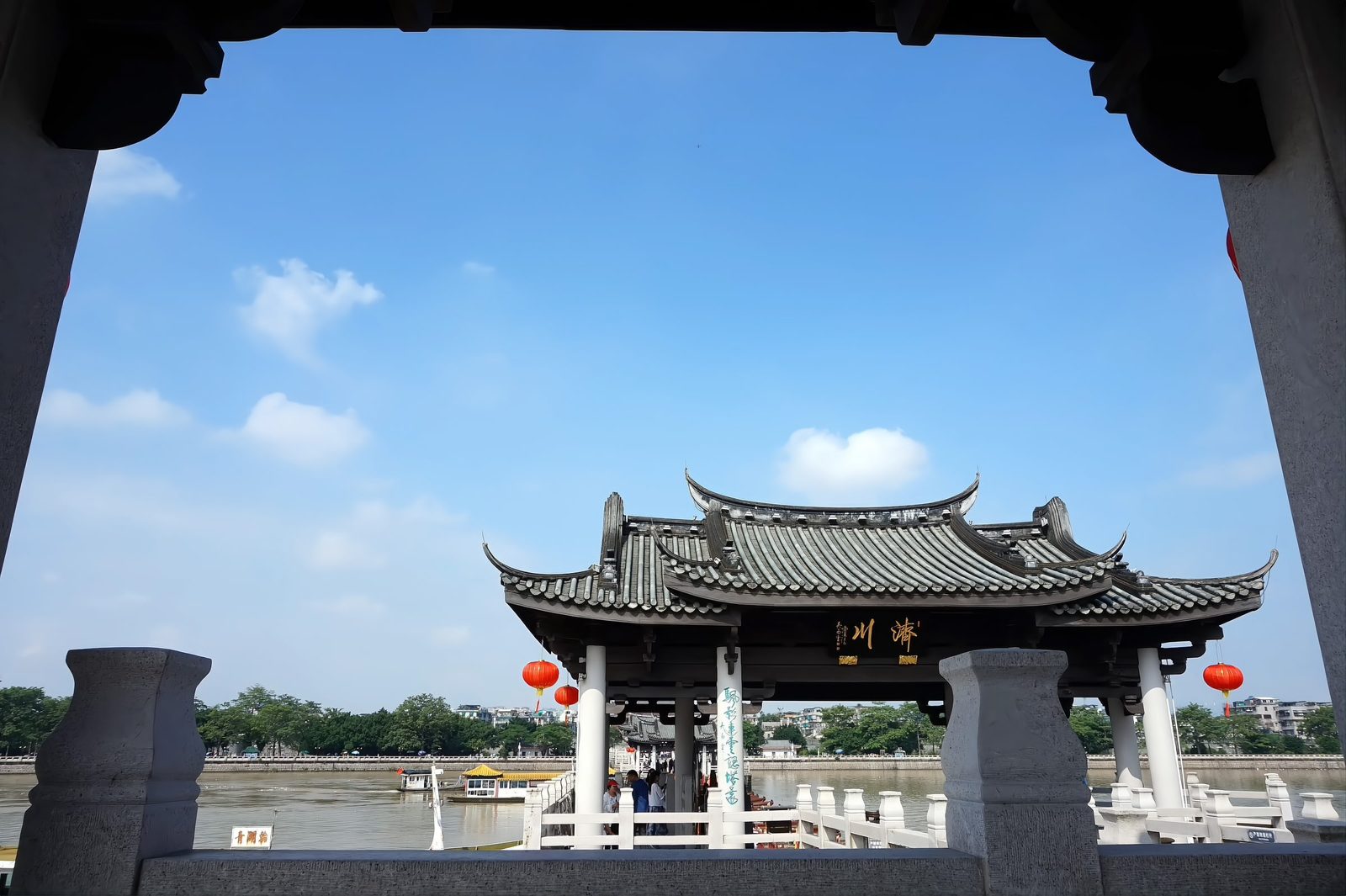
Twenty-four towers in twenty-four styles. The pavilions are the reason the old song says no two on the bridge are alike.
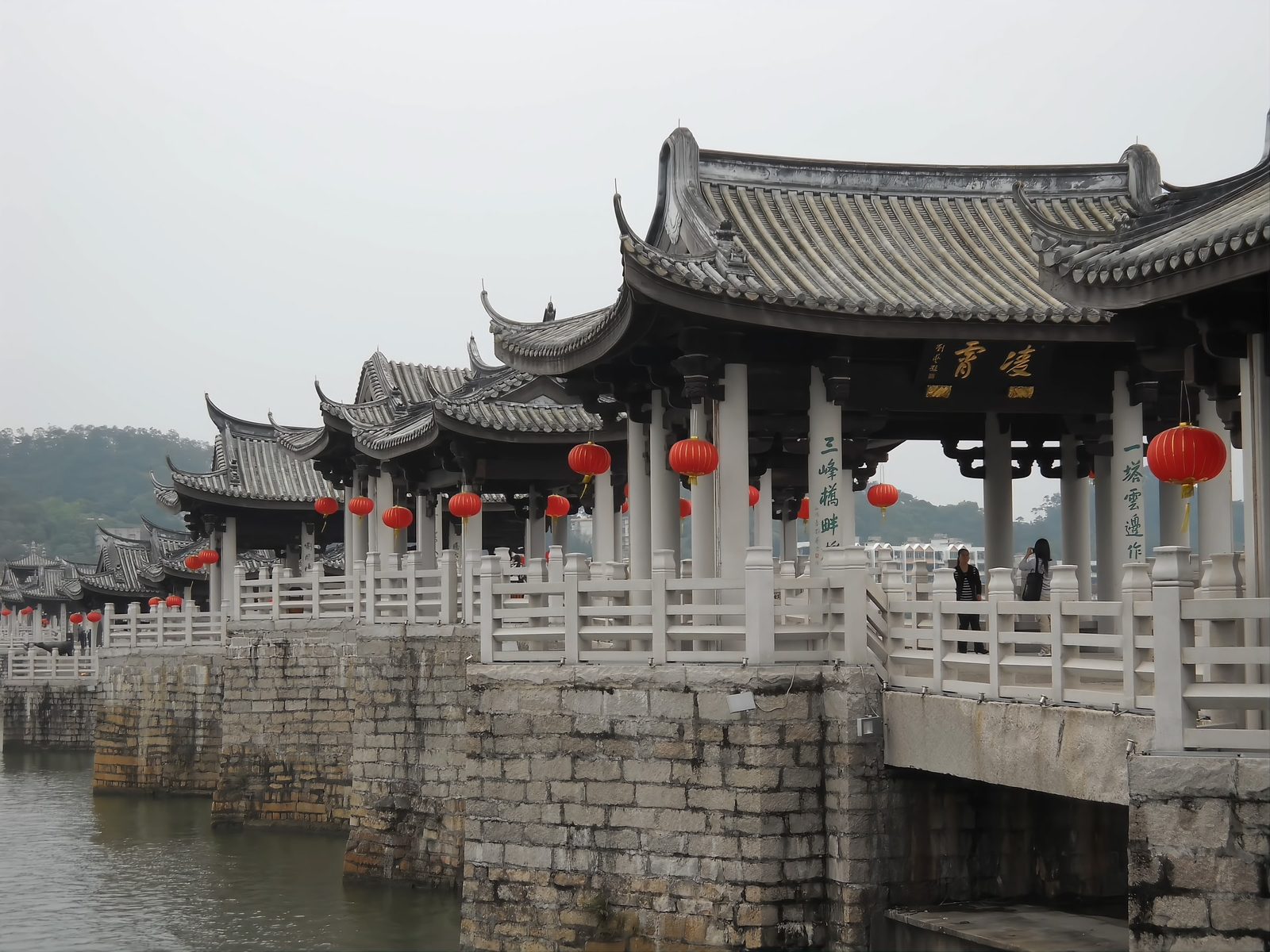
A mile of bridge, a mile of market. The pavilions held shops for most of the bridge's life; the crafts came back after 2007.
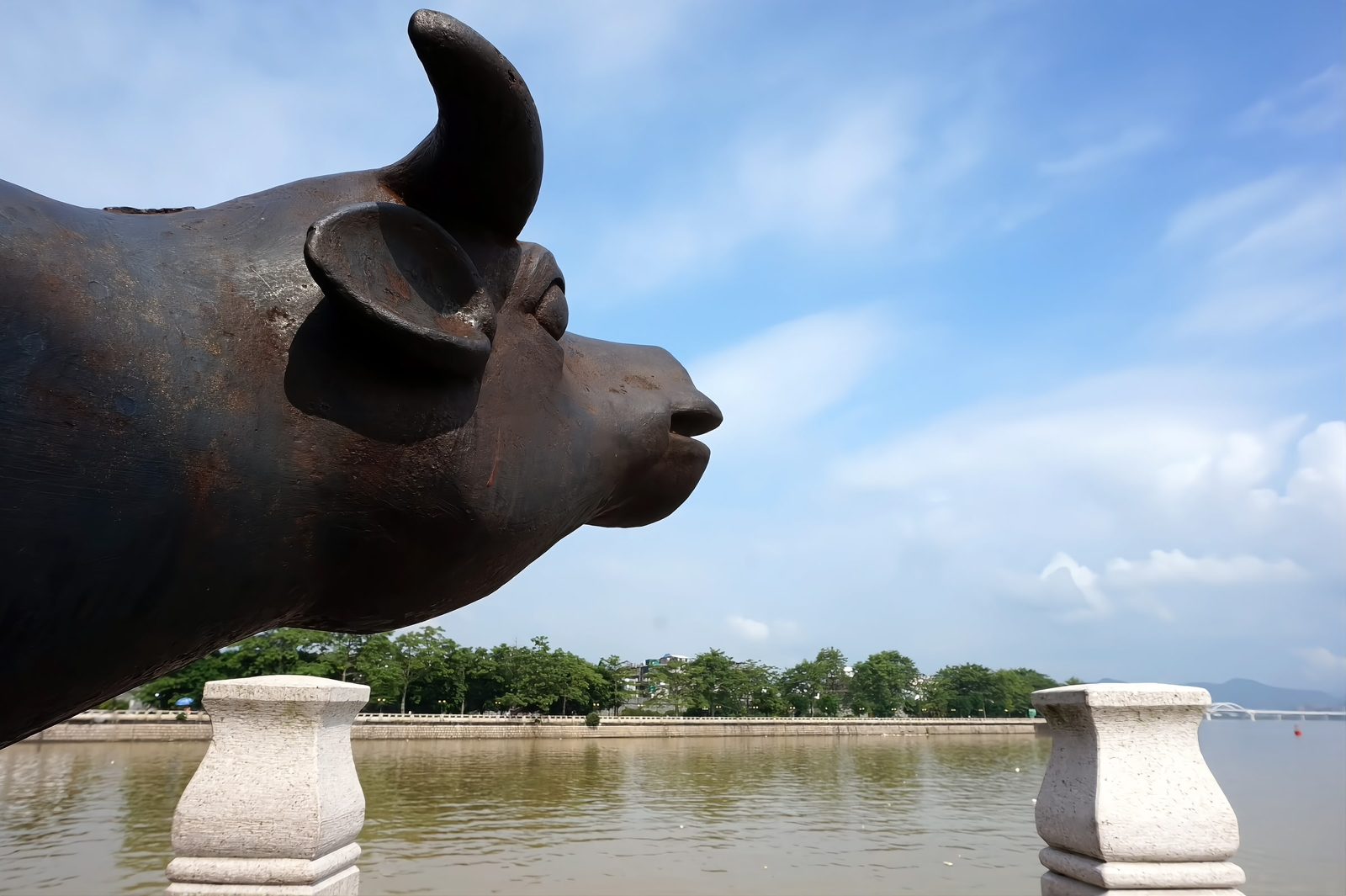
One of the two iron oxen. Cast in 1724 to hold the water down; its twin went into the river in the great flood of 1842.
The gate at the end of the bridge
Walk off the west end of the bridge and your feet land at the foot of a city wall. This is the Guangji Gate — the Guangji Tower, or the East Gate Tower as everyone in Chaozhou calls it — first raised in 1370, the third year of the Hongwu reign, when the Ming rebuilt the town's ramparts in brick. Of the seven gates in the old wall it was always the grandest, and its job was never only ceremonial: it stood where the road from Fujian and Jiangxi met the river crossing, holding the river and watching over the bridge. The gate and the bridge have been one argument ever since — the crossing is only worth guarding because the town is worth reaching.
The tower has burned and been rebuilt more than once. It went up in flames in 1853 and the townspeople paid to raise it again, grander than before; that rebuild is the one preserved in the Qing-dynasty map of the old city, and it is the drawing the restorers worked from. By the end of the last century the tower was tired, so between 2002 and 2004 the city took it apart piece by piece and put it back together on the same footings — the sound old timbers re-used in place, the rest recut in the Ming manner. It stands 24.5 metres now: three storeys of tiled eaves on a brick bastion, an arch through the base, and a road running under it to the river.
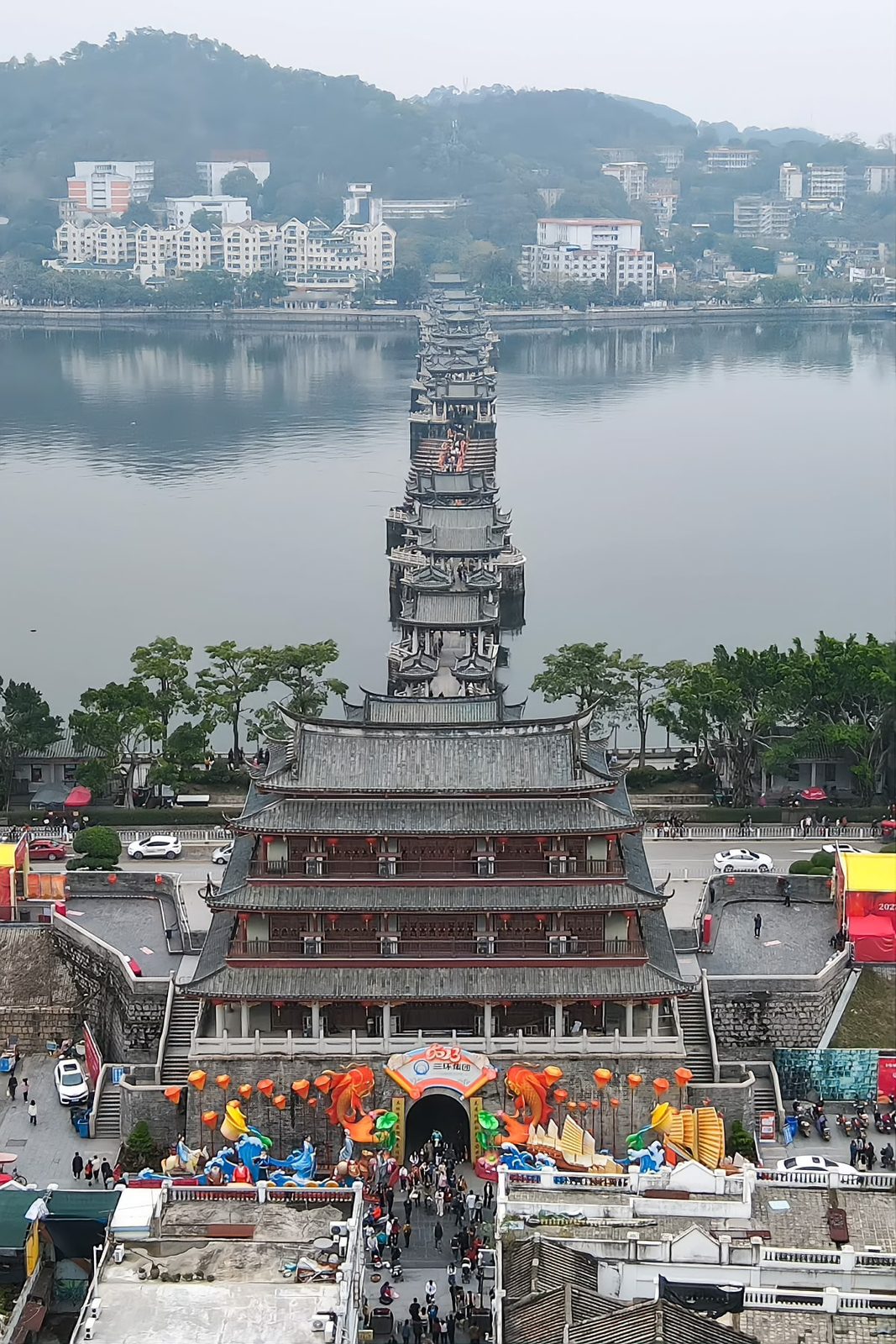
The gate and the bridge, from above. The tower at the near end, the span running away behind it — the two have faced each other across this road for six and a half centuries.
Each storey carries a plaque and a couplet, and between them they read like a description of the view. The bottom board names the town the first town east of the ranges. The middle one, written by the scholar Rao Zongyi, says spring comes from the east — its spring character drawn in oracle-bone script, three thousand years old for a word about the morning. The top simply says Guangji Tower. The couplets do the rest: the city embraces the river like a belt, the peaks hang like a screen below, and ten thousand peaks stand at the door, one water arrives from the sky above. In spring, when the Han rises and the boats ride high on it, the old town counted this as one of its eight inner views — watching the tide from the East Gate Tower.
Go through the arch and you are on Paifang Street, twenty-two Ming and Qing arches in a row with the teahouses and the arcades between them. The tower's own first two floors are now a hall for the city's living crafts — embroidery, porcelain, carving, clay figures. And from the top, on a clear day, the whole argument is visible at once: the bridge running off to the east, the wooded hills on the far bank with Han Yu's shrine among them, and the old town's tiled roofscape behind you. The gate was built to defend a crossing; six hundred years on, it is the best place to understand one.
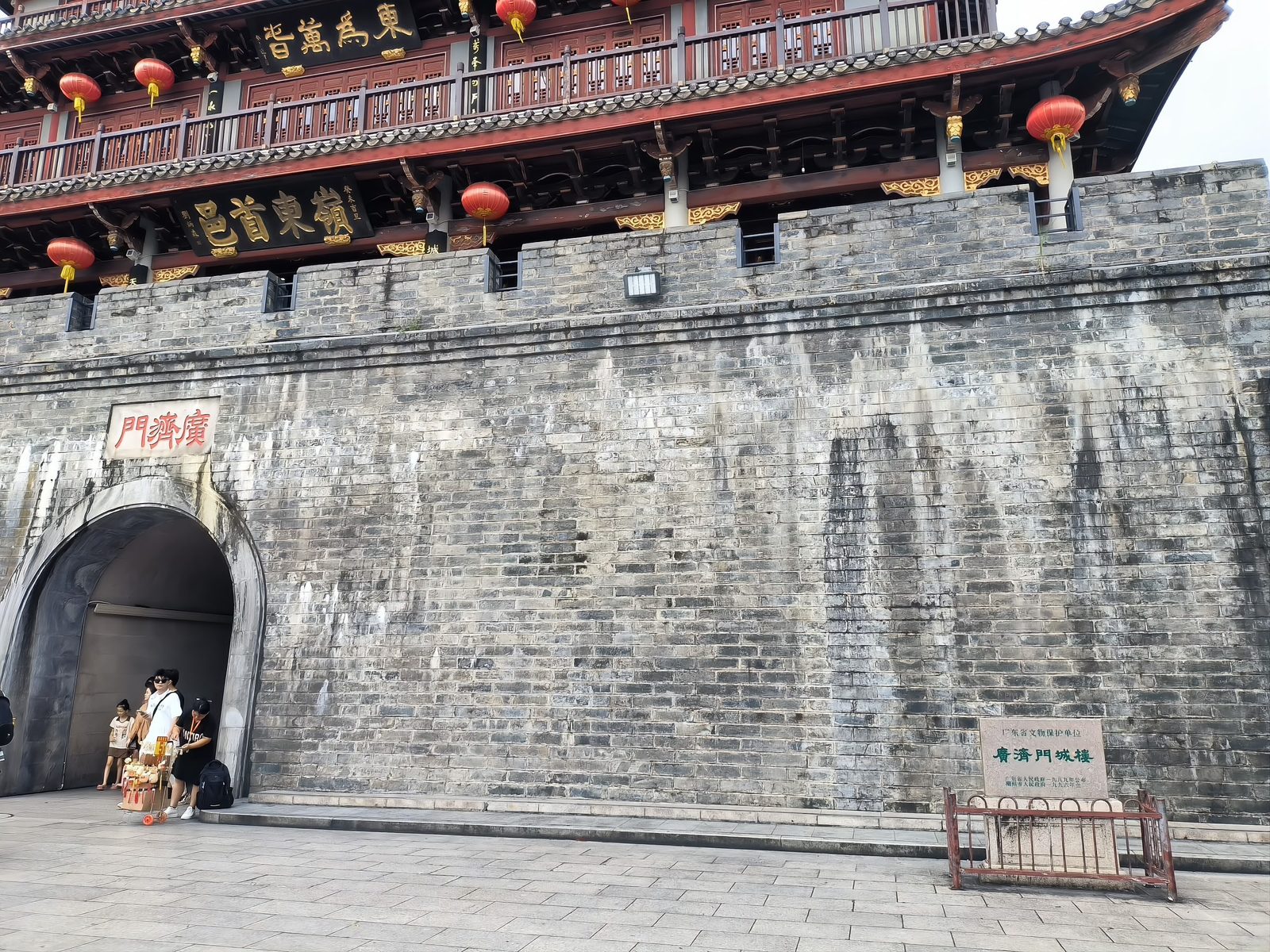
The ramparts and the arch. First built in 1370, burned in 1853, rebuilt in the Qing, taken apart and put back together in 2002–2004 — the plaques above the eaves are the ones you can still read today.
The iron ox and the floods
If the immortals were watching, they watched a bridge that spent its life being broken. Flood, typhoon, earthquake and war took it apart more than twenty times that anyone wrote down, and each time the prefect and the people built it again.
In the second year of the Yongzheng reign, 1724, the prefect Zhang Ziqian cast two iron oxen — heavy beasts meant to sit on the piers and, in the old belief, hold the water down. A hundred and eighteen years later, in 1842, a great flood threw one of them into the river, and it was never recovered. The loss entered the folk song that names the bridge: the Xiangqiao of Chaozhou is fine and free, eighteen shuttle boats and twenty-four islets, twenty-four towers in twenty-four styles, two iron oxen and one slipped away.
The people answered the same flood with a gate. When the Han wrecked piers in 1841 and again in 1842, the prefect Liu Xun and the salt commissioner Wu Jun called on the merchants and the rich to rebuild, and the people put up a memorial arch whose inscription says, in a character that is an old form of the word forget: the people cannot forget. It is a plain line about good government — that the officials who served the river earned a place in memory, and the ones who forgot the people would not.
A market on the water
For most of its life the bridge was not only a crossing but a street. Because it linked the road to Fujian and Jiangxi with the town, it became the place where goods changed hands, and the pavilions filled with shops until there was a saying: a mile of bridge and a mile of market. To ask the way at the Xiangqiao was to ask about the bridge itself, because everyone was on it.
That market is back. After the repair that finished in 2007 the city brought the bridge's old craft to the planks again, and now the piers carry stalls of Chaozhou's living arts: hand-pulled red clay teapots, woodcarving, embroidery, wheat-straw pictures, porcelain. The bridge is a walking museum of the things this city makes with its hands, and on a normal day the boards are crowded the way they were meant to be.
It is also, for the overseas Chaozhou people, the thing they come home to. A migrant returning from Southeast Asia once stood on the floating section and said it felt like floating on the water, and that she had brought her children so they would remember where they came from. The bridge is a hometown in one span, and the market on it is the welcome.
The cut, and the return
The bridge nearly lost its strangeness in the middle of the last century. In 1958, to carry a national road, the city took the eighteen boats out and put in a steel truss on high pile foundations, and for the first time cars ran across the Han on Guangji Bridge. In 1976 the deck was widened again. The boats were gone and the opening and closing stopped; the bridge had become ordinary.
Then the city changed its mind. In 2003 a repair began that would take four years and close to ninety-eight million yuan — a third of it given by overseas Chinese — and would rebuild the bridge in the Ming manner: the floating section returned with its eighteen boats, the piers took their pavilions back, and the span opened and closed once more. It reopened in 2007 as a walking bridge for visitors, and the earliest opening-and-closing bridge in the world went back to opening and closing.
The State Council had named it a major protected site in 1988. The 2007 return is what made it whole.
Night: the whole mountain lights up
Since the spring festival of 2018 the city has run a light show along the river, and it is not really about the bridge at all — the bridge is only the instrument. The official name is Fengcheng Zhiguang, the Light of Phoenix City; everyone calls it the one-river-two-banks show, because that is what it covers. North to the Jinshan Bridge, south to the Hanjiang Bridge, east to the hills across the water, west to West Lake: more than six square kilometres of the old city and its river. When it runs, the ridge on the far bank is traced in warm light from one end to the other, the wall and the gate tower glow, and the bridge becomes the keyboard the whole thing is played on.
The bridge carries some three thousand lights on its own. The show opens with the pavilions picking themselves out one by one and the floating section turning into a river of stars, and then the projections start: Han Yu's years in this town twelve centuries back, the Chaozhou merchants sailing out of this same river for Southeast Asia, the drums and opera tunes of the place. A 2023 rebuild added lasers sweeping from the far bank to answer the bridge. It runs about ten minutes, it costs nothing, and you watch it from the riverbank — the span itself is already unlinked and dark by the time it starts.
When. Monday to Thursday, one show at 20:00. Friday to Sunday and public holidays, two — 20:00 and 21:30. Each runs about ten minutes, and storms cancel it; the city posts notices on its Kanchao app.
Where. The square by the Xiashuimen tower, straight across from the bridge, is the head-on view. The far bank towards Bijiashan is quieter and takes in the hills with the bridge. The top of the Guangji Gate looks the other way, down the whole lit span.
Cost. Nothing. It is a city show, watched from the riverside walk — bring a layer, the wind off the Han is cold even after a hot day.
What lights up. The show is not a bridge show with scenery — it is the whole riverside, from the Jinshan Bridge in the north to the Hanjiang Bridge in the south, the ridge on the far bank included. The two green dots are where to stand; both are free.
“To reach Guangdong and miss Chaozhou is a wasted trip, and to reach Chaozhou and miss the bridge is a wasted trip within it.”
An old line with no author and no need of one. The writer Li Yingqun, himself a Chaozhou man, put it differently: the bridge is to this city what the gate of Tiananmen is to Beijing.
Going, and what to expect
Getting there. High-speed trains from Guangzhou South reach Chaoshan station in roughly two and a half hours; from there it's about forty minutes to the old town by the tourist bus or a short taxi ride. Chaoshan's airport is a similar distance out. The bridge sits at the west gate of the old town, on Huancheng East Road, facing the Guangji Gate tower.
Walking the bridge. Admission to walk the span is a small one — about twenty yuan — and the hours are set by the boats, not by the clock on the wall. From February to October the bridge is open 10:00 to 17:30 on weekdays and 9:00 to 17:30 on weekends and holidays, with last entry before the boats come apart at 17:30. From November to the end of January the whole day shifts an hour earlier. Check the day's arrangement on the local ticketing mini-program before you set out, because the seasonal times move.
The moment to be there for. Late afternoon into dusk. Walk the span west while the light is good, then watch from the east bank riverside walk as the boats are drawn aside and the channel opens — the local name for it is, bluntly, "taking the bridge apart to cross the river". After dark the light show takes over the whole riverside; it is free, and it is best seen from the bank rather than from the deck.
Around it. The Guangji Gate tower is at the east end of the bridge and costs a few yuan to climb. Paifang Street begins a few minutes' walk east, twenty-two Ming and Qing arches in a row with the shops and teahouses between them. Kaiyuan Temple is further along the same street. Han Yu's shrine is on the east bank across the water — free, quiet, and the best possible answer to the question of who actually built this city.
Opening hours, the admission price and the exact time the boats come apart all move with the season and with maintenance work. Everything above is right in shape and could be wrong in detail on the day you arrive — check locally, and build the evening around being on the riverbank an hour early rather than five minutes early.
Photographs and sources
Photographs from Wikimedia Commons, used under their Creative Commons licences and enhanced for this page: the panorama of the full span, the floating section and the aerial views (CC BY-SA 4.0, San Lie and Windmemories), the morning view and the view down from the gate tower (CC BY-SA 4.0, Windmemories), the gate's ramparts and plaques (CC BY 4.0, FradonStar), the iron ox (CC BY-SA 4.0), the roofline with lanterns (CC BY-SA 3.0), and the bridge over green water (CC BY 4.0). History drawn from the Chaozhou Guangji Bridge records as summarised in our editorial source file, cross-checked against the Chinese Wikipedia article; the two conflicting dates for the final form of the floating section (1530 and 1513) are both given rather than resolved. Opening hours and the light-show schedule verified against the Chaozhou ancient-city heritage administration's 2026 notices, the Chaozhou city government's published answers, and Chaozhou Daily reporting.
There's more where this came from.
Read the latest insider notes →Two new posts a week — the things a non-resident can't know, written down before they cost you a morning.